
Landmark Asia
Prambanan Temple
Prambanan is a group of tall, pointed stone temples in Indonesia. The main temple stands in the middle. Many smaller temples lie around them.
Prambanan Temple is a huge group of Hindu temples on the island of Java in Indonesia, about 17 kilometers east of the city of Yogyakarta. Its tall, pointed stone towers date from the 9th century AD. Together with nearby Buddhist temples, it forms a UNESCO World Heritage Site.
Prambanan Temple, also called Loro Jonggrang, is a 9th-century Hindu temple complex of 240 temples on the border of the Yogyakarta and Central Java provinces. With the Buddhist Sewu complex and the Lumbung, Bubrah and Asu temples it forms the Prambanan Temple Compounds, inscribed on the World Heritage List in 1991, which UNESCO calls a proof of past peaceful religious coexistence.
Photo: Gunawan Kartapranata, CC BY-SA 3.0, via Wikimedia Commons
Discover Prambanan
Prambanan is in Indonesia, on the island of Java.
It has tall stone temples with pointed tops. Many smaller temples stand around them.
Prambanan Temple stands on the island of Java, on the border between the provinces of Yogyakarta and Central Java. Indonesia's official tourism website places it about 17 kilometers east of the center of Yogyakarta.
It is a Hindu temple complex made up of 240 temples, many of them now ruins. The main temple, in the middle, is up to 47 meters high, and two temples beside it are about 33 meters. Prambanan and several nearby temples, including a large Buddhist complex called Sewu, form a World Heritage Site.
The World Heritage property, the Prambanan Temple Compounds, lies on the border of the Yogyakarta and Central Java provinces. UNESCO describes two groups of buildings: Prambanan Temple (also called Loro Jonggrang), itself a complex of 240 temples, and Sewu, which UNESCO calls Indonesia's largest Buddhist complex, together with the Lumbung, Bubrah and Asu temples. In all there are 508 stone temples, some complete and some kept as ruins, and the 77-hectare property was placed under central government ownership by a presidential decree in 1992.
Indonesia's official tourism website gives the central temple a height of up to 47 m and the two beside it about 33 m. The property was inscribed in 1991 under criteria (i) and (iv).
- Where
- Java, on the border of the Yogyakarta and Central Java provinces, Indonesia
- Temples in Prambanan Temple itself
- 240
- Main temple
- up to 47 m, in the middle of the complex
- World Heritage
- inscribed 1991
Built, fallen and found again
People built Prambanan more than a thousand years ago.
Later, many temples fell down. People found them again and slowly put them back together.
Indonesia's official tourism website says Prambanan was built in the 9th century AD, under King Rakai Pikatan of the Medang, or Ancient Mataram, kingdom. UNESCO also dates Prambanan Temple to the 9th century.
In the early 11th century, UNESCO says, the temples collapsed because of an earthquake, a volcanic eruption and a shift of political power. They were found again centuries later, and restoration work began in the 20th century. In 1953, the tourism website says, President Soekarno inaugurated a restoration of the temple.
Sources date the complex differently. UNESCO's statement places Loro Jonggrang in the 9th century and says the compounds were built in the heyday of the Sailendra dynasty in the 8th century (its short description says the 10th), while ICOMOS's 1991 evaluation said the main complex was built in the first half of the 10th century. Indonesia's official tourism website credits King Rakai Pikatan of the Medang (Ancient Mataram) kingdom in the 9th century.
UNESCO says the temples collapsed in the early 11th century through an earthquake, a volcanic eruption and a shift of political power, and were rediscovered in the 17th century; the tourism website says the Dutch found them in the 18th century. UNESCO dates restoration from 1918, ICOMOS from 1937, and the tourism website says a restoration was inaugurated by President Soekarno in 1953.
Stone on stone
The temples are made of many stone blocks.
The blocks fit together tightly, like a puzzle. Builders have put many fallen stones back in their places.
ICOMOS describes the plan: a square platform divided by square walls into courts, one inside another. In the middle of the innermost court stand three large temples and three smaller ones. Other small temples stood at the gates and outside the central court.
UNESCO says restorers have used the old method of interlocking stones and also modern methods, such as concrete, to strengthen the temples. Its statement says hundreds of shrines were arranged in three parts, showing a high level of stone building technology.
According to ICOMOS (1991), a square platform is divided into concentric courts by square walls; in the middle of the last enclosure stand three great temples and three small ones, and other minor temples stood at the entrance gates or outside the central enclosure. UNESCO adds that the main temples are surrounded by hundreds of shrines arranged in three parts, which it says show high levels of stone building technology and architecture in Java.
Restoration has combined the original traditional method of interlocking stone with modern methods using concrete to strengthen the structures. UNESCO says extensive work was done after the earthquake of 27 May 2006, with great care taken to keep the structures authentic. In its statement it reported that the central temple had not yet been rehabilitated and that technical studies in 2010 and 2011 concluded more research was needed, including monitoring with seismographs and crack meters.
Towers, shrines and a Buddhist neighbor
The main temples are decorated with stone carvings.
Nearby is another group of temples called Sewu. It has four pairs of giant stone statues.
The main Hindu temples are decorated with carved stone pictures called reliefs, which UNESCO calls masterpieces of stone carving.
Sewu, a neighboring Buddhist complex, has a central temple surrounded by many smaller ones and four pairs of giant statues called Dwarapala. ICOMOS noticed that Sewu shares many design ideas with the Hindu temples of Prambanan. UNESCO calls the whole group of more than 500 temples proof of past peaceful living together between religions.
UNESCO calls Loro Jonggrang a brilliant example of Hindu religious bas-reliefs, and the reliefs on the main temples masterpieces of stone carving. Sewu, with its four pairs of Dwarapala giant statues, comprises a central temple surrounded by a multitude of minor ones. ICOMOS (1991) found it 'surprising' that the Buddhist Sewu shares many design attributes with the Hindu temple, and suggested this might show how far such temples also reflected state policies and control.
The ruined Lumbung, Bubrah and Asu temples lie between Sewu and Loro Jonggrang. With over 500 temples, UNESCO describes the compounds as an architectural and cultural treasure and 'a standing proof of past religious peaceful cohabitation'.
- Stone temples in the whole property
- 508
- Two temples beside the main one
- about 33 m each
- Sewu
- Indonesia's largest Buddhist complex, with four pairs of giant statues called Dwarapala
- Property area
- 77 hectares
Prambanan today
In the photo, tall pointed towers rise behind a stone wall.
In front, piles of fallen stones lie on the grass. A small temple with a dark doorway stands on the right.
In the photo you can see several tall, pointed towers behind a low stone wall, with a smaller temple on the right that has a dark doorway and steps. Piles of fallen stone blocks lie on the grass in front.
Indonesia's tourism website says the site is still used today for a ballet performed on an open stage with the temple in the background, for yearly cultural festivals and for teaching history.
The photo shows several of the tall towers rising behind the enclosure wall, a smaller shrine with a doorway and stairway in the foreground on the right, and heaps of loose stone blocks on the grass, many of the 240 temples that, as the tourism website notes, remain only as ruins.
UNESCO's statement found no threats of development or neglect, but noted that the area is prone to earthquakes and volcanic eruptions. It said the area within the boundary was managed by the Ministry of Culture and Tourism through the archaeological preservation offices of Yogyakarta and Central Java, and that the Borobudur, Prambanan and Ratu Boko tourism park company was responsible for the buffer zone. The tourism website adds that the site hosts a ballet on an open-air stage, annual cultural festivals and history education.
Amazing facts
-
Prambanan has 240 temples, but many are now piles of stones.
Prambanan Temple is made up of 240 temples, and many of them remain only as ruins.
Of the 240 temples of Prambanan Temple, many remain only as ruins, and UNESCO counts 508 stone temples, complete or ruined, in the whole property.
-
The main temple at Prambanan is up to 47 meters tall.
The main temple at Prambanan, in the middle of the complex, is up to 47 meters high.
The central temple reaches up to 47 m and the two beside it about 33 m, according to Indonesia's official tourism website.
-
A Hindu temple and a Buddhist temple stand close together here.
The Buddhist Sewu complex near Prambanan shares many design ideas with the Hindu temples.
ICOMOS found it surprising that the Buddhist Sewu shares many design attributes with the Hindu temple of Loro Jonggrang.
-
Workers have been fixing the temples for more than 100 years.
Restoration work at Prambanan has gone on since 1918.
UNESCO dates restoration from 1918; it has combined interlocking stone with concrete strengthening and continued after the 2006 earthquake.
Words to know
- temple
- a building for worship
- complex
- a group of buildings that belong together
- relief
- a picture carved into a stone surface so that it stands out from it
- shrine
- a small building or place for worship
- restoration
- careful work to repair an old building and bring it back to how it was
- interlocking
- fitting together so that each piece holds the others in place
Discovery challenge
-
On which island is Prambanan?
On which Indonesian island is Prambanan Temple?
On which island do the Prambanan Temple Compounds lie, on the border of two provinces?
- Java
- Bali
- Borneo
Show the answer
Java
Java!
Java, about 17 kilometers east of Yogyakarta.
Java, on the border of Yogyakarta and Central Java.
-
How tall is the main temple?
How tall is the main temple at Prambanan?
What height does Indonesia's tourism website give for the central temple?
- Up to 47 meters
- Up to 4.7 meters
- Up to 470 meters
Show the answer
Up to 47 meters
Up to 47 meters, very tall!
Up to 47 meters; the two beside it are about 33 meters.
Up to 47 m; the two flanking temples about 33 m.
-
What is the Buddhist temple group near Prambanan called?
What is the name of the large Buddhist complex near Prambanan?
Which complex in the property does UNESCO call Indonesia's largest Buddhist complex?
- Sewu
- Borobudur
- Angkor Wat
Show the answer
Sewu
Sewu!
Sewu, with four pairs of giant statues called Dwarapala.
Sewu, which ICOMOS noted shares many design attributes with the Hindu temple.
-
How are the fallen temples fixed?
How do restorers put the temples back together?
Alongside modern concrete strengthening, which traditional method has the restoration used?
- Fitting the stones back together
- Building them from wood
- Painting pictures of them
Show the answer
Fitting the stones back together
They fit the stones back together, like a puzzle!
They fit the interlocking stones back together and strengthen them with modern methods such as concrete.
The traditional interlocking-stone method, plus modern concrete strengthening.
Nearby places
-
 Watch
Landmark
Borobudur
Borobudur is a huge Buddhist monument in central Java, Indonesia, built about 1,200 years ago. It is shaped like a stepped pyramid around a small hill, with carved walls and 72 bell-shaped stupas on its round top terraces. For centuries it lay hidden under volcanic ash and plants, and today it is a UNESCO World Heritage Site.
-
 Watch
Natural wonder
Java
Java is an island of Indonesia on the Pacific Ring of Fire, and it has many active volcanoes. Its tallest, Mount Semeru, is also its most active. At its western tip, Ujung Kulon National Park protects the island's largest remaining lowland rainforest and the endangered Javan rhinoceros.
-
 Watch
Natural wonder
Semeru
Semeru is a stratovolcano on the island of Java, in Indonesia. NASA calls it Java's highest volcano, rising 3,676 meters above the nearby coastal plains, and one of Indonesia's most active volcanoes.
-
 Watch
City
Jakarta
Jakarta, Indonesia's largest city and its capital, lies on the northwest coast of the island of Java, where the Ciliwung River meets the Java Sea. About 11 million people live there (2025). Indonesia is building a new capital called Nusantara, but under the law Jakarta stays the capital until the president signs a decree moving it.
-
 Watch
City
Denpasar
Denpasar is the main city of the island of Bali, in Indonesia, and a center for shops and visitors. The city's own history says it grew up around a royal palace finished in 1788. The census of 15 September 2020 counted 725,314 people in the city.
-
 Watch
Natural wonder
Mount Agung
Mount Agung is a cone-shaped volcano on the eastern end of Bali, in Indonesia, and the island's highest point at about 3,000 meters. It erupted strongly in 1963 and 1964, and again with explosions, ash clouds and lava in its crater from 2017 to 2019. Scientists watch it all the time and set safety zones around it when it is restless.
-
 Watch
Natural wonder
Krakatoa
Krakatoa, also called Krakatau, is a volcano between the Indonesian islands of Java and Sumatra. After an enormous eruption in 1883 destroyed the old island, a new volcano, Anak Krakatau, meaning 'child of Krakatau', rose from the sea about fifty years later. It still erupts often.
-
 Watch
City
Palembang
Palembang is a city on the Musi River, in the south of the island of Sumatra, in Indonesia. The encyclopedia Larousse says it was once the capital of the kingdom of Srivijaya. Indonesia's 2020 census counted 1,668,848 people in the city.
Explore next
-
Watch
 Country
Indonesia
Indonesia is a country of about 17,500 islands in Southeast Asia, spread across the Equator between the Indian and Pacific oceans. It has more than 100 active volcanoes, rainforests full of wildlife, and about 286 million people (2025).
-
Watch
Natural wonder
Java
Java is an island of Indonesia on the Pacific Ring of Fire, and it has many active volcanoes. Its tallest, Mount Semeru, is also its most active. At its western tip, Ujung Kulon National Park protects the island's largest remaining lowland rainforest and the endangered Javan rhinoceros.
-
Watch
Landmark
Borobudur
Borobudur is a huge Buddhist monument in central Java, Indonesia, built about 1,200 years ago. It is shaped like a stepped pyramid around a small hill, with carved walls and 72 bell-shaped stupas on its round top terraces. For centuries it lay hidden under volcanic ash and plants, and today it is a UNESCO World Heritage Site.
-
 Watch
Landmark
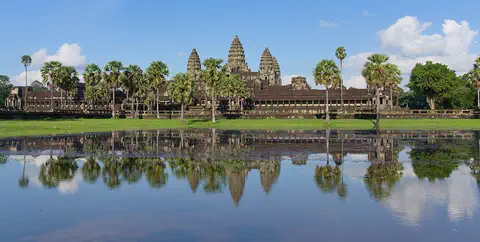
Angkor Wat
Angkor Wat, near the town of Siem Reap in Cambodia, was built in the 12th century by the Khmer king Suryavarman II. Britannica (2026) calls it the world's largest religious structure. It was built as a Hindu temple and later became a Buddhist place of worship.
- Watch Geography What is a World Heritage Site? World Heritage Sites are places so important that they belong, in a way, to everyone. Under a 1972 agreement, countries nominate their most outstanding places, experts check them, and a UNESCO committee decides. By 2026 the list held 1,273 sites: cultural places like the Taj Mahal, natural places like the Galápagos, and mixed ones like Machu Picchu.
-
 Watch
Landmark
Somapura Mahavihara
Somapura Mahavihara, near the village of Paharpur in northwest Bangladesh, is the ruin of a great Buddhist monastery. Its first builder was King Dharmapala (770–810 AD). Rows of small rooms once formed a huge square around a tall brick building in the middle, and it was a famous center of learning for centuries.
-
 Watch
Landmark
Abraj Al Bait
Abraj Al Bait is a group of seven hotel towers in Mecca, Saudi Arabia, beside the city's Great Mosque. In the middle rises the Makkah Royal Clock Tower, 601 meters tall to the tip of its spire, with a huge clock near the top. It was finished in 2012.
-
 Watch
Landmark
Agra Fort
Agra Fort is a huge red sandstone fortress beside the Yamuna River in Agra, India. The Mughal emperor Akbar began it in 1565. Its walls, about 2.5 kilometers around, protect palaces, halls and mosques added by later emperors. It was both an army base and a royal home.
For parents & teachers
What children will learn
- Locate Prambanan on the island of Java and describe it as a 9th-century Hindu temple complex of 240 temples.
- Explain how collapsed stone temples can be restored by fitting the original blocks back together.
- Recognize that UNESCO sees the nearby Hindu and Buddhist temples as evidence of peaceful coexistence in the past.
Recommended ages: 4 to 17 · About 15 minutes
Talk about it
- Why might restorers try to use the original stones instead of making new ones?
- What could earthquakes and volcanoes mean for people looking after old buildings?
- What can we learn from temples of different religions being built close together?
Try at home or in class
- Build a tower from blocks or sugar cubes, take it apart, mix up the pieces and try to put it back exactly as it was. Talk about why it helps to label each piece first.
- Fold a square of paper and draw a square plan with walls one inside another, then place the biggest buildings in the middle court.
Key vocabulary: temple, complex, relief, shrine, restoration, interlocking
Where these facts come from
- Wikidata , Wikimedia Foundation (CC0 1.0)
- Prambanan Temple Compounds , UNESCO World Heritage Centre
- Prambanan Temple Compound (No 642), ICOMOS evaluation, November 1991 , ICOMOS, via UNESCO World Heritage Centre
- Prambanan Temple: Historical Heritage , Indonesia Travel, Indonesia's official tourism website
- UNESCO World Heritage List , UNESCO World Heritage Centre (Linked as a reference; site facts come from Wikidata)
- Wikimedia Commons , Wikimedia Foundation (Per file (public domain, CC0, CC BY or CC BY-SA); see each media record)
Checked, not yet human-reviewed. Last updated November 1, 2026. Spotted a mistake? Tell us.