
Landmark Asia
Borobudur
Borobudur is a giant stone temple on the island of Java, in Indonesia. It looks like a big stepped hill. It has lots of bell-shaped towers and carvings.
Borobudur is a huge Buddhist monument in central Java, Indonesia, built about 1,200 years ago. It is shaped like a stepped pyramid around a small hill, with carved walls and 72 bell-shaped stupas on its round top terraces. For centuries it lay hidden under volcanic ash and plants, and today it is a UNESCO World Heritage Site.
Built between about 778 and 850 CE under the Shailendra dynasty, Borobudur wraps 56,600 m³ of volcanic stone around a natural hill: a square base, five square terraces and three circular ones, crowned by a stupa 35 m above the base. Buried under ash from about 1000 and restored in 1907 to 1911 and 1973 to 1983, it was inscribed by UNESCO in 1991.
Photo: Heri nugroho, CC BY-SA 4.0, via Wikimedia Commons
Discover Borobudur
Borobudur is on Java, an island in Indonesia.
It is a giant temple made of gray stone. It is built like a big cake with layers, getting smaller toward the top. Bell-shaped towers sit on the round top layers.
Borobudur stands in the Kedu Valley in central Java, about 42 kilometers northwest of the city of Yogyakarta. It is a Buddhist monument, built between about 778 and 850 CE, when a family of kings called the Shailendra dynasty ruled the area.
The monument is built around a small natural hill, like a giant stepped pyramid. Its walls are covered in carved pictures, and on its round upper terraces stand 72 stone stupas shaped like bells, most of them still holding a statue of the Buddha. UNESCO made Borobudur a World Heritage Site in 1991, together with two smaller temples nearby, Mendut and Pawon.
Borobudur lies in the Kedu Valley of southern Central Java, 42 km northwest of Yogyakarta. UNESCO calls it one of the greatest Buddhist monuments in the world and an outstanding dynastic monument of the Shailendra dynasty, under which Britannica dates its construction to about 778 to 850 CE.
The World Heritage property (1991) comprises three monuments on a straight east-west axis: Borobudur itself and the smaller Mendut and Pawon temples to the east. UNESCO notes that Borobudur's art and architecture, from the early 8th to late 9th centuries, influenced an architectural revival in Indonesia between the mid-13th and early 16th centuries. Britannica traces its style to Indian Gupta and post-Gupta art.
- Where
- Central Java, 42 km northwest of Yogyakarta
- Built
- about 778 to 850 CE
- Height of the center
- 35 m above the base
- UNESCO World Heritage
- since 1991
Built, buried and found again
People built Borobudur more than 1,000 years ago.
Later, a volcano covered it with ash, and plants grew all over it. For a long time it was hidden. Then people cleared it and fixed it.
Borobudur was used as a Buddhist temple for a long time after it was built. Then, sometime between the 900s and 1400s, it was abandoned. From about the year 1000, it lay buried under volcanic ash and overgrown with plants.
In 1814, it came to the attention of the English lieutenant governor Thomas Stamford Raffles. Dutch archaeologists restored it from 1907 to 1911. A second, much bigger restoration, with help from UNESCO, took place from 1973 to 1983.
UNESCO records that Borobudur served as a Buddhist temple from its construction until sometime between the 10th and 15th centuries, when it was abandoned. Britannica adds that it was buried under volcanic ash from about 1000 and overgrown until it came to the attention of the English lieutenant governor Thomas Stamford Raffles in 1814; UNESCO describes this as its rediscovery in the 19th century.
Restoration came in two 20th-century phases: by a team of Dutch archaeologists in 1907 to 1911, and in 1973 to 1983 with UNESCO's help. UNESCO judges that, although today's monument is the result of these restorations, enough original material survived to make reconstruction possible, and mostly original stone was used, with some additions to strengthen it and improve drainage.
Stone wrapped around a hill
Builders did not start on flat ground. They built Borobudur around a small hill.
They stacked gray stone from volcanoes, layer upon layer. At the very top is one big bell-shaped tower.
Builders wrapped Borobudur around a small natural hill, using about 56,600 cubic meters of gray volcanic stone. They shaped it into three main parts: a square base, then five square terraces, then three round terraces on top.
At the very center, 35 meters above the base, sits one large stupa. Because the monument has no roof over its terraces, it is like an open, climbable mountain of stone. Walkways run around each level, and stairways lead upward.
Britannica describes about 56,600 m³ (2 million cubic feet) of gray volcanic stone enclosing a small hill, shaped as a stepped pyramid of three major levels: a square base, a middle level of five square terraces and an upper level of three circular terraces, with a large stupa at the center 35 m above the base. UNESCO describes the whole as a stepped, unroofed pyramid of ten superimposed terraces crowned by a large bell-shaped dome.
The walls and balustrades carry fine low reliefs covering 2,520 m², according to UNESCO. Around the circular platforms stand 72 openwork stupas, each containing a statue of the Buddha. UNESCO also notes a growing rate of deterioration of the building stone, whose cause needs more research.
Carvings and bell-shaped stupas
The walls of Borobudur are covered in carved pictures. People look at them as they climb.
On the top layers are 72 stone bells with holes in them. Inside most of them sits a statue.
Borobudur's walls and railings are covered with carved stone pictures called reliefs, about 2,520 square meters of them, about the area of six basketball courts. As people climb, they walk around each level and pass carving after carving.
On the three round terraces stand 72 bell-shaped stupas made of stone lattice, full of holes, so you can peek at the statue of the Buddha sitting inside many of them. People following the traditional route start at the east stairway and walk around every level before reaching the top, more than 5 kilometers in all.
UNESCO's figure of 2,520 m² of low reliefs makes Borobudur's carved surface its defining feature: the walls and balustrades of the square terraces form galleries lined with relief panels. Britannica notes that the hundreds of reliefs at the lowest level are partially hidden.
The three circular terraces carry 72 openwork stupas, perforated bell shapes built to shelter statues of the Buddha (Britannica notes that many still contain one), around the large central stupa. Britannica describes the traditional route: a pilgrim begins at the eastern stairway and walks clockwise around each of the nine levels before reaching the top, a distance of more than 5 km. The photograph shows people in robes walking in procession at the foot of the monument.
- Volcanic stone
- about 56,600 m³
- Carved reliefs
- about 2,520 m²
- Openwork stupas
- 72
- Walk to the top, round every level
- more than 5 km
Protecting Borobudur
Today, many visitors come to see Borobudur.
People work hard to protect it from volcano ash and too many feet.
Borobudur is protected by Indonesian law and by UNESCO. Its keepers have to deal with many challenges. Mount Merapi, a volcano nearby, covered the temple with acidic ash in 2010. Huge numbers of tourists put pressure on the site, and some visitors have damaged the stone.
UNESCO also warns that new buildings around the temple could spoil its setting, and that the stone is slowly wearing away. UNESCO says more research is needed to find out why.
Borobudur is protected under Indonesia's Law No. 11/2010 on Cultural Heritage and managed within a National Strategic Area. UNESCO lists the main threats: development that could compromise the relationship between the monument and its wider setting, heavy tourism pressure, a small degree of damage by unsupervised visitors, uncontrolled commercial activity and a growing rate of stone deterioration whose cause needs further research.
The eruption of Mount Merapi is also a potential threat, as in 2010, when it deposited acidic ash on the monument. UNESCO adds that the property can be used today as a Buddhist pilgrimage site, as the procession in the photograph shows.
Amazing facts
-
Borobudur was hidden under volcano ash for a very long time.
From about the year 1000, Borobudur lay buried under volcanic ash and covered by plants for hundreds of years.
Britannica dates the burial under volcanic ash to about 1000; the site stayed overgrown until 1814.
-
Walking around every level to the top is a very long walk.
If you walk around every level of Borobudur on the way to the top, you walk more than 5 kilometers.
The traditional route, clockwise around each of the nine levels from the eastern stairway, covers more than 5 km.
-
The 72 stone bells were made to hold statues.
The 72 bell-shaped stupas on the round terraces are made of stone lattice, and each was built to hold a statue of the Buddha.
Around the circular platforms stand 72 openwork stupas, each containing a statue of the Buddha.
-
Fixing Borobudur the second time took ten years.
Borobudur's second big restoration, with help from UNESCO, lasted ten years, from 1973 to 1983. Workers used mostly the original stones.
The 1973 to 1983 restoration reused mostly original material, with additions to consolidate the monument and ensure proper drainage.
Words to know
- monument
- a large building or structure made to remember or honor something
- stupa
- a dome- or bell-shaped Buddhist structure
- terrace
- a flat level, like a giant step, on a slope or building
- relief
- a carving where pictures stand out from a flat stone surface
- volcanic ash
- tiny bits of rock and glass thrown out by a volcano
- restoration
- careful work to repair something old and bring it back to good condition
Discovery challenge
-
Which country is Borobudur in?
In which country does Borobudur stand?
Borobudur stands in central Java. Which country is that?
- India
- Indonesia
- Thailand
Show the answer
Indonesia
Indonesia! It is on the island of Java.
Borobudur is in Indonesia, on the island of Java, near Yogyakarta.
Indonesia: Borobudur is in the Kedu Valley of Central Java, 42 km northwest of Yogyakarta.
-
How many stone bells sit on the round top layers?
How many bell-shaped stupas stand on Borobudur's round terraces?
How many openwork stupas surround the circular platforms?
- 7
- 72
- 720
Show the answer
72
72 stone bells! Most still have a statue inside.
There are 72, each built to hold a statue of the Buddha.
72 openwork stupas, each containing a statue of the Buddha, around the central stupa.
-
What covered Borobudur for a long time?
What buried Borobudur for centuries?
What buried Borobudur from about 1000 CE?
- Desert sand
- Volcanic ash and plants
- Sea water
Show the answer
Volcanic ash and plants
Ash from volcanoes, and lots of plants!
Volcanic ash buried it, and plants grew over it, until it was uncovered in the 1800s.
Volcanic ash, with vegetation overgrowing it, until Raffles's attention in 1814.
-
What is inside Borobudur?
What did the builders wrap Borobudur's stone around?
According to Britannica and UNESCO, what lies at the core of Borobudur?
- A small natural hill
- A secret room full of gold
- A lake
Show the answer
A small natural hill
A hill! The stones are stacked all around it.
Builders laid the stone terraces around a small natural hill.
A natural hill, enclosed by about 56,600 m³ of volcanic stone.
Nearby places
-
 Watch
City
Jakarta
Jakarta, Indonesia's largest city and its capital, lies on the northwest coast of the island of Java, where the Ciliwung River meets the Java Sea. About 11 million people live there (2025). Indonesia is building a new capital called Nusantara, but under the law Jakarta stays the capital until the president signs a decree moving it.
-
 Watch
Natural wonder
Mount Agung
Mount Agung is a cone-shaped volcano on the eastern end of Bali, in Indonesia, and the island's highest point at about 3,000 meters. It erupted strongly in 1963 and 1964, and again with explosions, ash clouds and lava in its crater from 2017 to 2019. Scientists watch it all the time and set safety zones around it when it is restless.
-
 Watch
Natural wonder
Komodo National Park
Komodo National Park, in Indonesia, is a group of rugged, dry islands between Sumbawa and Flores. Its three main islands, Komodo, Rinca and Padar, were made by volcanoes. The park contains most of the places where wild Komodo dragons, the largest living lizards, still live, along with rich coral reefs visited by turtles, dolphins and whales.
-
 Watch
Landmark
Petronas Towers
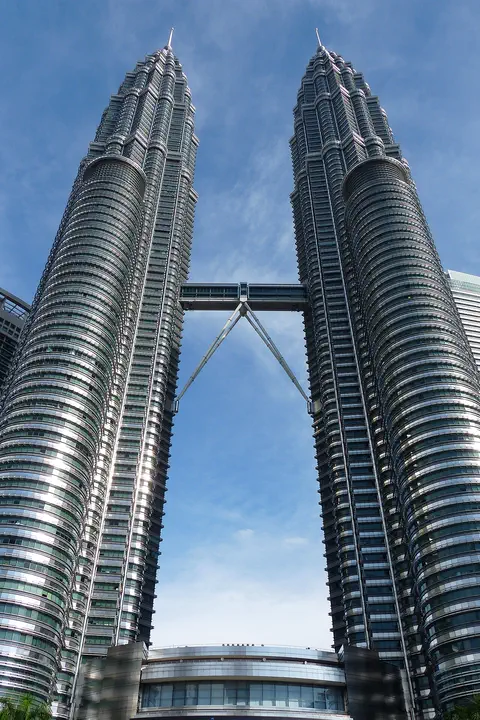
The Petronas Twin Towers in Kuala Lumpur, Malaysia, are two matching skyscrapers 452 meters tall, finished in 1998. Seen from above, each floor is shaped like an eight-pointed star, a pattern from Islamic art. A two-story skybridge joins them 170 meters above the ground, and from 1996 to 2003 they were counted as the tallest buildings in the world.
-
 Watch
City
Ho Chi Minh City
Ho Chi Minh City, once called Saigon, is Vietnam's largest city and the economic heart of the country. It lies on the Saigon River, north of the Mekong Delta. Since merging with two neighboring provinces in 2025, it has more than 14 million people, and in 2024 it opened its first metro line.
-
 Watch
Landmark
Angkor Wat
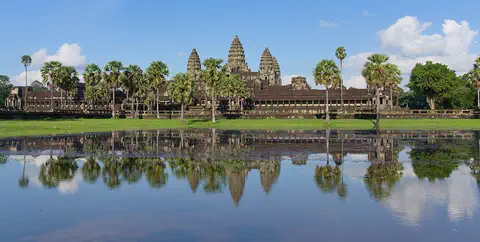
Angkor Wat, near the town of Siem Reap in Cambodia, was built in the 12th century by the Khmer king Suryavarman II. Britannica (2026) calls it the world's largest religious structure. It was built as a Hindu temple and later became a Buddhist place of worship.
-
Watch
Landmark
Angkor
Angkor, in northwestern Cambodia, was the capital of the Khmer Empire from the 9th to the 15th century. Its kings built city after city here, with scores of temples, such as Angkor Wat and the Bayon, and giant reservoirs and canals to water the rice fields. Today it covers about 400 square kilometers, and more than 100,000 people live in villages inside it.
-
 Watch
Natural wonder
Kakadu National Park
Kakadu, in Australia's Northern Territory, is the country's largest national park. It stretches from a high sandstone cliff called the escarpment down to floodplains, mangroves and the sea. Aboriginal people have lived here for tens of thousands of years, and their rock paintings, some up to 20,000 years old, record their way of life.
Explore next
-
 Watch
 Country
Indonesia
Indonesia is a country of about 17,500 islands in Southeast Asia, spread across the Equator between the Indian and Pacific oceans. It has more than 100 active volcanoes, rainforests full of wildlife, and about 286 million people (2025).
-
Watch
Landmark
Angkor Wat
Angkor Wat, near the town of Siem Reap in Cambodia, was built in the 12th century by the Khmer king Suryavarman II. Britannica (2026) calls it the world's largest religious structure. It was built as a Hindu temple and later became a Buddhist place of worship.
-
 Watch
Landmark
Persepolis
Persepolis was a royal city of the Persian kings. King Darius I began it around 518 BCE on a huge terrace at the foot of a mountain in southwestern Iran. Its palaces had very tall, slender columns and walls carved with long parades of people bringing gifts. It is a UNESCO World Heritage Site.
-
 Watch
Natural wonder
Ajanta Caves
The Ajanta Caves are about 30 halls and rooms carved by hand into a curving cliff above the Waghora River in western India. Buddhist communities made them in two big phases, starting more than 2,000 years ago. Their wall paintings and stone carvings are some of the most famous ancient art in India, and they have been a UNESCO World Heritage Site since 1983.
-
Watch
City
Jakarta
Jakarta, Indonesia's largest city and its capital, lies on the northwest coast of the island of Java, where the Ciliwung River meets the Java Sea. About 11 million people live there (2025). Indonesia is building a new capital called Nusantara, but under the law Jakarta stays the capital until the president signs a decree moving it.
-
 Watch
Landmark
Anuradhapura
Anuradhapura, in north-central Sri Lanka, was the island's capital for more than 1,000 years. Its ruins include huge bell-shaped brick monuments called dagobas, monasteries, palaces and ancient reservoirs. It is an important place for Buddhists, and a World Heritage Site since 1982.
-
Watch
Landmark
Angkor
Angkor, in northwestern Cambodia, was the capital of the Khmer Empire from the 9th to the 15th century. Its kings built city after city here, with scores of temples, such as Angkor Wat and the Bayon, and giant reservoirs and canals to water the rice fields. Today it covers about 400 square kilometers, and more than 100,000 people live in villages inside it.
-
 Watch
Landmark
Agra Fort
Agra Fort is a huge red sandstone fortress beside the Yamuna River in Agra, India. The Mughal emperor Akbar began it in 1565. Its walls, about 2.5 kilometers around, protect palaces, halls and mosques added by later emperors. It was both an army base and a royal home.
For parents & teachers
What children will learn
- Locate Borobudur on the island of Java, Indonesia, and describe its terraced shape.
- Explain how Borobudur was built around a hill, buried by volcanic ash and later restored.
- Discuss the challenges of protecting a famous monument from tourism and nature.
Recommended ages: 3 to 17 · About 15 minutes
Talk about it
- Borobudur was hidden for hundreds of years. How do you think people forgot about such a huge building?
- Millions of feet can wear down old stone. What rules would you make so visitors can enjoy a monument without harming it?
- Why might builders have chosen to build on top of a hill instead of on flat ground?
Try at home or in class
- Build a terraced 'temple' from stacked boxes or blocks, each level smaller than the one below, and walk a toy figure around every level to the top.
- Press shapes into a slab of clay to make your own relief carving that tells a short story.
Key vocabulary: monument, stupa, terrace, relief, volcanic ash, restoration
Where these facts come from
- Wikidata , Wikimedia Foundation (CC0 1.0)
- Borobudur Temple Compounds (World Heritage List 592) , UNESCO World Heritage Centre
- Borobudur , Encyclopaedia Britannica (updated Oct. 14, 2026)
- UNESCO World Heritage List , UNESCO World Heritage Centre (Linked as a reference; site facts come from Wikidata)
- Wikimedia Commons , Wikimedia Foundation (Per file (public domain, CC0, CC BY or CC BY-SA); see each media record)
Checked, not yet human-reviewed. Last updated October 27, 2026. Spotted a mistake? Tell us.