
Animal
Arctic fox
The Arctic fox lives in the coldest places in the north. In winter its fur turns white like the snow. Even its paws are furry!
The Arctic fox lives on the frozen tundra around the North Pole. Its coat changes color with the seasons, white or blue-gray in winter and brown or gray in summer, and it has short ears, a short nose and furry feet to keep the cold out. It eats lemmings, birds and leftovers from polar bears.
Vulpes lagopus is a small fox of the circumpolar Arctic tundra and coasts, adapted to extreme cold with dense fur, short rounded ears, a short muzzle and fur-covered soles, and a coat that molts between seasonal colors. Its breeding success rises and falls with lemming numbers. The IUCN lists it as Least Concern globally, though some populations, such as in Fennoscandia, are small.
Photo: Jonatan Pie (unsplash.com/@r3dmax), CC0 1.0, via Wikimedia Commons
Meet the Arctic fox
The Arctic fox is a small fox that lives in the snow.
It has thick, soft fur, small round ears and a fluffy tail. It is about the size of a pet cat.
The Arctic fox is a small, fluffy fox about the size of a pet cat: 50 to 60 centimeters long, plus a bushy tail about 30 centimeters long, and 3 to 8 kilograms. It lives in the far north, all the way around the Arctic.
There are two color types. 'White' Arctic foxes are grayish brown in summer and pure white in winter. 'Blue' Arctic foxes are gray in summer and blue-gray in winter. Both help the fox blend in with its surroundings.
Vulpes lagopus, once placed in its own genus as Alopex lagopus, is a small canid: adults measure about 50 to 60 centimeters in head and body plus a tail of about 30, and weigh about 3 to 8 kilograms (Britannica). Britannica lists its fur-covered soles, with its short rounded ears and short muzzle, as adaptations to the Arctic climate.
Two color phases occur. The white phase is grayish brown in summer and white in winter; the blue phase, the 'blue fox' of the fur trade, is grayish in summer and gray-blue in winter. Animal Diversity Web notes that in milder areas some foxes keep a darker coat all year.
Quick facts
- Group
- Mammal
- Length
- 0.5 to 0.6 m
- Weight
- 3 to 8 kg
- Lifespan in the wild
- 3 years
Where it lives
Arctic foxes live in the far north, around the North Pole.
They live on cold, flat land called tundra. They also live near the icy sea.
Arctic foxes live all around the Arctic, in northern Canada, Alaska, Greenland, Iceland, northern Scandinavia and Russia. Their home is the tundra, a cold, treeless land where the ground stays frozen deep down, and mountains and coasts near the sea.
In winter, foxes near the coast find food from the sea, such as seabirds, fish and the remains of seals. In northern Scandinavia, Arctic foxes have become rare, partly because bigger red foxes have moved into their land.
The Arctic fox has a circumpolar distribution on Arctic tundra and mountains, usually near the sea. The IUCN Red List (2014 global assessment) lists it as native in Canada, Finland, Greenland, Iceland, Norway, Russia, Sweden, Svalbard and the United States (Alaska), with introduced populations on Alaska's Aleutian Islands.
The Fennoscandian population (Norway, Sweden, Finland) is small and fragmented: Animal Diversity Web notes that Arctic foxes have been driven out of parts of northern Scandinavia, in part by competition with the larger red fox. The map shades whole countries, but Arctic foxes live only in their Arctic and mountain parts.
Continents
Its habitat

Where can you find this animal?
- Lives here naturally · Countries and seas named by a scientific source
- Sightings recorded · Records of wild sightings (GBIF)
Lives here naturally · Countries and seas named by a scientific source
Arctic tundra, mountains and coasts around the North Pole. In the United States only in Alaska; in Norway, Sweden and Finland only in small mountain populations in the far north; in Russia and Canada only in the Arctic north. Arctic foxes also live on Svalbard (Norway).
Places: Canada, Finland, Greenland, Iceland, Norway, Russia, Sweden and United States.
Source: iucn-red-list · checked October 2026
Sightings recorded · Records of wild sightings (GBIF)
Counts of GBIF records of wild observations (human and machine) and preserved specimens. Records include introduced populations, vagrants, escaped or released animals and misidentifications, so a country with records is not necessarily part of the native range.
Wild sightings have been recorded in United States, Canada, Norway, Greenland, Iceland, Russia, Finland, Poland and 17 more places.
Source: gbif · checked October 2026
Range maps show where scientists say an animal lives, often country by country. An animal may live in only part of a country shown, and sightings records can include animals that wandered far from home.
What it eats
Arctic foxes eat lemmings, which are small furry animals.
They also eat birds, eggs and berries. Sometimes they follow polar bears and eat their leftovers.
In summer, Arctic foxes mostly hunt lemmings and other small rodents, and they catch birds and take eggs. In winter, when food is hard to find, they hunt birds like ptarmigan, eat fish and carrion, and even follow polar bears to eat what is left of their meals.
Arctic foxes plan ahead. In summer, when there is plenty of food, they carry extra back to their dens and hide it under stones to eat later.
Britannica describes an opportunistic diet: in summer mainly rodents such as lemmings, plus birds; in winter birds such as ptarmigan, grouse and puffins, rodents and even reindeer, often as carrion. Arctic foxes frequently follow polar bears to scavenge the remains of their kills. Animal Diversity Web adds fish, eggs, insects, fruit and even dung.
Inland, lemmings dominate the diet, and fox breeding tracks lemming abundance: litter size varies with lemming availability. In summer, surplus prey is carried back to the den and cached under stones, a buffer for leaner times.
Did you know?
Some fox homes are hundreds of years old.
Some Arctic fox dens have been used by fox families for centuries.
Den systems with 4 to 8 entrances and about 30 square meters of tunnels can be occupied by successive generations for centuries.
Made for the cold
The Arctic fox has very thick fur.
Its ears are small and round, so they don't get cold. Even the bottoms of its feet are furry.
The Arctic fox is built to save heat. Its ears are short and round, and its nose is short too, so less warm skin is exposed to the icy wind. The bottoms of its paws are covered in thick fur, like built-in slippers.
Its coat changes twice a year. The thick winter coat is white (or blue-gray) to match the snow, and the thinner summer coat is brown or gray to match rocks and plants.
Britannica lists short rounded ears, a short muzzle and fur-covered soles as adaptations to the climate: compact extremities reduce the surface through which heat is lost. The dense winter pelage, including the furred foot pads, insulates against Arctic cold.
The coat molts twice a year, from an entirely white (or gray-blue) winter coat to a gray-to-brown summer coat that is lighter on the belly, keeping the fox camouflaged against snow in winter and against rock, soil and vegetation in summer. In milder regions some foxes keep a darker coat through the winter.
Growing up
Baby Arctic foxes are called pups.
They are born in spring in a den underground. They have dark fur. A mom and dad fox look after them together.
Arctic fox parents usually stay together for life. About 52 days after mating, the mother has her pups in a den, between April and June. In years when there are lots of lemmings, a litter can be very big, up to 20 pups!
The pups are born with dark fur. They stop drinking milk at about 45 days old and come out of the den to explore. By September or October they leave to live on their own.
Arctic foxes are monogamous and usually pair for life. Gestation is about 52 days, and litters, born between April and June, can reach about 20 dark-furred pups, with size closely linked to lemming abundance; Animal Diversity Web reports a second litter in some cases in July or August.
Britannica gives weaning at about 45 days, with young dispersing in September or October of their birth year. Dens can be elaborate: mounds 1 to 4 meters high with 4 to 8 entrances and about 30 square meters of tunnels, some used by generations of foxes for centuries. Wild life expectancy is about three years.

Family dens and long winters
Arctic fox families live in a den with many doors.
Some dens are very, very old. Many fox families have used the same den, one after another.
An Arctic fox family lives in a den dug into a low mound on the tundra or among rocks below a cliff. A den can have 4 to 8 entrances and lots of tunnels. Some dens are so good that fox families have used them for hundreds of years.
Dens are spaced out, often at least 1.6 kilometers apart. Arctic foxes must watch out for bigger hunters like polar bears, wolves and wolverines, and in some places red foxes push them out of the best land.
Family groups use dens built in low tundra mounds or rock piles at the base of cliffs, typically at least 1.6 kilometers apart. The tunnel systems, with 4 to 8 entrances over about 30 square meters, can be used for centuries, which makes good den sites a long-term resource for a population.
Arctic foxes are prey for polar bears, wolves and wolverines, and the larger red fox competes with and displaces them where the two meet. Researchers of the COAT program in northern Norway link the red fox's spread into the low Arctic to warmer winters and to more carrion, such as reindeer, left in the landscape. Arctic foxes are both hunters and scavengers, and following polar bears is one way they survive the Arctic winter.
Did you know?
Arctic fox pups can come in very big families.
In years with lots of lemmings, an Arctic fox mother can have up to 20 pups.
Litters can reach about 20 pups, with size tracking lemming abundance.
Helping Arctic foxes
There are lots of Arctic foxes in the far north.
But in some places they are rare. People are helping them by watching over their dens.
Worldwide, Arctic foxes are listed as Least Concern. In the past, many were trapped for their fur, but fur hunting has fallen a great deal since the end of the 1900s.
In some places, though, Arctic foxes are rare, like northern Scandinavia, where there are not many left. There, scientists and wildlife workers protect den areas, watch the fox families closely and study how red foxes and warmer winters affect them.
The IUCN Red List lists the Arctic fox as Least Concern globally (2014) and in Europe (2023), but notes a severely fragmented European population. Commercial trapping once put heavy pressure on the species; Britannica notes this has fallen sharply with the decline of the fur industry since the late 20th century, though hunting remains common among some Arctic communities.
The main concerns now are regional: small, isolated Fennoscandian populations, competition with northward-spreading red foxes, and changes in lemming cycles, on which Arctic fox breeding depends. In northern Norway, the COAT program checks known dens every year with automatic cameras; in Sweden and Finland, EU LIFE projects that combined winter feeding, protection around dens and other actions halted the decline, and the population more than doubled where the work was most intensive.
IUCN Red List
How is the arctic fox doing in the wild?
- Least Concern (this animal)
- Near Threatened
- Vulnerable
- Endangered
- Critically Endangered
- Extinct in the Wild
- Extinct
Least Concern
Not at risk of disappearing from the wild right now.
See the IUCN Red List assessment · The IUCN Red List of Threatened Species 2022.2
Amazing facts
-
An Arctic fox has fur under its feet!
In winter, the bottoms of an Arctic fox's paws are covered in fur, like warm slippers.
Fur-covered soles join short rounded ears and a short muzzle in Britannica's list of the Arctic fox's adaptations to cold.
-
Arctic fox pups can come in very big families.
In years with lots of lemmings, an Arctic fox mother can have up to 20 pups.
Litters can reach about 20 pups, with size tracking lemming abundance.
-
Some fox homes are hundreds of years old.
Some Arctic fox dens have been used by fox families for centuries.
Den systems with 4 to 8 entrances and about 30 square meters of tunnels can be occupied by successive generations for centuries.
-
Arctic foxes eat polar bear leftovers.
Arctic foxes often follow polar bears to eat what is left of their meals.
Arctic foxes often follow polar bears to feed on the remains of their kills, one of many ways they find food in winter.
Words to know
- tundra
- cold, flat land with no trees, where the ground deep down stays frozen
- molt
- to shed an old coat of fur and grow a new one
- lemming
- a small, furry rodent of the Arctic
- camouflage
- colors that help an animal blend in with its surroundings
- den
- an animal's underground home
- scavenge
- to eat leftovers or dead animals
Discovery challenge
-
What color is an Arctic fox in winter?
Why does an Arctic fox's coat change color?
What is the function of the Arctic fox's seasonal molt?
- White, to hide in the snow
- Orange, to look bright
- Green, to match leaves
Show the answer
White, to hide in the snow
Many Arctic foxes turn white in winter, like the snow.
A white winter coat matches the snow, and a brown summer coat matches the bare ground.
The molt maintains camouflage as the tundra changes between snow cover and bare ground.
-
What helps the fox's feet stay warm?
Which body part is special on an Arctic fox?
Which of these is one of the Arctic fox's adaptations to cold?
- Fur under its paws
- Webbed toes
- Hooves
Show the answer
Fur under its paws
Fur under its paws keeps its feet warm.
Its paws are covered in fur underneath in winter.
Fur-covered soles, along with short rounded ears and a short muzzle.
-
What does an Arctic fox like to eat?
What is the Arctic fox's main summer food inland?
Which prey most affects Arctic fox litter size?
- Lemmings
- Bananas
- Seaweed only
Show the answer
Lemmings
Arctic foxes love to eat lemmings.
Lemmings and other small rodents are the main summer food.
Lemmings: litter size varies with lemming availability.
-
Why are its ears small?
Why does an Arctic fox have short ears and a short nose?
What do short ears and a short muzzle help an Arctic fox do?
- Lose less heat
- Hear music
- Swim faster
Show the answer
Lose less heat
Small ears don't get as cold.
Shorter body parts have less skin for heat to escape from.
Reduce surface area and so heat loss in extreme cold.
Places where you might see it
-
 Watch
Natural wonder
Ural Mountains
The Ural Mountains run about 2,500 kilometers from north to south through Russia, and they form most of the traditional boundary between Europe and Asia. They are very old mountains that have been worn down over a very long time; their highest peak, Mount Narodnaya, is 1,895 meters tall. The Urals stretch from icy Arctic tundra to dry steppe and are rich in metals and gems.
-
 Watch
 Country
Iceland
Iceland is an island country in the North Atlantic, close to the Arctic Circle. It sits on the border between two giant plates of Earth's crust and has about 200 volcanoes, many hot springs and huge glaciers, and about 396,500 people lived there in mid-2026.
-
 Watch
Natural wonder
Svalbard
Svalbard is a group of Arctic islands, part of Norway, far north of the Arctic Circle. Glaciers and snowfields cover nearly 60 percent of the land. Polar bears hunt seals on the sea ice, walruses rest on the beaches, and inside a mountain on Spitsbergen the world keeps a frozen store of seeds.
Explore next
-
 Watch
Animal
Red fox
The red fox is a small, clever member of the dog family with an orange coat, black legs and a bushy, white-tipped tail. It lives across North America, Europe, Asia and North Africa, more of the world than any other wild land carnivore, and has even moved into big cities.
-
 Watch
Animal
Fennec fox
The fennec fox is the smallest member of the dog family. It lives in the Sahara and other deserts of North Africa, sleeps in cool burrows by day, and uses its enormous ears to hear insects moving under the sand at night.
-
 Watch
Animal
Polar bear
The polar bear is a huge bear that lives on the frozen sea of the Arctic. Thick fur and a layer of fat keep it warm, its amazing nose finds seals under the snow, and it can swim for many hours. It needs sea ice to hunt, so a warming Arctic is a big problem for it.
-
 Watch
Animal
Snowy owl
The snowy owl is a large white owl that nests on the Arctic tundra. Unlike most owls it hunts in daylight, and in the endless light of an Arctic summer it may hunt at any hour. Lemmings are its favorite food.
-
 Watch
Animal
Muskox
Muskoxen are shaggy Arctic grazers with long coats that nearly reach the ground and a super-warm underwool called qiviut. Herds protect their calves by standing in a ring with their horns facing out. Despite the name, they are more closely related to goats and sheep than to oxen.
-
 Watch
3D
Animal
Reindeer
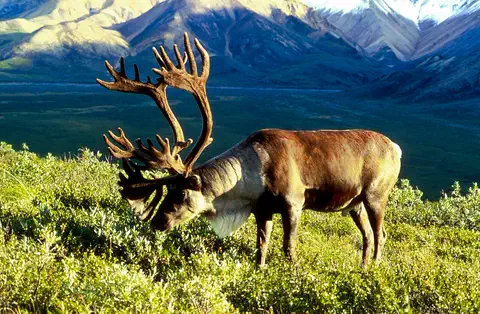
Reindeer, called caribou in North America, are deer of the Arctic tundra and northern forests. They are the only deer in which females grow antlers too. Some herds walk thousands of kilometers a year, and people in northern Europe and Asia have herded reindeer for a very long time.
-
Watch
Natural wonder
Ural Mountains
The Ural Mountains run about 2,500 kilometers from north to south through Russia, and they form most of the traditional boundary between Europe and Asia. They are very old mountains that have been worn down over a very long time; their highest peak, Mount Narodnaya, is 1,895 meters tall. The Urals stretch from icy Arctic tundra to dry steppe and are rich in metals and gems.
-
 Watch
3D
Animal
Stoat
The stoat is a small, slender hunter with a long body, short legs and a black-tipped tail. It lives across the northern parts of Europe, Asia and North America, and in snowy places some stoats turn white in winter.
For parents & teachers
What children will learn
- Explain how the Arctic fox's body is adapted to extreme cold.
- Describe how its coat changes with the seasons and why.
- Explain what Arctic foxes eat and how lemmings affect their families.
- Locate the Arctic and understand regional threats to Arctic foxes.
Recommended ages: 3 to 17 · About 15 minutes
Talk about it
- Why might short ears be better than big ears in the Arctic?
- What would happen to an Arctic fox if the snow came late but its coat had already turned white?
- Why might Arctic foxes have bigger families in some years than others?
Try at home or in class
- Wrap one cup of warm water in a sock and leave another bare; check which stays warm longer to see how fur insulates.
- Cut out a fox shape and color one side white and one side brown, then hold it against a white sheet and a brown floor to test camouflage.
Key vocabulary: tundra, molt, lemming, camouflage, den, scavenge
Where these facts come from
- The IUCN Red List of Threatened Species , International Union for Conservation of Nature (IUCN terms of use (no redistribution of Red List data or range maps))
- GBIF Backbone Taxonomy and GBIF Occurrence Search , Global Biodiversity Information Facility (CC0 1.0 (backbone); occurrence counts are facts derived from records under CC0, CC BY and CC BY-NC)
- Wikidata , Wikimedia Foundation (CC0 1.0)
- Vulpes lagopus (Arctic Fox), 2014 global assessment , IUCN Red List of Threatened Species
- Vulpes lagopus (Arctic Fox), 2023 European assessment , IUCN Red List of Threatened Species
- Arctic fox , Encyclopaedia Britannica
- Vulpes lagopus (Arctic fox) , Animal Diversity Web, University of Michigan Museum of Zoology
- Arctic fox: Varanger , COAT, Climate-ecological Observatory for Arctic Tundra
- Saving the endangered Fennoscandian Alopex lagopus (LIFE03 NAT/S/000073) , European Commission LIFE Programme
- Wikimedia Commons , Wikimedia Foundation (Per file: Public domain, CC0, CC BY or CC BY-SA only (credited on each page))
Checked, not yet human-reviewed. Last updated October 24, 2026. Spotted a mistake? Tell us.