
Animal
Common loon
The common loon is a black and white bird that lives on lakes. It dives deep under the water to catch fish, and it has a red eye.
The common loon is a big diving bird of northern lakes. In summer it wears a black head, a striped white necklace and a checkered back. It chases fish underwater, calls with eerie wails and yodels, and spends the winter on the coast.
Gavia immer is a large, heavy-bodied diving bird that breeds on lakes from Alaska and Canada to Greenland and Iceland and winters mostly on sea coasts. Solid bones and legs set far back make it a powerful underwater hunter but clumsy on land. The IUCN rates it Least Concern, with a stable population (2018).
Photo: John Picken from Chicago, USA, CC BY 2.0, via Wikimedia Commons
Meet the common loon
The common loon is a big water bird.
In summer it has a black head and a red eye. Its back has white spots like a checkerboard. It can dive under the water like a little submarine.
The common loon is a large diving bird, bigger than a mallard duck but smaller than a goose. It is about 66 to 91 centimeters long and sits low in the water.
In summer a loon has a black head, a red eye, a necklace of white stripes and a back checkered in black and white. In winter it turns plain gray above and white below. Males and females look alike, though males are a little bigger. Another name for this bird is the great northern diver.
Gavia immer belongs to the loon family (order Gaviiformes, family Gaviidae). Audubon gives a length of 66 to 91 centimeters, a wingspan of 1.3 to 1.5 meters and a weight of 2.5 to 6.4 kilograms; males are slightly larger, but the sexes look alike.
Breeding plumage is unmistakable: black head with a green sheen, red eye, a white-and-black barred collar and a boldly checkered back. Animal Diversity Web notes that in winter adults become evenly gray above and white below, and that juveniles resemble winter adults. The thick, dagger-like bill is black in the breeding season and gray the rest of the year.
Quick facts
- Group
- Bird
- Length
- 0.66 to 0.91 m
- Wingspan
- 1.3 to 1.5 m
- Weight
- 2.5 to 6.4 kg
- Top speed
- up to 121 km/h
Lakes in summer, coasts in winter
In summer, loons live on quiet lakes in the north.
In autumn, they fly away to the sea. They spend the winter near the coast.
Common loons nest on lakes across Canada, Alaska and the northern United States, and also in Greenland and Iceland. They like large lakes with plenty of small fish and a long stretch of open water for taking off.
Loons cannot nest on frozen water. In autumn, from September on, they migrate. Most spend the winter on shallow coastal seas, on both coasts of North America and along the western coasts of Europe. Some winter on big lakes that stay free of ice.
Animal Diversity Web describes a breeding range on lakes from western Greenland west across Canada and the northernmost United States, including Alaska, with a breeding population on Iceland. Audubon adds tundra ponds beyond the tree line and notes that breeding lakes need ample room for takeoff and a good supply of small fish.
In winter loons move to fairly shallow coastal waters, south to Baja California and Texas in North America and along the western coasts of Europe, and to large ice-free lakes and reservoirs. Migration begins in September; ADW notes they travel by day, singly or in flocks of up to 15. The map shows the breeding and wintering countries listed in the IUCN's 2018 assessment.
Continents
Its habitat

Where can you find this animal?
- Lives here naturally · Countries and seas named by a scientific source
- Sightings recorded · Records of wild sightings (GBIF)
- Visits for part of the year · Countries and seas named by a scientific source
Lives here naturally · Countries and seas named by a scientific source
Breeds on lakes across Canada, Alaska and the northern United States, and in Greenland and Iceland. Loons live only on suitable lakes and coasts within each country shown.
Places: Canada, Greenland, Iceland and United States.
Source: iucn-red-list · checked October 2026
Sightings recorded · Records of wild sightings (GBIF)
Counts of GBIF records of wild observations (human and machine) and preserved specimens. Records include introduced populations, vagrants, escaped or released animals and misidentifications, so a country with records is not necessarily part of the native range.
Wild sightings have been recorded in United States, Canada, Norway, UK, Netherlands, Iceland, Spain, France and 35 more places.
Source: gbif · checked October 2026
Visits for part of the year · Countries and seas named by a scientific source
Coasts where loons spend the winter or pass through on migration: Mexico and Cuba, and the Atlantic coasts of western Europe from Norway to Portugal.
Places: Belgium, Cuba, Denmark, France, Ireland, Mexico, Netherlands, Norway and 3 more places.
Source: iucn-red-list · checked October 2026
Range maps show where scientists say an animal lives, often country by country. An animal may live in only part of a country shown, and sightings records can include animals that wandered far from home.
An underwater fish hunter
Loons eat fish.
A loon looks under the water. Then it dives and swims fast to catch a fish. It needs clear water to see.
Loons eat mostly small fish, such as perch, minnows and suckers, plus crayfish, frogs, leeches and water insects. They hunt by sight, so they need clear water.
A loon may swim with its face dipped under the surface, peering for fish. Then it dives and chases them, kicking with its feet. Small fish are swallowed underwater. Bigger ones are brought up and eaten at the surface.
The diet is mainly small fish; Audubon lists minnows, suckers, perch, gizzard shad and killifish among others, up to about 25 centimeters long, as well as crustaceans, mollusks, aquatic insects, leeches, frogs and some aquatic plants. Animal Diversity Web stresses that loons are visual predators, so water clarity matters, and that they usually hunt in water 2 to 4 meters deep.
Before diving a loon may swim with its head partly submerged to look below. It is propelled mainly by its feet. Small prey is swallowed underwater, while larger items are carried to the surface. To drink, a loon scoops water with its bill and tilts its head back.

Built like a torpedo
Most birds have light bones. Loons have heavy bones.
Heavy bones help loons dive deep. Their legs are far back, so they swim well but walk badly.
Most birds have hollow, light bones, but a loon's bones are solid. The extra weight helps it dive as deep as about 76 meters and stay underwater for up to five minutes.
Its legs sit far back on its body, which makes it a powerful swimmer but very awkward on land. Because the loon is heavy for its wing size, it needs a runway of about 30 to 180 meters of open water to take off. Once flying, it can go faster than 120 kilometers per hour.
The Minnesota DNR notes that, unlike most birds, loons have solid rather than hollow bones; the extra weight helps them dive to about 76 meters (250 feet) and stay under for up to five minutes. Legs set very far back give strong underwater propulsion, but ADW notes they make walking difficult.
The high body weight for its wing area has a cost in the air: the DNR says a loon needs a 100 to 600 foot (about 30 to 180 meter) run across the water to take off, though once airborne it can exceed 75 miles (121 kilometers) per hour. ADW describes the bill as straight, thick and dagger-like.
Chicks that ride on a back
Mom and dad loon make a nest at the edge of the water.
Both parents keep the eggs warm. The fluffy chicks can swim very soon. Sometimes they ride on a parent's back!
A loon pair builds a nest of grasses and reeds right at the water's edge, often on an island. The female lays one or two brown eggs, and both parents take turns keeping them warm for about four weeks.
The chicks are blackish brown. They leave the nest a day or two after hatching and can dive at just two or three days old. When they are small they often ride on a parent's back. They can fly at about 12 weeks.
Pairs nest on islands, peninsulas or floating mats of vegetation close to deep water, so they can slip in and out unseen; Audubon notes nests are often reused year after year. Clutches are one to two olive to brown eggs (ADW gives 1 to 3, usually 2), incubated by both parents for about 26 to 30 days depending on the source.
Chicks are precocial: they leave the nest within a day or two, can dive at two to three days and are fed whole food by both parents. Riding on a parent's back keeps them away from predators such as large fish and turtles. They fly at about 12 to 13 weeks (Audubon) and can then become independent. First breeding comes at 2 to 4 years, depending on the source.
Wails, yodels and tremolos
Loons make spooky, beautiful calls.
One call sounds like a long wail. Another sounds like laughing. Dad loon yodels to say, this is my lake.
Loon calls are a well-known sound of early summer in the northern woods, often heard at night. The Minnesota DNR describes four calls. The tremolo sounds a bit like wild laughter and is an aggressive call. The wail is long and drawn out. Short hoots keep parents and chicks in touch. The yodel is the male's call for guarding his territory.
Pairs defend a stretch of lake, and they are thought to stay with the same partner for life.
Loons communicate with displays and calls. The Minnesota DNR describes four calls: the tremolo, an aggressive call likened to manic laughter; the long wail; the short hoot used between parents and young; and the yodel, given by males defending a territory. Audubon notes that birds often call at night.
During the breeding season most loons live in pairs that defend a territory of about 0.24 to 0.81 square kilometers (ADW), using yodels and circling flights over the lake. Courtship includes repeated bill-dipping, rearing upright with wings half spread and racing side by side across the water. ADW notes pairs are thought to stay together for life; in winter, birds feed alone by day and gather loosely at night.
Did you know?
The common loon is Minnesota's state bird.
The common loon is the state bird of Minnesota, which has more loons than any other state except Alaska.
The common loon is Minnesota's state bird; the state DNR says only Alaska has more loons.
Keeping lakes loon-friendly
There are lots of loons.
But loons need quiet, clean lakes. Some helpers watch over the lakes and teach visitors about loons.
The IUCN Red List rates the common loon Least Concern, and its numbers are stable. But loons need clean, quiet lakes. Disturbance by people on lakes in summer has driven loons away from some places where they used to nest, and pollution such as lead and mercury is a threat too.
In parts of the northeastern United States, volunteers called Loon Rangers patrol lakes and teach visitors about protecting loons. Scientists also warn that climate change could shrink the area where loons can breed.
The IUCN assessed Gavia immer as Least Concern in 2018, with a stable population trend; Audubon describes its numbers as increasing overall but notes it is listed as Threatened in Michigan and New Hampshire and considered sensitive in the northwestern United States.
Threats named by the sources include human disturbance on breeding lakes, which has driven loons from some former nesting areas, acid rain that may reduce food supplies, and lead and mercury pollution (Minnesota DNR). Audubon's climate models project that the species will lose much of its breeding range as the climate warms. Responses include volunteer Loon Rangers who patrol lakes and educate visitors, and monitoring: the Minnesota DNR tracks its loons with the help of volunteers.
IUCN Red List
How is the common loon doing in the wild?
- Least Concern (this animal)
- Near Threatened
- Vulnerable
- Endangered
- Critically Endangered
- Extinct in the Wild
- Extinct
Least Concern
Not at risk of disappearing from the wild right now.
See the IUCN Red List assessment · The IUCN Red List of Threatened Species 2021.3
Amazing facts
-
Loons have heavy bones, not light ones like most birds.
Unlike most birds, loons have solid bones. The extra weight helps them dive as deep as about 76 meters.
The Minnesota DNR notes that loons have solid rather than hollow bones, which helps them dive to about 76 meters (250 feet).
-
A loon needs a long run across the water to fly.
A loon is so heavy for its wings that it needs a runway of 30 to 180 meters of open water to take off.
A high body weight for its wing area means a loon needs a 100 to 600 foot (about 30 to 180 meter) takeoff run across the water.
-
Baby loons ride on their parents' backs.
Small loon chicks often ride on a parent's back, which keeps them away from hungry fish and turtles.
Parents carry small chicks on their backs during the first weeks, which the Minnesota DNR says keeps them safe from fish and turtle predators.
-
The common loon is Minnesota's state bird.
The common loon is the state bird of Minnesota, which has more loons than any other state except Alaska.
The common loon is Minnesota's state bird; the state DNR says only Alaska has more loons.
Words to know
- loon
- a large diving bird of northern lakes; the common loon is also called the great northern diver
- plumage
- all the feathers on a bird
- migrate
- to travel to a different place for part of the year
- territory
- an area an animal guards against others of its kind
- precocial
- able to move about and swim soon after hatching
- tremolo
- a loon call that sounds like wobbly laughter
Discovery challenge
-
What does a loon mostly eat?
What makes up most of a common loon's diet?
Which food makes up most of the common loon's diet?
- Fish
- Grass
- Flower nectar
Show the answer
Fish
Loons dive to catch fish.
Loons eat mostly small fish, plus crayfish, frogs, leeches and insects.
The diet is mainly small fish up to about 25 cm, caught by sight underwater, with crustaceans, insects, leeches and frogs.
-
Are a loon's bones heavy or light?
What is special about a loon's bones?
How do loon bones differ from those of most birds?
- They are solid and heavy
- They are hollow and light
- They are soft like rubber
Show the answer
They are solid and heavy
Loons have heavy bones that help them dive.
Most birds have hollow bones, but loons have solid ones. The weight helps them dive deep.
Solid rather than hollow bones add weight, which the Minnesota DNR says helps loons dive to about 76 meters.
-
Where do little loon chicks sometimes ride?
Where do small loon chicks often ride?
Where do young loon chicks often travel during their first weeks?
- On a parent's back
- In a nest high in a tree
- Inside a parent's beak
Show the answer
On a parent's back
Chicks ride on mom or dad's back.
Small chicks often ride on a parent's back, which keeps them away from fish and turtles.
Parents carry chicks on their backs during the first weeks, protecting them from aquatic predators.
-
Why is it hard for a loon to walk?
Why is a loon clumsy on land?
What makes the common loon a strong swimmer but a poor walker?
- Its legs are far back on its body
- It has no feet
- Its wings are too big
Show the answer
Its legs are far back on its body
Its legs are far back, so it swims well but walks badly.
A loon's legs sit far back on its body. That makes it a powerful swimmer but awkward on land.
Legs set very far back give strong underwater propulsion but make walking difficult.
Places where you might see it
-
 Watch
 Country
Canada
Canada is the second-largest country in the world, stretching across the north of North America from the Atlantic to the Pacific and up into the Arctic. It has the Rocky Mountains, thousands of islands and about 42 million people, who speak English, French and many other languages.
-
 Watch
 Country
United States
The United States is a large country in North America made of 50 states, from icy Alaska to the warm islands of Hawaii. It has the Grand Canyon, the Mississippi River and Yellowstone, and about 342 million people live there.
Explore next
-
 Watch
3D
Animal
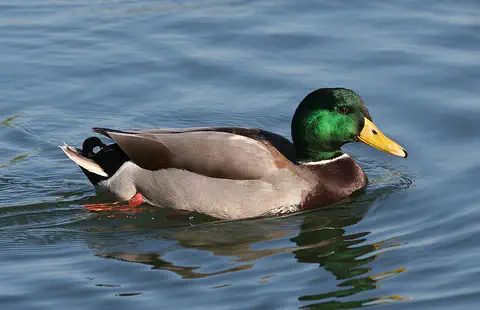
Mallard
The mallard is perhaps the most familiar duck in the world, found on ponds, lakes, rivers and city parks across North America, Europe and Asia. Males have glossy green heads; females are mottled brown. Almost all farm ducks are descended from mallards.
-
 Watch
3D
Animal
Atlantic puffin
The Atlantic puffin is a small seabird of the North Atlantic, often called the clown of the sea because of its huge, colorful bill. It spends most of its life far out on the ocean and comes ashore only in summer to nest in burrows on islands and cliff tops. Underwater, its small wings work like flippers.
-
 Watch
3D
Animal
Bald eagle
The bald eagle is one of North America's biggest birds, with a white head and tail, a dark brown body and a huge yellow bill. It lives near lakes, rivers and coasts and eats mostly fish. Once rare because of hunting and pesticides, it has made an amazing comeback.
-
Watch
Country
Canada
Canada is the second-largest country in the world, stretching across the north of North America from the Atlantic to the Pacific and up into the Arctic. It has the Rocky Mountains, thousands of islands and about 42 million people, who speak English, French and many other languages.
-
Watch
Country
United States
The United States is a large country in North America made of 50 states, from icy Alaska to the warm islands of Hawaii. It has the Grand Canyon, the Mississippi River and Yellowstone, and about 342 million people live there.
-
 Watch
Animal
Adélie penguin
The Adélie penguin is a medium-sized penguin, about 70 centimeters tall, with a black back, a white front and a bright white ring around each eye. It breeds in summer on rocky, ice-free ground all around Antarctica, building nests of pebbles, and spends the winter far out at sea among the pack ice.
-
 Watch
Animal
African fish eagle
The African fish eagle is a big eagle of Africa's lakes, rivers and coasts, with a white head, chest and tail and a chestnut-brown body. It snatches fish from the surface of the water, and its loud, ringing call is one of the best-known sounds of Africa.
-
 Watch
Animal
African penguin
The African penguin is a penguin of warm, sunny coasts. It lives only in South Africa and Namibia, nests in burrows and under bushes, and hunts sardines and anchovies in the cold sea. Its numbers have fallen so far that it is now Critically Endangered, and people are working hard to protect it.
For parents & teachers
What children will learn
- Describe how the common loon's bones, legs and bill suit a life of diving for fish.
- Describe where loons spend the summer and where they spend the winter.
- Describe how loon parents raise their chicks.
- Explain how people can share lakes with nesting loons.
Recommended ages: 3 to 17 · About 15 minutes
Talk about it
- Why might heavy bones help a bird that dives, and make flying harder?
- Why do loons need clear water to find their food?
- What could you do on a lake to avoid disturbing a nesting bird?
Try at home or in class
- Float a plastic bottle in a sink or tub, then add a little sand to it: watch how extra weight makes it ride lower, like a loon.
- Measure 80 centimeters with a tape measure to see how long a common loon is from bill to tail.
Key vocabulary: loon, plumage, migrate, territory, precocial, tremolo
Where these facts come from
- The IUCN Red List of Threatened Species , International Union for Conservation of Nature (IUCN terms of use (no redistribution of Red List data or range maps))
- GBIF Backbone Taxonomy and GBIF Occurrence Search , Global Biodiversity Information Facility (CC0 1.0 (backbone); occurrence counts are facts derived from records under CC0, CC BY and CC BY-NC)
- Wikidata , Wikimedia Foundation (CC0 1.0)
- Gavia immer (Common Loon), Red List assessment 2018 , IUCN Red List of Threatened Species
- Gavia immer (common loon) , Animal Diversity Web, University of Michigan Museum of Zoology
- Common Loon , National Audubon Society, Guide to North American Birds
- Common loon , Minnesota Department of Natural Resources
- Wikimedia Commons , Wikimedia Foundation (Per file: Public domain, CC0, CC BY or CC BY-SA only (credited on each page))
Checked, not yet human-reviewed. Last updated October 24, 2026. Spotted a mistake? Tell us.