Animal
Mallard
The mallard is a duck you can see in many ponds and parks. The dad has a shiny green head. The mom is brown, and she says 'quack!'
The mallard is perhaps the most familiar duck in the world, found on ponds, lakes, rivers and city parks across North America, Europe and Asia. Males have glossy green heads; females are mottled brown. Almost all farm ducks are descended from mallards.
Anas platyrhynchos is a widespread dabbling duck of Northern Hemisphere wetlands and the ancestor of nearly all domestic duck breeds. A generalist feeder, it thrives in both wild marshes and city parks, hybridizes readily with related ducks, and is the most heavily hunted duck in North America while remaining abundant.
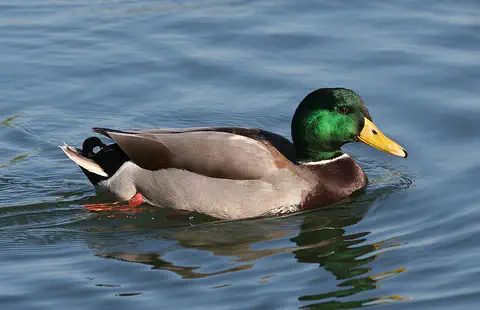
Photo: Calibas (edit by Aqwis), CC BY-SA 3.0, via Wikimedia Commons
Meet the mallard
The mallard is a big, friendly-looking duck.
The dad duck has a shiny green head, a yellow beak and a white ring around his neck. The mom duck is speckled brown. Both have a bright blue patch on each wing.
The mallard may be the most familiar duck of all. Males, called drakes, have a gleaming green head, a bright yellow bill, a thin white neck ring, a brown chest, a gray body and a black tail with a little curl. Females are mottled brown with orange-and-brown bills.
Both males and females have a blue patch on each wing, edged in white, called the speculum. The classic 'quack' is the voice of the female. Males make a quieter, raspy sound.
Anas platyrhynchos is a dabbling duck of the family Anatidae, 50 to 65 centimeters long and 1 to 1.3 kilograms (Cornell). Males have an iridescent green head, yellow bill, brown breast, gray flanks and a black rear with curled tail feathers; females and juveniles are mottled brown with orange-and-brown bills, and both sexes show a white-bordered blue speculum.
The species has given rise to populations distinct enough to be treated as separate species, among them the Mexican duck and the Hawaiian duck, in which males are dull like females. Mallards also hybridize with many other ducks, including American black ducks, pintails, teal and Australia's Pacific black duck.
Quick facts
- Group
- Bird
- Length
- 0.5 to 0.65 m
- Wingspan
- 0.82 to 0.95 m
- Weight
- 1 to 1.3 kg
- Top speed
- up to 89 km/h
Where it lives
Mallards live in lots of countries.
They swim on ponds, lakes, rivers and marshes. Many live in city parks, close to people.
Mallards live across North America, Europe and Asia, and in parts of North Africa. People have also brought them to Australia and New Zealand.
They can live in almost any wetland: marshes, ponds, lakes, rivers, floodplains, beaver ponds and estuaries. They also feed in ditches, fields and rice paddies, and many live in city and suburban parks. Some mallards stay in one place all year, while others fly south for the winter.
The IUCN's 2025 global assessment lists the mallard as native across Europe, much of Asia from Turkey and Iran to China, Japan, Korea and India, North Africa, and North and Central America, with non-breeding visitors in the Arabian Peninsula, Afghanistan and Costa Rica; populations in Australia and New Zealand are introduced.
Cornell describes mallards in almost every kind of wetland, from permanent marshes, bogs, floodplains and reservoirs to temporary prairie potholes, as well as farms and city parks, and notes that migrating birds feed on crops along the way. In city and suburban parks they often accept food from people.
Continents
Its habitat

Where can you find this animal?
- Brought here by people · Countries and seas named by a scientific source
- Lives here naturally · Countries and seas named by a scientific source
- Sightings recorded · Records of wild sightings (GBIF)
- Visits for part of the year · Countries and seas named by a scientific source
Brought here by people · Countries and seas named by a scientific source
Mallards brought by people now breed in the wild in Australia and New Zealand.
Places: Australia and New Zealand.
Source: iucn-red-list · checked October 2026
Lives here naturally · Countries and seas named by a scientific source
Wetlands, rivers, lakes and parks across North America, Europe, much of Asia and North Africa. Many northern mallards migrate south in winter. Mallards live in only part of many countries shown.
Places: Albania, Algeria, Azerbaijan, Austria, Bahamas, Bangladesh, Armenia, Belgium and 82 more places.
Source: iucn-red-list · checked October 2026
Sightings recorded · Records of wild sightings (GBIF)
Counts of GBIF records of wild observations (human and machine) and preserved specimens. Records include introduced populations, vagrants, escaped or released animals and misidentifications, so a country with records is not necessarily part of the native range.
Wild sightings have been recorded in United States, Canada, Sweden, UK, Netherlands, Norway, Denmark, France and 136 more places.
Source: gbif · checked October 2026
Visits for part of the year · Countries and seas named by a scientific source
Countries the IUCN lists for mallards outside the breeding season only.
Places: Afghanistan, Costa Rica, Palestine, Jordan, Oman, Qatar, Saudi Arabia, South Sudan and 1 more places.
Source: iucn-red-list · checked October 2026
Range maps show where scientists say an animal lives, often country by country. An animal may live in only part of a country shown, and sightings records can include animals that wandered far from home.
Dabbling for dinner
Mallards tip upside down in the water to eat.
Their tails stick up in the air! They eat seeds, plants, bugs and snails.
Mallards are dabbling ducks: instead of diving, they tip forward with their heads underwater and their tails in the air to reach seeds and water plants. They also walk on the shore pecking at plants and small animals.
What they eat changes through the year. In the breeding season they eat lots of insect larvae, earthworms, snails and freshwater shrimp. On migration, many eat grain and seeds from farm fields.
Mallards are generalist foragers. They do not dive but dabble, tipping forward to reach seeds and aquatic vegetation, and they also forage on land.
Diet shifts seasonally: during breeding they take mainly animal food, including aquatic insect larvae, earthworms, snails and freshwater shrimp, while many migrants feed heavily on agricultural seed and grain. In city parks they readily accept handouts, which Cornell links to how tame park mallards can become.
Did you know?
Most farm ducks come from mallards.
Nearly all domestic duck breeds, except the Muscovy duck, are descended from mallards.
The mallard is the ancestor of nearly all domestic ducks; only the Muscovy duck has a different wild origin.
A duck's body
Mallards have orange webbed feet for paddling.
Their beaks are flat. Their feathers keep them dry. They can fly fast too!
A mallard swims with orange webbed feet and feeds with a broad, flat bill. It is also a strong flier: migrating flocks have been estimated flying at about 89 kilometers an hour.
After the breeding season, mallards shed all their flight feathers at once and cannot fly for 3 to 4 weeks. During this time the males grow dull 'eclipse' feathers that make them look a lot like females, and the ducks keep out of sight.
Mallards are strong fliers; Cornell cites migrating flocks estimated at 55 mph (about 89 km/h), with wings spanning 82 to 95 centimeters.
Like other ducks, mallards molt all their flight feathers at the end of the breeding season and are flightless for 3 to 4 weeks. During this vulnerable period they are secretive, and their body feathers molt into a concealing 'eclipse' plumage that makes them hard to identify.
Nests and ducklings
The mother duck makes a nest on the ground near water.
She lines it with soft feathers from her chest. The fluffy ducklings can leave the nest the day they hatch!
Mallards pair up in the fall, months before spring nesting. The female makes a shallow bowl on the ground near water, hidden under grass, and lines it with grass, leaves and soft down feathers plucked from her own breast.
She lays up to 13 creamy or greenish eggs and keeps them warm for 23 to 30 days. Only the mother sits on the eggs and looks after the ducklings. The ducklings hatch fluffy and alert, and they are ready to leave the nest within about 13 to 16 hours.
Pairs form in autumn, and courtship continues through winter. Pairs search for nest sites together, often on low evening flights. The female scrapes a shallow bowl on dry ground near water, pulling in nearby vegetation, lining it with grasses and twigs and, once incubation begins, with down plucked from her breast.
Cornell gives a clutch of 1 to 13 eggs, one or two broods a year and incubation of 23 to 30 days. Only the female incubates and tends the ducklings, which hatch downy and alert and leave the nest within 13 to 16 hours. The oldest known mallard, a male banded in Louisiana in 1981, was at least 27 years 7 months old.

Duck displays
Mallards bob and shake their heads and flap their wings to send messages to other ducks.
In parks they can be very tame. In wild places they are shy and keep away from people.
Mallards have lots of displays, special moves that send messages. Males bob their heads at each other, open their bills to warn rivals, and sometimes push breast to breast. To court a female, a male shakes his head, looks over his shoulder or rises up in the water flapping his wings.
In city parks, where people often feed them, mallards can become very tame. Where they are hunted, they are much more wary of people.
Mallards have a large repertoire of ritualized displays. Males face off with head-bobs, threaten with an open bill, push breast to breast and defend territories with acrobatic chases. Courting males head-shake, look over the shoulder or rise up and flap; several males often display around one female, who encourages a chosen male by nodding or paddling with her head low.
Behavior toward people depends on experience: park birds fed by visitors become tame, while heavily hunted populations are very wary. Mallards often associate with other dabbling ducks and may hybridize with them.
Did you know?
For a few weeks every year, mallards cannot fly.
After nesting, mallards lose all their flight feathers at once and cannot fly for 3 to 4 weeks.
The post-breeding wing molt leaves mallards flightless for 3 to 4 weeks, during which they hide in eclipse plumage.
A very common duck
There are lots and lots of mallards.
They need clean water and healthy wetlands. Keeping ponds and marshes clean helps them.
Mallards are listed as Least Concern, and they are the most widespread and abundant duck in North America, with about 19 million breeding birds. Their numbers rise in wet years and fall in droughts.
Mallards are also hunted more than any other duck in North America, so wildlife agencies keep track of how many are taken. Ducks used to be poisoned by swallowing lead shot; switching to steel shot has helped. Dirty water, oil spills and draining wetlands can harm them.
The IUCN lists the mallard as Least Concern (global assessment, 2025). In North America, Cornell reports steady populations from 1966 to 2019 (North American Breeding Bird Survey) and a Partners in Flight estimate of about 19 million breeding birds; numbers have cycled between about 5 and 19 million over 50 years with wet and dry periods.
Mallards account for about one in three ducks shot in North America, and harvests are closely monitored. Ingested lead shot poisoned many; a mandatory switch to steel shot along the Mississippi Flyway in 1977 greatly reduced this. Water pollution (mercury, pesticides, selenium), wetland drainage and oil spills remain threats.
IUCN Red List
How is the mallard doing in the wild?
- Least Concern (this animal)
- Near Threatened
- Vulnerable
- Endangered
- Critically Endangered
- Extinct in the Wild
- Extinct
Least Concern
Not at risk of disappearing from the wild right now.
See the IUCN Red List assessment · The IUCN Red List of Threatened Species 2021.3
Amazing facts
-
Only mother mallards say 'quack'.
The classic duck quack is the voice of a female mallard. Males make a quieter, raspy sound.
The familiar quack is the female's call; males give a quieter, rasping note.
-
Most farm ducks come from mallards.
Nearly all domestic duck breeds, except the Muscovy duck, are descended from mallards.
The mallard is the ancestor of nearly all domestic ducks; only the Muscovy duck has a different wild origin.
-
Ducklings can leave the nest the day they hatch.
Mallard ducklings hatch fluffy and alert and can leave the nest within 13 to 16 hours.
Young are precocial, leaving the nest within 13 to 16 hours of hatching.
-
For a few weeks every year, mallards cannot fly.
After nesting, mallards lose all their flight feathers at once and cannot fly for 3 to 4 weeks.
The post-breeding wing molt leaves mallards flightless for 3 to 4 weeks, during which they hide in eclipse plumage.
Words to know
- dabbling
- feeding by tipping forward in shallow water instead of diving
- drake
- a male duck
- duckling
- a baby duck
- speculum
- a shiny colored patch on a duck's wing
- eclipse plumage
- dull feathers some ducks grow after the breeding season
- migrate
- to travel to a different place for part of the year
Discovery challenge
-
Which mallard has a green head?
Which mallards have glossy green heads?
Which mallards show an iridescent green head in breeding plumage?
- The males
- The females
- The ducklings
Show the answer
The males
The daddy ducks have green heads.
Males (drakes) have green heads; females are mottled brown.
Breeding males; females and juveniles are mottled brown.
-
How does a mallard reach food underwater?
How does a mallard usually feed in the water?
Which feeding method do mallards use in water?
- It tips upside down
- It dives very deep
- It catches food in the air
Show the answer
It tips upside down
It tips up with its tail in the air.
Mallards dabble: they tip forward to reach seeds and plants, instead of diving.
Dabbling, tipping forward from the surface; mallards do not dive to feed.
-
Who looks after mallard ducklings?
Which parent sits on the eggs and cares for the ducklings?
Which parent incubates mallard eggs and tends the young?
- The mother
- The father
- Both, taking turns
Show the answer
The mother
The mother duck looks after them.
Only the female incubates the eggs and takes care of the ducklings.
Incubation and brood care are by the female alone.
-
Which duck makes the famous 'quack'?
Which mallard makes the classic 'quack' sound?
Which sex of mallard gives the familiar quack call?
- The female
- The male
- Neither
Show the answer
The female
The mother duck quacks.
The female quacks; the male makes a quieter, raspy sound.
The quack is the female's call; males give a rasping note.
Places where you might see it
-
 Watch
 Country
Canada
Canada is the second-largest country in the world, stretching across the north of North America from the Atlantic to the Pacific and up into the Arctic. It has the Rocky Mountains, thousands of islands and about 42 million people, who speak English, French and many other languages.
-
 Watch
Natural wonder
Mississippi River
The Mississippi River flows about 3,770 kilometers from Lake Itasca in Minnesota to the Gulf of Mexico, through the middle of the United States. Its basin drains about 40 percent of the continental United States. Long ago Native Americans paddled canoes on it; later came steamboats, and today huge barges carry grain and fuel. Millions of birds follow it when they migrate.
-
 Watch
Natural wonder
Volga
The Volga is Europe's longest river. It rises in the Valdai Hills northwest of Moscow and flows about 3,530 kilometers to the Caspian Sea, all within Russia. Almost half of Russia's people live in its basin. Big dams now turn much of it into a chain of long lakes, and its huge delta shelters up to 750,000 waterbirds in mild winters.
Explore next
-
 Watch
3D
Animal
Canada goose
The Canada goose is a big, black-necked goose with a white chinstrap, found near lakes, rivers, fields and parks across North America. Many migrate in noisy V-shaped flocks, but more and more stay all year on city lawns. People also brought Canada geese to Britain and other parts of Europe.
-
 Watch
Animal
Mute swan
The mute swan is among the largest waterfowl, all white with an orange bill topped by a black knob. It is native to Europe and Asia, where it lives on lakes, rivers and park ponds. People took mute swans to North America and other places, where they now live in the wild and can cause problems for native wildlife.
-
 Watch
Animal
American flamingo
The American flamingo is a tall, bright pink wading bird of the Caribbean. It gets its color from pigments in the tiny water animals and algae it eats, and it feeds by filtering water through its bent bill with its head upside down. Flamingos live and nest in huge, noisy groups.
-
 Watch
3D
Animal
Chicken
The chicken is a domesticated bird: people raise it on farms and in backyards all over the world for eggs and meat. Its wild ancestor is the red junglefowl of the forests of southern and Southeast Asia, and scientists think chickens were first domesticated about 3,500 years ago near rice fields in Southeast Asia.
-
Watch
Country
Canada
Canada is the second-largest country in the world, stretching across the north of North America from the Atlantic to the Pacific and up into the Arctic. It has the Rocky Mountains, thousands of islands and about 42 million people, who speak English, French and many other languages.
-
 Watch
3D
Animal
Great blue heron
The great blue heron is the largest heron in North America. It wades slowly through marshes, rivers and ponds, or stands as still as a statue, then strikes like lightning with its dagger-shaped bill to catch fish, frogs and even small mammals.
-
 Watch
Animal
Common loon
The common loon is a big diving bird of northern lakes. In summer it wears a black head, a striped white necklace and a checkered back. It chases fish underwater, calls with eerie wails and yodels, and spends the winter on the coast.
-
Watch
Natural wonder
Mississippi River
The Mississippi River flows about 3,770 kilometers from Lake Itasca in Minnesota to the Gulf of Mexico, through the middle of the United States. Its basin drains about 40 percent of the continental United States. Long ago Native Americans paddled canoes on it; later came steamboats, and today huge barges carry grain and fuel. Millions of birds follow it when they migrate.
For parents & teachers
What children will learn
- Identify male and female mallards and describe how they differ.
- Explain how dabbling ducks feed and how mallard diets change through the year.
- Describe how mallards nest and how quickly ducklings become active.
- Explain some threats to ducks and how a change from lead to steel shot helped.
Recommended ages: 3 to 17 · About 15 minutes
Talk about it
- Why might a mother duck that sits on a nest on the ground be brown, not bright green?
- Why might ducks in a park be tamer than ducks in the wild?
- What could we do to keep a local pond healthy for ducks?
Try at home or in class
- Visit a local pond with an adult and count how many male and female mallards you can see.
- Fill a tub with water and float some lettuce leaves, then try to 'dabble' them up with a spoon to see how a duck feeds.
Key vocabulary: dabbling, drake, duckling, speculum, eclipse plumage, migrate
Where these facts come from
- The IUCN Red List of Threatened Species , International Union for Conservation of Nature (IUCN terms of use (no redistribution of Red List data or range maps))
- GBIF Backbone Taxonomy and GBIF Occurrence Search , Global Biodiversity Information Facility (CC0 1.0 (backbone); occurrence counts are facts derived from records under CC0, CC BY and CC BY-NC)
- Wikidata , Wikimedia Foundation (CC0 1.0)
- Anas platyrhynchos (Mallard), Red List global assessment 2025 , IUCN Red List of Threatened Species
- Mallard overview , Cornell Lab of Ornithology, All About Birds
- Mallard life history , Cornell Lab of Ornithology, All About Birds
- Mallard identification , Cornell Lab of Ornithology, All About Birds
- Wikimedia Commons , Wikimedia Foundation (Per file: Public domain, CC0, CC BY or CC BY-SA only (credited on each page))
Checked, not yet human-reviewed. Last updated October 28, 2026. Spotted a mistake? Tell us.