
Animal
Eastern tiger swallowtail
The eastern tiger swallowtail is a big yellow butterfly with black stripes, like a tiger. It has long tails on its back wings.
The eastern tiger swallowtail is a large butterfly of eastern North America. Males are yellow with black tiger stripes, while many females are dark, which helps them look like a bad-tasting butterfly. Its caterpillars disguise themselves as bird droppings, then turn green with big fake eyes.
Papilio glaucus is a swallowtail (family Papilionidae) of eastern North America, from Ontario to the Gulf Coast. Females come in yellow and dark forms; the dark form is considered a Batesian mimic of the toxic pipevine swallowtail, and the color is inherited from mother to daughter. Its larvae pass from bird-dropping disguise to green caterpillars with false eyespots.
Photo: HaarFager at English Wikipedia, CC BY-SA 3.0, via Wikimedia Commons
Meet the tiger swallowtail
The eastern tiger swallowtail is a big butterfly.
Its wings are yellow with black stripes, like a tiger's coat. Its back wings end in long, thin tails. Some mother swallowtails are dark instead of yellow.
The eastern tiger swallowtail is probably the most recognizable swallowtail butterfly in the eastern United States. It is big: its wings can measure up to about 11 centimeters across, about as wide as a grown-up's hand.
Males are yellow with four black stripes on each front wing, like a tiger. The edges of the wings are black with a row of yellow spots. Females come in two colors: some are yellow like the males, and some are almost all black. The back wings end in long points that look like the tail of a swallow, which gives the butterfly its name.
Papilio glaucus belongs to the swallowtails, family Papilionidae. Papilio is Latin for butterfly; some scientists place the species in the genus Pterourus, from Greek roots meaning wing and tail. Butterflies and Moths of North America gives a wingspan of 6.2 to 11.4 centimeters.
Adults are yellow with four black bands on each forewing and black margins with a row of yellow spots. Females are dimorphic: yellow, or dark with only faint stripes and powdery blue on the hindwings. The species has a long history with people. According to the University of Florida, the first drawing of a North American swallowtail, made in 1587 by John White of Sir Walter Raleigh's third expedition, showed a male tiger swallowtail, and the butterfly has appeared on two US postage stamps.
Quick facts
- Group
- Invertebrate
- Wingspan
- 6.2 to 11.4 cm
- Lifespan in the wild
- 6 to 14 days
Where it lives
Tiger swallowtails live in North America.
They fly in woods, by rivers, in parks and in gardens. You might see one in your own yard!
Eastern tiger swallowtails live in eastern North America, from Ontario in Canada south to the Gulf of Mexico and west to the plains of Colorado and central Texas.
They like leafy woods, forest edges and river valleys, but they also visit parks, backyards and orchards in towns and cities. In Georgia, where it is the state butterfly, you can see them from March into early November.
Butterflies and Moths of North America gives the range as eastern North America from Ontario south to the Gulf Coast and west to the Colorado plains and central Texas; the University of Florida describes it from New England through the southern Great Lakes and most of the Great Plains states to Texas and Florida.
In the northern United States and southern Canada it overlaps with the closely related Canadian tiger swallowtail (Papilio canadensis), once treated as a subspecies, and some hybrids occur there. Habitats include deciduous broadleaf woods, forest edges, river valleys, parks and suburbs. Adults fly in two broods in the north, from May to September, and three or possibly four in Florida, beginning in late February or early March.
Continent
Its habitat

Where can you find this animal?
- Lives here naturally · Countries and seas named by a scientific source
- Sightings recorded · Records of wild sightings (GBIF)
Lives here naturally · Countries and seas named by a scientific source
Eastern North America, from Ontario south to the Gulf Coast and west to the Colorado plains and central Texas. In Canada it lives only in the south.
Places: United States and Canada.
Source: https://www.butterfliesandmoths.org/species/Papilio-glaucus · checked October 2026
Sightings recorded · Records of wild sightings (GBIF)
Counts of GBIF records of wild observations (human and machine) and preserved specimens. Records include introduced populations, vagrants, escaped or released animals and misidentifications, so a country with records is not necessarily part of the native range.
Wild sightings have been recorded in United States, Canada, Mexico, India, UK and Russia.
Source: gbif · checked October 2026
Range maps show where scientists say an animal lives, often country by country. An animal may live in only part of a country shown, and sightings records can include animals that wandered far from home.
What it eats
Tiger swallowtail caterpillars eat tree leaves.
They like tulip trees, cherry trees and ash trees. The butterflies sip sweet nectar from flowers, and they drink from mud puddles too.
The caterpillars eat the leaves of trees and shrubs, such as wild cherry, tulip tree, sweet bay, basswood, ash, birch and willow. A mother butterfly lays her eggs one at a time, spread over many trees.
Adults drink nectar through a long, straw-like tongue. They visit milkweed, Joe-Pye weed, lilac, butterfly bush, lantana and bee balm. Tiger swallowtails also sip water and minerals from wet mud, a habit called puddling.
Larvae feed on trees and shrubs from at least seven plant families. Hosts include wild cherry (Prunus), sweet bay (Magnolia), basswood (Tilia), tulip tree (Liriodendron), birch, ash, cottonwood, mountain ash and willow. In peninsular Florida, sweet bay is favored and appears to be the only host in the southern half of the peninsula.
Adults take nectar from many plants; Butterflies and Moths of North America names wild cherry and lilac, with milkweed and Joe-Pye weed as summer favorites. They also sip water and minerals from mud. In Georgia, a female lays up to 250 eggs, usually singly on the upper surface of leaves, a few per tree across a wide area.
Did you know?
Tiger swallowtail caterpillars flick their poop away.
Tiger swallowtail caterpillars throw their droppings away with their jaws, which may help keep hunters from finding them.
Larvae throw their frass with their mandibles; Lederhouse (1990) suggested this may reduce detection by predators and parasitoids.
Stripes, tails and fake eyes
A tiger swallowtail has big striped wings and a long, curly tongue.
Its back wings have tails and a bright orange spot. It warms up in the sun before it can fly.
Like all butterflies, a tiger swallowtail has a head, a thorax and an abdomen, six legs and four wings. On its head are two antennae, two big compound eyes and a coiled tongue called a proboscis.
Its back wings have long tails, a row of pale spots along the edge and an orange spot near the tail. Tiger swallowtails are cold-blooded, so they rely on the sun to warm their bodies. A swallowtail cannot fly until its body warms up to about 24 °C (75 °F).
The body plan is the standard butterfly one: compound eyes made of thousands of ommatidia, scale-covered antennae and palpi that sense airborne molecules, a coiled proboscis, and a thorax that carries six legs and two pairs of wings. Each hindwing ends in a tail and, above, shows a prominent orange marginal spot; both female forms add blue chevrons and an iridescent blue wash on the hindwing.
As an ectotherm, the butterfly depends on outside heat. Georgia's Department of Natural Resources reports that a swallowtail cannot fly until its body reaches 75 °F (about 24 °C), and cannot fly for long until it reaches 82 °F (about 28 °C), which is why it basks with its wings spread. Yet swallowtails stay active even on days of 100 °F and higher.
From bird dropping to butterfly
A tiny caterpillar hatches from an egg.
At first it looks like a bird dropping, so birds leave it alone. Later it turns green with two big fake eyes. Then it makes a chrysalis and becomes a butterfly.
Newly hatched caterpillars often eat their own eggshells first. For the first three stages of growth they are dark brown with a white patch, so they look like bird droppings. Then they turn green, with two big fake eyespots that give them a snake-like look.
If a bird comes close, the caterpillar pushes out a forked orange organ called an osmeterium. It looks like a pair of horns and gives off a strong, nasty smell. After three to four weeks of eating, the caterpillar turns brown, crawls down the tree and makes a chrysalis. The butterfly comes out 10 to 20 days later, though some chrysalises last through the winter.
Eggs are laid singly, and newly hatched larvae often eat their eggshells, which still hold some yolk. The first three instars are dark brown with a white saddle, mimicking bird droppings; the fourth and fifth are green with a swollen thorax and a pair of false eyespots, and when alarmed the larva can evert its osmeterium, a forked orange gland behind the head that releases a strong, unpleasant odor (Mississippi State University Extension). Full-grown larvae reach up to 6.4 centimeters.
Larvae rest on a silk mat that curls the leaf edges upward and fling their droppings away with their mandibles, behavior that may help them avoid predators. When feeding ends, they turn greenish or chocolate brown, wander down the trunk and pupate under twigs or dead leaves. In Georgia, the larva feeds for three to four weeks and the adult emerges 10 to 20 days after pupation; the pupa is also the overwintering stage.
Copycats and patrols
Many mother tiger swallowtails are dark.
They look like another butterfly that tastes very bad. Birds remember that taste, so they leave the dark ones alone. Boy swallowtails fly around looking for girls.
Many female tiger swallowtails are dark instead of yellow. They look a lot like the pipevine swallowtail, a butterfly that tastes terrible to birds. A bird that has tried a pipevine swallowtail usually avoids anything that looks like it, so the dark females have a better chance of surviving. This kind of copying is called mimicry.
Males patrol flower beds, hilltops and treetops looking for females, and they chase away other males.
Dark females are considered Batesian mimics: harmless, edible butterflies that resemble the poisonous pipevine swallowtail (Battus philenor). Georgia's DNR notes that in middle Georgia more than 90 percent of females are dark, while dark females are far less common in New England; some lepidopterists suggest dark females are commonest where pipevine swallowtails are most abundant.
The color is inherited unusually. In butterflies, females carry two different sex chromosomes and males two alike, the opposite of mammals. Yellow females have yellow daughters and dark females have dark daughters, indicating the color gene sits on the female-only chromosome. Males patrol, often at treetop level, swooping down to intercept females.
Did you know?
A tiger swallowtail was drawn more than 400 years ago.
The first drawing of a North American swallowtail, made in 1587, was a male tiger swallowtail.
John White, commander of Sir Walter Raleigh's third expedition, drew a male tiger swallowtail in 1587: the first drawing of a North American swallowtail.
A common neighbor
Tiger swallowtails are not in danger.
You can help them by planting flowers and trees. Caterpillars need leaves, and butterflies need flowers.
The eastern tiger swallowtail is common and not in danger. It is so well loved that Georgia made it the state butterfly.
You can help it by planting the trees its caterpillars eat, such as wild cherry and tulip tree, and the flowers adults drink from, like milkweed, phlox and bee balm. Female swallowtails especially choose host trees that grow near nectar flowers.
NatureServe ranks the species G5, demonstrably secure globally, though it may be quite rare in parts of its range, especially at the edges. It lives in cities, suburbs and rural areas alike.
Gardeners can help by pairing host trees (wild cherry, tulip tree, sweet bay, basswood, ash) with nectar plants; Georgia's DNR notes that females lay especially on host trees growing near nectar sources. The pupa spends the winter attached to a twig or a dead leaf, often on the ground, and the butterfly flies the next spring.
Did you know?
Baby tiger swallowtail caterpillars eat their eggshells first.
Newly hatched tiger swallowtail caterpillars often eat their own eggshells, which still hold a little leftover yolk.
Residual yolk trapped between embryonic membranes stays in the shell after hatching and becomes the larva's first meal.
Amazing facts
-
Baby tiger swallowtail caterpillars eat their eggshells first.
Newly hatched tiger swallowtail caterpillars often eat their own eggshells, which still hold a little leftover yolk.
Residual yolk trapped between embryonic membranes stays in the shell after hatching and becomes the larva's first meal.
-
Tiger swallowtail caterpillars flick their poop away.
Tiger swallowtail caterpillars throw their droppings away with their jaws, which may help keep hunters from finding them.
Larvae throw their frass with their mandibles; Lederhouse (1990) suggested this may reduce detection by predators and parasitoids.
-
A tiger swallowtail was drawn more than 400 years ago.
The first drawing of a North American swallowtail, made in 1587, was a male tiger swallowtail.
John White, commander of Sir Walter Raleigh's third expedition, drew a male tiger swallowtail in 1587: the first drawing of a North American swallowtail.
-
A tiger swallowtail has to warm up before it can fly.
A swallowtail cannot fly until its body warms to about 75 °F (24 °C), so it basks in the sun with its wings open.
Georgia's DNR gives 75 °F as the minimum body temperature for flight and 82 °F for sustained flight.
Words to know
- mimicry
- when one living thing looks like another to stay safe
- osmeterium
- a forked orange organ a swallowtail caterpillar pushes out to make a bad smell
- eyespot
- a marking that looks like a big eye
- basking
- resting in the sun to warm up
- puddling
- when butterflies drink water and minerals from wet mud
- chrysalis
- the hard case a caterpillar forms while it changes into a butterfly
Discovery challenge
-
What do young tiger swallowtail caterpillars look like?
What do tiger swallowtail caterpillars look like in their first three stages?
Which disguise do tiger swallowtail larvae use in their first three instars?
- A flower
- A bird dropping
- A leaf
Show the answer
A bird dropping
They look like bird droppings, so birds don't want to eat them!
Dark brown with a white patch, they look just like bird droppings.
Instars one to three are dark brown with a white saddle, resembling bird droppings; later instars turn green with eyespots.
-
What color are boy tiger swallowtails?
What color are male eastern tiger swallowtails?
Which color form do male eastern tiger swallowtails have?
- Yellow with black stripes
- All black
- Bright blue
Show the answer
Yellow with black stripes
Boys are yellow with black stripes, like a tiger.
Males are yellow with black stripes. Some females are yellow too, and some are dark.
Males are yellow; females are dimorphic, yellow or dark, with the dark form mimicking the pipevine swallowtail.
-
Why are many mother swallowtails dark?
Why does being dark help many female tiger swallowtails?
What is the dark female form of Papilio glaucus thought to be?
- To keep warm at night
- To look like a bad-tasting butterfly
- To hide in caves
Show the answer
To look like a bad-tasting butterfly
They look like a butterfly that tastes yucky, so birds leave them alone.
Dark females look like the pipevine swallowtail, which tastes terrible to birds, so birds tend to avoid them.
A Batesian mimic: an edible species resembling the toxic pipevine swallowtail, Battus philenor.
-
Where do tiger swallowtails live?
Where do eastern tiger swallowtails live?
Which describes the native range of Papilio glaucus?
- Eastern North America
- Australia
- Antarctica
Show the answer
Eastern North America
They live in North America, in the United States and Canada.
They live in the eastern United States and southern Canada.
From Ontario south to the Gulf Coast and west to the Colorado plains and central Texas.
Places where you might see it
-
 Watch
 Country
United States
The United States is a large country in North America made of 50 states, from icy Alaska to the warm islands of Hawaii. It has the Grand Canyon, the Mississippi River and Yellowstone, and about 342 million people live there.
-
 Watch
 Country
Canada
Canada is the second-largest country in the world, stretching across the north of North America from the Atlantic to the Pacific and up into the Arctic. It has the Rocky Mountains, thousands of islands and about 42 million people, who speak English, French and many other languages.
Explore next
-
 Watch
3D
Animal
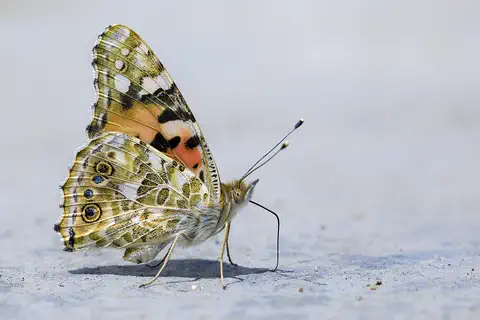
Painted lady
The painted lady is one of the most widespread butterflies in the world. Its orange and black wings carry it on huge journeys: each year, families of painted ladies fly between Africa and northern Europe, one generation after another.
-
 Watch
3D
Animal
Monarch butterfly
The monarch butterfly is famous for its bright orange wings and its amazing journey. Each fall, monarchs from eastern North America fly up to 3,000 miles to mountain forests in Mexico, where they spend the winter clustered together on fir trees. Their caterpillars eat only milkweed, which makes them taste bad to predators.
-
 Watch
3D
Animal
Luna moth
The luna moth is a large green moth of the forests of eastern North America. Its long, twisting wing tails may help it escape hungry bats. Grown-up luna moths have no working mouth, so they live only about a week, just long enough to find a mate and lay eggs.
-
Watch
Country
United States
The United States is a large country in North America made of 50 states, from icy Alaska to the warm islands of Hawaii. It has the Grand Canyon, the Mississippi River and Yellowstone, and about 342 million people live there.
-
Watch
Country
Canada
Canada is the second-largest country in the world, stretching across the north of North America from the Atlantic to the Pacific and up into the Arctic. It has the Rocky Mountains, thousands of islands and about 42 million people, who speak English, French and many other languages.
-
 Watch
3D
Animal
Old World swallowtail
The Old World swallowtail is a large butterfly with yellow wings, black veins, blue spots and a red eyespot near the long tails on its hindwings. It lives across Europe and Asia and in northern North America. Its green and black caterpillar has a hidden orange fork that pops out when it is bothered.
-
 Watch
Animal
American lobster
The American lobster is a big crustacean that lives on the rocky sea floor of the northwest Atlantic Ocean. It has two very different claws, one for crushing and one for tearing, and it must climb out of its hard shell again and again to grow.
-
 Watch
3D
Animal
Antarctic krill
Antarctic krill are small, shrimp-like crustaceans about 6 centimeters long that live in the icy Southern Ocean around Antarctica. They gather in enormous swarms, and almost all the bigger animals of the Antarctic, from penguins to blue whales, depend on them for food.
For parents & teachers
What children will learn
- Describe how the tiger swallowtail caterpillar's disguises change as it grows.
- Explain mimicry using the dark female and the pipevine swallowtail.
- Name the four stages of complete metamorphosis.
- Explain why butterflies bask in the sun before flying.
Recommended ages: 3 to 17 · About 15 minutes
Talk about it
- Why might looking like a bird dropping keep a caterpillar safe?
- Why would dark females be more common where pipevine swallowtails live?
- Which trees and flowers near your home might help tiger swallowtails?
Try at home or in class
- Draw a tiger swallowtail at real size: mark 9 centimeters across for the wings, then add four stripes on each front wing and tails on the back wings.
- On a sunny morning, watch butterflies in a garden and note which ones sit with their wings spread in the sun.
Key vocabulary: mimicry, osmeterium, eyespot, basking, puddling, chrysalis
Where these facts come from
- GBIF Backbone Taxonomy and GBIF Occurrence Search , Global Biodiversity Information Facility (CC0 1.0 (backbone); occurrence counts are facts derived from records under CC0, CC BY and CC BY-NC)
- Wikidata , Wikimedia Foundation (CC0 1.0)
- Tiger Swallowtail, Eastern Tiger Swallowtail, Papilio glaucus (EENY-61) , University of Florida, IFAS Extension (Featured Creatures)
- Eastern Tiger Swallowtail, Papilio glaucus , Butterflies and Moths of North America
- Out My Backdoor: For This Butterfly, Beauty Is Fragile and Short-lived , Georgia Department of Natural Resources, Wildlife Resources Division
- Monarch biology , Monarch Watch, University of Kansas
- Eastern Tiger Swallowtail (Bug's Eye View, Vol. 6, No. 1) , Mississippi State University Extension
- Wikimedia Commons , Wikimedia Foundation (Per file: Public domain, CC0, CC BY or CC BY-SA only (credited on each page))
Checked, not yet human-reviewed. Last updated October 27, 2026. Spotted a mistake? Tell us.