
Animal
European rabbit
The European rabbit has long ears, a fluffy white tail and strong back legs. It lives with other rabbits in tunnels under the ground.
The European rabbit is the wild rabbit that all pet and farm rabbits come from. It lives in groups in big underground tunnel homes called warrens. Its numbers have fallen in its first home in Spain, Portugal and France, but people have carried it to many other places, where it became a pest.
Oryctolagus cuniculus is native to the Iberian Peninsula and southern France and is the ancestor of every domestic rabbit breed. Introduced by people across Europe, Australia, New Zealand, South America and elsewhere, it became a serious agricultural and ecological pest in many of those places, while in its native range it has declined enough to be listed as Endangered.
Photo: JJ Harrison, CC BY-SA 3.0, via Wikimedia Commons
Meet the European rabbit
This is a European rabbit.
It has long ears and big eyes. Its fur is brown and gray, and its tail is white underneath. Every pet rabbit comes from this wild rabbit.
The European rabbit is a small, gray-brown mammal with long ears, large eyes and a short tail that is white underneath. A wild adult is about 38 to 50 centimeters long and weighs about 1.5 to 2.5 kilograms, about as much as a bag of sugar or two.
This is the rabbit that people tamed long ago. Every breed of pet and farm rabbit, from tiny dwarfs to giant lop-eared rabbits, is descended from it. Rabbits are not rodents: they belong to a separate group called lagomorphs, together with hares and pikas.
Oryctolagus cuniculus is the only species in its genus and belongs to the order Lagomorpha, with hares and pikas, not to the rodents. Wild adults measure about 38 to 50 centimeters and weigh about 1.5 to 2.5 kilograms; the coat is grizzled gray-brown with a paler belly, and the underside of the tail is white.
It is the ancestor of all domestic rabbits, roughly 80 recognized varieties according to Animal Diversity Web. Genome comparisons between domestic rabbits and wild rabbits in France suggest the two became isolated between about 17,700 and 12,200 years ago, so the popular story of a single medieval domestication is not supported.
Quick facts
- Group
- Mammal
- Length
- 0.38 to 0.5 m
- Weight
- 1.5 to 2.5 kg
- Lifespan in the wild
- up to 7 years
Where it lives
Wild rabbits first lived in Spain, Portugal and France.
People took rabbits to many other places. Now they live in lots of countries. They like grassy fields with soft ground for digging.
The European rabbit's original home is the Iberian Peninsula, where Spain and Portugal are, plus parts of France. It likes dry, open places near shrubs, with soft, sandy soil that is easy to dig.
Over many centuries people carried rabbits to new places for meat, fur and sport. Today wild rabbits live across much of Europe and in Australia, New Zealand, Chile, southern Africa and elsewhere. In parts of Europe they even live in city parks, cemeteries and gardens.
The IUCN's global assessment lists the species as native only to Portugal, Spain and France. Animal Diversity Web notes that the last ice age confined it to the Iberian Peninsula and small areas of France and northwest Africa, but the IUCN treats the rabbits living in Morocco and Algeria today as introduced. It prefers dry, low-lying areas with soft soil for burrowing and shrubby cover, though it ranges from sea level to about 3,000 meters.
Introductions by people mean that wild European rabbits now live on every continent except Asia and Antarctica. The IUCN lists introduced populations in about thirty countries, including the United Kingdom, Ireland, much of central and northern Europe, Morocco, Algeria, South Africa, Namibia, Chile, the United States, Australia and New Zealand.
Continents

Where can you find this animal?
- Brought here by people · Countries and seas named by a scientific source
- Lives here naturally · Countries and seas named by a scientific source
- Sightings recorded · Records of wild sightings (GBIF)
Brought here by people · Countries and seas named by a scientific source
Released by people over many centuries. Wild rabbits now live across much of Europe and in North Africa, southern Africa, Chile, the United States, Australia and New Zealand, often as a serious pest. They live in only part of many countries shown.
Places: Albania, Algeria, Australia, Austria, Belgium, Bulgaria, Chile, Croatia and 21 more places.
Source: iucn-red-list · checked October 2026
Lives here naturally · Countries and seas named by a scientific source
Native to the Iberian Peninsula (Spain and Portugal) and France, in dry, open country with shrubs and soft soil for burrowing.
Places: Spain, Portugal and France.
Source: iucn-red-list · checked October 2026
Sightings recorded · Records of wild sightings (GBIF)
Counts of GBIF records of wild observations (human and machine) and preserved specimens. Records include introduced populations, vagrants, escaped or released animals and misidentifications, so a country with records is not necessarily part of the native range.
Wild sightings have been recorded in UK, France, Netherlands, Belgium, Australia, Spain, Chile, Germany and 93 more places.
Source: gbif · checked October 2026
Range maps show where scientists say an animal lives, often country by country. An animal may live in only part of a country shown, and sightings records can include animals that wandered far from home.
What it eats
Rabbits eat plants.
They munch grass, leaves, roots and bark. In gardens they nibble lettuce and cabbage. They come out to eat in the evening.
European rabbits are herbivores. They eat grasses, leaves, buds, roots and tree bark, and in farms and gardens they help themselves to lettuce, cabbage, root vegetables and grain.
Grass is hard to digest, so rabbits have a clever trick. Part of their gut holds bacteria that break down tough plant material. The rabbit passes soft droppings full of these nutrients and eats them, so the food goes through its body twice and it gets the most out of every meal.
The diet is broad: grasses and other herbs, leaves, buds, bark, roots and crops. Much of this food is low in nutrients and high in fiber.
Rabbits have a very large caecum, a pouch of the gut where bacteria ferment otherwise indigestible material. Periodically its contents are passed as soft droppings and swallowed again, a behavior called coprophagy. On this second pass the rabbit absorbs nutrients released or made by the bacteria, and it appears to depend on them. Their grazing pressure is high: New Zealand's Department of Conservation estimates that 7 to 10 rabbits eat as much as one ewe.
Did you know?
Every pet rabbit comes from the wild European rabbit.
All breeds of pet and farm rabbit, about 80 varieties, are descended from the European rabbit.
Oryctolagus cuniculus is the sole ancestor of all domestic rabbit breeds, around 80 recognized varieties.
Ears, eyes and strong legs
Rabbits have long ears to hear danger.
Their eyes are on the sides of the head. That helps them see all around. Strong back legs help them hop and run fast.
A rabbit's long ears turn to catch the smallest sounds, warning it of foxes, cats or hawks. Its big eyes sit on the sides of its head, so it can watch almost all around while it eats.
Long, powerful back legs make rabbits quick, zigzagging runners. Compared with hares, their close relatives, European rabbits have shorter ears and less powerful legs. When chased, a rabbit does not try to outrun the predator: it dodges and zigzags to confuse it and dashes for cover. When danger is near, a rabbit thumps its back feet on the ground to warn others.
Lagomorph features include long ears (Britannica gives up to about 6 centimeters for rabbits generally), large laterally placed eyes for wide vision, and long hind limbs with a strengthened pelvic girdle for fast, agile running.
Compared with hares, European rabbits have smaller ears and shorter, less powerful legs. Britannica describes the escape of a chased rabbit as quick, irregular movement meant to evade and confuse a pursuer rather than outdistance it. Rabbits communicate through scent and touch and drum their hind feet on the ground as an alarm.
Growing up
Baby rabbits are called kittens.
They are born in a cozy nest with no fur, and their eyes are closed. Mom feeds them rich milk. Soon they hop out to explore.
A mother rabbit is pregnant for about a month and usually has a litter of five or six babies, called kittens. They are born in a nest in a burrow, with no fur and with their eyes shut.
The mother visits only for a few minutes each day, but her milk is very rich, and the kittens grow fast. They stop drinking milk at about four weeks and can have babies of their own at around eight months. Very few wild rabbits live past their first year, but a lucky one can reach about seven.
Gestation is about 29 to 30 days, and litters average five to six young but range from one to fourteen. Females come into breeding condition again right after giving birth and ovulate in response to mating, so several litters a year are possible; New Zealand's Department of Conservation notes that does can be pregnant for about 70 percent of a year.
Newborns, called kittens, are naked, blind and helpless. The mother nurses for only a few minutes a day with very rich milk; young are weaned at about four weeks and mature at about eight months. In wild populations, more than 90 percent often die in their first year.
Life in the warren
Rabbits dig tunnels under the ground.
Many rabbits live together in these tunnels. They rest inside in the day. They come out in the evening to eat grass.
European rabbits dig the biggest burrow systems of any rabbit. These tunnel networks, called warrens, have many entrances and rooms. A colony usually has about six to ten adults, and a big warren can hold up to about 20 rabbits.
Rabbits spend the day underground and come out from evening until morning to feed. Each colony has a pecking order, which means the top male gets the first chance to mate and fewer fights break out. If a rabbit spots danger, it thumps the ground and everyone races for the holes.
European rabbits build the most extensive burrow systems of any rabbit species and are the most social rabbit, with warrens holding groups of up to about 20. A typical colony has six to ten adults of both sexes with distinct dominance hierarchies, which reduce costly fights between males over females.
Social organization is flexible: in some habitats the main unit is a territorial breeding pair. Home ranges are usually small, often just one or two acres, and males range about twice as widely as females. Activity is mainly nocturnal and crepuscular, with foraging from evening until morning.
Did you know?
A rabbit thumps its feet to warn its friends.
When a rabbit senses danger, it drums its back feet on the ground to warn the rest of the colony.
Hind-foot drumming is an alarm signal that carries through the ground to other members of the warren.
Endangered at home, a pest abroad
In Spain, Portugal and France there are fewer rabbits than before.
In other places, there are too many. Rabbits eat the plants that farm animals and wild animals need.
The European rabbit has a strange story. In its first home in Spain, Portugal and France, its numbers have dropped because of diseases, changes to the land and other threats, and the IUCN lists it as Endangered.
But where people released it, rabbits often spread out of control. Wild rabbits were released in Australia in 1859, and within about 60 years they had spread across the southern half of the continent, eating crops and harming native plants and animals. New Zealand and other countries also spend a lot of money controlling rabbits.
In its native range the species is listed as Endangered (IUCN assessment, 2018), with a decreasing population. Threats recorded in the assessment include introduced diseases, habitat change from agriculture, livestock farming and plantations, hunting, fire and climate change.
Elsewhere it is a textbook invasive species. Wild rabbits released in Australia in 1859 spread up to about 350 kilometers a year and occupied the southern half of the continent within 60 years, causing declines and even extinctions of native species. Myxomatosis, introduced there in the early 1950s, at first killed about 99 percent of rabbits, but resistance and weaker virus strains followed. In New Zealand, introducing stoats and ferrets to control rabbits proved disastrous for native birds.
IUCN Red List
How is the european rabbit doing in the wild?
- Least Concern
- Near Threatened
- Vulnerable
- Endangered (this animal)
- Critically Endangered
- Extinct in the Wild
- Extinct
Endangered
At very high risk of disappearing from the wild.
See the IUCN Red List assessment · The IUCN Red List of Threatened Species 2022.2
Amazing facts
-
Every pet rabbit comes from the wild European rabbit.
All breeds of pet and farm rabbit, about 80 varieties, are descended from the European rabbit.
Oryctolagus cuniculus is the sole ancestor of all domestic rabbit breeds, around 80 recognized varieties.
-
Rabbits eat some of their own droppings.
Rabbits eat their soft droppings so that their food passes through twice and they get more goodness from it.
Caecal contents are passed as soft pellets and reingested, letting the rabbit absorb nutrients released or made by gut bacteria.
-
A rabbit thumps its feet to warn its friends.
When a rabbit senses danger, it drums its back feet on the ground to warn the rest of the colony.
Hind-foot drumming is an alarm signal that carries through the ground to other members of the warren.
-
Rabbits are not rodents.
Rabbits are not rodents. They belong to a group called lagomorphs, with hares and pikas.
Rabbits, hares and pikas make up the order Lagomorpha, a group separate from the rodents.
Words to know
- warren
- a network of rabbit tunnels and rooms under the ground
- kitten
- a baby rabbit
- herbivore
- an animal that eats only plants
- introduced species
- a living thing that people have taken to a place where it did not live before
- invasive
- an introduced species that spreads and causes harm
- lagomorph
- the group of mammals made up of rabbits, hares and pikas
Discovery challenge
-
What is a rabbit's tunnel home called?
What is a European rabbit colony's burrow system called?
What is distinctive about the European rabbit's burrows?
- A nest in a tree
- A warren
- A hive
Show the answer
A warren
Rabbits live in tunnels called a warren.
A warren is a big network of tunnels where a colony of rabbits lives.
European rabbits build the most extensive burrow systems, warrens, of any rabbit species.
-
Where did wild European rabbits first live?
Where is the European rabbit's native home?
Which describes the species' native range?
- Australia
- Spain, Portugal and France
- Antarctica
Show the answer
Spain, Portugal and France
They first lived in Spain, Portugal and France.
Their native home is the Iberian Peninsula and France; people took them to Australia later.
The IUCN lists it as native only to Spain, Portugal and France; elsewhere, including Australia, it was introduced.
-
What are baby rabbits like when they are born?
What are newborn rabbits like?
Which describes European rabbit young at birth?
- Furry and hopping
- No fur and eyes closed
- Covered in feathers
Show the answer
No fur and eyes closed
Baby rabbits have no fur, and their eyes are closed.
Newborn kittens are naked, blind and helpless, and stay in a nest.
The young are altricial: naked, blind and helpless, nursed briefly each day with very rich milk.
-
Why are there too many rabbits in Australia?
Why did rabbits become a big problem in Australia?
How did European rabbits come to live in Australia?
- People released them and they spread fast
- They swam there from Spain
- They were always there
Show the answer
People released them and they spread fast
People let rabbits go there, and they made lots of babies.
Rabbits were released in 1859, bred quickly and spread across the southern half of the continent.
Wild rabbits were released in 1859 and spread up to about 350 kilometers a year. They are an introduced population; the species' Endangered status reflects declines in its native range, where disease and habitat change are among the threats.
Places where you might see it
Experiments to try
- Watch What If? Lab What if an invasive species entered an ecosystem? An invasive species is a living thing that ends up somewhere it doesn't naturally live and causes harm there. In this thought experiment, follow two real stories from Australia: cane toads, brought to eat beetles in sugar cane fields in 1935, and rabbits, which probably spread mostly from 24 brought in 1859. Then find out how people try to keep ecosystems in balance.
- Watch Try it What If? Lab What if rabbits had more babies? Rabbits are famous for having lots of babies. So if every rabbit in a meadow had babies twice as fast, you would expect a meadow full of rabbits. In our rabbit and fox model, something surprising happens instead: the extra rabbits mostly end up feeding more foxes.
- Watch Try it What If? Lab What if there were no predators? In a meadow, rabbits have babies and foxes hunt them, so both numbers rise and fall in turns. Take every fox away in our model and watch what the rabbits do, then find out what happened in a real park when its wolves were taken away and brought back.
Explore next
-
 Watch
Animal
Red fox
The red fox is a small, clever member of the dog family with an orange coat, black legs and a bushy, white-tipped tail. It lives across North America, Europe, Asia and North Africa, more of the world than any other wild land carnivore, and has even moved into big cities.
-
 Watch
3D
Animal
Stoat
The stoat is a small, slender hunter with a long body, short legs and a black-tipped tail. It lives across the northern parts of Europe, Asia and North America, and in snowy places some stoats turn white in winter.
-
 Watch
Animal
Eurasian eagle-owl
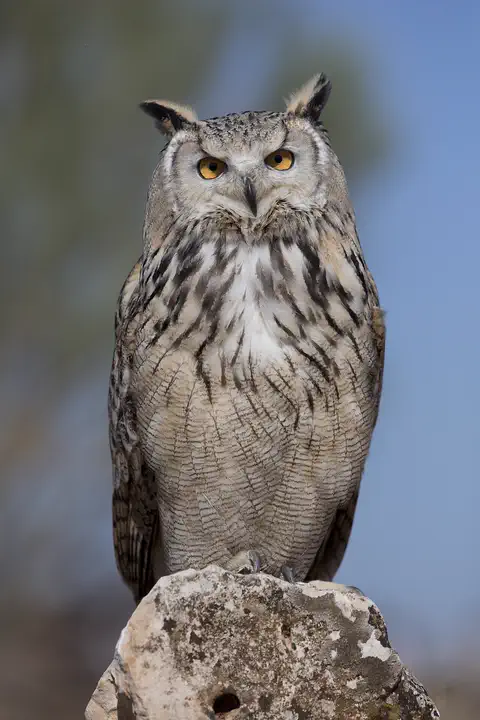
The Eurasian eagle-owl is one of the biggest owls in the world, with wings up to about 2 meters across, big orange eyes and two tall ear tufts. It lives across Europe and Asia, nests on rocky ledges and flies silently at night to catch rats, voles, hares and birds.
- Watch What If? Lab What if an invasive species entered an ecosystem? An invasive species is a living thing that ends up somewhere it doesn't naturally live and causes harm there. In this thought experiment, follow two real stories from Australia: cane toads, brought to eat beetles in sugar cane fields in 1935, and rabbits, which probably spread mostly from 24 brought in 1859. Then find out how people try to keep ecosystems in balance.
-
 Watch
Animal
Guinea pig
The guinea pig is not a pig and does not come from Guinea. It is a rodent, first tamed thousands of years ago by people in the Andes mountains of South America. Today it is a popular pet around the world, and in parts of Peru, Ecuador and Bolivia it is still raised for food.
-
 Watch
 Country
Portugal
Portugal is a country on the Atlantic coast of the Iberian Peninsula in southwestern Europe, with Spain as its only land neighbor. It also includes the Azores and Madeira islands far out in the ocean. About 11.4 million people lived there at the start of 2026, and its capital is Lisbon, on the Tagus River.
-
 Watch
Animal
Dingo
The dingo is Australia's wild dog and the country's largest meat-eating mammal. People brought its ancestors to Australia about 4,000 years ago. It hunts rabbits, kangaroos and wallabies, howls rather than barks, and scientists still argue about whether it is its own species or a very old kind of dog.
- Watch Try it What If? Lab What if rabbits had more babies? Rabbits are famous for having lots of babies. So if every rabbit in a meadow had babies twice as fast, you would expect a meadow full of rabbits. In our rabbit and fox model, something surprising happens instead: the extra rabbits mostly end up feeding more foxes.
For parents & teachers
What children will learn
- Describe how a rabbit's ears, eyes and legs help it notice and escape danger.
- Explain how rabbits live in colonies in warrens.
- Explain how a species can be endangered in its native range and invasive elsewhere.
- Describe what happened when rabbits were introduced to Australia and New Zealand.
Recommended ages: 3 to 17 · About 15 minutes
Talk about it
- Why might an animal spread so fast in a new place with few predators?
- Should people try to help rabbits in Spain while controlling them in Australia? Why?
- What could go wrong when people bring in one animal to control another?
Try at home or in class
- Hold your hands beside your eyes and notice how much of the room you can still see; then compare with a rabbit's eyes on the sides of its head.
- Draw a warren on a big sheet of paper with tunnels, rooms and several entrances, and mark where the rabbits would sleep and where they would watch for danger.
Key vocabulary: warren, kitten, herbivore, introduced species, invasive, lagomorph
Where these facts come from
- The IUCN Red List of Threatened Species , International Union for Conservation of Nature (IUCN terms of use (no redistribution of Red List data or range maps))
- GBIF Backbone Taxonomy and GBIF Occurrence Search , Global Biodiversity Information Facility (CC0 1.0 (backbone); occurrence counts are facts derived from records under CC0, CC BY and CC BY-NC)
- Wikidata , Wikimedia Foundation (CC0 1.0)
- Oryctolagus cuniculus (European Rabbit), Red List assessment 2018 , IUCN Red List of Threatened Species
- Oryctolagus cuniculus (European rabbit) , Animal Diversity Web, University of Michigan Museum of Zoology
- Rabbit , Encyclopaedia Britannica
- Rabbits: animal pests , New Zealand Department of Conservation
- Wikimedia Commons , Wikimedia Foundation (Per file: Public domain, CC0, CC BY or CC BY-SA only (credited on each page))
Checked, not yet human-reviewed. Last updated October 28, 2026. Spotted a mistake? Tell us.