
Animal
Peregrine falcon
The peregrine falcon is the fastest animal in the world. It dives down from high in the sky to catch other birds in the air.
The peregrine falcon is a crow-sized bird of prey famous for its hunting dive, called a stoop. Diving from high above, it can reach about 320 kilometers per hour, making it the fastest animal on Earth. It lives on every continent except Antarctica, even in big cities.
Falco peregrinus is one of the world's most widespread birds and the fastest animal known, reaching about 320 km/h in a hunting stoop; in a 1999 experiment a trained falcon was reportedly clocked at about 389 km/h. DDT nearly wiped it out of eastern North America, and its recovery is a conservation landmark.
Photo: Carlos Delgado, CC BY-SA 4.0, via Wikimedia Commons
Meet the peregrine falcon
The peregrine falcon is a fast, strong bird.
It has blue-gray wings and a dark head. It has a dark mark under each eye, like a mustache. It catches other birds while they fly.
The peregrine falcon is a bird of prey about the size of a crow. Adults are blue-gray above with barred, pale undersides and a dark head with thick dark 'sideburns' under the eyes. Young birds are browner, with streaks instead of bars.
Peregrines are built for speed, with long, pointed wings. In ordinary flight they travel at about 40 to 55 kilometers per hour, and they chase prey at up to about 112. But their real fame comes from the dive called a stoop, the fastest movement of any animal.
Falco peregrinus is a large falcon (family Falconidae). Adults measure about 36 to 49 centimeters, weigh about 530 to 1,600 grams and have a wingspan of about 1 to 1.1 meters. The plumage is steel blue-gray above with barred underparts and a dark hood and malar stripe, though it varies with age and region; Arctic birds are paler.
Cornell's All About Birds gives cruising speeds of 40 to 55 kilometers per hour and pursuit speeds up to 112. Despite looking like small hawks, falcons belong to their own family and order, the Falconidae and Falconiformes.
Quick facts
- Group
- Bird
- Length
- 0.36 to 0.49 m
- Wingspan
- 1 to 1.1 m
- Weight
- 0.53 to 1.6 kg
- Top speed
- up to 320 km/h
Where it lives
Peregrine falcons live almost everywhere in the world.
They live on cliffs, by the sea and in the mountains. Some live in big cities, on tall buildings and bridges.
The peregrine falcon is one of the most widespread birds in the world. It lives on every continent except Antarctica and on many ocean islands, from Arctic tundra to deserts, coasts and mountains.
Peregrines need two things: a high ledge to nest on and plenty of birds to hunt. Cliffs are their natural homes, but tall buildings and bridges work just as well, so many cities now have peregrines. Birds that nest in the far north fly long distances in autumn, many all the way to South America.
The IUCN 2021 global assessment lists native populations in more than 160 countries and territories on every continent except Antarctica, as residents, breeders, wintering birds or passage migrants; it is a vagrant in places such as Iceland. Habitats span tundra to desert mountains and coasts, wherever open hunting ground meets high nest sites.
Audubon notes that numbers are limited by nest sites and prey, which explains the move into cities, where building ledges and abundant pigeons provide both. Northern breeders are long-distance migrants, while populations on the northwest coast of North America and in many temperate regions are resident.
Continents


Where can you find this animal?
- Lives here naturally · Countries and seas named by a scientific source
- Sightings recorded · Records of wild sightings (GBIF)
Lives here naturally · Countries and seas named by a scientific source
Found on every continent except Antarctica, on cliffs, coasts, mountains, tundra, deserts and city buildings. Some countries host peregrines only in winter or on migration, and falcons live in only part of many countries shown.
Places: Afghanistan, Albania, Algeria, Angola, Azerbaijan, Argentina, Australia, Austria and 160 more places.
Source: iucn-red-list · checked October 2026
Sightings recorded · Records of wild sightings (GBIF)
Counts of GBIF records of wild observations (human and machine) and preserved specimens. Records include introduced populations, vagrants, escaped or released animals and misidentifications, so a country with records is not necessarily part of the native range.
Wild sightings have been recorded in United States, Sweden, Netherlands, Canada, Denmark, France, UK, Spain and 164 more places.
Source: gbif · checked October 2026
Range maps show where scientists say an animal lives, often country by country. An animal may live in only part of a country shown, and sightings records can include animals that wandered far from home.
What it eats
Peregrine falcons eat other birds.
They catch them in the air. In cities they often catch pigeons. By the sea they catch ducks and shorebirds.
Peregrine falcons eat mostly birds, which they catch in midair. In cities they are expert pigeon hunters. Along coasts they take ducks and shorebirds, and they can catch birds as small as songbirds or as large as geese and gulls.
A peregrine climbs high above its prey, sometimes more than a kilometer, then folds its wings and drops in a steep dive. It strikes the bird with its feet. Big prey may be knocked out of the air, and the falcon eats it where it lands.
The diet is mostly birds taken in flight: pigeons in cities, ducks and shorebirds on coasts, with prey ranging from songbirds to loons, geese and large gulls. The classic attack is the stoop, begun from heights that can exceed 1 kilometer, in which the falcon folds its wings and accelerates toward prey below.
Pursuit in level flight reaches about 112 kilometers per hour. Because it eats other birds, the peregrine was badly exposed to persistent pesticides such as DDT, which harmed bird-eating and fish-eating raptors far more than mammal hunters such as the golden eagle.
Did you know?
People have trained falcons for a very long time.
People have trained falcons for hunting for more than a thousand years, and their skills later helped save the peregrine.
Falconers' captive-handling methods were essential to the breeding and release programs that restored peregrine populations after DDT.
Built for the fastest dive
A peregrine's wings are long and pointy.
When it dives, it tucks its wings in close. Its sharp eyes see birds far away. Its strong feet grab its food.
A peregrine falcon has long, pointed, swept-back wings and a strong, compact body, perfect for speed. In a dive it pulls its wings in tight so it slices through the air like a dart.
Its hooked bill tears food, and its feet have sharp talons for striking and holding prey. Young peregrines are browner and streaked, and they get the blue-gray adult colors as they grow up.
Long, tapered, swept wings and a dense, streamlined body suit both fast pursuit and the stoop, in which the wings are pulled close to reduce drag. Guinness World Records estimates terminal velocity in a stoop at about 320 kilometers per hour in ideal conditions.
Prey is struck with the feet. Plumage varies considerably with age and geography: juveniles are heavily streaked rather than barred, and Arctic birds are paler, yet the overall steely, barred look remains.
Growing up
Peregrines do not build a nest.
They lay their eggs in a little scrape on a high ledge. Dad brings food while Mom keeps the eggs warm. The chicks fly at about six weeks old.
Peregrine falcons do not build nests. The female lays two to five eggs in a simple scrape on a cliff ledge, a building or a bridge. Pairs may stay together for life.
The female does most of the incubating for about 29 to 32 days, while the male brings her food. When the chicks hatch, the male hunts for the whole family, and later the female hunts too. The young make their first flights at about 39 to 49 days old.
No nest is built: two to five eggs are laid in a scrape on a ledge, occasionally in a tree hollow or an old stick nest of another bird, or on the ground on a hilltop. Pairs may mate for life and defend the area around the nest while hunting over a much larger range.
Incubation, mostly by the female, lasts about 29 to 32 days, with the male provisioning her. After hatching he feeds the female and young; later she hunts as well. Young first fly at about 39 to 49 days. Cornell reports a banded wild peregrine that lived at least 19 years and 9 months.

The stoop
A peregrine flies very high.
Then it folds its wings and dives down, faster than any other animal. Zoom! That dive is called a stoop.
The stoop is one of the most amazing sights in nature. A peregrine rises high above its prey, folds its wings and plunges. Guinness World Records estimates it can reach about 320 kilometers per hour in ideal conditions.
The fastest dive ever reported was made in 1999 by a trained peregrine named Frightful. Her falconer, Ken Franklin, released her from an airplane and measured her speed with a small altimeter-computer on her tail: about 389 kilometers per hour. That was an experiment, not an everyday hunting dive.
Guinness World Records lists the peregrine as the fastest-diving bird, estimating a stoop terminal velocity of about 320 kilometers per hour. Experimental dives suggest more: in 1999 the trained falcon Frightful, flown by falconer Ken Franklin, was reportedly clocked at about 389 kilometers per hour (242 mph).
That figure came from a 113-gram altimeter-computer attached to her tail feathers, which measured how far she fell over a time interval while Franklin and a cameraman skydived alongside. Guinness says the falcon was 'reportedly' clocked at this speed, and some ornithologists doubt that the dives, started far higher than wild peregrines usually dive from, recreated natural conditions. It is an experimental figure, not a typical hunting speed.
Did you know?
Peregrines live in many big cities.
Peregrines nest on skyscrapers and bridges, and in cities they mostly hunt pigeons.
Limited mainly by nest sites and prey, peregrines have colonized cities, where building ledges and pigeons supply both.
From the brink to the city skyline
Long ago, a harmful chemical made peregrines very rare.
People stopped using it. They raised young falcons and set them free. Now peregrines live in many cities!
In the middle of the 1900s, the pesticide DDT nearly wiped out peregrine falcons in eastern North America. Pesticides like DDT thinned the eggshells of many birds of prey, so their eggs failed.
After DDT was restricted, people bred peregrines in captivity and released them, using skills that falconers had developed over centuries. The falcons made an incredible comeback, and today they nest on skyscrapers and bridges in many cities. The IUCN lists them as Least Concern, with numbers rising.
Peregrines were virtually eradicated from eastern North America in the mid-20th century by DDT and other persistent pesticides, which thinned the eggshells of many birds of prey and caused breeding failure.
Recovery combined restrictions on these chemicals with captive breeding and release, helped by handling methods developed by falconers. Peregrines have been reintroduced across many temperate parts of North America, Arctic populations have partly recovered, and the 2021 IUCN global assessment lists the species as Least Concern with an increasing population.
IUCN Red List
How is the peregrine falcon doing in the wild?
- Least Concern (this animal)
- Near Threatened
- Vulnerable
- Endangered
- Critically Endangered
- Extinct in the Wild
- Extinct
Least Concern
Not at risk of disappearing from the wild right now.
See the IUCN Red List assessment · The IUCN Red List of Threatened Species 2021.3
Amazing facts
-
A peregrine falcon wore a tiny computer to measure its dive.
In 1999 a trained peregrine named Frightful wore a small altimeter-computer on her tail, which recorded a dive of about 389 kilometers per hour.
Frightful's reported 1999 dive of about 389 km/h was measured with a 113-gram skydiving altimeter-computer fastened to her tail feathers.
-
Peregrines live in many big cities.
Peregrines nest on skyscrapers and bridges, and in cities they mostly hunt pigeons.
Limited mainly by nest sites and prey, peregrines have colonized cities, where building ledges and pigeons supply both.
-
Peregrines do not build nests.
Instead of building a nest, a peregrine lays its eggs in a simple scrape on a ledge.
Eggs are laid in a scrape, occasionally in an old stick nest of another large bird or in a tree hollow.
-
People have trained falcons for a very long time.
People have trained falcons for hunting for more than a thousand years, and their skills later helped save the peregrine.
Falconers' captive-handling methods were essential to the breeding and release programs that restored peregrine populations after DDT.
Words to know
- stoop
- a falcon's steep, very fast hunting dive
- bird of prey
- a bird that hunts animals using sharp claws and a hooked beak
- talons
- the sharp, curved claws of a bird of prey
- scrape
- a shallow hollow on the ground or a ledge where some birds lay eggs
- pesticide
- a chemical used to kill insects or other pests
- falconer
- a person who trains falcons and other birds of prey
Discovery challenge
-
What is special about the peregrine falcon?
What is a peregrine falcon's hunting dive called?
What is the best estimate of a peregrine's stoop speed in ideal conditions?
- It is the fastest animal
- It is the slowest bird
- It cannot fly
Show the answer
It is the fastest animal
The peregrine is the fastest animal in the world.
Its dive is called a stoop, and it can reach about 320 kilometers per hour.
Guinness World Records estimates about 320 km/h; in a 1999 experiment a trained falcon was reportedly clocked at about 389 km/h.
-
What do peregrine falcons eat?
What do peregrines mostly catch?
Why were peregrines so badly affected by DDT?
- Other birds
- Leaves
- Fish only
Show the answer
Other birds
They catch other birds in the air.
Mostly birds, such as pigeons in cities and ducks and shorebirds by the sea.
As bird-eaters near the top of food chains, they accumulated DDT, which thinned their eggshells.
-
Where do peregrines lay their eggs?
What kind of nest does a peregrine make?
Which describes the peregrine's nest site?
- In a scrape on a high ledge
- In a big woven nest
- Underwater
Show the answer
In a scrape on a high ledge
They lay eggs on a high ledge, with no nest.
No nest at all: just a scrape on a cliff, building or bridge ledge.
A simple scrape on a ledge, occasionally a tree hollow, an old stick nest or a hilltop on the ground.
-
Where can you find peregrine falcons?
On how many continents do peregrines live?
Which describes the peregrine's range?
- Every continent except Antarctica
- Only in Australia
- Only in Antarctica
Show the answer
Every continent except Antarctica
Almost everywhere, except icy Antarctica.
On every continent except Antarctica, and on many islands.
Native in more than 160 countries and territories; one of the most widespread birds in the world.
Explore next
-
 Watch
Animal
Golden eagle
The golden eagle is one of the largest and fastest birds of prey in North America, and it lives across much of the Northern Hemisphere. It soars over mountains and open country on wings more than two meters wide and dives at tremendous speed to catch rabbits, hares and ground squirrels.
-
 Watch
3D
Animal
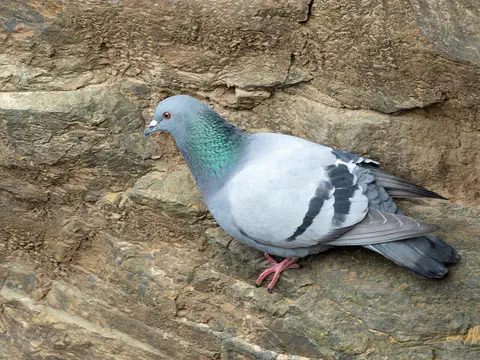
Rock pigeon
The rock pigeon, also called the rock dove, is the pigeon you see in city squares. Its wild ancestors nest on sea cliffs and mountain ledges, and city pigeons use buildings as if they were cliffs. Pigeons are famous for finding their way home from far away.
-
 Watch
3D
Animal
Red-tailed hawk
The red-tailed hawk is probably the most common hawk in North America. It soars in wide circles over fields or waits on a pole or fence post, watching for voles, mice and rabbits, then drops down to catch them with its sharp talons.
-
 Watch
3D
Animal
Southern crested caracara
The southern crested caracara is a large bird of prey from South America and a surprising member of the falcon family. It has a black crest, a bare orange-red face and long yellow legs, and it eats almost anything: dead animals, small creatures and insects.
-
 Watch
Animal
Adélie penguin
The Adélie penguin is a medium-sized penguin, about 70 centimeters tall, with a black back, a white front and a bright white ring around each eye. It breeds in summer on rocky, ice-free ground all around Antarctica, building nests of pebbles, and spends the winter far out at sea among the pack ice.
-
 Watch
Animal
African fish eagle
The African fish eagle is a big eagle of Africa's lakes, rivers and coasts, with a white head, chest and tail and a chestnut-brown body. It snatches fish from the surface of the water, and its loud, ringing call is one of the best-known sounds of Africa.
-
 Watch
Animal
African penguin
The African penguin is a penguin of warm, sunny coasts. It lives only in South Africa and Namibia, nests in burrows and under bushes, and hunts sardines and anchovies in the cold sea. Its numbers have fallen so far that it is now Critically Endangered, and people are working hard to protect it.
-
 Watch
Animal
American crow
The American crow is an all-black bird found across much of North America, from fields and beaches to city centers. It eats almost anything, lives in close family groups, gathers in huge winter roosts, and a University of Washington study found that wild crows can recognize and remember a human face.
For parents & teachers
What children will learn
- Describe how a peregrine's body suits fast flight and diving.
- Distinguish an estimated hunting speed from an experimental record, and explain how the 1999 dive was measured.
- Describe the peregrine's nest site and life cycle.
- Explain how DDT harmed peregrines and how people helped them recover.
Recommended ages: 3 to 17 · About 15 minutes
Talk about it
- Why is a measured record different from a typical speed?
- Why might a falcon choose a skyscraper instead of a cliff?
- How can a chemical sprayed on crops end up harming a falcon that never eats crops?
Try at home or in class
- Drop two identical sheets of paper, one flat and one crumpled into a tight ball, and see which falls faster; talk about how tucking in its wings helps a falcon dive.
- Use a map of your town or city to spot tall buildings or bridges where a peregrine might nest.
Key vocabulary: stoop, bird of prey, talons, scrape, pesticide, falconer
Where these facts come from
- The IUCN Red List of Threatened Species , International Union for Conservation of Nature (IUCN terms of use (no redistribution of Red List data or range maps))
- GBIF Backbone Taxonomy and GBIF Occurrence Search , Global Biodiversity Information Facility (CC0 1.0 (backbone); occurrence counts are facts derived from records under CC0, CC BY and CC BY-NC)
- Wikidata , Wikimedia Foundation (CC0 1.0)
- Falco peregrinus (Peregrine Falcon), Red List assessment 2021 , IUCN Red List of Threatened Species
- Peregrine Falcon overview , Cornell Lab of Ornithology, All About Birds
- Peregrine Falcon identification , Cornell Lab of Ornithology, All About Birds
- Peregrine Falcon , National Audubon Society, Guide to North American Birds
- Golden Eagle Overview , All About Birds, Cornell Lab of Ornithology
- Fastest bird (diving) , Guinness World Records
- Peregrine falcon , Encyclopaedia Britannica
- Wikimedia Commons , Wikimedia Foundation (Per file: Public domain, CC0, CC BY or CC BY-SA only (credited on each page))
Checked, not yet human-reviewed. Last updated October 28, 2026. Spotted a mistake? Tell us.