
Animal
White-tailed deer
The white-tailed deer is a shy deer with big ears. When it runs, it lifts its tail like a white flag.
White-tailed deer live in forests, fields and even towns from Canada down to South America. They are named for the white underside of the tail, which they hold up like a flag when they run. Males grow new antlers every year.
Odocoileus virginianus is a New World deer whose range runs from the Arctic Circle in western Canada to about 18 degrees south in Peru and Bolivia. Once reduced by unrestricted hunting, it was restored by game management in the 20th century and is now so abundant in places that it damages forests and crops.
Photo: Hillebrand Steve, U.S. Fish and Wildlife Service, public domain, via Wikimedia Commons
Meet the white-tailed deer
The white-tailed deer is a shy, quick deer.
It has big ears and a white throat. Under its tail the fur is white. When the deer runs, it lifts its tail up high, like a little white flag.
The white-tailed deer gets its name from the long white hairs under its tail and rump. When it runs away, it holds its tail up high and the white hair flares out, like a flag waving goodbye.
Its coat is bright reddish in summer and duller grayish brown in winter, with white on the belly, throat and around the eyes. Only the males, called bucks, grow antlers. The animal in our photo is a doe, a female, so she has none.
Odocoileus virginianus belongs to the family Cervidae and to the New World deer, which keep small remnants of the second and fifth hand bones that Old World deer have almost entirely lost. Britannica calls it the oldest living deer species: it predates the Ice Ages but became abundant only after the last glaciation, when many large American predators went extinct.
The white tail is a signal. In flight the long hairs on the underside of the tail and rump flare and the tail is held aloft. Size varies hugely across the range: large males reach 106 centimeters at the shoulder and 180 kilograms, while the Key deer of Florida stands 76 centimeters and weighs 23 kilograms.
Quick facts
- Group
- Mammal
- Length
- 1.6 to 2.2 m
- Height
- 0.8 to 1 m
- Weight
- 57 to 137 kg
- Top speed
- up to 48 km/h
- Lifespan in the wild
- 2 to 3 years
Where it lives
White-tailed deer live in North America and South America.
They live in woods, fields and swamps. Some even visit gardens in towns.
White-tailed deer live across most of southern Canada and the United States, through Mexico and Central America, and into northern South America as far as Peru and Bolivia.
They can live almost anywhere with good food and cover: big northern forests, Florida swamps, farmland, brushy fields and even dry thornbrush in southern Texas and Mexico. The best deer homes have thick bushes to hide in and open edges where tasty plants grow.
Britannica describes a range from the Arctic Circle in western Canada to 18 degrees south of the Equator in Peru and Bolivia. The IUCN lists the species as native from Canada and the United States through Mexico and Central America to Colombia, Venezuela, the Guianas, Ecuador, Peru and Brazil, from sea level up to 4,500 meters.
Habitat use is broad: forest, savanna, shrubland, grassland and swamp, plus farmland and suburbs. Animal Diversity Web notes that ideal habitat combines dense thickets for cover with edges that supply food. People have also released white-tailed deer outside the Americas: the IUCN lists introduced populations in Finland, the Czech Republic, Slovakia and New Zealand, shown on the map as a separate layer.
Continents
Its habitats


Where can you find this animal?
- Brought here by people · Countries and seas named by a scientific source
- Lives here naturally · Countries and seas named by a scientific source
- Sightings recorded · Records of wild sightings (GBIF)
Brought here by people · Countries and seas named by a scientific source
Populations released by people in Finland, the Czech Republic, Slovakia and New Zealand.
Places: Finland, Czechia, Slovakia and New Zealand.
Source: iucn-red-list · checked October 2026
Lives here naturally · Countries and seas named by a scientific source
Forests, swamps, farmland and brushy country from southern Canada through the United States, Mexico and Central America into northern South America. The deer live in only part of some countries shown.
Places: Canada, United States, Mexico, Belize, Guatemala, El Salvador, Honduras, Nicaragua and 9 more places.
Source: iucn-red-list · checked October 2026
Sightings recorded · Records of wild sightings (GBIF)
Counts of GBIF records of wild observations (human and machine) and preserved specimens. Records include introduced populations, vagrants, escaped or released animals and misidentifications, so a country with records is not necessarily part of the native range.
Wild sightings have been recorded in United States, Canada, Mexico, Finland, Colombia, Ecuador, Costa Rica, Panama and 32 more places.
Source: gbif · checked October 2026
Range maps show where scientists say an animal lives, often country by country. An animal may live in only part of a country shown, and sightings records can include animals that wandered far from home.
What it eats
Deer eat plants.
They nibble leaves, twigs, buds, fruit and nuts. They eat most in the early morning and in the evening.
White-tailed deer are herbivores, which means they eat only plants. In eastern forests they nibble the buds and twigs of maple, aspen, poplar and birch trees and many shrubs. In deserts they eat tough plants like yucca and prickly pear cactus. In winter, when food is scarce, they eat cone-bearing evergreen trees.
They also munch leaves, fruit, nuts, lichens and mushrooms. Deer feed mostly around dawn and dusk, which is called being crepuscular.
Deer are selective herbivores. Britannica explains that they prefer young, protein-rich and low-fiber foods such as tender herbs, buds, shoots and fruit, and that they need high-quality food to support antler growth, which demands minerals, protein and energy. White-tailed deer eat leaves, twigs, fruits, nuts, lichens and fungi, and readily turn to orchards and crops.
The diet follows the habitat: maple, sassafras, poplar, aspen and birch browse in eastern forests; huajillo, yucca and prickly pear in southern deserts; conifers in hard winters. Feeding is crepuscular, from before dawn until a few hours after, then from late afternoon to dusk. Where deer are very abundant, their browsing changes which plants grow in a forest, and in severe winters they can kill many trees by stripping bark.
Did you know?
The smallest white-tailed deer live in Florida.
The Key deer of Florida is a tiny kind of white-tailed deer: about 76 centimeters tall at the shoulder and 23 kilograms.
Body size varies more than appearance: the Key deer of Florida reaches 76 centimeters and 23 kilograms, while large northern males reach 106 centimeters and 180 kilograms.
Ears, nose and antlers
Deer have big ears that turn to listen. They have good eyes, too.
Their best sense is smell. A deer sniffs the air to find out if danger is near.
White-tailed deer have good eyesight and sharp hearing, but they depend most on their sense of smell to notice danger. They also make their own smells: scent glands between the two halves of each hoof and on the hind legs leave messages for other deer.
Each year a buck grows a new set of antlers that curve forward. He sheds them in late winter, and new ones start growing in spring, covered in soft, fuzzy skin called velvet. By late summer the velvet comes off.
Animal Diversity Web reports good vision and acute hearing, with smell the main sense for detecting danger. Chemical communication is important: interdigital glands lie between the two parts of each hoof, metatarsal glands on the outside of each hind leg and larger tarsal glands on the inside of the hock, and their secretions grow stronger in the rut.
Antlers are grown only by males. They are shed from January to March, regrow from April or May under velvet, and are cleaned of velvet in August or September; the forward-curving beams carry unbranched tines. Body and antler size are largest in cold temperate climates and on rich agricultural soils, and smallest in the tropics, deserts and small islands.
Spotted fawns
A baby deer is called a fawn.
It has white spots on its coat. The fawn lies very still in the grass while its mother looks for food.
Deer mate in late fall, and the fawns are born in spring, about six and a half months later. A young mother usually has one fawn; after that, twins are common. A newborn fawn weighs only about 1.5 to 2.5 kilograms and is covered in white spots.
Fawns can walk right away, but they mostly hide. The mother leaves her fawn lying flat in thick plants for about four hours while she feeds. At about four weeks old it starts following her, and by its first winter its spots are gone.
Mating runs from October to December, and gestation averages about 200 days (Animal Diversity Web gives 198 days, Britannica 202 and Grzimek's encyclopedia 205). In the tropics breeding may happen year-round. A first-time mother usually has one fawn, later two, occasionally three or four, each weighing 1.5 to 2.5 kilograms.
Fawns are precocial: they walk at birth and nibble plants within days, yet spend their first weeks hidden, lying flat with necks outstretched while the doe feeds for about four hours at a time. They follow her from about four weeks, are weaned at 8 to 10 weeks and lose their spots by the first winter. Young males leave after about a year; young females often stay two years. Most wild deer live only 2 to 3 years, though the wild maximum is 20.

Quiet, quick and careful
Deer are shy and careful.
If a deer is scared, it snorts and runs away fast. It can jump and swim, too. In snowy winters, many deer stay together.
White-tailed deer are nervous, careful animals. When something startles them they snort or whistle and bound away through thick forest at up to about 48 kilometers an hour. They are good swimmers too, and cross streams and lakes to escape.
In summer most deer live alone or as a mother with her fawns. In winter many gather in big groups. In deep snow they trample down paths in one area, called a deer yard, and stay close to home instead of traveling far.
Animal Diversity Web describes white-tailed deer as the most nervous and shy of North American deer. They bound through tangled forest at up to 30 miles (about 48 kilometers) per hour, swim well, and usually keep small home ranges, often a square kilometer or less. They reuse the same paths while foraging. They do not migrate to a winter range; in deep snow they gather in trampled areas called deer yards.
The basic social unit is a doe and her fawns, but winter herds can be large. During the autumn rut bucks do not keep harems; they compete one-on-one, clashing antlers for access to a female. Deer are not very vocal: fawns bleat, and disturbed adults whistle or snort. Predators include wolves, pumas, bears, jaguars and coyotes.
Did you know?
A baby deer lies so still that it is hard to see.
A hiding fawn lies flat with its neck stretched out on the ground. Its spotted coat blends with the forest floor.
Hidden fawns lie flat with necks outstretched, camouflaged against the forest floor, while the doe forages for about four hours at a time.
Too few, then too many
Long ago, people hunted too many deer.
Then people made rules to protect them. Now there are lots of white-tailed deer again.
More than a hundred years ago, so much hunting went on that white-tailed deer disappeared from many places. Then people made hunting rules and protected the deer, and by the middle of the 1900s they were common again. Today the IUCN lists them as Least Concern.
Now some places have too many deer. They eat garden plants, crops and young trees, they cross roads where cars can hit them, and they carry the ticks that spread Lyme disease to people.
The IUCN assesses the white-tailed deer as Least Concern with a stable population trend (assessed in 2015). Animal Diversity Web calls it the most numerous of the large North American mammals. Unrestricted hunting once greatly reduced its range and numbers, but by the mid-20th century game management had restored it across North America; Animal Diversity Web adds that cutting mature forests created more of the brushy growth deer feed on.
Britannica notes that where deer are protected from predators and from adequate hunting, overabundance leads to severe damage to forestry and agriculture, many collisions with vehicles and more transmissible disease such as Lyme disease; Animal Diversity Web explains that deer host the ticks that carry the bacteria behind Lyme disease. Deer also carry parasites that have harmed woodland caribou, moose and elk.
IUCN Red List
How is the white-tailed deer doing in the wild?
- Least Concern (this animal)
- Near Threatened
- Vulnerable
- Endangered
- Critically Endangered
- Extinct in the Wild
- Extinct
Least Concern
Not at risk of disappearing from the wild right now.
See the IUCN Red List assessment · The IUCN Red List of Threatened Species 2022.2
Amazing facts
-
A deer can swim across a lake.
White-tailed deer are good swimmers and often cross streams and lakes to escape danger or reach islands.
White-tailed deer swim well and enter large streams and lakes to escape predators or biting insects, or to visit islands.
-
The smallest white-tailed deer live in Florida.
The Key deer of Florida is a tiny kind of white-tailed deer: about 76 centimeters tall at the shoulder and 23 kilograms.
Body size varies more than appearance: the Key deer of Florida reaches 76 centimeters and 23 kilograms, while large northern males reach 106 centimeters and 180 kilograms.
-
A baby deer lies so still that it is hard to see.
A hiding fawn lies flat with its neck stretched out on the ground. Its spotted coat blends with the forest floor.
Hidden fawns lie flat with necks outstretched, camouflaged against the forest floor, while the doe forages for about four hours at a time.
-
Deer leave smell messages with their feet.
White-tailed deer have scent glands between the two halves of each hoof, so their footsteps leave smelly messages for other deer.
Interdigital glands on all four feet, plus metatarsal and tarsal glands on the hind legs, are used for chemical communication between deer.
Words to know
- fawn
- a baby deer
- buck
- a male deer
- doe
- a female deer
- antlers
- branching bones that grow from a male deer's head and fall off each year
- velvet
- soft, fuzzy skin that covers growing antlers
- crepuscular
- most active around dawn and dusk
Discovery challenge
-
What does a deer do with its tail when it runs?
What does a white-tailed deer do with its tail when it runs away?
How does a fleeing white-tailed deer use its tail?
- Lifts it up like a white flag
- Wraps it around a branch
- Drags it along the ground
Show the answer
Lifts it up like a white flag
The deer lifts its tail. The white fur shows, like a flag.
It holds its tail up high, and the long white hairs underneath flare out like a waving flag.
The long white hairs of the tail and rump flare and the tail is held aloft, a visual signal during flight.
-
What is a baby deer called?
What is a baby white-tailed deer called?
What is the name for a young white-tailed deer, which hides while its mother feeds?
- A fawn
- A cub
- A chick
Show the answer
A fawn
A baby deer is a fawn. It has white spots.
A fawn. It has white spots and hides in thick plants while its mother eats.
A fawn: precocial and able to walk at birth, yet hidden for its first weeks while the doe forages.
-
Which deer grow antlers?
Which white-tailed deer grow antlers?
In white-tailed deer, which animals grow a new set of antlers each year?
- Only the males
- Only the females
- Only the babies
Show the answer
Only the males
Only boy deer, called bucks, grow antlers.
Only bucks grow antlers. They lose them in late winter and grow new ones in spring.
Only males: antlers are shed from January to March and regrow from April or May under velvet.
-
What does a deer use most to notice danger?
Which sense do white-tailed deer depend on most to notice danger?
According to Animal Diversity Web, which sense do white-tailed deer rely on most to detect danger?
- Smell
- Taste
- Touch
Show the answer
Smell
Deer sniff the air. Smell is their best warning.
They have good eyes and ears, but smell is the sense they depend on most.
Vision and hearing are good, but smell is the main sense for detecting predators.
Places where you might see it
-
 Watch
 Country
United States
The United States is a large country in North America made of 50 states, from icy Alaska to the warm islands of Hawaii. It has the Grand Canyon, the Mississippi River and Yellowstone, and about 342 million people live there.
-
 Watch
 Country
Canada
Canada is the second-largest country in the world, stretching across the north of North America from the Atlantic to the Pacific and up into the Arctic. It has the Rocky Mountains, thousands of islands and about 42 million people, who speak English, French and many other languages.
Experiments to try
- Watch Try it What If? Lab What if a habitat lost its water supply? Water makes plants grow, and plants feed animals. In our model, a dry spell cuts the plant food from 50 tonnes a year to 20, so the land can feed far fewer deer. Watch the herd shrink to fit, then find out how drought affects real wildlife and how people help.
- Watch Try it What If? Lab What if animal populations grew beyond available food? Land can only feed so many animals. In our model, a herd of deer grows until it nears that number. But what if the deer react to crowding late? Watch the herd shoot past what the food can feed, then fall back, and meet real herds that did the same.
Explore next
-
 Watch
Animal
Moose
The moose is the largest member of the deer family. It lives in northern forests, wades and even dives into lakes to eat water plants, and bull moose grow enormous new antlers every year. In Europe it is called an elk.
-
 Watch
Animal
Red deer
The red deer is one of the largest deer in the world. It lives in forests, hills and moors across Europe and into western Asia and North Africa. Males, called stags, grow huge branching antlers every year and roar to win mates in autumn.
-
 Watch
3D
Animal
Reindeer
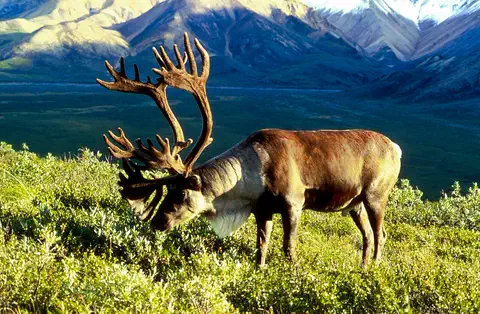
Reindeer, called caribou in North America, are deer of the Arctic tundra and northern forests. They are the only deer in which females grow antlers too. Some herds walk thousands of kilometers a year, and people in northern Europe and Asia have herded reindeer for a very long time.
-
Watch
Country
United States
The United States is a large country in North America made of 50 states, from icy Alaska to the warm islands of Hawaii. It has the Grand Canyon, the Mississippi River and Yellowstone, and about 342 million people live there.
-
Watch
Country
Canada
Canada is the second-largest country in the world, stretching across the north of North America from the Atlantic to the Pacific and up into the Arctic. It has the Rocky Mountains, thousands of islands and about 42 million people, who speak English, French and many other languages.
-
 Watch
3D
Animal
Puma
The puma, also called the cougar or mountain lion, is a big, slender cat with plain tan fur and a long tail. It lives in more of the Americas than any other wild cat, from Canada all the way to the southern tip of South America, in mountains, forests, deserts and swamps.
-
 Watch
3D
Animal
Gray wolf
The gray wolf is the largest member of the dog family and the wild ancestor of pet dogs. Wolves live in family packs that hunt big animals like elk and moose together, and their howls can carry about 10 kilometers. After being wiped out in many places, wolves are coming back in parts of North America and Europe.
-
 Watch
3D
Animal
Eastern box turtle
The eastern box turtle is a small land turtle of eastern North America with a high, domed shell splashed with yellow and orange. A hinge on the bottom shell lets it close up almost completely, like a box with a lid. It eats mushrooms, berries, worms and slugs and can live for decades.
For parents & teachers
What children will learn
- Describe how a white-tailed deer's senses, tail signal and speed help it avoid predators.
- Explain the yearly antler cycle and the deer's life cycle from hidden fawn to adult.
- Explain how hunting rules brought deer back, and why too many deer can cause problems.
Recommended ages: 3 to 17 · About 15 minutes
Talk about it
- Why might a white tail held high be a useful signal for other deer?
- Why do you think a fawn hides instead of running with its mother?
- What are fair ways for people to share towns and farms with lots of deer?
Try at home or in class
- Go on a quiet walk at the edge of a park or wood near dusk and look for deer tracks: two pointed halves side by side.
- Play a still-as-a-fawn game: lie flat and see who can stay still and quiet the longest.
Key vocabulary: fawn, buck, doe, antlers, velvet, crepuscular
Where these facts come from
- The IUCN Red List of Threatened Species , International Union for Conservation of Nature (IUCN terms of use (no redistribution of Red List data or range maps))
- GBIF Backbone Taxonomy and GBIF Occurrence Search , Global Biodiversity Information Facility (CC0 1.0 (backbone); occurrence counts are facts derived from records under CC0, CC BY and CC BY-NC)
- Odocoileus virginianus (white-tailed deer) , Animal Diversity Web, University of Michigan
- White-tailed deer , Encyclopaedia Britannica
- Odocoileus virginianus (global assessment) , IUCN Red List
- Wikidata , Wikimedia Foundation (CC0 1.0)
- Wikimedia Commons , Wikimedia Foundation (Per file: Public domain, CC0, CC BY or CC BY-SA only (credited on each page))
Checked, not yet human-reviewed. Last updated October 24, 2026. Spotted a mistake? Tell us.