
City Africa
Kinshasa
Kinshasa is a very big city in Africa. It sits beside the wide Congo River. It is the capital of the Democratic Republic of the Congo.
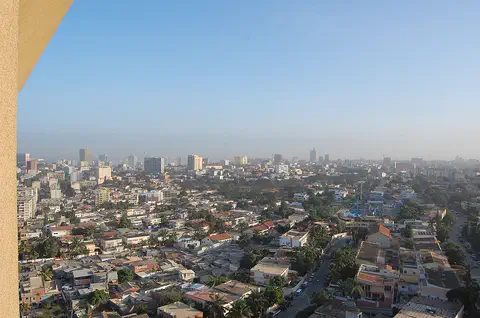
Kinshasa is the capital and largest city of the Democratic Republic of the Congo. It stands on the south bank of the Congo River, about 515 kilometers from the Atlantic Ocean, facing the city of Brazzaville across the water. It grew from fishing and trading villages and was called Léopoldville until 1966.
Kinshasa, capital and largest city of the Democratic Republic of the Congo, lies on the south bank of the Congo River about 515 km from the Atlantic, beside Pool Malebo and opposite Brazzaville. It grew from the villages of Nshasa and Ntamo into a colonial river port, Léopoldville, linked to the sea by rail in 1898. No census has been taken since 1984; the national statistics institute projected about 14.6 million people for the city-province in 2020.
Photo: Rahul Tilak, CC BY-SA 4.0, via Wikimedia Commons
Discover Kinshasa
Kinshasa is a very big city in the middle of Africa. Millions of people live there.
It sits beside the Congo River. The river is very wide here.
Kinshasa is the capital of the Democratic Republic of the Congo (DR Congo). It stands on the south bank of the Congo River, about 515 kilometers (320 miles) from the Atlantic Ocean. The people of the city are called Kinois.
Nobody knows exactly how many people live here, because the last census was taken in 1984. That census counted about 2.7 million people. The country's national statistics institute projected about 14.6 million for 2020. Encyclopaedia Universalis calls Kinshasa one of the largest cities in sub-Saharan Africa.
Kinshasa is the capital and largest city of the Democratic Republic of the Congo. Encyclopaedia Universalis describes it as a special political unit that counts as a region of the country, with its own governor; the city-province covers 9,965 km². Its residents are known locally as Kinois.
Counting them is hard. The last census, on 1 July 1984, recorded 2,664,309 people in the city-province. The Institut National de la Statistique has since published projections: 8,683,000 for 2010, 11,575,000 for 2015 and 14,565,700 for 2020. City Population, which collects these official figures, warns that all population figures for the country are of low reliability, so the projection is best read as an order of size, not a count.
- Country
- Democratic Republic of the Congo (capital)
- People in the city-province (2020 projection)
- 14,565,700
- People at the last census (1984)
- 2,664,309
- Founded
- 1881, as the trading post Léopoldville
A wide river, a twin city and a home for bonobos
Across the river is another city, called Brazzaville. It is in a different country.
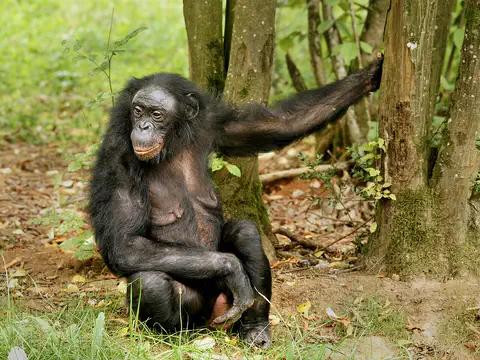
Near Kinshasa, young bonobos with no mothers are cared for. Bonobos are apes, a little like chimpanzees.
Kinshasa stretches along the river beside Pool Malebo, a wide, lake-like part of the Congo River. Right across the water stands Brazzaville, the capital of a different country, the Republic of the Congo.
An hour or so outside the city is Lola ya Bonobo, a sanctuary for orphaned bonobos rescued from the illegal wildlife trade. Caretakers nurse them back to health, and some are later released into a protected forest far away. The University of Kinshasa, founded in 1954, lies south of the city center.
The Gran Enciclopèdia Catalana places Kinshasa along the left bank of the lower Congo, facing Brazzaville and beside Pool Malebo (once called Stanley Pool), a broad widening of the river. Brazzaville is the capital of the neighboring Republic of the Congo, so two capitals face each other across the same stretch of water.
Lola ya Bonobo takes in orphaned bonobos rescued from the illegal wildlife trade and cares for them as long as needed, sometimes for the rest of their lives, according to Friends of Bonobos, the US group that supports it. The sanctuary releases bonobos at the Ekolo ya Bonobo Community Reserve in Équateur Province, about 500 miles away by plane, and has hosted scientists since at least 2005, when researcher Brian Hare first went there to compare bonobos and chimpanzees. Friends of Bonobos calls it the world's only bonobo sanctuary. The University of Kinshasa, founded in 1954, is a center of higher education.
- Across the river
- Brazzaville, capital of the Republic of the Congo
- Lola ya Bonobo
- a sanctuary for orphaned bonobos, an hour or so outside Kinshasa
- University of Kinshasa
- founded in 1954
From two villages to a capital
Long ago, there were two villages by the river. Fishers and traders came there.
The villages grew into a big town, and then a huge city. Now it is the capital.
People have lived along the shores of Pool Malebo for a very long time. The city grew from two villages, Nshasa and Ntamo, visited by fishers and traders. In 1881 the explorer Henry Morton Stanley set up a trading post here and named it Léopoldville, after King Leopold II of Belgium.
The town became important after a railway linked it to the town of Matadi, nearer the sea, in 1898. In 1923 it became the administrative center of the Belgian Congo. In 1960 it became the capital of the newly independent country, and in 1966 it was renamed Kinshasa.
Encyclopaedia Universalis traces the city to two villages, Nshasa and Ntamo (later called Kintamo), controlled by Bahumbu people and visited by Batéké fishers and traders. Henry Morton Stanley arrived in 1877, allied himself with the chief of Kintamo, a wealthy ivory trader, and on his return in 1881 obtained a trading post, which he named Léopoldville after his patron, King Leopold II of the Belgians.
The post only gained importance in 1898, when a railway joined it to Matadi, downstream of the river's falls. An oil pipeline from Matadi followed in 1914, and an air link to Stanleyville (now Kisangani) in 1920; in 1923 the administrative center of the Belgian Congo moved here from Boma. New districts grew near the port in the 1930s, and after 1950 Lemba, Matete and parts of Ndjili were built for workers of the Limete industrial area. In 1960 Léopoldville became the capital of the independent republic, and in 1966 it was renamed Kinshasa. The Gran Enciclopèdia Catalana records 290,277 people in 1955 and more than a million by 1969.
- Henry Morton Stanley sets up a trading post
- 1881, named Léopoldville
- Railway to Matadi reaches the town
- 1898
- Capital of the newly independent country
- 1960; renamed Kinshasa in 1966
Boats, a railway to the sea and an airport
Boats come and go on the river at Kinshasa. Long ago, a railway was built from the city toward the sea.
Kinshasa also has an international airport for planes.
Kinshasa is an important river port. Below the city, the Congo River drops over falls, so a railway and a road were built around them to link the city with the sea. The railway, from the town of Matadi downstream, arrived in 1898. Upstream, Henry Morton Stanley had opened a river route north to the town now called Kisangani.
The city also has an international airport, N'Djili, on its eastern side.
Kinshasa's growth followed its transport links. The Gran Enciclopèdia Catalana calls it a very important river port, and notes that a railway and a road join it to the sea by getting around the stretch of falls downstream. That railway, from Matadi, reached Léopoldville in 1898, and Encyclopaedia Universalis dates the town's rise to its arrival.
Upstream, Stanley had already opened a river route north to Stanleyville (Kisangani since 1966), so goods could move by boat into the interior, then by train to the coast. An air link to Stanleyville followed in 1920. Today the city is served by N'Djili International Airport, on its eastern side.
- River port
- on the Congo River, upstream of the falls
- Railway to Matadi
- reached Léopoldville in 1898
- Airport
- N'Djili International Airport, east of the center
Warm all year, with a dry season
Kinshasa is warm all year long. Even its coolest month is warm.
In the middle of the year, almost no rain falls. Then the rain comes back.
Kinshasa is warm in every month. Averages from the Japan Meteorological Agency for 1991 to 2020 give a monthly average temperature between about 23.5 °C in July and about 27 °C in March.
The year has a long rainy season and a short dry one. From June to August, each month gets less than 15 millimeters of rain. November and December are the wettest months, with about 274 millimeters each, and a whole year brings about 1,726 millimeters.
The Japan Meteorological Agency's 1991–2020 normals for the Kinshasa station (309 m) show little change in temperature through the year: monthly means run from 23.5 °C in July to 26.9 °C in March, and every month from October to May averages between 25.9 °C and 26.9 °C.
Rainfall is strongly seasonal. The monthly averages add up to about 1,726 mm. June (14.6 mm), July (4.5 mm) and August (8.7 mm) are almost dry; September brings 49.3 mm and October 136.4 mm as the rains return. The wettest months are November (273.6 mm) and December (274.3 mm), with a second peak in April (248.9 mm). The normals give average temperatures only, not daily highs and lows.
- Warmest month, average temperature (JMA normals, 1991–2020)
- March, 26.9 °C
- Coolest month, average temperature (same period)
- July, 23.5 °C
- Rain in a year (sum of the monthly averages)
- about 1,726 mm
Rumba, Kinois and city life
Rumba is a kind of music and dance. It is played in Kinshasa and other cities of the two Congos.
Two people often dance the rumba together, as a pair.
Congolese rumba is a kind of music and dance found in the cities of both Congos, including Kinshasa. It is usually danced by a couple. In 2021, UNESCO added Congolese rumba to its list of the world's living heritage.
Young people learn rumba in neighborhood clubs, music schools and community groups, where rumba musicians take on apprentices and teach them to play and even to make instruments.
UNESCO inscribed Congolese rumba on its Representative List of the Intangible Cultural Heritage of Humanity in 2021, nominated jointly by the Democratic Republic of the Congo and the Republic of the Congo. UNESCO describes it as a musical genre and dance common in the urban areas of both countries, usually danced by a male-female couple and descended from an older dance called nkumba, meaning 'waist' in Kikongo.
Rumba is played at celebrations and in times of mourning, by professional and amateur orchestras, choirs and solo musicians, and UNESCO notes that women have shaped its religious and romantic styles. It is passed on through neighborhood clubs, training schools and community organizations, where musicians take on apprentices to keep both the playing and the making of instruments alive.
- Congolese rumba
- on UNESCO's Representative List of the Intangible Cultural Heritage of Humanity since 2021
- Shared by
- the Democratic Republic of the Congo and the Republic of the Congo
- People of the city
- called Kinois
Kinshasa on the map
Find Kinshasa on the globe.
It is in Africa, a little south of the Equator. Look for the big Congo River.
Kinshasa is in central Africa, a little south of the Equator, in the far west of the Democratic Republic of the Congo. It lies on the south bank of the Congo River, about 515 kilometers from the Atlantic Ocean.
On the map you can see Brazzaville just across the river, and Pool Malebo, where the river spreads out wide just upstream.
Kinshasa lies at about 4.3° S and 15.3° E, on the south bank of the lower Congo, about 515 km from the Atlantic. Upstream, the river widens into Pool Malebo; downstream of the city it drops through falls, which is why a railway and a road were built overland toward Matadi and the sea.
Brazzaville, capital of the Republic of the Congo, faces Kinshasa across the river. N'Djili International Airport lies east of the center, and the University of Kinshasa and the Lola ya Bonobo sanctuary lie to the south and southwest.
- Latitude
- about 4.3° south
- Longitude
- about 15.3° east
- Distance from the Atlantic Ocean
- about 515 km, along the Congo River
Amazing facts
-
Kinshasa and Brazzaville are two capital cities. Only a river is between them!
Kinshasa faces Brazzaville, the capital of the Republic of the Congo, across the Congo River.
Kinshasa, on the left bank of the lower Congo, faces Brazzaville on the opposite bank, so the capitals of two countries look at each other across the same river.
-
Kinshasa used to have a different name: Léopoldville.
Until 1966, Kinshasa was called Léopoldville, a name Henry Morton Stanley gave his trading post in 1881.
Stanley named his 1881 trading post Léopoldville after King Leopold II of the Belgians; the city was renamed Kinshasa in 1966, the same year Stanleyville became Kisangani.
-
Congolese rumba is often danced by two people.
Congolese rumba, a music and dance of both Congos, joined UNESCO's list of living heritage in 2021.
UNESCO traces Congolese rumba to an older dance called nkumba, meaning 'waist' in Kikongo, and inscribed it on its Representative List in 2021.
-
People who live in Kinshasa are called Kinois.
The people of Kinshasa are known locally as Kinois.
Kinshasa's residents are known locally as Kinois, and Encyclopaedia Universalis notes that the city is a special political unit with its own governor.
Words to know
- capital
- the city where a country's government meets
- river port
- a harbor on a river where boats load and unload people and goods
- falls
- a place where a river drops steeply over rocks
- census
- an official count of all the people in a place
- projection
- a careful estimate of a future number, worked out from earlier counts
- sanctuary
- a safe place where animals that need help are looked after
Discovery challenge
-
Which big river flows past Kinshasa?
Kinshasa stands on the bank of which river?
On which river's south bank, about 515 km from the Atlantic, does Kinshasa stand?
- The Nile
- The Congo
- The Amazon
Show the answer
The Congo
The Congo River! It is very wide here.
The Congo River. Kinshasa is on its south bank.
The Congo; just upstream it widens into Pool Malebo.
-
What was Kinshasa's old name?
What was Kinshasa called until 1966?
What name did Stanley give his 1881 trading post, used until 1966?
- Léopoldville
- Stanleyville
- Boma
Show the answer
Léopoldville
Léopoldville! Now it is Kinshasa.
Léopoldville, after King Leopold II of Belgium.
Léopoldville. Stanleyville was the old name of Kisangani, and Boma was the colony's earlier administrative center.
-
Which city is across the river from Kinshasa?
Which capital city faces Kinshasa across the Congo River?
Which capital, of the Republic of the Congo, stands on the opposite bank from Kinshasa?
- Nairobi
- Cairo
- Brazzaville
Show the answer
Brazzaville
Brazzaville! It is in another country.
Brazzaville, the capital of the Republic of the Congo.
Brazzaville, capital of the Republic of the Congo.
-
Which music and dance is played in Kinshasa?
Which music and dance from the two Congos joined UNESCO's heritage list in 2021?
Which genre, descended from a dance called nkumba, did UNESCO inscribe in 2021?
- Congolese rumba
- Flamenco
- Tango
Show the answer
Congolese rumba
Rumba! Two people often dance it together.
Congolese rumba, usually danced by a couple.
Congolese rumba, nominated jointly by DR Congo and the Republic of the Congo.
-
Which animals are cared for at Lola ya Bonobo?
Which apes are cared for at the Lola ya Bonobo sanctuary near Kinshasa?
Which great ape, rescued from the illegal wildlife trade, is raised at Lola ya Bonobo?
- Gorillas
- Bonobos
- Orangutans
Show the answer
Bonobos
Bonobos! They are apes.
Bonobos, rescued from the illegal wildlife trade.
Bonobos; some are later released at the Ekolo ya Bonobo reserve in Équateur Province.
Nearby places
-
 Watch
City
Brazzaville
Brazzaville, capital of the Republic of the Congo, lies on the Pool Malebo, a lake on the Congo River, facing Kinshasa across the water. It began as a small post in October 1880. The 2023 census counted 2,138,236 people in the commune of Brazzaville (preliminary figures).
-
 Watch
Natural wonder
River Congo
The Congo is Africa's second-longest river, about 4,700 kilometers long. It curves in a giant arc through the rainforests of central Africa and empties into the Atlantic Ocean. Rain falls in its basin all year, so it carries a huge amount of water, and its wild lower rapids are home to about 320 kinds of fish, about 90 of them found nowhere else.
-
 Watch
City
Luanda
Luanda is the capital of Angola, on the Atlantic coast of Africa. It began in 1575 as a Portuguese fort and trading post beside a bay, and it is now Angola's largest city: the 2024 census counted 8,642,051 people there.
-
 Watch
City
Yaoundé
Yaoundé is the capital of Cameroon, in Central Africa. Cameroon's official projection gives the city 3,762,900 people at the start of 2025, the second-most in the country after Douala. It grew from a German military post of the late 19th century, among hills 700 to 1,100 meters high.
-
 Watch
City
São Tomé
São Tomé is the capital of São Tomé and Príncipe, a small country of volcanic islands in the Atlantic Ocean, just north of the equator. The city curves around Ana Chaves Bay. In the 2024 census, 80,647 people were counted in its district, Água Grande.
-
 Watch
City
Douala
Douala is the main port of Cameroon, on the estuary of the Wouri River near the Gulf of Guinea. The encyclopedia Larousse calls it the country's economic capital, a center of trade and industry. Cameroon's 2005 census counted 1,906,962 people in the city.
-
 Watch
Natural wonder
Mount Nyiragongo
Mount Nyiragongo is a steep volcano in the Virunga Mountains of the Democratic Republic of the Congo, near the border with Rwanda and just north of Lake Kivu. It is 3,470 meters high, and its deep summit crater often holds a lake of bubbling lava. Its lava is very runny, and eruptions in 1977, 2002 and 2021 sent lava flowing down its sides toward the city of Goma.
-
 Watch
Natural wonder
Lake Tanganyika
Lake Tanganyika lies in a deep crack in Africa called a rift valley. Britannica calls it the longest freshwater lake in the world, and only Lake Baikal, in Russia, is deeper. Four countries share it: Tanzania, the Democratic Republic of the Congo, Burundi and Zambia. Its water is home to about 250 kinds of cichlid fish found nowhere else.
Explore next
-
 Watch
 Country
Democratic Republic of the Congo
The Democratic Republic of the Congo, or DR Congo, is the second-largest country in Africa. The mighty Congo River curves through its rainforests, volcanoes rise in the east, and its capital, Kinshasa, is a center of music, fashion and popular culture.
-
Watch
Natural wonder
River Congo
The Congo is Africa's second-longest river, about 4,700 kilometers long. It curves in a giant arc through the rainforests of central Africa and empties into the Atlantic Ocean. Rain falls in its basin all year, so it carries a huge amount of water, and its wild lower rapids are home to about 320 kinds of fish, about 90 of them found nowhere else.
-
 Watch
Animal
Bonobo
The bonobo is a great ape that looks a lot like a chimpanzee but is more slender, with a rounder head. It lives only in the rainforests south of the Congo River, in groups where females take the lead and squabbles rarely turn into fights.
-
 Watch
 Country
Republic of the Congo
The Republic of the Congo lies on the equator in west-central Africa. Thick rainforests cover much of it, the mighty Congo River forms its eastern border, and it has a short coast on the Atlantic Ocean. Forest elephants and gorillas live in its parks. About 6.5 million people lived there in 2025, most of them in two cities.
-
 Watch
City
Nairobi
Nairobi, the capital of Kenya, sits high in the highlands of East Africa. It began in the late 1890s as a railway camp beside a Maasai water hole called Enkare Nairobi, "Cold Water." Today it is one of the biggest cities in tropical Africa, with Nairobi National Park, full of wild animals, at its edge.
- Watch Geography Capital cities A capital is the city where a country's government is based. Many capitals grew up over hundreds of years beside rivers and trade routes. A few, like Brasília and Canberra, were built from scratch, and some countries share out their capital's jobs among two or three cities.
-
Watch
City
Luanda
Luanda is the capital of Angola, on the Atlantic coast of Africa. It began in 1575 as a Portuguese fort and trading post beside a bay, and it is now Angola's largest city: the 2024 census counted 8,642,051 people there.
-
 Watch
City
Kigali
Kigali is the capital of Rwanda, a country of many hills in the middle of Africa. Rwanda's 2022 census counted 1,745,555 people in the City of Kigali. When Rwanda became independent in 1962, Kigali was a small town of about 6,000 people.
For parents & teachers
What children will learn
- Locate Kinshasa on the Congo River and name it as the capital of the Democratic Republic of the Congo.
- Explain how a river, its falls and a railway shaped where a city grew.
- Understand why some population figures are projections and not counts.
- Read monthly rainfall averages to describe a wet season and a dry season.
Recommended ages: 3 to 17 · About 15 minutes
Talk about it
- Kinshasa grew where boats had to stop and goods went on by train. What makes a good place for a town?
- Nobody has counted Kinshasa's people since 1984. How could we find out how many people live in a big city?
- Two capitals face each other across one river. What might the people of the two cities share?
Try at home or in class
- River and falls: lay a strip of blue paper across the floor as a river, put a pile of blocks on it as falls, and move toy boats and a toy train to get goods around the falls to the sea.
- Rain chart: draw twelve bars for Kinshasa's rain, from about 274 millimeters in December to under 5 in July, and color the dry months.
- Rumba listening: listen to some Congolese rumba together and clap along to the beat.
Key vocabulary: capital, river port, falls, census, projection, sanctuary
Where these facts come from
- Wikidata , Wikimedia Foundation (CC0 1.0)
- Natural Earth vector data , Natural Earth (NACIS) (Public domain)
- Congo (Dem. Rep.): Provinces, Major Cities and Towns , City Population (Thomas Brinkhoff), from the Institut National de la Statistique
- Kinshasa , Encyclopaedia Universalis
- Kinshasa , Gran Enciclopèdia Catalana (enciclopedia.cat)
- Congolese rumba , UNESCO Intangible Cultural Heritage
- Friends of Bonobos: rescue, sanctuary and rewilding , Friends of Bonobos / Lola ya Bonobo
- FAQ: volunteer, visit, work , Friends of Bonobos
- Lola sanctuary: a hot spot for important bonobo research , Friends of Bonobos
- Climate normals, Kinshasa (station 64210), 1991–2020 , Japan Meteorological Agency
- World normals by region and country (normals period 1991-2020) , Japan Meteorological Agency
- Wikimedia Commons , Wikimedia Foundation (Per file (public domain, CC0, CC BY or CC BY-SA); see each media record)
Checked, not yet human-reviewed. Last updated November 1, 2026. Spotted a mistake? Tell us.