
Landmark Asia
Taipei 101
Taipei 101 is a very tall building in the city of Taipei, Taiwan. It has 101 floors. A giant steel ball inside helps keep it steady in strong wind.
Taipei 101 is a skyscraper in Taipei, Taiwan, 508 meters tall with its spire and 101 stories high. When it opened, it was the tallest building in the world. Inside hangs a 660-ton steel ball, a tuned mass damper, that helps steady the tower in typhoon winds and earthquakes.
Designed by C.Y. Lee & Partners and built from 1999 to 2004, Taipei 101 (508 m, 101 stories) held the title of world's tallest building from its opening until the Burj Khalifa passed it in 2007. Giant concrete-filled steel columns and a 660-metric-ton tuned mass damper help it resist typhoons and earthquakes.
Photo: User:Sinsyuan, CC BY-SA 4.0, via Wikimedia Commons
Discover Taipei 101
Taipei 101 is in Taipei, a big city on the island of Taiwan.
It is a super tall building with 101 floors. It has shops at the bottom and offices higher up. Near the top, visitors can look out over the whole city.
Taipei 101 rises in the Xinyi District of Taipei, a city on the island of Taiwan. It is 508 meters tall, counting the spire on top, and has 101 stories above the ground. When it officially opened, it was the tallest building in the world.
The bottom floors hold a big shopping mall, and most floors above are offices. High up on floors 88 to 91 are observatories, places where visitors can look out across the city and the mountains around it.
Taipei 101, also called the Taipei Financial Center, stands in Taipei's Xinyi District. Britannica describes it as a mixed-use office building and retail center that, at its official opening, was the world's tallest building: 101 stories and 1,667 ft (508 m) including the spire. It passed the Petronas Twin Towers in Kuala Lumpur, and in 2007 it was itself exceeded by the Burj Khalifa in Dubai while that building was still under construction.
The lowest floors hold a luxury shopping mall and most floors above it are offices. The public observatories occupy floors 88 to 91, with an indoor observatory on 89 and an outdoor one on 91 at 392.8 m (1,285 ft), which Britannica says was the highest in the world at the time of completion.
- Height
- 508 m (1,667 ft), including the spire
- Stories
- 101
- Built
- 1999 to 2004
- Architects
- C.Y. Lee & Partners
Racing to the sky
Workers started building Taipei 101 in 1999.
The tower grew and grew. It was finished in 2004. For a few years, it was the tallest building in the whole world!
Building started in 1999. In 2003, workers reached the very top, a moment called "topping out," and the tower was completed in 2004. It was designed by C.Y. Lee & Partners, a firm of architects from Taipei.
Taipei 101 took the title of world's tallest building from the Petronas Twin Towers in Malaysia. It kept the title until 2007, when the Burj Khalifa in Dubai grew taller, even before that building was finished.
Britannica dates the project as follows: construction began in 1999, the structure was topped out in 2003 and work was completed in 2004. The local firm C.Y. Lee & Partners designed it.
At its official opening it surpassed the Petronas Twin Towers as the world's tallest building. In 2007 the Burj Khalifa, then under construction, rose past it. The tower has since been modernized for efficiency: Britannica reports LEED platinum certification in 2011, 2016 and 2021, and a WELL v2 core platinum certification in 2023, making it at that time the first of the world's ten tallest super-tall buildings to hold platinum ratings from both LEED and WELL.
Strong enough for typhoons and earthquakes
Taiwan has strong storms called typhoons, and the ground sometimes shakes.
So Taipei 101 was built very strong. Giant steel columns hold it up. A huge steel ball hangs inside to keep it steady.
Typhoons, huge storms with fierce winds, and earthquakes can shake tall buildings. Taipei 101 was designed to stay strong.
In the middle is a strong core with 16 steel columns, and around the outside stand 8 extra-large steel columns. Up to the 62nd floor, these columns are filled with concrete to make them even stronger. Every eight floors, giant steel braces tie the core to the outer columns.
Near the top hangs a tuned mass damper: a steel ball 5.5 meters wide that weighs 660 tons. When the building sways, the ball swings the other way and calms the movement.
Britannica describes a strong central core of 16 steel columns and eight extra-large perimeter columns, all filled with concrete up to the 62nd floor; every eighth floor, large steel braces connect the core to the outer columns for stability.
The tuned mass damper is a steel sphere of 660 metric tons (728 short tons) suspended between the 87th and 92nd floors. Taiwan News, citing Taipei 101, reports a diameter of 5.5 m, built of 41 circular steel plates each 125 mm thick welded together, and says the sphere can offset the tower's sway from wind gusts and earthquakes by up to 40 percent. Under seismic stress or typhoon-force winds, Britannica explains, the damper's sway tends to counteract the building's own. Its largest recorded movement, 100 cm, came during Typhoon Soudelor on August 8, 2015; the largest from an earthquake, 20 cm, during a magnitude 6.1 quake on April 18, 2019 (reported in 2019).
Eight blocks of eight floors
Look at the tower's shape. It is made of eight big blocks stacked up, one on top of another.
Each block has eight floors. Some people say the tower looks like a tall stalk of bamboo.
Between its wide base and its spire, the biggest part of Taipei 101 is made of eight sections, called modules, with eight floors in each. The number eight is considered a lucky number in Chinese tradition.
The stacked shape reminds many people of a stalk of bamboo or a tall pagoda, a tower with many tiers. Visitors ride up to the indoor observatory on floor 89 and can see the giant damper ball hanging inside the building.
Britannica notes that the largest section, between base and spire, consists of eight modules of eight stories each, eight being an auspicious number in Chinese numerology, and that the tower expresses a distinctively Chinese character in its resemblance to a stalk of bamboo or an elongated pagoda.
The public observatories are on floors 88 to 91: an indoor observatory on 89 and an outdoor observatory on 91 at 392.8 m. A further indoor observatory on the 101st floor, not open to the public, is 438 m (1,437 ft) high. The damper, hanging in the center of the building between floors 87 and 92, can be seen from the public observatory.
- Main tower
- 8 modules of 8 stories each
- Tuned mass damper
- 660 metric tons, 5.5 m across
- Observatories
- Floors 88 to 91
- Outdoor observatory
- 392.8 m up (floor 91)
Taipei 101 today
Today, people work, shop and eat in Taipei 101.
Visitors go up to look at the view. They can also see the giant steel ball inside!
Taipei 101 is no longer the tallest building in the world, but it still towers above the other buildings in central Taipei. Offices fill most of its floors, and its mall is busy with shoppers.
The observatories draw visitors who come to see the city from above and to watch the damper. It has also earned top (platinum) ratings for being a green building and a healthy place to work.
Although it is no longer the world's tallest, Britannica notes that Taipei 101 towers above other major buildings in central Taipei. It remains a working office tower above a luxury mall, with public observatories on floors 88 to 91.
Its sustainability record is part of its story today: platinum LEED certification in 2011, 2016 and 2021 and WELL v2 core platinum in 2023. The damper remains its most famous feature; Taiwan News reported in 2019 that its biggest swing, 100 cm, was caused by Typhoon Soudelor in 2015, while earthquakes had moved it at most 20 cm.
Amazing facts
-
A giant steel ball weighing 660 tons hangs inside the tower.
The damper ball weighs 660 metric tons and hangs between the 87th and 92nd floors. Visitors can see it from the observatory.
The 660-metric-ton (728-short-ton) damper is suspended between floors 87 and 92 in the center of the building and is visible from the public observatory.
-
In a big storm in 2015, the steel ball swung a whole meter.
On August 8, 2015, Typhoon Soudelor's winds swung the damper 100 centimeters, its biggest swing on record by 2019.
Taiwan News (2019) reported the damper's record movement as 100 cm in Typhoon Soudelor (August 8, 2015); the largest from an earthquake was 20 cm, on April 18, 2019.
-
The tower is built in eight blocks of eight floors.
The main part of the tower is eight blocks of eight floors each. Eight is a lucky number in Chinese tradition.
Between base and spire, the tower is eight modules of eight stories, eight being an auspicious number in Chinese numerology.
-
Its columns are filled with concrete to make them extra strong.
The tower's steel columns are filled with concrete up to the 62nd floor to make them stronger.
All 16 core columns and 8 perimeter mega-columns are concrete-filled up to the 62nd floor.
Words to know
- skyscraper
- a very tall building with many floors
- spire
- a thin, pointed top on a tall building
- typhoon
- a huge, powerful storm with very strong winds, in the western Pacific
- tuned mass damper
- a heavy weight that swings against a building's sway to keep it steady
- observatory
- a high place built for looking out at the view
- module
- one of several matching sections that fit together to make something bigger
Discovery challenge
-
How many floors does Taipei 101 have?
How many stories does Taipei 101 have?
How many stories gave Taipei 101 its name?
- 10
- 101
- 1,001
Show the answer
101
101 floors! That is where its name comes from.
It has 101 stories above the ground, and reaches 508 meters with its spire.
101 stories; 508 m (1,667 ft) including the spire.
-
What hangs inside the tower to keep it steady?
What hangs near the top of Taipei 101 to calm its swaying?
Which device suspended between floors 87 and 92 counteracts the building's sway?
- A giant steel ball
- A big bell
- A swimming pool
Show the answer
A giant steel ball
A giant steel ball! It swings to keep the tower steady.
A 660-ton steel ball, the tuned mass damper, swings against the tower's sway.
A 660-metric-ton tuned mass damper sphere, 5.5 m across.
-
Which taller building came after Taipei 101?
Which building passed Taipei 101 as the world's tallest in 2007?
Which building, still under construction, exceeded Taipei 101's height in 2007?
- The Eiffel Tower
- The Burj Khalifa
- Big Ben
Show the answer
The Burj Khalifa
The Burj Khalifa, in Dubai. It is even taller!
In 2007 the Burj Khalifa in Dubai grew taller than Taipei 101, even before it was finished.
The Burj Khalifa in Dubai overtook it in 2007 while being built.
-
How many floors are in each big block of the tower?
The main tower is made of eight blocks. How many floors does each block have?
How many stories make up each of the tower's eight modules?
- Two
- Eight
- Twenty
Show the answer
Eight
Eight floors in each block!
Each of the eight blocks has eight floors. Eight is a lucky number in Chinese tradition.
Eight stories per module, eight modules: a design built on an auspicious number.
Nearby places
-
 Watch
City
Shanghai
Shanghai is China's most populous city, on the coast where the great Yangtze River meets the East China Sea. Once a small fishing village, it grew into one of the world's busiest seaports. About 24.9 million people lived in Shanghai in 2020, and the towers of Pudong rise across the Huangpu River.
-
 Watch
City
Hong Kong
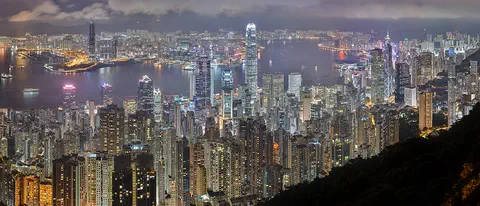
Hong Kong, on the south coast of China, grew around one of the world's great natural harbors. It was a British colony for 156 years and has been a special administrative region of China since 1997. About 7.5 million people lived there in mid-2026.
-
 Watch
Landmark
Three Gorges Dam
The Three Gorges Dam crosses the Yangtze River in central China. It is 2,335 meters long and 185 meters high, and it can make more electricity than any other hydroelectric dam in the world. It also lets big ships travel far up the river, but building it meant that more than a million people had to move.
-
 Watch
City
Seoul
Seoul is the capital of South Korea, on the Han River. It became a capital in 1394, and its old palaces and city gates still stand among skyscrapers. About 9.7 million people lived there in 2020, and its subway is one of the main ways to get around.
-
 Watch
Natural wonder
Ha Long Bay
Ha Long Bay is a bay in northeast Vietnam where more than a thousand limestone islands rise straight out of the sea. Over millions of years, water dissolved the limestone into towers and caves, and then the sea flooded in around them. Together with the nearby Cat Ba Archipelago it is a World Heritage site.
-
 Watch
Landmark
Terracotta Army
In 1974, farmers digging a well near Xi'an, China, found pieces of clay soldiers. Archaeologists uncovered an army of about 8,000 life-size soldiers and horses, made for the tomb of Qin Shi Huang, the first emperor of a united China, who died in 210 BCE. The figures were once brightly painted, and each has its own face.
-
 Watch
Landmark
Forbidden City
The Forbidden City in Beijing was built between 1406 and 1420 as the palace of China's emperors. Over about 500 years, 24 emperors came to the throne there. High walls and a wide moat surround it. Since 1925 it has been the Palace Museum, and it became a World Heritage Site in 1987.
-
Watch
City
Beijing
Beijing, the capital of China, has been the country's capital for most of the last 600 years. At its heart is the Forbidden City, the emperors' palace. About 21.8 million people lived in the Beijing municipality at the end of 2024.
Experiments to try
- Watch What If? Lab What if skyscrapers could not sway? Tall buildings sway a little in strong winds and earthquakes, and some even hang giant weights inside to calm the motion. Imagine a skyscraper that couldn't sway at all, and follow the clues: the push of the wind, giant swinging weights, and bending without breaking.
- Watch Try it What If? Lab What if concrete had no steel inside? Concrete is very good at being squashed but bad at being stretched, and a bent beam is stretched along its bottom. In our model, a 20-meter beam of plain concrete with no steel inside cracks under a 20-tonne truck, and it cannot even hold up its own weight.
Explore next
-
 Watch
 Country
Taiwan
Taiwan is an island in the western Pacific Ocean, about 160 kilometers off the coast of southeastern China. Mountains cover about two-thirds of it, and most of its 23 million people live on the flatter west side. It has its own government, based in Taipei. The People's Republic of China, governed from Beijing, says Taiwan is part of China, and Taiwan's status is disputed.
-
 Watch
Landmark
Burj Khalifa
Burj Khalifa in Dubai, United Arab Emirates, is 828 meters tall, the tallest building in the world (2026). It took about six years to build, from 2004 to 2010. Its Y-shaped plan, inspired by a desert flower, helps it stand up to strong winds.
-
 Watch
Landmark
Petronas Towers
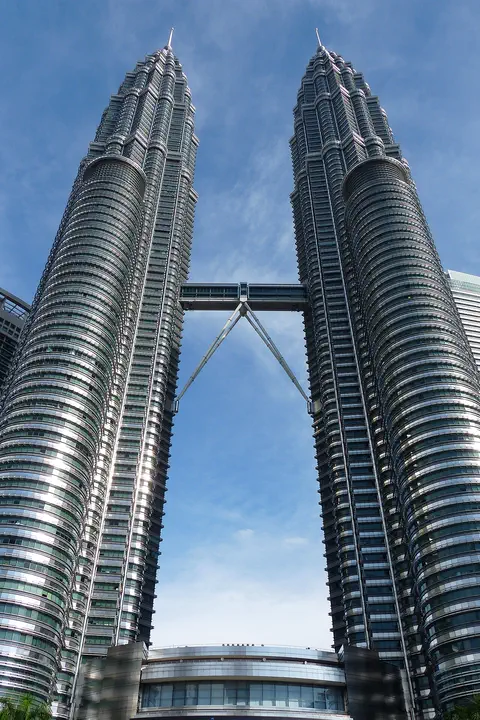
The Petronas Twin Towers in Kuala Lumpur, Malaysia, are two matching skyscrapers 452 meters tall, finished in 1998. Seen from above, each floor is shaped like an eight-pointed star, a pattern from Islamic art. A two-story skybridge joins them 170 meters above the ground, and from 1996 to 2003 they were counted as the tallest buildings in the world.
- Watch What If? Lab What if skyscrapers could not sway? Tall buildings sway a little in strong winds and earthquakes, and some even hang giant weights inside to calm the motion. Imagine a skyscraper that couldn't sway at all, and follow the clues: the push of the wind, giant swinging weights, and bending without breaking.
- Watch Try it What If? Lab What if concrete had no steel inside? Concrete is very good at being squashed but bad at being stretched, and a bent beam is stretched along its bottom. In our model, a 20-meter beam of plain concrete with no steel inside cracks under a 20-tonne truck, and it cannot even hold up its own weight.
-
 Watch
Landmark
Agra Fort
Agra Fort is a huge red sandstone fortress beside the Yamuna River in Agra, India. The Mughal emperor Akbar began it in 1565. Its walls, about 2.5 kilometers around, protect palaces, halls and mosques added by later emperors. It was both an army base and a royal home.
-
 Watch
Landmark
Al-Aqsa Mosque
Al-Aqsa Mosque stands at the southern end of a huge raised plaza in the Old City of Jerusalem. Built in the early 700s, it has a silver-gray dome, and the golden Dome of the Rock stands nearby. The plaza is important to Muslims and to Jews.
-
 Watch
Landmark
Al-Masjid al-Haram
Al-Masjid al-Haram, the Great Mosque of Mecca in Saudi Arabia, was built around the Kaaba, a cube-shaped building that Muslims face when they pray. It is the most important place of pilgrimage in Islam. In 2026, 1,707,301 pilgrims came to Mecca for the hajj, and the mosque can hold up to about one million worshippers.
For parents & teachers
What children will learn
- Locate Taipei and describe Taipei 101's height, floors and uses.
- Explain how strong columns, braces and a tuned mass damper help a tall building resist wind and earthquakes.
- Describe how the tower's design uses eight modules of eight floors.
- Discuss why the title of tallest building keeps changing.
Recommended ages: 3 to 17 · About 15 minutes
Talk about it
- Why do you think a building in a place with typhoons and earthquakes needs special engineering?
- Taipei 101 was the tallest building in the world for only a few years. Why do people keep building taller towers?
- What would you like to see from an observatory 392 meters up?
Try at home or in class
- Hang a heavy washer on a string from the top of a tall paper-straw tower, push the tower gently and watch how the swinging weight changes the sway.
- Stack eight equal blocks of paper cups or LEGO bricks and count the levels, then build a tapered base like the tower's.
Key vocabulary: skyscraper, spire, typhoon, tuned mass damper, observatory, module
Where these facts come from
- Wikidata , Wikimedia Foundation (CC0 1.0)
- Taipei 101 , Encyclopaedia Britannica
- Video shows biggest-ever movement of Taipei 101 damper due to earthquake (April 19, 2019) , Taiwan News
- Wikimedia Commons , Wikimedia Foundation (Per file (public domain, CC0, CC BY or CC BY-SA); see each media record)
Checked, not yet human-reviewed. Last updated October 27, 2026. Spotted a mistake? Tell us.