
Natural wonder Asia
Komodo National Park
Komodo National Park is a group of islands in Indonesia. It is home to Komodo dragons, the biggest lizards in the world. Around the islands, the sea is full of coral, fish, turtles and dolphins.
Komodo National Park, in Indonesia, is a group of rugged, dry islands between Sumbawa and Flores. Its three main islands, Komodo, Rinca and Padar, were made by volcanoes. The park contains most of the places where wild Komodo dragons, the largest living lizards, still live, along with rich coral reefs visited by turtles, dolphins and whales.
Komodo National Park lies in Indonesia's Lesser Sunda Islands, between Sumbawa and Flores, in the volcanic "shatter belt" of Wallacea between the Australian and Sunda ecosystems. Created in 1980 and inscribed by UNESCO in 1991, it covers 219,322 ha of dry savanna islands and productive seas, and contains most of the areas where wild Komodo dragons (Varanus komodoensis) survive; UNESCO estimates their population at about 5,700.
Photo: Charles J. Sharp, CC BY-SA 4.0, via Wikimedia Commons
Discover Komodo National Park
Komodo National Park is in Indonesia.
It has three big islands and many small ones. The hills are dry and grassy. The beaches are white, and the sea is bright blue. Giant lizards called Komodo dragons live here.
Komodo National Park sits in the middle of the Indonesian islands, between the larger islands of Sumbawa and Flores. It is made up of three main islands, Komodo, Rinca and Padar, and many smaller ones, plus the sea around them.
UNESCO calls it one of the most dramatic landscapes in Indonesia. Instead of the thick green forests found in much of the country, Komodo has rugged hills of dry savanna, patches of thorny green plants, white sandy beaches and blue water flowing over coral. Its most famous residents are the Komodo dragons.
UNESCO places the park in the center of the Indonesian archipelago, between Sumbawa and Flores, in East Nusa Tenggara: three major islands (Rinca, Komodo and Padar) and numerous smaller ones, all of volcanic origin, plus extensive marine areas, totaling 219,322 ha. It was inscribed in 1991 under criterion (vii) for its scenery and (x) for biodiversity.
UNESCO stresses the contrast: starkly rugged hillsides of dry savanna, pockets of thorny vegetation, brilliant white beaches and blue waters over coral, an irregular coastline of bays and headlands with sheer cliffs, set against the lush forests most people associate with Indonesia. It calls the surrounding seas among the most productive in the world and the property a global conservation priority area.
- Country
- Indonesia (East Nusa Tenggara)
- Main islands
- Komodo, Rinca and Padar
- Area
- 219,322 ha (land and sea)
- Komodo dragons
- about 5,700 (UNESCO estimate)
- World Heritage Site
- since 1991
Volcanic islands between two worlds
Long ago, volcanoes made these islands.
The islands sit where two big pieces of Earth meet. The weather here is dry, so grass grows on the hills instead of thick forest.
All of Komodo's islands were made by volcanoes. UNESCO explains that they lie where two of Earth's plates meet, in an area scientists call a "shatter belt": a zone of broken, rugged land.
The park is also in a special region called Wallacea, which lies between the plants and animals of Asia and those of Australia, so it has a mix of both. Komodo has a dry climate. That dryness has shaped its plants: open grassy savanna with scattered trees, forests that drop their leaves in the dry season, and on the highest hills, a misty kind of forest.
UNESCO describes the islands as being of volcanic origin, at the juncture of two continental plates, forming the "shatter belt" within the Wallacea biogeographical region between the Australian and Sunda ecosystems. That position explains the rugged topography and the mixture of fauna, which UNESCO calls characteristic of the Wallacean zoogeographic region.
The dry climate has driven specific evolutionary adaptations in the plants, which range from open grass-woodland savanna to tropical deciduous (monsoon) forest and quasi cloud forest. Offshore, coral reefs are diverse and luxuriant thanks to clear water, intense sunlight and the rapid exchange of nutrient-rich water from deeper parts of the archipelago.
Komodo dragons
Komodo dragons are the biggest lizards in the world.
They have rough, scaly skin and long tails. They flick out a yellow forked tongue to smell the air. They can run fast, but only for a short time.
The Komodo dragon is the largest living lizard. UNESCO says adults usually grow 2 to 3 meters long, and the Smithsonian's National Zoo says wild dragons typically weigh about 70 kilograms. They live only on a few Indonesian islands, and this park contains most of the places where wild ones still live. UNESCO estimated about 5,700 in all.
Komodo dragons find food mostly by smell, flicking their yellow forked tongues to sample the air. They eat almost any kind of meat, and deer are their most popular meal. Young dragons eat small lizards and insects until they are big enough to hunt larger animals.
UNESCO calls Varanus komodoensis the largest and heaviest living lizard, averaging 2–3 m, the last representative of a relict population of large lizards that once ranged across Indonesia and Australia; the park contains the majority of the areas where wild populations survive, with about 5,700 animals on Komodo, Rinca and Gili Motang and in parts of western and northern Flores. Smithsonian's National Zoo gives a typical wild weight of about 70 kg and a largest verified specimen of 3.13 m and 166 kg. The species is listed as Endangered on the IUCN Red List.
The dragons hunt mainly by smell, sampling the air with the tongue and Jacobson's organ, and can detect carrion up to about 4 km away. They are ambush predators; deer are the most common prey. Researchers have documented a venom gland in the lower jaw. Hatchlings average about 40 cm, and the young feed on small lizards and insects before moving to larger prey at about five years old (Smithsonian).
Savanna, reefs and whales
Many other animals live in the park.
Deer, monkeys and wild pigs live on the islands. Cockatoos fly in the trees. In the sea, there are colorful corals, turtles, dolphins and even big whales.
On land, the dragons share the islands with Timor deer, crab-eating macaques, a rat found nowhere else and 72 kinds of birds, including the lesser sulphur-crested cockatoo and the orange-footed scrubfowl, which builds big mounds of earth for its eggs.
The sea is just as rich. UNESCO says Komodo's coral reefs are diverse and luxuriant, and strong currents bring dolphins, dugongs and sea turtles. Blue whales and sperm whales have been recorded in the park's waters, along with 10 kinds of dolphins and five kinds of sea turtles.
UNESCO records seven species of terrestrial mammal, including the endemic rat Rattus rintjanus and the crab-eating macaque (Macaca fascicularis), plus Timor deer, and 72 bird species such as the lesser sulphur-crested cockatoo (Cacatua sulphurea), orange-footed scrubfowl (Megapodius reinwardt) and noisy friarbird. Smithsonian's National Zoo notes that female dragons may lay their roughly 30 eggs in the mounds of megapodes like the scrubfowl.
Marine fauna is broadly Indo-Pacific but unusually species-rich. Notable mammals include the blue whale and sperm whale, 10 species of dolphin and the dugong, along with five sea turtle species. UNESCO names illegal fishing and poaching as the main threats, the latter including poaching of the deer and other prey on which the dragons depend; Smithsonian notes that dragons have not been seen on Padar since the 1970s, a result of widespread deer poaching.
Protecting the dragons
People have protected Komodo dragons for a long time.
The islands became a national park in 1980. Rangers watch over the dragons and the sea.
People have worked to protect Komodo dragons for more than a hundred years. The Smithsonian says the Dutch colonial government made protection plans as early as 1915. UNESCO says the area's protection goes back to 1938, and in 1980 Indonesia made it a national park.
In 1984 the park was enlarged to include more sea and part of the island of Flores, and in 1991 UNESCO named it a World Heritage Site. Rangers patrol the land and sea to stop illegal fishing and poaching. The Smithsonian says dragons disappeared from the island of Padar after widespread poaching of deer, their main prey, so protecting the deer helps protect the dragons.
Protection plans date from 1915 under the Dutch colonial government (Smithsonian), and UNESCO traces the site's protection to 1938. A Ministerial Decree created a 72,000 ha national park in March 1980, extended to 219,322 ha in 1984 to take in a larger marine area and part of mainland Flores; the Komodo Biosphere Reserve was accepted under UNESCO's Man and the Biosphere Programme in January 1977, and a 1990 national law strengthened the legal basis.
The park is managed by Indonesia's central government. UNESCO identifies increasing tourism and depletion of the dragons' prey as major management issues and notes that regular marine and land patrols have reduced some illegal fishing and poaching. A marine buffer zone lets managers regulate fishing and helps control the poaching of the deer and other prey species.
Visiting safely
Visitors walk on the islands with a park ranger.
The ranger knows where the dragons are. Stay with the group and look from far away. Never walk off alone.
Visitors reach Rinca by boat from the town of Labuan Bajo. There, Indonesia's official tourism website says, every trek is led by a ranger who knows the trails and the animals, and walks last from about one to three hours.
Komodo dragons are wild predators, so stay with your ranger and group, keep well back from the animals and never try to feed or touch them. At sea, protect the reefs by not touching or standing on coral, and follow the park's rules on fishing.
Indonesia's official tourism website describes treks on Rinca of about one to three hours on several routes, each guided by a ranger, after arrival by ferry from Labuan Bajo at Loh Buaya. Komodo dragons are large wild predators, so visitors should remain with rangers, keep a wide distance and never feed animals.
UNESCO notes that rising visitor numbers and the impacts of tourism are among the park's main management issues and that the Indonesian government runs an ecotourism program to keep tourism sustainable. Visitors help by choosing licensed operators, keeping off the coral and supporting the patrols and community programs that protect the islands.
Amazing facts
-
Komodo dragons smell with their tongues.
A Komodo dragon flicks its yellow forked tongue to collect smells from the air, and can smell food up to about 4 kilometers away.
The tongue carries airborne molecules to the Jacobson's organ; dragons can detect carrion up to about 4 km away (Smithsonian).
-
Baby Komodo dragons are about as long as your arm.
Komodo dragon hatchlings are about 40 centimeters long and weigh less than 100 grams.
Hatchlings average 40 cm and under 100 g, reaching about 2 m and 25 kg by five years old (Smithsonian).
-
Long ago, giant lizards lived in Australia too.
Komodo dragons are the last of a group of large lizards that once lived across Indonesia and Australia.
UNESCO describes the species as the last representative of a relict population of large lizards that once lived across Indonesia and Australia.
-
Komodo dragon eggs take about nine months to hatch.
A female lays about 30 eggs, sometimes in a mound nest built by a scrubfowl, and they take about nine months to hatch.
Clutches of about 30 eggs incubate for about nine months, sometimes in megapode nests (Smithsonian).
Words to know
- lizard
- a reptile with scaly skin, four legs and a long tail
- savanna
- grassland with scattered trees
- coral reef
- a stony underwater structure built by tiny sea animals called corals
- predator
- an animal that hunts other animals for food
- prey
- an animal that is hunted by another for food
- ranger
- a person who looks after a park and its animals and guides visitors
Discovery challenge
-
Which giant lizard lives in this park?
Which animal is Komodo National Park famous for?
Which species does UNESCO single out under criterion (x)?
- Komodo dragon
- Green iguana
- Gila monster
Show the answer
Komodo dragon
The Komodo dragon, the biggest lizard!
The Komodo dragon, the largest living lizard.
Varanus komodoensis, with the majority of its wild range inside the park.
-
What made Komodo's islands?
How did Komodo's islands form?
What is the geological origin of the park's islands?
- Volcanoes
- Glaciers
- Coral only
Show the answer
Volcanoes
Volcanoes made them long ago.
They are volcanic islands, where two plates meet.
Volcanic, in the shatter belt between two continental plates.
-
How does a Komodo dragon smell its food?
Which body part does a Komodo dragon flick out to smell the air?
Which structure carries scent molecules to the Jacobson's organ?
- Its forked tongue
- Its tail
- Its claws
Show the answer
Its forked tongue
Its long forked tongue!
Its yellow forked tongue samples the air.
The forked tongue, which delivers molecules to the Jacobson's organ.
-
Who walks with visitors on the islands?
Who leads treks to see Komodo dragons on Rinca?
Who guides treks on Rinca, according to Indonesia's tourism website?
- A park ranger
- Nobody
- A pet dog
Show the answer
A park ranger
A ranger who knows the dragons.
A ranger who knows the trails and the animals.
A ranger, on routes of about one to three hours.
-
What do Komodo dragons like to eat most?
Which animal is the Komodo dragon's most popular meal?
Which prey is most important to adult Komodo dragons, making its protection vital?
- Deer
- Grass
- Fruit
Show the answer
Deer
Deer!
Deer, so protecting deer helps protect dragons.
Deer; deer poaching is linked to the dragons' loss from Padar.
Nearby places
-
 Watch
Natural wonder
Mount Agung
Mount Agung is a cone-shaped volcano on the eastern end of Bali, in Indonesia, and the island's highest point at about 3,000 meters. It erupted strongly in 1963 and 1964, and again with explosions, ash clouds and lava in its crater from 2017 to 2019. Scientists watch it all the time and set safety zones around it when it is restless.
-
 Watch
Landmark
Borobudur
Borobudur is a huge Buddhist monument in central Java, Indonesia, built about 1,200 years ago. It is shaped like a stepped pyramid around a small hill, with carved walls and 72 bell-shaped stupas on its round top terraces. For centuries it lay hidden under volcanic ash and plants, and today it is a UNESCO World Heritage Site.
-
 Watch
City
Jakarta
Jakarta, Indonesia's largest city and its capital, lies on the northwest coast of the island of Java, where the Ciliwung River meets the Java Sea. About 11 million people live there (2025). Indonesia is building a new capital called Nusantara, but under the law Jakarta stays the capital until the president signs a decree moving it.
-
 Watch
Natural wonder
Kakadu National Park
Kakadu, in Australia's Northern Territory, is the country's largest national park. It stretches from a high sandstone cliff called the escarpment down to floodplains, mangroves and the sea. Aboriginal people have lived here for tens of thousands of years, and their rock paintings, some up to 20,000 years old, record their way of life.
-
 Watch
Natural wonder
Uluru
Uluru is a huge sandstone rock in the desert of central Australia, rising 348 meters above the plain, with a base 9.4 kilometers around. The Anangu are its Traditional Owners, and the national park around it is run by Anangu and Parks Australia together.
-
 Watch
Landmark
Petronas Towers
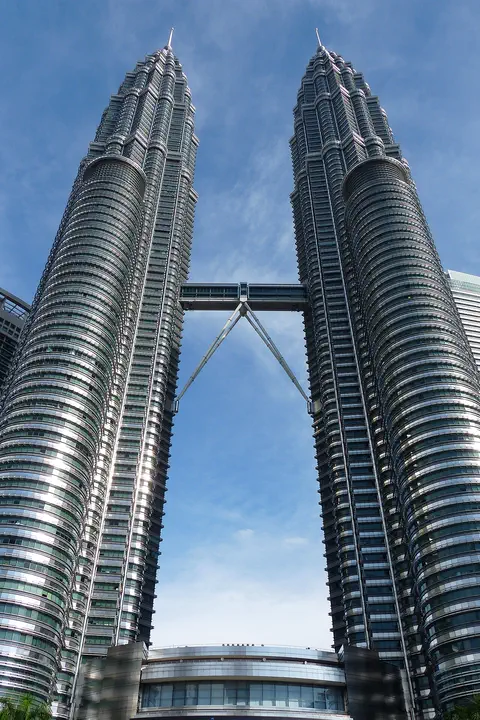
The Petronas Twin Towers in Kuala Lumpur, Malaysia, are two matching skyscrapers 452 meters tall, finished in 1998. Seen from above, each floor is shaped like an eight-pointed star, a pattern from Islamic art. A two-story skybridge joins them 170 meters above the ground, and from 1996 to 2003 they were counted as the tallest buildings in the world.
-
 Watch
City
Ho Chi Minh City
Ho Chi Minh City, once called Saigon, is Vietnam's largest city and the economic heart of the country. It lies on the Saigon River, north of the Mekong Delta. Since merging with two neighboring provinces in 2025, it has more than 14 million people, and in 2024 it opened its first metro line.
-
 Watch
Natural wonder
Great Barrier Reef
The Great Barrier Reef stretches about 2,300 kilometers along the coast of Queensland, Australia. It is made of about 2,500 separate reefs and more than 900 islands, built by tiny coral animals, and it is home to more than 1,500 kinds of fish.
Explore next
-
 Watch
 Country
Indonesia
Indonesia is a country of about 17,500 islands in Southeast Asia, spread across the Equator between the Indian and Pacific oceans. It has more than 100 active volcanoes, rainforests full of wildlife, and about 286 million people (2025).
-
 Watch
3D
Animal
Komodo dragon
The Komodo dragon is the largest lizard alive today. It lives only on a handful of Indonesian islands, where it tracks food with its flicking yellow tongue, rests in burrows in the heat and spends its first years safely up in the trees.
-
 Watch
Animal
Dugong
The dugong is a large, slow marine mammal that grazes on seagrass meadows in warm, shallow coastal seas from East Africa to the western Pacific. It is a relative of the manatee and, surprisingly, more closely related to elephants than to cows. It has a whale-like tail, a big bristly snout and very good hearing.
-
Watch
Natural wonder
Mount Agung
Mount Agung is a cone-shaped volcano on the eastern end of Bali, in Indonesia, and the island's highest point at about 3,000 meters. It erupted strongly in 1963 and 1964, and again with explosions, ash clouds and lava in its crater from 2017 to 2019. Scientists watch it all the time and set safety zones around it when it is restless.
- Watch Geography Islands An island is a piece of land surrounded by water that is smaller than a continent. Islands form in different ways: some broke away from continents, some were built by volcanoes on the sea floor, and some were made by corals or by waves piling up sand. Because they are cut off by water, islands often have unusual plants and animals.
- Watch Geography Tectonic plates Earth's hard outer shell is cracked into a dozen or so giant pieces called tectonic plates. They carry the continents and oceans and move a few centimeters a year. Where plates pull apart, push together or slide past each other, we find volcanoes, mountains and earthquakes.
-
 Watch
Natural wonder
Mount Everest
Mount Everest, in the Himalayas on the border of Nepal and China, is what Britannica calls the highest mountain in the world. In 2020 China and Nepal announced its height as 8,848.86 meters. It grew as two giant plates of Earth's crust pushed together, and it is still rising a tiny bit each year.
-
 Watch
Natural wonder
Mount Fuji
Mount Fuji, 3,776 meters high, is the highest mountain in Japan and an active volcano that last erupted in 1707. Its almost perfect cone was built by three volcanoes, one on top of another, and it has inspired artists for hundreds of years.
For parents & teachers
What children will learn
- Locate Komodo National Park in Indonesia between Sumbawa and Flores.
- Describe the Komodo dragon and how it finds food.
- Explain why protecting prey animals protects a predator.
- Describe the park's land and sea habitats.
Recommended ages: 3 to 17 · About 15 minutes
Talk about it
- Why might a giant lizard survive on only a few islands?
- How can tourism both help and harm a place like Komodo?
- Why does protecting deer help Komodo dragons?
Try at home or in class
- Measure 3 meters with a tape measure on the floor or sidewalk to see how long a big Komodo dragon can be. Lie down beside it.
- Play a smell game: hide a cotton ball with a little vanilla or lemon and try to find it by smell, like a Komodo dragon.
Key vocabulary: lizard, savanna, coral reef, predator, prey, ranger
Where these facts come from
- Wikidata , Wikimedia Foundation (CC0 1.0)
- UNESCO World Heritage List , UNESCO World Heritage Centre (Linked as a reference; site facts come from Wikidata)
- Komodo National Park , UNESCO World Heritage Centre
- Komodo dragon , Smithsonian's National Zoo and Conservation Biology Institute
- Labuan Bajo: Explore Rinca Island, UNESCO World Heritage Site in Indonesia , Indonesia Travel (Ministry of Tourism, Republic of Indonesia)
- The IUCN Red List of Threatened Species , International Union for Conservation of Nature (IUCN terms of use (no redistribution of Red List data or range maps))
Checked, not yet human-reviewed. Last updated October 27, 2026. Spotted a mistake? Tell us.