
Landmark Asia
Anuradhapura
Anuradhapura is a very old city in Sri Lanka. It has giant dome-shaped buildings made of bricks. People built it more than 2,000 years ago.
Anuradhapura, in north-central Sri Lanka, was the island's capital for more than 1,000 years. Its ruins include huge bell-shaped brick monuments called dagobas, monasteries, palaces and ancient reservoirs. It is an important place for Buddhists, and a World Heritage Site since 1982.
Founded in the 5th century BCE, Anuradhapura was the Sinhalese capital from the 4th century BCE until invasions forced the capital's move in the 11th century CE. Its brick stupas, among them the Jetavanaramaya and the Ruwanwelisaya, its monasteries and reservoirs form a UNESCO World Heritage Site (1982).
Photo: Bernard Gagnon, CC BY-SA 3.0, via Wikimedia Commons
Discover Anuradhapura
Anuradhapura is in Sri Lanka, an island country in Asia.
Long ago, it was the island's most important city. It has giant round brick buildings shaped like bells, old stone pillars and big ponds for water. Many trees grow among the ruins.
Anuradhapura lies on the plains of north-central Sri Lanka, beside the Aruvi Aru River. For more than 1,000 years it was the capital of the island's kings.
Today its old part is an archaeological park, an area where ruins are protected. Britannica calls it the best known of Sri Lanka's ancient ruined cities. Visitors find enormous bell-shaped monuments called dagobas, or stupas, made of small bricks, along with temples, carvings, palaces and old reservoirs for drinking water. It is an important place of pilgrimage for Buddhists.
Britannica describes Anuradhapura as a city in north-central Sri Lanka on the Aruvi Aru River whose old section, preserved as an archaeological park, is the best known of the country's ancient ruined cities. Around it stand huge bell-shaped dagobas (Buddhist commemorative shrines, or stupas) of small bricks, with temples, sculptures, palaces and ancient drinking-water reservoirs.
UNESCO inscribed the Sacred City of Anuradhapura in 1982, describing a Ceylonese political and religious capital that flourished for 1,300 years before it was abandoned after an invasion in 993, and whose palaces, monasteries and monuments, long hidden by dense jungle, are now accessible again. A CNN report (2026) calls it the island's first great capital.
- Where
- North-central Sri Lanka, on the Aruvi Aru River
- Founded
- 5th century BCE
- Capital
- 4th century BCE to 11th century CE
- World Heritage Site
- Sacred City of Anuradhapura (1982)
A capital for 1,300 years
People started the city more than 2,000 years ago.
Kings ruled the island from here for a very long time. Later, the city was left empty, and the jungle grew over it. Much later, people found the ruins again.
Anuradhapura was founded about 2,500 years ago. From the 300s BCE it was the capital of the Sinhalese kings, and UNESCO says it flourished for 1,300 years.
Around 245 BCE, a branch of a famous tree from India was planted here. After an invasion in 993, the city was abandoned, and the capital moved elsewhere. The jungle covered the ruins. In the 1800s, the British rediscovered them, and the city became a center of Buddhist pilgrimage again. Rebuilding the city began in earnest in the 1870s.
Britannica dates the city's founding to the 5th century BCE; it was the Sinhalese capital from the 4th century BCE until the 11th century CE, when invasions from South India forced the capital to move. UNESCO dates the abandonment to an invasion in 993. The city was overrun by jungle, rediscovered by the British in the 19th century, and became a Buddhist pilgrimage center; its revival began in earnest in the 1870s.
UNESCO records that the city grew around a cutting of the Buddha's fig tree brought in the 3rd century BCE by Sanghamitta, founder of an order of Buddhist nuns; Britannica dates the planting to about 245 BCE. CNN's 2026 report describes the great Jetavanaramaya as completed around 301 CE and controversial from the start, built on land associated with the Maha Vihara monastery and later linked to the Sagalika sect.
Mountains of brick
The giant round buildings are made of millions of small bricks.
Workers made the bricks from mud. Elephants may have helped carry them. The builders dug very deep, strong bases first.
The great dagobas are solid domes made of bricks. The biggest, the Jetavanaramaya, used about 93 million bricks! It was finished around the year 301 and was about 122 meters tall, with a spire on top.
The builders were careful engineers. Ancient chronicles say they flooded the dug ground to test how it soaked up water before building. The Jetavanaramaya stands on bedrock and stone foundations 8.5 meters deep. The bricks were held together with mortar made of crushed stone, sand and clay, and covered in lime plaster.
Britannica describes the dagobas as built of small sun-dried bricks; CNN's 2026 report speaks of baked mud bricks, an estimated 93.3 million for the Jetavanaramaya. Guinness World Records lists it as the largest ancient stupa: a base area of 233,000 square meters and 70.4 m high today, about 122 m when completed in 301 with its original spire, on bedrock and stone foundations 8.5 m deep.
CNN reports that the original mortar mixed finely crushed dolomite, limestone, sieved sand and clay; that ancient chronicles describe builders flooding excavated ground to test its absorption; and that archaeologists have found ancient brick kilns around Anuradhapura, though none yet securely linked to the stupa. Historians think elephants and bullock carts were almost certainly used, as at other great sites; Guinness World Records says elephants with leather bindings on their feet pressed down its foundations.
Dagobas, an ancient tree and stone carvings
The biggest dome is called the Jetavanaramaya. Another, the Ruwanwelisaya, is gleaming white.
There is also a very old tree that was planted more than 2,200 years ago. Stone steps and carved stones lead into old buildings.
The Jetavanaramaya was once one of the tallest buildings in the world; today, after parts fell down, it is about 70 meters tall. The gleaming white Ruwanwelisaya, built about 140 BCE, has been looked after ever since and is still a busy place of pilgrimage.
In the city grows an ancient fig tree. It is believed to have grown from a branch of a famous fig tree at Bodh Gaya, in India. It was planted about 245 BCE, and Britannica says it may be the oldest tree in the world with a historical record. All around are ruined monasteries with stone pillars, stairs and carved stones.
Guinness ranks the Jetavanaramaya, at its completion, as one of the tallest buildings in the world, beaten only by two Egyptian pyramids; CNN reports it was the third-largest human-made building of its time and is still the largest brick structure by volume. The Ruwanwelisaya, which CNN dates to 140 BCE, has been continuously maintained and remains the focus of pilgrimage in the city (CNN).
Britannica notes an ancient pipal tree believed to have grown from a branch of the Bo tree at Bodh Gaya, India, planted about 245 BCE and possibly the oldest tree with a historical record. The photograph shows a ruined building of the kind found across the site: stone pillars, a staircase with carved balustrades and a half-moon step, a moss-covered brick platform and a carved stone slab with a standing figure.
- Jetavanaramaya
- about 122 m when completed (301); 70.4 m today
- Bricks in the Jetavanaramaya
- about 93 million
- Ruwanwelisaya
- built about 140 BCE (CNN); still cared for today
- The Bo tree
- planted about 245 BCE
Anuradhapura today
Today, many people visit the old city.
Buddhists come to visit and pray. Experts work hard to protect the old bricks and stones.
Today a modern city of about 50,000 people stands beside the ruins. In the middle of the 1900s, much of the town was moved so the ancient capital could be protected. Anuradhapura is also home to the headquarters of Sri Lanka's archaeological survey.
Caring for brick monuments is tricky. Some repairs in the past used cement, and archaeologists now think this may have harmed the old bricks. Pilgrims and visitors keep coming, and more visitors from other countries have arrived in recent years.
Britannica notes that much of the contemporary city was moved during the mid-20th century to preserve the ancient capital; the city (50,595 people in 2012) is a major road junction, lies on a railway line, hosts the headquarters of Sri Lanka's archaeological survey and depends significantly on tourism.
CNN's 2026 report describes the conservation challenge at the Jetavanaramaya: earthquakes, monsoon rains and centuries of abandonment caused collapses; the last major renovation came under Parakramabahu I in the 12th century; and recent restoration that added cement to outer layers may, archaeologists now believe, have accelerated deterioration. Excavations found reliquary caskets and gold panels with Sanskrit texts, now in the National Museum in Colombo.
Amazing facts
-
One giant dome is made of about 93 million bricks.
The Jetavanaramaya was built from about 93 million bricks, covered in lime plaster.
Around 93 million bricks, plastered with lime, sit on bedrock and stone foundations 8.5 m deep (Guinness World Records).
-
A tree here was planted more than 2,200 years ago.
A fig tree in Anuradhapura was planted about 245 BCE. Britannica says it may be the oldest tree with a historical record.
The pipal tree, planted about 245 BCE, may be the oldest tree in existence for which there is any historical record, Britannica notes.
-
Elephants may have helped build the giant domes.
Historians think elephants and bullock carts helped carry the materials for the great dagobas, as at other big building sites.
Historians believe elephants and bullock carts were almost certainly used to build the Jetavanaramaya, as at other major Sri Lankan building sites (CNN, 2026).
-
Part of the modern town was moved to protect the ruins.
In the middle of the 1900s, much of the modern town was moved so the ancient capital could be preserved.
Much of the contemporary city was relocated in the mid-20th century to preserve the site of the ancient capital.
Words to know
- dagoba
- a bell-shaped Buddhist monument in Sri Lanka, also called a stupa
- stupa
- a dome-shaped Buddhist monument
- reservoir
- a large human-made lake that stores water
- monastery
- a place where monks live, study and pray together
- mortar
- a paste that hardens to hold bricks or stones together
- pilgrimage
- a journey to a place that is important to a person's religion
Discovery challenge
-
Which island country is Anuradhapura in?
In which island country is Anuradhapura?
Of which island was Anuradhapura the capital for some 1,300 years, by UNESCO's count?
- Sri Lanka
- Iceland
- Japan
Show the answer
Sri Lanka
Sri Lanka, an island in Asia.
Anuradhapura is in north-central Sri Lanka.
Sri Lanka (Ceylon): UNESCO says the capital flourished for 1,300 years.
-
What are the giant domes made of?
What were the great dagobas of Anuradhapura built from?
What was the main building material of the Jetavanaramaya, used about 93 million times?
- Ice blocks
- Bricks
- Glass
Show the answer
Bricks
Bricks! Millions and millions of them.
They are built of small bricks; the Jetavanaramaya alone used about 93 million.
Brick: Guinness counts around 93 million, laid in a mortar of crushed stone, sand and clay.
-
About how tall was the biggest dome when it was new?
About how tall was the Jetavanaramaya when it was completed in 301?
What height does Guinness give for the Jetavanaramaya on completion, with its spire?
- About 12 meters
- About 122 meters
- About 1,200 meters
Show the answer
About 122 meters
About 122 meters. Now it is about 70 meters.
About 122 meters with its spire; today it is about 70 meters tall.
About 122 m in 301; 70.4 m today.
-
What grew over the old city after people left?
After the city was abandoned, what covered its ruins for centuries?
What hid the abandoned capital until the British rediscovered it in the 19th century?
- Snow
- Sand dunes
- Jungle
Show the answer
Jungle
The jungle grew over it!
Jungle covered the ruins until they were found again in the 1800s.
Dense jungle; the revival of the city began in earnest in the 1870s.
Nearby places
-
 Watch
City
Mumbai
Mumbai, once called Bombay, is a giant port city on India's west coast, by the Arabian Sea. It grew on seven small islands that were joined into one, and it is India's main center of business and banking. At the 2011 census, more than 12 million people lived in the city and more than 18 million in its urban area.
-
 Watch
Natural wonder
Ajanta Caves
The Ajanta Caves are about 30 halls and rooms carved by hand into a curving cliff above the Waghora River in western India. Buddhist communities made them in two big phases, starting more than 2,000 years ago. Their wall paintings and stone carvings are some of the most famous ancient art in India, and they have been a UNESCO World Heritage Site since 1983.
-
 Watch
Natural wonder
Sundarbans
The Sundarbans is a vast mangrove forest where the Ganges and Brahmaputra rivers meet the Bay of Bengal. It is shared by Bangladesh and India. Twice a day the tides flood its muddy islands, and its trees are made to live in salty water. It is one of the last homes of the Bengal tiger, and both countries protect it as a World Heritage Site.
-
 Watch
Landmark
Fatehpur Sikri
Fatehpur Sikri, the "City of Victory," was built on a ridge near Agra, India, by the Mughal emperor Akbar from 1571. It was his capital until 1585. Its red sandstone palaces, halls and great mosque still stand, and its gateway, the Buland Darwaza, is 40 meters tall.
-
 Watch
Landmark
Taj Mahal
The Taj Mahal is a white marble tomb in Agra, India, beside the Yamuna River. The Mughal emperor Shah Jahan had it built in memory of his wife, Mumtaz Mahal. More than 20,000 workers spent about 22 years on the tomb, its gardens, a mosque and a great gateway.
-
 Watch
Landmark
Agra Fort
Agra Fort is a huge red sandstone fortress beside the Yamuna River in Agra, India. The Mughal emperor Akbar began it in 1565. Its walls, about 2.5 kilometers around, protect palaces, halls and mosques added by later emperors. It was both an army base and a royal home.
-
 Watch
Natural wonder
Chitwan National Park
Chitwan National Park, in the lowlands of southern Nepal, was Nepal's first national park. Its sal forests, tall grasslands and rivers are home to the second-largest population of greater one-horned rhinoceroses in the world, 694 in 2021, and to Bengal tigers, 145 counted in and around the park in 2026.
-
 Watch
City
Bangkok
Bangkok, the capital of Thailand, lies on the delta of the Chao Phraya River, about 40 kilometers from the sea. It became the capital in 1782, when the new royal palace and temples were built. Once called the 'Venice of the East' for its canals, it is now a huge, busy city with skyscrapers and an elevated railway.
Experiments to try
Explore next
-
 Watch
 Country
Sri Lanka
Sri Lanka is an island country in the Indian Ocean, just south of India. Green highlands rise in the middle, surrounded by plains and sandy beaches. About 22 million people live there, and the island is famous for its tea, its ancient cities and its wild elephants.
-
 Watch
Landmark
Borobudur
Borobudur is a huge Buddhist monument in central Java, Indonesia, built about 1,200 years ago. It is shaped like a stepped pyramid around a small hill, with carved walls and 72 bell-shaped stupas on its round top terraces. For centuries it lay hidden under volcanic ash and plants, and today it is a UNESCO World Heritage Site.
-
 Watch
Landmark
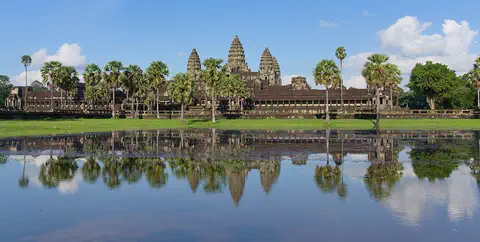
Angkor Wat
Angkor Wat, near the town of Siem Reap in Cambodia, was built in the 12th century by the Khmer king Suryavarman II. Britannica (2026) calls it the world's largest religious structure. It was built as a Hindu temple and later became a Buddhist place of worship.
-
 Watch
Landmark
Mohenjo-daro
Mohenjo-daro was the largest city of the Indus civilization, which UNESCO calls one of the world's three great ancient civilizations. Built of baked brick and flourishing by about 2500 BCE beside the Indus River, it had streets in a neat grid, houses with bathrooms and covered drains. Its ruins were found in 1922.
- Watch Geography What is a World Heritage Site? World Heritage Sites are places so important that they belong, in a way, to everyone. Under a 1972 agreement, countries nominate their most outstanding places, experts check them, and a UNESCO committee decides. By 2026 the list held 1,273 sites: cultural places like the Taj Mahal, natural places like the Galápagos, and mixed ones like Machu Picchu.
- Watch Try it What If? Lab What if buildings had different foundations? A building's whole weight presses down through its foundation onto the ground. A wide foundation spreads that weight out, like snowshoes on snow. In our model, a 200-tonne building on sand is safe on a 40-square-meter footing. Shrink the footing to 8 square meters and it presses five times harder, more than the sand can take, so the building would sink and could crack or tilt.
-
Watch
Landmark
Agra Fort
Agra Fort is a huge red sandstone fortress beside the Yamuna River in Agra, India. The Mughal emperor Akbar began it in 1565. Its walls, about 2.5 kilometers around, protect palaces, halls and mosques added by later emperors. It was both an army base and a royal home.
-
 Watch
Landmark
Al-Aqsa Mosque
Al-Aqsa Mosque stands at the southern end of a huge raised plaza in the Old City of Jerusalem. Built in the early 700s, it has a silver-gray dome, and the golden Dome of the Rock stands nearby. The plaza is important to Muslims and to Jews.
For parents & teachers
What children will learn
- Locate Anuradhapura in Sri Lanka and explain that it was the island's capital for over 1,000 years.
- Describe the city's dagobas and how they were built from millions of bricks.
- Explain why the city is important to Buddhists, using neutral, factual words.
- Discuss the challenges of conserving brick monuments, including repairs that went wrong.
Recommended ages: 3 to 17 · About 15 minutes
Talk about it
- The Jetavanaramaya lost about 50 meters of height over the centuries. What do you think wore it down?
- Some repairs with cement may have harmed the old bricks. How should people decide how to fix ancient buildings?
- Part of a modern town was moved to protect old ruins. Do you think that was a good idea? Why?
Try at home or in class
- Build a small dome from sugar cubes or toy bricks and count how many you need; then guess how many it would take to make one twice as tall.
- Pour water on a patch of sand and a patch of soil and watch how fast each soaks it up, like the ancient builders' ground test.
Key vocabulary: dagoba, stupa, reservoir, monastery, mortar, pilgrimage
Where these facts come from
- Wikidata , Wikimedia Foundation (CC0 1.0)
- UNESCO World Heritage List , UNESCO World Heritage Centre (Linked as a reference; site facts come from Wikidata)
- Sacred City of Anuradhapura , UNESCO World Heritage Centre
- Anuradhapura , Encyclopaedia Britannica
- Largest ancient stupa , Guinness World Records
- The massive megastructure built for eternity and still standing 1,700 years later (CNN, 2026) , CNN, via KRDO
- Wikimedia Commons , Wikimedia Foundation (Per file (public domain, CC0, CC BY or CC BY-SA); see each media record)
Checked, not yet human-reviewed. Last updated October 27, 2026. Spotted a mistake? Tell us.