
Landmark Asia
Kiyomizu-dera
Kiyomizu-dera is an old wooden temple on a hill in Kyoto, Japan. Its big wooden stage sticks out over the trees. Tall wooden pillars hold it up, without a single nail!
Kiyomizu-dera is a Buddhist temple on the slope of Mount Otowa in Kyoto, Japan. The temple says it was founded in 778. Its Main Hall, rebuilt in 1633, has a famous wooden stage about 13 meters high, held up by 18 giant pillars joined without nails. The name means "pure water," after a waterfall on the grounds.
Founded, by its own account, in 778 and named for the Otowa Waterfall, Kiyomizu-dera is a Kita-Hosso Buddhist temple whose present buildings mostly date from 1633. Its Main Hall, a National Treasure, stands on a cliff on a nail-free lattice of zelkova pillars and rails; it is part of UNESCO's Historic Monuments of Ancient Kyoto (1994).
Photo: Martin Falbisoner, CC BY-SA 4.0, via Wikimedia Commons
Discover Kiyomizu-dera
Kiyomizu-dera is in Kyoto, an old city in Japan.
It sits halfway up a mountain covered in trees. It has many wooden buildings with curved roofs. The biggest one has a wide wooden stage where people stand and look out over the city.
Kiyomizu-dera stands halfway up Mount Otowa, one of the peaks of the Higashiyama hills on the east side of Kyoto. It is a Buddhist temple, a place of worship for people who follow Buddhism. The temple says it was founded in 778, more than 1,250 years ago.
Its grounds spread over more than 130,000 square meters of hillside and hold about 30 buildings. The most famous is the Main Hall, with its huge wooden stage hanging over the slope. The name Kiyomizu means "pure water," after the clear waterfall that flows on the grounds. In every season the view changes: cherry blossoms in spring, green in summer, red leaves in autumn and snow in winter.
The temple describes itself as standing halfway up Mt. Otowa in Kyoto's Higashiyama range, on grounds of over 130,000 square meters with some thirty Buddhist buildings, including the Main Hall, a National Treasure, and many Important Cultural Properties. It dates its founding to 778 and takes its name, "pure water," from the Otowa Waterfall.
Kiyomizu-dera belongs to the Kita-Hosso sect. It first followed the doctrine of the Hosso sect, one of the six sects of Nara Buddhism, and was for a time a branch temple of Kofuku-ji in Nara; in 1965 it became head temple of the new Kita-Hosso ("Northern Hosso") sect, founded by its then chief abbot. UNESCO includes it among the Historic Monuments of Ancient Kyoto, inscribed in 1994, which illustrate the development of Japanese wooden, especially religious, architecture.
- Where
- Mount Otowa, Higashiyama, Kyoto, Japan
- Founded
- 778 (temple's account)
- Grounds
- over 130,000 square meters, about 30 buildings
- World Heritage
- Historic Monuments of Ancient Kyoto, 1994
Burned and rebuilt, again and again
The temple is very, very old.
Fire burned its wooden buildings many times. Each time, people helped build them again. Most of the buildings you see today were built about 400 years ago.
Kiyomizu-dera was founded in 778, the temple says, before Kyoto became Japan's capital in 794. Since then, most of its wooden buildings have burned down more than ten times. Each time, people who supported the temple helped rebuild it.
Most of the buildings standing today were rebuilt in 1633. The big front gate, the Nio-mon, was burned in a civil war in 1469 and rebuilt around 1500. People have visited the temple all through its history, and old books describe crowds coming to enjoy it. From 2008, a restoration lasting 12 years renewed the stage floor.
The temple dates its founding to 778, shortly before Kyoto became the imperial capital in 794 (UNESCO). Its own history records that since then most of its buildings have been destroyed by fire more than ten times and rebuilt with the help of supporters, and that most present buildings, including the Main Hall and its stage, date from the reconstruction of 1633.
The two-story Nio-mon, the main entrance, burned during a civil war in 1469, was rebuilt around 1500 and was dismantled and refurbished in 2003. The temple notes that it has long been open to people of all classes, and that history books and literature describe large numbers of visitors through the centuries. A 12-year restoration from 2008 replaced the stage floor with more than 166 hinoki (Japanese cypress) boards.
A stage on wooden stilts
The Main Hall is built on a steep cliff.
Underneath the stage stand 18 giant wooden pillars. Wooden beams slide right through the pillars to hold them together. There are no nails at all!
The Main Hall was built on a steep cliff using a traditional Japanese way of building. Underneath its stage stand 18 pillars made from zelkova trees that were around 400 years old. The tallest is about 12 meters high and 2 meters around.
Wooden beams called rails pass right through the pillars and lock them together, like a giant wooden frame. Not a single nail is used. The temple says this frame is so strong that the hall stands up well to earthquakes, even on its steep slope. The stage itself is nearly 13 meters high, about as tall as a four-story building.
The Main Hall uses a traditional Japanese construction method on a steep cliff: an assembled lattice of pillars and rails acts like scaffolding and, the temple says, makes the structure highly earthquake-resistant on the slope. The overhanging veranda, the Kiyomizu Stage, stands nearly 13 m high, which the temple compares to a four-story building.
It rests on 18 pillars of zelkova from trees some 400 years old, the largest about 12 m tall and 2 m in girth. Rails penetrate each pillar to form joints, strengthening the frame without a single nail. The hall's hipped roof (yosemune-zukuri) is thatched with hinoki cypress bark in an elegant curve, and the temple sees in it traces of Heian-period palace and aristocratic architecture.
The stage, the gates and the waterfall
The wide wooden stage is the most famous part. From it, you can see all of Kyoto!
Below the temple, clear water pours down in three little streams. Visitors catch the water with long-handled cups.
The stage in front of the Main Hall has a floor of about 200 square meters, made of more than 166 boards of hinoki, a Japanese cypress wood. From it, visitors can see across the whole city of Kyoto.
Visitors enter through the Nio-mon, a two-story gate about 14 meters high. Nearby, the Okuno-in Hall has a stage of its own, with a famous view back to the Main Hall. Below it is the Otowa Waterfall, where clear water falls in three streams. Visitors catch the water with long-handled ladles.
The temple calls the stage, about 200 square meters of hinoki boarding renewed in the restoration begun in 2008, the most renowned of its structures; it looks out over the whole of Kyoto. A Japanese expression, "standing on a hinoki stage," means stepping into the limelight, though the temple says it is uncertain whether the phrase comes from this stage.
The Nio-mon gate measures about 10 by 5 meters and 14 meters high. Okuno-in Hall, rebuilt with the Main Hall in 1633, stands above the Otowa Waterfall on a stage built in the same way. At the waterfall, whose water has long been called konjiki-sui, golden water, visitors catch the three streams with ladles. In the photo, a red pagoda, a tower with stacked roofs, rises at the left beyond the other halls.
- Stage height
- nearly 13 m
- Stage floor
- about 200 square meters, over 166 hinoki boards
- Pillars under the stage
- 18 zelkova pillars, no nails
- Nio-mon gate
- about 14 m high, rebuilt around 1500
Kiyomizu-dera today
Today, many visitors climb the hill to see the temple.
In autumn, the trees around it turn bright red and orange. It is a very pretty sight!
The temple says its stage is always bustling with visitors. In autumn, the leaves around the Main Hall turn red and orange, as in the photo. The temple also holds Buddhist events and special viewings during the year. From the stage, visitors look out over the whole city of Kyoto, and around the Main Hall stand about 30 other temple buildings to explore.
The temple sits in Kyoto's Higashiyama district, a part of the city with old paved streets.
The temple describes its stage as always bustling with visitors and holds regular Buddhist events and special viewings. The photo, taken in November 2016, shows the Main Hall and its stage crowded with visitors amid autumn leaves, with a pagoda and other halls to the left.
The temple lies in Higashiyama ward, among the traditional streets of eastern Kyoto, part of a city that UNESCO describes as the center of Japanese culture for more than 1,000 years. Besides the Main Hall, a National Treasure, the temple counts many Important Cultural Properties among its thirty buildings, from the Nio-mon gate to Okuno-in Hall above the Otowa Waterfall.

Amazing facts
-
The big wooden stage is held up without any nails!
The stage's 18 pillars are held together by rails that pass through them. Not a single nail is used.
Rails penetrating each of the 18 zelkova pillars form joints that strengthen the frame without a single nail.
-
Kiyomizu means pure water.
The temple's name, Kiyomizu, means "pure water," after the clear Otowa Waterfall.
Kiyomizu, "pure water," refers to the clarity of the Otowa Waterfall, where the temple originated.
-
The stage is about as tall as a four-story building.
The stage stands nearly 13 meters high, about as tall as a four-story building.
The temple compares the stage's nearly 13 m height to a four-story building.
-
The stage pillars come from very old trees.
The pillars were made from zelkova trees that were about 400 years old.
The 18 stage pillars come from zelkova trees some 400 years old; the largest is about 12 m tall and 2 m in girth.
Words to know
- temple
- a building or group of buildings used for worship
- Buddhism
- a religion and way of life based on the teachings of the Buddha
- pillar
- a tall, strong post that holds something up
- zelkova
- a tree with very hard, strong wood, used for the stage's pillars
- hinoki
- Japanese cypress, a tree whose wood and bark are used in buildings
- pagoda
- a tower with several stacked roofs
Discovery challenge
-
Which city is Kiyomizu-dera in?
In which Japanese city does Kiyomizu-dera stand?
In which former imperial capital does Kiyomizu-dera stand, on Mt. Otowa?
- Kyoto
- Tokyo
- Seoul
Show the answer
Kyoto
Kyoto, in Japan!
Kyoto, on the hills to the east of the city.
Kyoto, capital of Japan from 794 until the mid-19th century.
-
What holds the pillars together?
How are the stage's pillars joined together?
What joins the 18 zelkova pillars of the stage's substructure?
- Wooden rails through the pillars
- Metal nails
- Glue and tape
Show the answer
Wooden rails through the pillars
Wooden beams slide through them. No nails!
Wooden rails pass through each pillar, locking them together without nails.
Penetrating rails form the joints; no nails are used.
-
What does Kiyomizu mean?
What does the name Kiyomizu mean?
After what is Kiyomizu-dera named?
- Pure water
- Red tower
- Tall mountain
Show the answer
Pure water
Pure water!
It means "pure water," after the Otowa Waterfall.
The clear water of the Otowa Waterfall: Kiyomizu means "pure water."
-
When were most of the buildings built again?
In which year were most of the temple's present buildings rebuilt?
When was the general reconstruction that produced most present buildings, including the Main Hall?
- 1633
- 1950
- 2020
Show the answer
1633
In 1633, almost 400 years ago.
In 1633, after fires had burned the buildings many times.
1633; the Nio-mon is older, rebuilt around 1500.
Nearby places
-
Watch
City
Kyoto
Kyoto was the capital of Japan for more than 1,000 years, from 794 to 1868. Its streets still follow a grid planned in 794. About 1.4 million people live there (2022), among hundreds of old temples, shrines, gardens and workshops.
-
 Watch
Natural wonder
Mount Fuji
Mount Fuji, 3,776 meters high, is the highest mountain in Japan and an active volcano that last erupted in 1707. Its almost perfect cone was built by three volcanoes, one on top of another, and it has inspired artists for hundreds of years.
-
 Watch
City
Tokyo
Tokyo is the capital of Japan, at the head of Tokyo Bay. It began as the small town of Edo and was renamed Tokyo, the Eastern Capital, in 1868. About 14.3 million people lived in the Tokyo Metropolis in 2022, and Greater Tokyo is Japan's largest city region.
-
 Watch
City
Seoul
Seoul is the capital of South Korea, on the Han River. It became a capital in 1394, and its old palaces and city gates still stand among skyscrapers. About 9.7 million people lived there in 2020, and its subway is one of the main ways to get around.
-
 Watch
City
Shanghai
Shanghai is China's most populous city, on the coast where the great Yangtze River meets the East China Sea. Once a small fishing village, it grew into one of the world's busiest seaports. About 24.9 million people lived in Shanghai in 2020, and the towers of Pudong rise across the Huangpu River.
-
 Watch
Landmark
Taipei 101
Taipei 101 is a skyscraper in Taipei, Taiwan, 508 meters tall with its spire and 101 stories high. When it opened, it was the tallest building in the world. Inside hangs a 660-ton steel ball, a tuned mass damper, that helps steady the tower in typhoon winds and earthquakes.
-
 Watch
Landmark
Great Wall of China
The Great Wall is not one wall but many walls, built over about 2,000 years across northern China. The best-kept part, built under the Ming emperors, runs about 8,850 kilometers, with watchtowers, gates and signal towers along the way.
-
 Watch
Landmark
Forbidden City
The Forbidden City in Beijing was built between 1406 and 1420 as the palace of China's emperors. Over about 500 years, 24 emperors came to the throne there. High walls and a wide moat surround it. Since 1925 it has been the Palace Museum, and it became a World Heritage Site in 1987.
Explore next
-
Watch
 Country
Japan
Japan is an island country in East Asia. Most of its land is steep mountains and forest, Mount Fuji is its tallest peak, and about 124 million people live there, many of them in big cities such as Tokyo.
-
Watch
City
Kyoto
Kyoto was the capital of Japan for more than 1,000 years, from 794 to 1868. Its streets still follow a grid planned in 794. About 1.4 million people live there (2022), among hundreds of old temples, shrines, gardens and workshops.
-
 Watch
Landmark
Agra Fort
Agra Fort is a huge red sandstone fortress beside the Yamuna River in Agra, India. The Mughal emperor Akbar began it in 1565. Its walls, about 2.5 kilometers around, protect palaces, halls and mosques added by later emperors. It was both an army base and a royal home.
-
 Watch
Landmark
Al-Aqsa Mosque
Al-Aqsa Mosque stands at the southern end of a huge raised plaza in the Old City of Jerusalem. Built in the early 700s, it has a silver-gray dome, and the golden Dome of the Rock stands nearby. The plaza is important to Muslims and to Jews.
-
 Watch
Landmark
Al-Masjid al-Haram
Al-Masjid al-Haram, the Great Mosque of Mecca in Saudi Arabia, was built around the Kaaba, a cube-shaped building that Muslims face when they pray. It is the most important place of pilgrimage in Islam. In 2026, 1,707,301 pilgrims came to Mecca for the hajj, and the mosque can hold up to about one million worshippers.
-
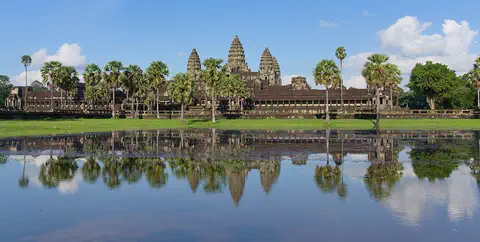 Watch
Landmark
Angkor
Angkor, in northwestern Cambodia, was the capital of the Khmer Empire from the 9th to the 15th century. Its kings built city after city here, with scores of temples, such as Angkor Wat and the Bayon, and giant reservoirs and canals to water the rice fields. Today it covers about 400 square kilometers, and more than 100,000 people live in villages inside it.
-
Watch
Landmark
Angkor Wat
Angkor Wat, near the town of Siem Reap in Cambodia, was built in the 12th century by the Khmer king Suryavarman II. Britannica (2026) calls it the world's largest religious structure. It was built as a Hindu temple and later became a Buddhist place of worship.
-
 Watch
Landmark
Anuradhapura
Anuradhapura, in north-central Sri Lanka, was the island's capital for more than 1,000 years. Its ruins include huge bell-shaped brick monuments called dagobas, monasteries, palaces and ancient reservoirs. It is an important place for Buddhists, and a World Heritage Site since 1982.
For parents & teachers
What children will learn
- Locate Kyoto and describe Kiyomizu-dera as a Buddhist temple on a hillside.
- Explain how the stage stands on wooden pillars joined without nails.
- Understand that wooden buildings were burned and rebuilt many times.
- Discuss how traditional building methods can resist earthquakes.
Recommended ages: 3 to 17 · About 15 minutes
Talk about it
- Why might builders choose to join wood without nails?
- The temple's buildings burned many times but were always rebuilt. Why do you think people kept rebuilding them?
- How does the view from the temple change through the seasons, and which season would you visit?
Try at home or in class
- Build a small stage from craft sticks: cut notches and slot the sticks together without glue, then test how much it can hold.
- Shake a table gently with a tower of loose blocks and a tower of blocks held in a criss-cross frame, and compare which stays standing.
Key vocabulary: temple, Buddhism, pillar, zelkova, hinoki, pagoda
Where these facts come from
- Wikidata , Wikimedia Foundation (CC0 1.0)
- Learn: history, the stage and the Main Hall , Kiyomizu-dera Temple (official site)
- Visit: Nio-mon, Main Hall, Okuno-in and Otowa Waterfall , Kiyomizu-dera Temple (official site)
- Historic Monuments of Ancient Kyoto (Kyoto, Uji and Otsu Cities) , UNESCO World Heritage Centre
- UNESCO World Heritage List , UNESCO World Heritage Centre (Linked as a reference; site facts come from Wikidata)
- Wikimedia Commons , Wikimedia Foundation (Per file (public domain, CC0, CC BY or CC BY-SA); see each media record)
Checked, not yet human-reviewed. Last updated October 27, 2026. Spotted a mistake? Tell us.