
Landmark Asia
Pergamon
Pergamon is an old city built on top of a steep hill in Türkiye. Long ago, kings lived there. Its ruins still stand above a wide plain.
Pergamon is an ancient city in western Türkiye, built on a steep hill above the Bakırçay Plain. It was the capital of the Attalid kings from the 3rd century BC and later of a Roman province. UNESCO says its kings founded one of the largest libraries, and it is a UNESCO World Heritage Site.
Pergamon, above the modern town of Bergama in Türkiye's Aegean region, was the capital of the Hellenistic Attalid dynasty from the 3rd century BC and, after 133 BC, a metropolis and capital of the Roman province of Asia. Its terraced acropolis, theater, library and water system, and the layers left by Byzantine and Ottoman towns below, were inscribed on the World Heritage List in 2014.
Photo: Bernard Gagnon, CC BY-SA 3.0, via Wikimedia Commons
Discover Pergamon
Pergamon is a very old city in Türkiye.
It sits on top of a steep hill. From up there, you can look down on a wide, flat plain. Today a town called Bergama lies below the hill.
Pergamon rises high above the Bakırçay Plain in the Aegean region of Türkiye. The old city sits on Kale Hill, a steep ridge between two rivers, and the modern town of Bergama spreads over the lower slopes.
UNESCO says the acropolis, the high part of the city, was the capital of the Attalid kings and a major center of learning in the ancient world. Builders set temples, theaters, a gymnasium, a library and long covered walkways into the sloping hill, inside a city wall.
The World Heritage property 'Pergamon and its Multi-Layered Cultural Landscape' has nine parts. The main one is the acropolis on Kale Hill, which ICOMOS describes as a steep-sided ridge between the Selinos and Keitos rivers, together with the Roman aqueducts to the north and a healing center to the south-west. Around it lie seven burial-mound sites and, about 6 km to the north-west on Kapıkaya Hill, a rock-cut sanctuary that lines up with the acropolis.
UNESCO calls the acropolis the capital of the Hellenistic Attalid dynasty and a major center of learning, and says it 'crowns' a landscape of burial mounds and Roman, Byzantine and Ottoman remains in and around Bergama. It was inscribed in 2014 under criteria (i), (ii), (iii), (iv) and (vi).
- Where
- Kale Hill above the town of Bergama, İzmir Province, Türkiye
- Capital of
- the Attalid kings (3rd century BC), then the Roman province of Asia
- Parts
- nine sites: the city on Kale Hill and eight more around it
- World Heritage
- inscribed 2014
Kings, Romans and later towns
Long ago, kings built Pergamon on the hill.
Later, the Romans ruled it, and the city grew very big. After that, new towns grew at the bottom of the hill.
UNESCO says Pergamon was founded in the 3rd century BC as the capital of the Attalid kings. Its first ruler, Philetairos, had been an officer in a Macedonian army. Under King Eumenes II, from 197 to 159 BC, the walls were made longer and many great buildings went up, including the Great Altar and the library.
In 133 BC the city passed to the Romans, and it became the capital of their province of Asia. Later it shrank to a middle-sized Byzantine town, and from the 14th century the Ottomans added mosques, baths, bridges and markets on the plain below.
According to ICOMOS, the first Hellenistic city was laid out by Philetairos, a former Macedonian army officer, between 282 and 263 BC, building on a trading and cultural center established under Alexander the Great. Under Eumenes II (197–159 BC) the walls were extended down the hill and the Great Altar, lower agora, gymnasium and library were built.
UNESCO says the city came to Rome in 133 BC through an Attalid bequest (a gift in a will) and became the capital of the Roman province of Asia (ICOMOS gives about 129 BC for the province). ICOMOS reports that the population grew from about 40,000 in the Hellenistic period to as many as 150,000 under Rome, and that earthquakes in the 5th century AD added to the city's decline. In Byzantine times the walls were rebuilt with stones from damaged buildings, especially the Great Altar. The Ottomans took the city in 1345 and, after a short period under Timur, again under Murad II; they added mosques, madrasas, inns, baths and bazaars.
A city built into a steep hill
Building on a steep hill is hard!
The builders cut flat steps, called terraces, into the hill. Then they put their buildings on the steps.
Kale Hill is steep, so the builders made flat terraces in its slopes and set their buildings on them, one above another. UNESCO calls this a masterpiece of Hellenistic and Roman town planning.
The hill had no spring of its own. ICOMOS explains that water came from mountains about 50 kilometers to the north through ceramic and lead pipes under pressure. Using the principle that water finds its own level, it flowed down into a valley and up again, to a height of almost 200 meters.
UNESCO's criterion (i) praises the way Pergamon was built into the top of Kale Hill, 'exploiting the topography with manmade terraces and grand monuments dominating the surrounding plain'. UNESCO lists a gymnasium on three terraces, and ICOMOS singles out 'the extraordinarily steep theatre' on the western slope.
Water was a problem, since the hill had no source of its own. ICOMOS describes ceramic pipes and lead pipelines carrying water under pressure from mountains some 50 km to the north, using the principle that water finds its own level, so that it ran down and up the valley between to a height of almost 200 m, into cisterns and fountains. The Romans added aqueducts. They also covered the Selinos river at the foot of the hill with two huge tunnels to make a flat area for a large temple building under the emperor Hadrian.
Library, altar, theater and the Red Basilica
Pergamon had a huge library full of books.
It also had a theater with steep rows of seats. Big carved stones from its Great Altar are now in a museum far away, in Berlin.
The Attalid kings founded one of the largest libraries here, UNESCO says, and ICOMOS says it rivaled the library of Alexandria. UNESCO also names a tradition of making parchment, a writing material, that is special to Pergamon.
The Great Altar was famous for its carved stone friezes. They are now in Berlin, where the Pergamonmuseum plans to show them again from June 4, 2027. Down the slope is the very steep theater, and in the town below stands the Red Basilica (Kızıl Avlu), a Roman temple building later used as a church.
UNESCO credits the dynasty with 'one of the largest libraries' and with a sculpture school whose work became known as the 'Pergamon style'; ICOMOS adds that the library rivaled Alexandria's. UNESCO also lists a tradition of parchment making 'specific to Pergamon', and says the physician Galen trained here.
The Great Altar's sculptured friezes are in Berlin; Berlin's state museums date the altar to about 170 BC and plan to reopen the Pergamonmuseum on June 4, 2027. In the lower town, the Red Basilica (Kızıl Avlu) shows how buildings were reused: UNESCO describes a Roman temple that became a church, with one of its round side buildings used as a synagogue and later as a mosque. Around the city lie large Hellenistic burial mounds; the biggest, Yığma Tepe, is 158 m across and 35 m high.
- Library
- one of the largest (UNESCO); rivaled Alexandria's (ICOMOS)
- Great Altar friezes
- now in Berlin (altar about 170 BC)
- Largest burial mound
- Yığma Tepe, 158 m across and 35 m high
- Population under Rome
- as many as 150,000
The Temple of Trajan today
In the photo, tall white columns stand in a row.
Broken stones lie on the ground in front. Behind them are old stone walls.
The photo shows the Temple of Trajan, a Roman temple on the top of the acropolis. ICOMOS says it is partly restored; the biggest restoration work there began in 1979. You can see three tall fluted columns and a square pillar standing on low steps, with broken blocks scattered in front and walls of cut stone behind.
In 2010 a cable car was built on the east side of the hill to carry visitors up. By 2014, archaeologists from the German Archaeological Institute had studied the site for some 130 years, working with Türkiye's Ministry of Culture and Tourism.
The photo shows the Temple of Trajan, which ICOMOS says was built on the top of the acropolis and is now partly restored; the most extensive restoration work there was carried out from 1979. Three fluted columns and a square pillar stand on a stepped platform, with fallen blocks in the foreground, walls of squared stone behind and more ruined walls higher up.
In 2014 ICOMOS reported that the German Archaeological Institute's investigations had run for some 130 years, and that research and restoration were the responsibility of the Ministry of Culture and Tourism, with the work carried out by the Institute's Istanbul department. A road reached the acropolis in 1935; a cable car on the east side followed in 2010. ICOMOS wrote in 2014 that it spoiled the view of the site but was used by most visitors, and asked for monitoring of earthquake movement across the archaeological zones.
Amazing facts
-
People in Pergamon had their own way of making parchment to write on.
UNESCO lists a tradition of making parchment that is special to Pergamon.
Among the reasons for its World Heritage listing, UNESCO names 'the tradition of production of Parchment specific to Pergamon'.
-
Water came up the hill in pipes from far away mountains.
Pipes carried water about 50 kilometers from the mountains and lifted it almost 200 meters up to the city.
Pressurized ceramic and lead pipelines brought water some 50 km and up to a height of almost 200 m, across a valley, to a hill with no source of its own.
-
Carved stones from Pergamon are in a museum in Berlin.
The Great Altar's carved friezes are in Berlin, where the Pergamonmuseum plans to reopen on June 4, 2027.
Berlin's state museums date the Pergamon Altar to about 170 BC and announced in 2026 that the Pergamonmuseum would reopen on June 4, 2027, with the altar on view again.
-
One old building here was a temple, then a church, then a mosque.
In the Red Basilica, a Roman temple became a church, and one of its round side buildings became a synagogue and later a mosque.
UNESCO cites the Red Basilica's history, a Roman temple turned church, with one rotunda used as a synagogue and later as a mosque, as an example of continuous religious use of one place.
Words to know
- acropolis
- the high, protected part of an ancient Greek city, usually on a hill
- terrace
- a flat step cut into a slope so that something can be built on it
- parchment
- a writing material made from specially prepared animal skin
- frieze
- a long band of carved or painted decoration along a building
- aqueduct
- a channel or bridge built to carry water a long way
- burial mound
- a large hill of earth piled over a grave
Discovery challenge
-
In which country is Pergamon?
In which country are the ruins of Pergamon today?
In which present-day country does the acropolis of Pergamon rise above the Bakırçay Plain?
- Türkiye
- Greece
- Italy
Show the answer
Türkiye
Türkiye!
Türkiye, above the town of Bergama in the Aegean region.
Türkiye: Kale Hill above Bergama, İzmir Province.
-
Which writing material did Pergamon have its own way of making?
Which writing material does UNESCO say has a tradition special to Pergamon?
Which writing material's production does UNESCO describe as a tradition specific to Pergamon?
- Parchment
- Papyrus
- Clay tablets
Show the answer
Parchment
Parchment!
Parchment, which UNESCO names among the reasons Pergamon is a World Heritage Site.
Parchment, named under criterion (vi).
-
How did water get up the hill?
How did water reach the top of Kale Hill, which had no spring?
How was water supplied to the acropolis, which had no source of its own?
- In pipes from the mountains
- From a well at the top
- In boats up the river
Show the answer
In pipes from the mountains
Long pipes brought it from the mountains!
Ceramic and lead pipes brought it about 50 kilometers from the mountains.
Pressurized ceramic and lead pipelines from mountains some 50 km north.
-
Where are the Great Altar's carved stones now?
In which city are the Great Altar's carved friezes today?
Which city's museum holds the Great Altar's sculptured friezes?
- Berlin
- Paris
- London
Show the answer
Berlin
In Berlin, in Germany!
Berlin, in the Pergamonmuseum.
Berlin: the Pergamonmuseum, due to reopen on June 4, 2027.
-
Who ruled Pergamon after its kings?
Which empire made Pergamon the capital of its province of Asia?
To which power did Pergamon pass through the Attalid bequest of 133 BC?
- The Romans
- The Ottomans
- The Persians
Show the answer
The Romans
The Romans!
The Romans, after 133 BC.
Rome, which made it the capital of the province of Asia.
Nearby places
-
 Watch
City
İzmir
İzmir, once called Smyrna, is Türkiye's third-biggest city, with 2,948,160 people in the city at the end of 2022. It wraps around the inner end of the Gulf of İzmir on the Aegean coast, and it is the country's second port after Istanbul.
-
 Watch
Landmark
Temple of Artemis at Ephesus
The Temple of Artemis at Ephesus was one of the Seven Wonders of the ancient world. It was rebuilt several times, and its 6th-century BCE version was more than 300 feet long. After a fire in 356 BCE it was built again just as big. Today only scattered stones and one column remain.
-
 Watch
Landmark
Ephesus
Ephesus was a great Greek and Roman city on the west coast of what is now Türkiye. Its ruins include ancient streets, a theater for nearly 25,000 people and the Library of Celsus, whose two-story front has been rebuilt. Archaeologists have been digging there since 1895.
-
 Watch
Natural wonder
Aegean Sea
The Aegean Sea is part of the Mediterranean, between Greece and western Turkey. Its many islands are scattered across about 800 kilometers from north to south. On Santorini, a giant eruption about 3,600 years ago left a caldera hundreds of meters deep, partly flooded by the sea.
-
 Watch
Natural wonder
Sea of Marmara
The Sea of Marmara is a small inland sea between the Black Sea and the Aegean Sea, joined to them by two narrow straits. A big fault runs across its floor, and its water comes in two layers: less salty water from the Black Sea on top, and saltier Mediterranean water below.
-
 Watch
Natural wonder
Pamukkale
Pamukkale, in southwestern Türkiye, is a hillside of bright white terraces and pools built by warm spring water. The water is full of a dissolved mineral called calcium carbonate, and as it flows over the slope it leaves the mineral behind as a rock called travertine. Its name means "cotton castle". On top stand the ruins of Hierapolis, an ancient spa town.
-
 Watch
Landmark
Mausoleum at Halicarnassus
The Mausoleum at Halicarnassus was the tomb of Mausolus, ruler of Caria, in what is now southwestern Turkey. Built around 353 to 351 BCE, it was covered in sculptures by four famous Greek artists and became one of the Seven Wonders of the World. An earthquake probably brought it down, and its stones went into other buildings, but its name lives on in the word 'mausoleum'.
-
 Watch
Landmark
Aqueduct of Valens
The Aqueduct of Valens is a bridge of arches in Istanbul, Türkiye, 971 meters long with 86 arches. It carried a water channel across a valley between two hills. It is named after the emperor Valens, and a research project at Radboud University dates its construction to 368 to 373.
Explore next
-
 Watch
 Country
Türkiye (Turkey)
Türkiye, also called Turkey, lies partly in Asia and partly in Europe. A narrow waterway called the Bosporus runs through its biggest city, Istanbul, and its land is mostly mountains and high plains. About 86 million people live there.
-
Watch
Landmark
Ephesus
Ephesus was a great Greek and Roman city on the west coast of what is now Türkiye. Its ruins include ancient streets, a theater for nearly 25,000 people and the Library of Celsus, whose two-story front has been rebuilt. Archaeologists have been digging there since 1895.
-
Watch
Landmark
Mausoleum at Halicarnassus
The Mausoleum at Halicarnassus was the tomb of Mausolus, ruler of Caria, in what is now southwestern Turkey. Built around 353 to 351 BCE, it was covered in sculptures by four famous Greek artists and became one of the Seven Wonders of the World. An earthquake probably brought it down, and its stones went into other buildings, but its name lives on in the word 'mausoleum'.
-
 Watch
Landmark
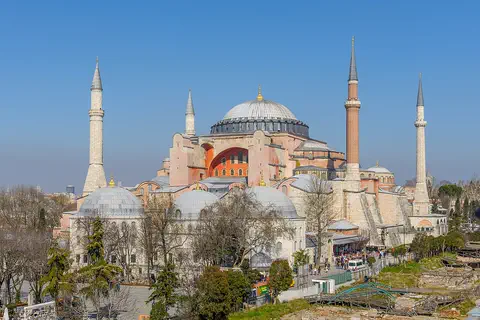
Hagia Sophia
Hagia Sophia in Istanbul was built in under six years, from 532 to 537, for the emperor Justinian. Its enormous dome seems to float on a ring of 40 windows. Over almost 1,500 years it has been a church, a mosque and a museum, and since 2020 it has been a mosque.
- Watch Geography What is a World Heritage Site? World Heritage Sites are places so important that they belong, in a way, to everyone. Under a 1972 agreement, countries nominate their most outstanding places, experts check them, and a UNESCO committee decides. By 2026 the list held 1,273 sites: cultural places like the Taj Mahal, natural places like the Galápagos, and mixed ones like Machu Picchu.
-
Watch
Natural wonder
Aegean Sea
The Aegean Sea is part of the Mediterranean, between Greece and western Turkey. Its many islands are scattered across about 800 kilometers from north to south. On Santorini, a giant eruption about 3,600 years ago left a caldera hundreds of meters deep, partly flooded by the sea.
-
 Watch
Landmark
Abraj Al Bait
Abraj Al Bait is a group of seven hotel towers in Mecca, Saudi Arabia, beside the city's Great Mosque. In the middle rises the Makkah Royal Clock Tower, 601 meters tall to the tip of its spire, with a huge clock near the top. It was finished in 2012.
-
 Watch
Landmark
Agra Fort
Agra Fort is a huge red sandstone fortress beside the Yamuna River in Agra, India. The Mughal emperor Akbar began it in 1565. Its walls, about 2.5 kilometers around, protect palaces, halls and mosques added by later emperors. It was both an army base and a royal home.
For parents & teachers
What children will learn
- Locate Pergamon in western Türkiye and describe it as the hilltop capital of the Attalid kings and later of a Roman province.
- Explain how builders used terraces to build on a steep hill and pressure pipes to bring water up to it.
- Recognize that one place can hold layers from many periods, from Hellenistic to Ottoman.
Recommended ages: 4 to 17 · About 15 minutes
Talk about it
- Why might rulers choose to build their capital on top of a steep hill, and what problems would that cause?
- The Great Altar's friezes are in Berlin, far from Pergamon. What do you think about objects being kept far from where they were made?
- What does it tell us when one building is used as a temple, a church, a synagogue and a mosque over time?
Try at home or in class
- Fill a bendy straw or a short length of clear tubing with water, hold both ends up and move one end higher and lower to see that the water levels stay the same (over a sink).
- Build a hill from sand or cardboard and cut flat terraces into it, then place small blocks on the terraces as buildings.
Key vocabulary: acropolis, terrace, parchment, frieze, aqueduct, burial mound
Where these facts come from
- Wikidata , Wikimedia Foundation (CC0 1.0)
- Pergamon and its Multi-Layered Cultural Landscape , UNESCO World Heritage Centre
- Pergamon (Turkey) No 1457, ICOMOS evaluation, 2014 , ICOMOS, via UNESCO World Heritage Centre
- Museumsinsel Berlin: The Pergamonmuseum returns, reopening on 4.6.2027 , Staatliche Museen zu Berlin
- UNESCO World Heritage List , UNESCO World Heritage Centre (Linked as a reference; site facts come from Wikidata)
- Wikimedia Commons , Wikimedia Foundation (Per file (public domain, CC0, CC BY or CC BY-SA); see each media record)
Checked, not yet human-reviewed. Last updated November 1, 2026. Spotted a mistake? Tell us.