
Landmark Asia
Aqueduct of Valens
The Aqueduct of Valens is a long bridge of arches in Istanbul, Türkiye. Long ago it carried water across a valley into the city!
The Aqueduct of Valens is a bridge of arches in Istanbul, Türkiye, 971 meters long with 86 arches. It carried a water channel across a valley between two hills. It is named after the emperor Valens, and a research project at Radboud University dates its construction to 368 to 373.
The Valens aqueduct bridge (Bozdoğan Kemeri) crosses the valley between Istanbul's Fourth and Third Hills: 971 m long, with 86 arches, it carried a water channel at about 56-57 m above sea level so the high-level Valens Waterway could reach the city's higher ground. Its attribution to the emperor Valens (364-378) rests on texts that the Istanbul-su project at Radboud University calls unreliable; the project's timeline gives construction in 368-373.
Photo: HALUK COMERTEL, CC BY 3.0, via Wikimedia Commons
Discover the Aqueduct of Valens
The Aqueduct of Valens is in Istanbul, a city in Türkiye.
It is a long bridge made of arches, one row on top of another.
The Aqueduct of Valens is an aqueduct bridge in Istanbul, Türkiye. An aqueduct carries water from one place to another. This bridge carried a water channel across a valley between two of the city's hills.
It is 971 meters long and has 86 arches. In Turkish it is called Bozdoğan Kemeri.
The Istanbul-su research database at Radboud University describes the Valens aqueduct bridge as a 971-meter structure with 86 arches, built as part of the Valens Waterway to add to the earlier Hadrian Waterway and meet Constantinople's growing need for water.
UNESCO names the aqueduct of Valens among the architectural achievements of the Historic Areas of Istanbul, inscribed on the World Heritage List in 1985.
- Where
- Istanbul, Türkiye
- Length
- 971 m
- Arches
- 86
- World Heritage Site
- 1985 (Historic Areas of Istanbul)
Water for Constantinople
The aqueduct was built long ago, in Roman times.
It brought water to the city then called Constantinople.
When the aqueduct was built, Istanbul was called Constantinople. The bridge is named after the emperor Valens, who ruled from 364 to 378, and the Istanbul-su research project dates its construction to 368 to 373.
Historians are not completely sure Valens built it: the old writings that name him are not always reliable.
A Byzantine chronicle quoted by the Istanbul-su project says that Valens, in the fourth year of his reign, built the aqueduct; the project's timeline gives construction in 368-373 and an inauguration in 373. Its notes add that this attribution relies on texts it calls unreliable, though the bridge's height shows it could only have belonged to the high-level supply. A fragment of carving on the keystone of Arch 30 suggests it was built, or heavily repaired, in the late 4th or 5th century.
The aqueduct was repaired many times. The chronicler Theophanes records that the emperor Justin II repaired it in 576 and supplied the city with abundant water.
Two rows of arches
The aqueduct has two rows of arches, one on top of the other.
Water flowed along the very top, high above the ground.
Along part of its length, the bridge has two rows of arches, one above the other. Along the top ran a channel for water, about 56 to 57 meters above sea level.
The system was fed by gravity, so the bridge was needed to keep the water flowing across the lower ground of the valley.
As a gravity-fed system, the Valens Waterway needed the bridge to keep the channel high across the lower ground: it ran at about 56-57 m above sea level, high enough to reach the city's higher districts, and inside the walls the waterway probably served installations up to 59.5 m.
The researchers Crow, Bardill and Bayliss (2008) measure the bridge at 971 m long, 3.40 m wide at its lower western end and broadening to 5.65 m over the higher double arcade at Pier 25.
Many repairs
Over hundreds of years, people fixed the aqueduct again and again.
That is why it still stands today.
Rulers of the city repaired the aqueduct many times, first under the Byzantine emperors and later under the Ottoman sultans. One record says five arches in the middle were rebuilt in their old form in the 1690s.
The most recent restoration, by ISKI, ran from 2018 to 2024.
The Istanbul-su timeline lists restorations under Justin II (576), Constantine V (766), Basil II (1020) and Romanos III (1028-1034), and in Ottoman times under Mehmed II, then repairs probably prompted by earthquake damage in 1509, with work recorded in 1536. Under Mustafa II (1696-1697), a surviving building inscription records that five arches in the middle part were renewed in their old form.
For the 766 repair, Theophanes lists the workers gathered: 1,000 masons and 200 plasterers from Asia and Pontos, 500 clay workers from Hellas and the islands, and 5,000 laborers and 200 brickmakers from Thrace. The latest restoration, by ISKI, ran from 2018 to 2024.
- Water channel
- about 56–57 m above sea level
- Width
- 3.40–5.65 m
- Repaired under Justin II
- 576
- Latest restoration
- 2018–2024
Arches over a busy road
In this photo, cars and buses drive under the old arches.
Trees grow beside the aqueduct, under a blue sky.
This photo was taken on 1 May 2010 at Unkapanı in Istanbul. A wide road runs under the arches, with buses and cars, and trees grow at both ends.
Today the bridge is known as Bozdoğan Kemeri, the Aqueduct of the Gray Falcon. It stopped carrying water in the 20th century, and its top is now capped with modern cement.
The photograph (1 May 2010, by HALUK COMERTEL, from Panoramio) shows the double arcade, with a wide road, buses and cars passing beneath the lower arches and trees at both ends.
The Istanbul-su project notes that the aqueduct ceased its original function in the 20th century and that its upper section has been capped with modern cement. Its Turkish name, Bozdoğan Kemeri, means the Aqueduct of the Gray Falcon; Ottoman sources called it Kemer-i âb-ı revan or Eski Kemerler.
Amazing facts
-
Its Turkish name means the Aqueduct of the Gray Falcon!
In Turkish the bridge is called Bozdoğan Kemeri, the Aqueduct of the Gray Falcon.
Today the bridge is known as Bozdoğan Kemeri ('Aqueduct of the Gray Falcon'); Ottoman names included Kemer-i âb-ı revan and Eski Kemerler.
-
Thousands of workers once came to fix the water supply!
When the water supply was restored in 766, an old chronicle says thousands of workers came from many places, including 5,000 laborers from Thrace.
Theophanes lists 1,000 masons, 200 plasterers, 500 clay workers, 5,000 laborers and 200 brickmakers gathered for Constantine V's restoration of 766.
-
The name 'Valens aqueduct' can mean two things!
The name 'Valens aqueduct' is used both for the whole water system and for this bridge, so researchers call the bridge the 'Valens aqueduct bridge'.
The Istanbul-su project notes that 'Valens aqueduct' is used for both the whole waterway and the surviving bridge, and uses 'Valens aqueduct bridge' for the latter to avoid confusion.
Words to know
- aqueduct
- a channel or bridge built to carry water from one place to another
- arch
- a curved opening that holds up the wall or bridge above it
- arcade
- a row of arches side by side
- gravity
- the pull that makes water flow downhill
- pier
- a thick post that holds up a bridge between its arches
- restoration
- repair work that brings an old building back to good condition
Discovery challenge
-
In which city is the Aqueduct of Valens?
The Aqueduct of Valens stands in which city?
Which city, once called Constantinople, does the Valens aqueduct bridge cross?
- Istanbul
- Rome
- Cairo
Show the answer
Istanbul
Istanbul!
Istanbul, in Türkiye.
Istanbul.
-
What did the aqueduct carry?
What did the channel along the top of the aqueduct carry?
What did the Valens Waterway bring to the city's higher districts?
- Water
- Trains
- Oil
Show the answer
Water
Water!
Water.
Water.
-
How many arches does the aqueduct have?
How many arches does the 971-meter bridge have?
How many arches does the Istanbul-su project count on the bridge?
- 86
- 8
- 860
Show the answer
86
86!
86 arches.
86.
-
What made the water flow along the aqueduct?
What moved the water along the Valens Waterway?
What kind of system was the Valens Waterway?
- Gravity
- Pumps
- Wind
Show the answer
Gravity
Gravity! The water flowed downhill.
Gravity.
A gravity-fed system.
-
What does the aqueduct's Turkish name mean?
Bozdoğan Kemeri means the aqueduct of which bird?
Which bird appears in the Turkish name Bozdoğan Kemeri?
- A gray falcon
- A white swan
- A black crow
Show the answer
A gray falcon
A gray falcon!
The gray falcon.
The gray falcon (Aqueduct of the Gray Falcon).
Nearby places
-
 Watch
Landmark
Süleymaniye Mosque
The Süleymaniye Mosque in Istanbul, Türkiye, was designed by the architect Sinan and built between 1550 and 1557 for the Ottoman sultan Süleyman. With the mosque, Sinan built a whole complex of schools, a hospital, an inn for travelers, a kitchen and a bath. It is part of the Historic Areas of Istanbul, a UNESCO World Heritage Site since 1985.
-
 Watch
Landmark
Sultan Ahmed Mosque
The Sultan Ahmed Mosque in Istanbul was built between 1609 and about 1616 for the Ottoman ruler Sultan Ahmed I. Its central dome is ringed by half-domes and smaller domes, and six slender minarets rise around it. Many people call it the Blue Mosque because of the blue and green tiles and painted decoration inside. It is still a working mosque, where Muslims come to pray.
-
 Watch
Landmark
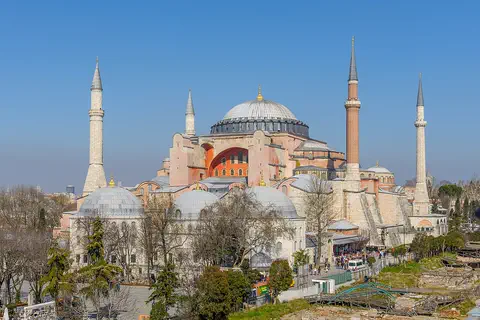
Hagia Sophia
Hagia Sophia in Istanbul was built in under six years, from 532 to 537, for the emperor Justinian. Its enormous dome seems to float on a ring of 40 windows. Over almost 1,500 years it has been a church, a mosque and a museum, and since 2020 it has been a mosque.
-
 Watch
Landmark
Topkapı Palace
Topkapı Palace sits on a point of land where the Bosphorus Strait meets the sea in Istanbul. Sultan Mehmed II built it between 1460 and 1478, and for nearly 400 years it was the home of the Ottoman sultans and the center of their government. In 1924 it became a museum.
-
 Watch
City
Istanbul
Istanbul is the biggest city in Türkiye, built on both sides of the Bosporus, the narrow strait between Europe and Asia. Once called Byzantium and then Constantinople, it was the capital of two great empires. About 15.7 million people lived in Istanbul province in 2023.
-
 Watch
Natural wonder
Sea of Marmara
The Sea of Marmara is a small inland sea between the Black Sea and the Aegean Sea, joined to them by two narrow straits. A big fault runs across its floor, and its water comes in two layers: less salty water from the Black Sea on top, and saltier Mediterranean water below.
-
 Watch
Landmark
Selimiye Mosque
The Selimiye Mosque in Edirne, Türkiye, was built from 1569 to 1575 for the Ottoman sultan Selim II. Its architect, Sinan, called it his masterpiece. A single great dome rests on eight supports, and four minarets about 71 meters tall stand around it. It became a UNESCO World Heritage Site in 2011.
-
 Watch
Landmark
Pergamon
Pergamon is an ancient city in western Türkiye, built on a steep hill above the Bakırçay Plain. It was the capital of the Attalid kings from the 3rd century BC and later of a Roman province. UNESCO says its kings founded one of the largest libraries, and it is a UNESCO World Heritage Site.
Explore next
-
 Watch
 Country
Türkiye (Turkey)
Türkiye, also called Turkey, lies partly in Asia and partly in Europe. A narrow waterway called the Bosporus runs through its biggest city, Istanbul, and its land is mostly mountains and high plains. About 86 million people live there.
-
Watch
City
Istanbul
Istanbul is the biggest city in Türkiye, built on both sides of the Bosporus, the narrow strait between Europe and Asia. Once called Byzantium and then Constantinople, it was the capital of two great empires. About 15.7 million people lived in Istanbul province in 2023.
-
 Watch
Landmark
Aqueduct of Segovia
The Aqueduct of Segovia is a Roman aqueduct in central Spain that carried water into the city of Segovia. Built about 2,000 years ago from big granite blocks set without mortar, it crosses the city on two tiers of arches up to about 28 meters high. It is the symbol of Segovia.
-
 Watch
Landmark
Aachen Cathedral
Aachen Cathedral in western Germany grew around the Palatine Chapel, the chapel of Emperor Charlemagne's palace, built around the year 800 with eight sides and a dome. A tall Gothic choir with very tall windows, called the Glass House, was added from 1355 to 1414. German kings were crowned here until 1531, and in 1978 it became a World Heritage Site.
-
 Watch
Landmark
Acropolis of Athens
The Acropolis is a steep, flat-topped rock in the middle of Athens. Walls have ringed its top for more than 3,300 years. In the 400s BCE, the Athenians built a grand gateway and three temples there, including the Parthenon. Restorers are still repairing them today.
-
 Watch
Landmark
Afsluitdijk
The Afsluitdijk is a dike 32 kilometers long in the Netherlands. It runs between the provinces of North Holland and Friesland and closes off the IJsselmeer lake from the Wadden Sea. Its last gap was closed on 28 May 1932, and for more than 90 years it has helped protect a large part of the country from floods.
-
 Watch
Landmark
Alhambra
The Alhambra is a palace and fortress above the city of Granada, in Spain. The Nasrid rulers built most of it between 1238 and 1358. It is famous for its courtyards, fountains, carved plaster and tiles, and the gardens of the Generalife next door.
-
 Watch
Landmark
Amphitheater of Durrës
The Amphitheater of Durrës is a Roman amphitheater in the center of the coastal city of Durrës, in Albania. It could hold 15,000 to 20,000 spectators. It lay hidden under the city until 1966, when it was found by chance.
For parents & teachers
What children will learn
- Explain how an aqueduct uses gravity to move water.
- Describe why a bridge of arches was needed to cross a valley.
- Explain why historians are sometimes unsure who built something.
Recommended ages: 4 to 17 · About 15 minutes
Talk about it
- Why would a growing city need more water?
- Why did people keep repairing the aqueduct for so many centuries?
- How can researchers find out when a building was made?
Try at home or in class
- Make a channel from a bent strip of card or a cut bottle and tilt it gently: pour water in and watch gravity move it.
- Find Istanbul on a map and see how the city sits on hills beside the water.
Key vocabulary: aqueduct, arch, arcade, gravity, pier, restoration
Where these facts come from
- Wikidata , Wikimedia Foundation (CC0 1.0)
- Valens aqueduct bridge (installation details) , Istanbul-su, Radboud University Nijmegen
- Historic Areas of Istanbul , UNESCO World Heritage Centre
- File:Unkapanı -İstanbul - panoramio.jpg , Wikimedia Commons
- Wikimedia Commons , Wikimedia Foundation (Per file (public domain, CC0, CC BY or CC BY-SA); see each media record)
Checked, not yet human-reviewed. Last updated November 1, 2026. Spotted a mistake? Tell us.