
Natural wonder Africa
Lake Malawi
Lake Malawi is a deep lake in Africa. Hundreds of kinds of colorful fish live in it.
Lake Malawi is one of the African Great Lakes, in the Great Rift Valley. UNESCO calls it one of the deepest lakes in the world, and it holds many hundreds of kinds of cichlid fish, nearly all found nowhere else.
Lake Malawi, in the Great Rift Valley, is one of the deepest lakes in the world (UNESCO) and, according to ESA, the third largest lake in Africa. Its isolated waters hold up to about 1,000 fish species, including over 350 mbuna cichlids, nearly all endemic.
Photo: Joachim Huber, CC BY-SA 2.0, via Wikimedia Commons
Discover Lake Malawi
Lake Malawi is a lake in Africa. It is one of the deepest lakes in the world.
In this photo, calm blue water lies beyond a sandy beach with dark rocks.
Lake Malawi is one of the African Great Lakes. The European Space Agency (ESA) calls it the third largest lake in Africa, and UNESCO calls it one of the deepest lakes in the world. UNESCO lists three countries around it: Malawi, Tanzania and Mozambique.
This photo by Joachim Huber, taken on 20 March 2007, shows a quiet shore in Malawi: pale sand, dark rocks and bushes, calm water and far hills, framed by tree branches.
Lake Malawi is one of the African Great Lakes; ESA ranks it the third largest lake in Africa and UNESCO one of the deepest lakes in the world. UNESCO notes that the lake's conservation and management fall to three states: Malawi, Tanzania and Mozambique.
The photo (Joachim Huber, CC BY-SA 2.0, 20 March 2007) shows a lakeshore in Malawi with pale sand, dark boulders, shrubs, calm water and distant hills under leafy branches.
- Where
- Great Rift Valley, East Africa
- Fish species
- up to about 1,000 (estimate)
- Lake Malawi National Park
- World Heritage Site since 1984
A lake in the Rift Valley
Lake Malawi lies in a long valley called the Great Rift Valley.
Its water is very deep and very clear.
Lake Malawi lies in the Great Rift Valley, which ESA describes as a geological fault system of East Africa and Southwest Asia. A string of lakes in and around the valley is known as the Great Lakes of Africa.
ESA calls Lake Malawi one of the world's few ancient lakes, with a long, uninterrupted history. It gives a depth of 750 meters. UNESCO notes the lake's remarkably clear water, set against the escarpment of the Rift Valley.
ESA's 2010 Envisat image caption places Lake Malawi in the Great Rift Valley, a geological fault system of Southwest Asia and East Africa, and calls it one of the world's few ancient lakes with a unique uninterrupted history; its deep (750 m), isolated waters shaped a unique diversity of fish.
UNESCO describes islands and clear waters set against the Great African Rift Valley escarpment, with granitic hills rising steeply from the lakeshore.
A lake full of cichlids
Small, brightly colored fish called mbuna live among the rocks.
Almost all of them live only in Lake Malawi.
UNESCO says Lake Malawi may hold up to about 1,000 kinds of fish, estimated as the most fish species of any lake in the world. Among them are the cichlids: of more than 350 kinds of mbuna, the small, brightly colored rock-shore cichlids, all but five live only in this lake.
Cut off from other waters, the fish evolved into many new species. UNESCO compares their value to science with the finches of the Galápagos Islands.
UNESCO estimates up to c. 1,000 fish species in Lake Malawi, about half in the national park: the largest number of fish species of any lake in the world. Of over 350 species of mbuna (small, brightly colored rocky-shore cichlids), all but five are endemic, and the lake holds 30% of all known cichlid species.
Isolation from other water bodies drove adaptive radiation and speciation; the cichlids are considered of equal value to science as Darwin's Galápagos finches or Hawaii's honeycreepers. The park is also rich in mammals, birds and reptiles.
Beaches, rocks and islands
The lake has sandy beaches, rocky shores and islands.
Hills rise steeply from the water.
Lake Malawi National Park lies at the southern end of the lake. UNESCO describes its shores as a mix of rocky shorelines and sandy beaches, wooded hillsides, swamps and lagoons, with granite hills rising steeply from the water and a number of sandy bays.
In July 2024 an astronaut on the International Space Station photographed Kasankha Bay, in the southern part of the lake, where sunlight made the water look like glass.
Lake Malawi National Park (World Heritage, 1984; 94.1 km², of which 7 km² is aquatic) lies at the southern end of the lake. Habitats range from rocky shorelines to sandy beaches and from wooded hillsides to swamps and lagoons; granitic hills rise steeply from the shore (UNESCO).
The park's water area protects all major underwater vegetation types and important cichlid breeding sites. On 21 July 2024 NASA astronaut Matthew Dominick photographed Kasankha Bay from the International Space Station.
Visiting safely
Wear a life jacket in and around the lake.
Always swim with a buddy and a grown-up watching.
The US Centers for Disease Control and Prevention (CDC) says children should wear life jackets for all activities in and around natural water such as lakes, and a grown-up should watch them closely the whole time.
Lakes can hide dangers such as currents, waves, rocks and water you cannot see through, so always swim with a buddy. Inside the national park, UNESCO notes, use of the park's resources is restricted to stop illegal harvesting.
The CDC advises life jackets for children in all activities in and around natural water, close and constant supervision by a designated adult, and the buddy system; lakes have hidden hazards such as currents, waves, rocks, vegetation and limited visibility.
UNESCO notes that use of park resources is restricted to curb illegal harvesting, and that many of the lake's fish lie outside the park, so the lake's long-term health depends on conservation of the whole lake.
Amazing facts
-
Lake Malawi may have more kinds of fish than any other lake.
UNESCO estimates up to about 1,000 kinds of fish in Lake Malawi, the largest number of fish species of any lake in the world.
With an estimated c. 1,000 fish species, Lake Malawi is estimated to hold the largest number of fish species of any lake in the world (UNESCO).
-
UNESCO calls Lake Malawi's fish an outstanding example of evolution.
UNESCO says Lake Malawi's cichlids are as important to science as the Galápagos finches that Charles Darwin wrote about.
UNESCO: the cichlids are considered of equal value to science as Darwin's Galápagos finches or the honeycreepers of Hawaii.
-
From space, the lake's water can shine like glass.
In 2024 a NASA astronaut photographed Kasankha Bay from the space station, where sunlight made the water look nearly like glass.
On 21 July 2024 Matthew Dominick photographed Kasankha Bay from the ISS, 262 miles above the Great Rift Valley; reflected sunlight gave the water a near glass-like look (NASA).
Words to know
- cichlid
- a family of freshwater fish with very many species, many of them colorful
- endemic
- found naturally in one place and nowhere else
- rift valley
- a long valley formed along faults in the Earth's crust
- adaptive radiation
- when one kind of living thing evolves into many species suited to different ways of life
- escarpment
- a long, steep slope or cliff
Discovery challenge
-
On which continent is Lake Malawi?
Lake Malawi is one of the Great Lakes of which continent?
Lake Malawi belongs to the Great Lakes of which continent?
- Africa
- South America
- Europe
Show the answer
Africa
Africa.
Africa: it is one of the African Great Lakes.
Africa (the Great Lakes of Africa, in and around the Great Rift Valley).
-
Which colorful fish live among the rocks in Lake Malawi?
What are Lake Malawi's small, brightly colored rock-shore cichlids called?
Which rocky-shore cichlids have over 350 species, all but five endemic to Lake Malawi?
- Mbuna
- Salmon
- Sharks
Show the answer
Mbuna
Mbuna, a kind of cichlid.
Mbuna, small brightly colored cichlids.
Mbuna (UNESCO).
-
In which long valley is Lake Malawi?
In which great valley does Lake Malawi lie?
Which fault system does ESA place Lake Malawi in?
- The Great Rift Valley
- The Grand Canyon
- Death Valley
Show the answer
The Great Rift Valley
The Great Rift Valley.
The Great Rift Valley of East Africa.
The Great Rift Valley (ESA).
-
Which birds are Lake Malawi's fish compared with?
UNESCO compares Lake Malawi's cichlids with which birds?
UNESCO rates the cichlids of equal value to science as which birds Darwin remarked on?
- The Galápagos finches
- Penguins
- Parrots
Show the answer
The Galápagos finches
The finches of the Galápagos Islands.
The Galápagos finches that Charles Darwin wrote about.
The Galápagos finches (and Hawaii's honeycreepers).
-
What should children wear in and around a lake?
What does the CDC say children should wear in and around natural water?
Which safety gear does the CDC advise for children in all activities around natural water?
- A life jacket
- A winter coat
- Nothing special
Show the answer
A life jacket
A life jacket.
A life jacket, and a grown-up watching closely.
Life jackets, with close and constant adult supervision and the buddy system.
Nearby places
-
 Watch
City
Lilongwe
Lilongwe is the capital of Malawi, in southern Africa. It grew from a market village, and a new capital city was built next to it and opened in 1975. It lies on a high plateau about 1,100 meters above sea level, and Malawi's statistics office projected 1,162,500 people for it in 2023.
-
 Watch
Natural wonder
Selous Game Reserve
The Selous Game Reserve in Tanzania is one of the largest protected areas in Africa. UNESCO says it holds some of the most important groups of elephants, black rhinos, cheetahs, giraffes, hippos and crocodiles.
-
 Watch
City
Lusaka
Lusaka is the capital of Zambia, an African country with no coast. Zambia's 2022 census counted 2,212,301 people in the city, by far the most in the country. Lusaka was planned in the 1930s as a new capital and officially opened in 1935.
-
 Watch
Landmark
Kariba Dam
The Kariba Dam is a curved concrete dam across the Zambezi River, between Zambia and Zimbabwe. It is 128 meters high. It was built between 1956 and 1960, and its lake, Lake Kariba, is 280 kilometers long. Two power stations use the water to make electricity.
-
 Watch
City
Dar es Salaam
Dar es Salaam is the largest city of Tanzania, on the coast of the Indian Ocean in East Africa. It was founded in 1862 beside a harbor that was good for ships. In the 2022 census, 5,383,728 people were counted there.
-
 Watch
City
Zanzibar City
Zanzibar City is the main town of Zanzibar island, off the coast of Tanzania in the Indian Ocean. Its old quarter, Stone Town, is a UNESCO World Heritage Site, a Swahili trading town shaped by Africa, the Arab region, India and Europe. Tanzania's 2022 census counted 709,809 people in the city.
-
 Watch
Natural wonder
Lake Tanganyika
Lake Tanganyika lies in a deep crack in Africa called a rift valley. Britannica calls it the longest freshwater lake in the world, and only Lake Baikal, in Russia, is deeper. Four countries share it: Tanzania, the Democratic Republic of the Congo, Burundi and Zambia. Its water is home to about 250 kinds of cichlid fish found nowhere else.
-
 Watch
City
Moroni
Moroni is the capital and largest town of the Comoros, a country of islands in the Indian Ocean. It lies on the southwest coast of the island of Grande Comore. In the 2017 census, 74,749 people were counted there.
Explore next
-
 Watch
Natural wonder
Great Rift Valley
The Great Rift Valley is a huge valley that runs through East Africa, where the continent is slowly being stretched and pulled apart. Long, steep cliffs line its sides, its floor holds lakes full of flamingos, and giant volcanoes such as Kilimanjaro and Mount Kenya rose beside it. Scientists think a new ocean may one day open here.
-
Watch
Natural wonder
Lake Tanganyika
Lake Tanganyika lies in a deep crack in Africa called a rift valley. Britannica calls it the longest freshwater lake in the world, and only Lake Baikal, in Russia, is deeper. Four countries share it: Tanzania, the Democratic Republic of the Congo, Burundi and Zambia. Its water is home to about 250 kinds of cichlid fish found nowhere else.
-
 Watch
Natural wonder
Lake Victoria
Lake Victoria is the largest lake in Africa, and Britannica says only Lake Superior, in North America, is a bigger freshwater lake. It is shared by Kenya, Tanzania and Uganda. The lake is wide but shallow, its only outlet is the Nile, and it is home to hundreds of kinds of colorful fish called cichlids.
-
 Watch
 Country
Malawi
Malawi is a narrow country in southeastern Africa that curves along the Great Rift Valley. Lake Malawi, one of the deepest lakes in the world, covers more than a fifth of the country, and it is home to hundreds of kinds of colorful fish. About 21 million people lived there in 2026.
- Watch Geography What is a World Heritage Site? World Heritage Sites are places so important that they belong, in a way, to everyone. Under a 1972 agreement, countries nominate their most outstanding places, experts check them, and a UNESCO committee decides. By 2026 the list held 1,273 sites: cultural places like the Taj Mahal, natural places like the Galápagos, and mixed ones like Machu Picchu.
-
 Watch
 Country
Mozambique
Mozambique stretches along the Indian Ocean coast of southeastern Africa. The great Zambezi River cuts through its middle, its beaches face the island of Madagascar, and parks like Gorongosa are home to elephants and lions. About 35.6 million people lived there in 2025, and Portuguese is the official language.
-
 Watch
Natural wonder
Victoria Falls
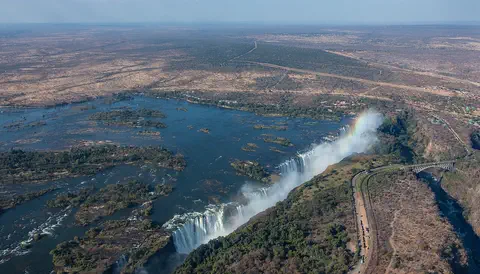
Victoria Falls, on the Zambezi River between Zambia and Zimbabwe, is about 1,708 meters wide and up to 108 meters deep. UNESCO calls it the largest curtain of falling water in the world, and its spray can be seen from tens of kilometers away.
-
 Watch
Natural wonder
Sahara
The Sahara fills almost all of northern Africa. Britannica calls it the largest hot desert in the world: about 4,800 kilometers from east to west and about 8.6 million square kilometers in all. Only about a quarter of it is sand dunes; the rest is gravel plains, rocky plateaus and mountains.
For parents & teachers
What children will learn
- Locate Lake Malawi in the Great Rift Valley of East Africa.
- Explain how isolation can lead to many new species.
- Describe the cichlid fish that make Lake Malawi important to scientists.
- Know how to stay safe in and around lakes.
Recommended ages: 3 to 17 · About 15 minutes
Talk about it
- Why might fish in an isolated lake evolve into many different species?
- Why do scientists compare Lake Malawi's cichlids with Darwin's finches?
- Why might a park protect only part of a lake's fish?
Try at home or in class
- Draw one 'starting' fish, then draw five new versions suited to rocks, sand, open water, plants and deep water.
- On a map of Africa, find the Great Rift Valley and the lakes along it, including Lake Malawi.
Key vocabulary: cichlid, endemic, rift valley, adaptive radiation, escarpment
Where these facts come from
- Wikidata , Wikimedia Foundation (CC0 1.0)
- Lake Malawi National Park (World Heritage List) , UNESCO World Heritage Centre
- Lake Malawi, Great Rift Valley , European Space Agency
- Kasankha Bay , NASA
- Preventing Drowning , US Centers for Disease Control and Prevention
- File:Lake Malawi, Malawi (2499200974).jpg , Wikimedia Commons
- Natural Earth vector data , Natural Earth (NACIS) (Public domain)
- Wikimedia Commons , Wikimedia Foundation (Per file (public domain, CC0, CC BY or CC BY-SA); see each media record)
Checked, not yet human-reviewed. Last updated November 1, 2026. Spotted a mistake? Tell us.