
Animal
Black swan
The black swan is a big black bird with a bright red beak. When it flies, you can see white feathers on its wings. It lives in Australia and New Zealand.
The black swan is the only swan in the world that is almost entirely black. It has a bright red bill with a white band near the tip, and white flight feathers that flash when it flies. It is native to Australia and New Zealand, and people have taken it to other countries too.
Cygnus atratus is a large swan of the family Anatidae, native to Australia and, by the IUCN's listing and New Zealand's own, to New Zealand, although people also released black swans there in the 1860s. Entirely herbivorous, it grazes submerged plants, nests as territorial pairs or in colonies, and is listed as Least Concern with a stable population.
Photo: W. Bulach, CC BY-SA 4.0, via Wikimedia Commons
Meet the black swan
The black swan is big and black.
Its beak is bright red with a white stripe near the end. Its eyes are red too. When it flies, white feathers show on its wings.
The black swan is the only swan in the world that is almost entirely black. It is 120 to 142 centimeters long, with a long neck and a bright red bill with a narrow white band near the tip. Its eyes are red, and its legs are dark gray.
When it opens its wings, big white flight feathers show at the wingtips, which is why black swans look black and white in the air. Females are noticeably smaller than males. Young swans are grayer, with black wing tips.
Cygnus atratus is a swan of the waterfowl family, Anatidae. The Australian Museum gives a size range of 120 to 142 centimeters; NZ Birds Online lists weights of 5 to 7 kilograms for males and 4 to 6 kilograms for females, with females noticeably smaller. The Australian Museum and BirdLife Australia both describe it as the only entirely black swan in the world.
Adults are mostly black, with broad white flight feathers that show in flight, a deep orange-red bill with a narrow white subterminal band, red eyes and dark gray legs. The upper wing feathers (coverts and tertials) are elaborately crinkled. Cygnets are gray with a black bill; newly fledged young are dull grayish-brown, and immatures have black-tipped flight feathers.
Quick facts
- Group
- Bird
- Length
- 1.2 to 1.42 m
- Wingspan
- 1.6 to 2 m
- Weight
- 4 to 7 kg
- Lifespan in the wild
- up to 15 years
Where it lives
Black swans come from Australia.
They live on lakes, rivers, bays and wetlands. Lots of black swans live in New Zealand too.
Black swans are native to Australia, where they live almost everywhere except Cape York Peninsula in the far north, and are most common in the south. They like large lakes, rivers, estuaries and permanent wetlands, with fresh, salty or brackish water.
A swan needs 40 meters or more of open water to take off. Where wetlands dry out, black swans fly long distances to find water, often at night. Black swans also live wild across New Zealand. People released some there in the 1860s, but so many appeared so quickly that experts think others flew there from Australia on their own, and New Zealand counts the black swan as a native bird. People have also taken black swans to other countries.
The Australian Museum describes black swans throughout Australia except Cape York Peninsula, more common in the south. They use larger salt, brackish or fresh waterways and permanent wetlands, needing 40 meters or more of clear water to take off. BirdLife Australia notes they stay year-round where wetlands are permanent but disperse widely when wetlands dry, even reaching isolated desert waterholes.
In New Zealand, NZ Birds Online reports deliberate introductions from Melbourne in the 1860s, while the birds' spread within a few years suggests natural colonization happened as well; it gives the species' New Zealand status as native, and the national population was about 50,000 in 2011. The IUCN's 2018 global assessment also lists Australia and New Zealand as native breeding range, with an introduced resident population in Spain. The Australian Museum, by contrast, names New Zealand among several countries where the black swan was introduced.
Continent
Its habitat

Where can you find this animal?
- Brought here by people · Countries and seas named by a scientific source
- Lives here naturally · Countries and seas named by a scientific source
- Sightings recorded · Records of wild sightings (GBIF)
Brought here by people · Countries and seas named by a scientific source
The IUCN lists an introduced population living in Spain all year.
Places: Spain.
Source: iucn-red-list · checked October 2026
Lives here naturally · Countries and seas named by a scientific source
Lakes, rivers, estuaries and wetlands throughout Australia except Cape York Peninsula, most common in the south, and lakes and estuaries across New Zealand. The IUCN lists both as native breeding range, and New Zealand lists the black swan as native, although people also released birds there from Melbourne in the 1860s.
Places: Australia and New Zealand.
Source: iucn-red-list · checked October 2026
Sightings recorded · Records of wild sightings (GBIF)
Counts of GBIF records of wild observations (human and machine) and preserved specimens. Records include introduced populations, vagrants, escaped or released animals and misidentifications, so a country with records is not necessarily part of the native range.
Wild sightings have been recorded in Australia, New Zealand, Netherlands, Belgium, France, UK, United States, Germany and 65 more places.
Source: gbif · checked October 2026
Range maps show where scientists say an animal lives, often country by country. An animal may live in only part of a country shown, and sightings records can include animals that wandered far from home.
A plant eater
Black swans only eat plants.
They dip their long necks into the water to pull up water weeds. Sometimes they eat grass on land.
Black swans are vegetarians. They eat water plants and algae, which they reach by plunging their long necks into water up to about 1 meter deep.
When the water is too deep or the water plants are scarce, black swans walk or swim to the shore and graze on grass, even though they are clumsy walkers. In estuaries they feed on beds of eelgrass, especially near places where fresh water flows in.
Black swans are entirely herbivorous. NZ Birds Online lists preferred submerged freshwater plants such as Egeria, Elodea, Potamogeton and Myriophyllum, and Ruppia in brackish water; in estuaries the main food is the seagrass Zostera, favored near streams or channels carrying fresh water.
The Australian Museum notes they reach plants by plunging the neck into water up to 1 meter deep. When lake levels are high or plants are sparse, swans graze lakeside pasture. In New Zealand, the loss of aquatic plants from eutrophic lowland lakes has greatly reduced swan numbers and made the remaining birds more reliant on lakeside plants and grasses, and some lakeside farmers object to swans grazing their pastures.
Did you know?
The black swan is the only swan that is almost all black.
The Australian Museum calls the black swan the only entirely black-colored swan in the world.
Both the Australian Museum and BirdLife Australia describe it as the world's only entirely black swan.
Black and white wings
Black swans have crinkly black feathers on their backs.
Their long necks reach down for food. On land they walk slowly and wobble.
A black swan's long neck lets it reach water plants far below the surface. On its back, the black wing feathers are crinkled and curly, and the male raises them in displays.
Black swans are slow, graceful swimmers but clumsy walkers. When they fly, their bright white flight feathers make a whistling sound. In January and February, many New Zealand swans gather on estuaries to replace their feathers, and they cannot fly until the new ones grow.
The long neck allows feeding on submerged vegetation up to about 1 meter down. The larger male raises the elaborately crinkled coverts and tertials in sexual and threat displays. On land black swans walk slowly and awkwardly; in flight they labor, and the conspicuous white flight feathers produce a whistling sound.
In New Zealand, birds gather in large flocks on selected estuaries in January and February to molt, and are flightless during that time. Pairs greet each other with head flicks and a musical bugling call, and swans hiss when defending young or threatening.
Cygnets on board
Black swan parents build a messy nest of reeds and grass.
The mother lays about five or six pale green eggs. Fluffy gray cygnets can swim and feed as soon as they hatch.
Black swans build an untidy nest of reeds and grass on a small island or floating in deeper water. In New Zealand a pair usually lays 5 to 6 pale green eggs, and the parents keep them warm for about 36 days, mostly the female.
The cygnets are covered in gray down and can swim and feed themselves as soon as they hatch. They fly at about 120 days old, but families may stay together for several months more.
The Australian Museum notes breeding from February to May in the north of Australia and June to September in the south; pairs nest alone or in small colonies, building an untidy nest of reeds and grasses on an island or floating in deeper water, and pair for life. Clutches of up to 10 are recorded.
NZ Birds Online gives an average of 5 to 6 pale green eggs, incubated for about 36 days (32 to 40) mostly but not only by the female. Young are precocial, fledge at about 120 days and may stay with their parents for several months. In colonies, females sometimes lay in unattended nests, giving clutches of 7 to 14, and where food is plentiful a pair may raise a second brood.

Pairs for life
Black swan partners stay together.
They greet each other by flicking their heads and calling. They hiss if anyone comes near their babies.
Black swans pair for life, and even in big flocks they seem to stay close to their partners. Partners greet each other with head flicks and trumpeting, bugle-like calls.
Some pairs nest alone and defend a pond or part of a lake. In other places many pairs nest close together in colonies. Outside the breeding season, black swans may travel long distances, flying at night and resting in flocks during the day.
Most breeding is by monogamous territorial pairs defending all or part of a pond or lake edge, though colonial nesting occurs on large lakes with rich plant beds and falling water levels. NZ Birds Online notes that such colonial nesting is now rare in New Zealand because most lowland lakes are eutrophic, and that colonies show considerable mating promiscuity.
Pairs perform elaborate greetings of head flicks and trumpeting. A large part of the population stays in flocks on fresh and estuarine waters year-round, and in Australia birds travel long distances outside the breeding season, flying at night and resting with other swans by day.
Did you know?
Black swans need a long stretch of water to take off.
A black swan needs 40 meters or more of clear water to take off, a bit like a plane needs a runway.
Takeoff requires at least 40 meters of clear water.
Common, and sometimes a problem
There are lots of black swans.
They need lakes with plenty of water plants to eat. Lakes full of water plants help swans.
Black swans are listed as Least Concern, and their numbers are stable. New Zealand had about 50,000 black swans in 2011, fewer than in the past, mostly because water plants have disappeared from many lowland lakes.
In New Zealand, black swans are a game bird that people are allowed to hunt in most areas. Some farmers do not want swans eating their pastures. Lakes with healthy beds of water plants help swans.
The IUCN lists the black swan as Least Concern (global assessment, 2018) with a stable trend; the global number of mature individuals is not given. In New Zealand the national population was about 50,000 in 2011, reduced from former levels by the loss of aquatic plants from eutrophic lowland lakes.
There the species is a legal game bird in most areas, with up to 7,000 shot each year (2011), and is unprotected on the Chatham Islands, where eggs are collected to control numbers. Some lakeside farmers ask Fish & Game councils to harass or cull swans that graze pasture, especially in winter.
IUCN Red List
How is the black swan doing in the wild?
- Least Concern (this animal)
- Near Threatened
- Vulnerable
- Endangered
- Critically Endangered
- Extinct in the Wild
- Extinct
Least Concern
Not at risk of disappearing from the wild right now.
See the IUCN Red List assessment · The IUCN Red List of Threatened Species 2021.3
Amazing facts
-
The black swan is the only swan that is almost all black.
The Australian Museum calls the black swan the only entirely black-colored swan in the world.
Both the Australian Museum and BirdLife Australia describe it as the world's only entirely black swan.
-
Black swans need a long stretch of water to take off.
A black swan needs 40 meters or more of clear water to take off, a bit like a plane needs a runway.
Takeoff requires at least 40 meters of clear water.
-
Black swan wings whistle when they fly.
The white flight feathers of black swans make a whistling sound in flight.
Conspicuous white remiges produce a whistling sound in the black swan's laboring flight.
-
Black swans fly at night.
Outside the nesting season, black swans travel long distances, flying at night and resting with other swans by day.
Dispersal flights are made at night; birds rest in company during the day.
Words to know
- cygnet
- a baby swan
- herbivore
- an animal that eats only plants
- introduced
- brought by people to a place where it did not live before
- molt
- to shed old feathers and grow new ones
- estuary
- the wide mouth of a river where fresh water meets the sea
- eutrophic
- describing water so full of nutrients that algae take over
Discovery challenge
-
What color is a black swan's beak?
What color is an adult black swan's bill?
Describe the adult black swan's bill.
- Red with a white band
- Yellow
- Black
Show the answer
Red with a white band
It is bright red with a white stripe near the end.
Bright red, with a narrow white band near the tip.
Deep orange-red with a narrow white subterminal band; cygnets have black bills.
-
Where do black swans come from?
In which country do black swans live almost everywhere except Cape York Peninsula?
Which country's native black swans range everywhere except Cape York Peninsula?
- Australia
- Canada
- Brazil
Show the answer
Australia
They come from Australia, and many live in New Zealand too.
Australia. They are native to New Zealand too, and people have taken them to other countries.
Australia, where they are most common in the south; New Zealand is also native range (IUCN), although birds were released there in the 1860s.
-
What do black swans eat?
What do black swans eat?
What kind of diet does the black swan have?
- Only plants
- Mostly fish
- Insects and worms
Show the answer
Only plants
They eat only plants, like water weeds.
They are vegetarians, eating water plants, algae and sometimes grass.
Entirely herbivorous: submerged plants, Zostera in estuaries, and pasture when needed.
-
What color feathers show when a black swan flies?
Which feathers flash when a black swan flies?
What makes a flying black swan look black and white?
- White flight feathers
- Blue tail feathers
- Green head feathers
Show the answer
White flight feathers
White feathers show on its wings.
Its white flight feathers, at the wingtips.
White remiges, normally hidden at rest, conspicuous in flight.
Places where you might see it
-
 Watch
 Country
Australia
Australia is a country and the smallest continent, surrounded by ocean in the Southern Hemisphere. Much of its middle is dry and flat, most people live near the coast, and its animals include kangaroos, koalas and the platypus, a mammal that lays eggs.
-
 Watch
 Country
New Zealand
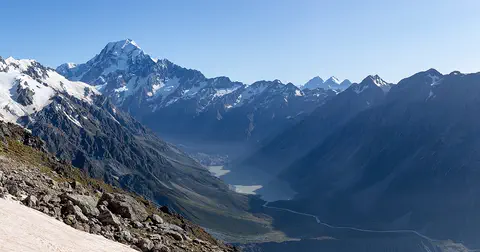
New Zealand, also called Aotearoa, is an island country in the South Pacific. Its two main islands have snowy mountains, glaciers, volcanoes and deep fiords, and about 5.36 million people lived there in 2026.
Explore next
-
 Watch
Animal
Mute swan
The mute swan is among the largest waterfowl, all white with an orange bill topped by a black knob. It is native to Europe and Asia, where it lives on lakes, rivers and park ponds. People took mute swans to North America and other places, where they now live in the wild and can cause problems for native wildlife.
-
 Watch
Animal
Emu
The emu is Australia's tallest native bird and the second-largest bird in the world, after the ostrich. It cannot fly, but it can sprint at about 48 kilometers an hour. Emus are famous fathers: the male sits on the eggs for about eight weeks without eating, then looks after the striped chicks.
-
 Watch
Animal
Laughing kookaburra
The laughing kookaburra is one of the larger members of the kingfisher family. It lives in the woodlands of eastern Australia, pounces on insects, worms and small animals, and lives in family groups. Its famous 'laugh' is really a territorial call that warns other birds to stay away.
-
Watch
Country
Australia
Australia is a country and the smallest continent, surrounded by ocean in the Southern Hemisphere. Much of its middle is dry and flat, most people live near the coast, and its animals include kangaroos, koalas and the platypus, a mammal that lays eggs.
-
Watch
Country
New Zealand
New Zealand, also called Aotearoa, is an island country in the South Pacific. Its two main islands have snowy mountains, glaciers, volcanoes and deep fiords, and about 5.36 million people lived there in 2026.
-
 Watch
Animal
Adélie penguin
The Adélie penguin is a medium-sized penguin, about 70 centimeters tall, with a black back, a white front and a bright white ring around each eye. It breeds in summer on rocky, ice-free ground all around Antarctica, building nests of pebbles, and spends the winter far out at sea among the pack ice.
-
 Watch
Animal
African fish eagle
The African fish eagle is a big eagle of Africa's lakes, rivers and coasts, with a white head, chest and tail and a chestnut-brown body. It snatches fish from the surface of the water, and its loud, ringing call is one of the best-known sounds of Africa.
-
 Watch
Animal
African penguin
The African penguin is a penguin of warm, sunny coasts. It lives only in South Africa and Namibia, nests in burrows and under bushes, and hunts sardines and anchovies in the cold sea. Its numbers have fallen so far that it is now Critically Endangered, and people are working hard to protect it.
For parents & teachers
What children will learn
- Describe a black swan and how young swans differ from adults.
- Explain what black swans eat and how they feed.
- Describe black swan nesting, cygnets and pair bonds.
- Explain the difference between the native range in Australia and New Zealand and introduced populations elsewhere, such as Spain.
Recommended ages: 3 to 17 · About 15 minutes
Talk about it
- Why might a large swan need a long stretch of water to take off?
- How could polluted lakes affect animals that eat water plants?
- Why do you think people took animals like black swans to other countries long ago?
Try at home or in class
- Measure 40 meters outside (for example, along a sports field) to see how much open water a black swan needs to take off.
- Compare pictures of a black swan and a mute swan and list the differences you can see.
Key vocabulary: cygnet, herbivore, introduced, molt, estuary, eutrophic
Where these facts come from
- The IUCN Red List of Threatened Species , International Union for Conservation of Nature (IUCN terms of use (no redistribution of Red List data or range maps))
- GBIF Backbone Taxonomy and GBIF Occurrence Search , Global Biodiversity Information Facility (CC0 1.0 (backbone); occurrence counts are facts derived from records under CC0, CC BY and CC BY-NC)
- Wikidata , Wikimedia Foundation (CC0 1.0)
- Cygnus atratus (Black Swan), Red List global assessment 2018 , IUCN Red List of Threatened Species
- Black Swan , Australian Museum
- Black Swan , BirdLife Australia
- Black swan | Kakīānau , NZ Birds Online (Te Papa, Department of Conservation and Birds New Zealand)
- Wikimedia Commons , Wikimedia Foundation (Per file: Public domain, CC0, CC BY or CC BY-SA only (credited on each page))
Checked, not yet human-reviewed. Last updated October 28, 2026. Spotted a mistake? Tell us.