
Animal
House sparrow
The house sparrow is a small brown bird that lives near people. It hops, chirps 'cheep cheep' and loves to take dust baths.
The house sparrow is one of the most widespread songbirds in the world. It is native to Europe, Asia and North Africa, but people released it in many other places, and now it lives in towns and farms almost everywhere people do. Its numbers have fallen sharply in some places, including Britain and North America.
Passer domesticus is an Old World sparrow that has lived alongside people for centuries and was introduced to the Americas, southern Africa and Australasia. With an estimated 740 million breeding birds it is extraordinarily abundant, yet it has declined by about 80 percent in North America since 1966 and by 71 percent in the UK between 1977 and 2008.
Photo: Rhododendrites, CC BY-SA 4.0, via Wikimedia Commons
Meet the house sparrow
The house sparrow is a small, round bird.
Boy sparrows have a gray cap, white cheeks and a black bib. Girl sparrows are soft brown with stripes on their backs.
The house sparrow is a chunky little bird, 15 to 17 centimeters long and about 27 to 30 grams, with a round head and a thick, stout bill. Males and females look very different. Breeding males have a gray crown, white cheeks, a black bib and a chestnut neck. Females are buffy brown with a striped back and a pale stripe over the eye.
Despite its name, the house sparrow is not related to the sparrows native to North America. It belongs to a different group called the Old World sparrows.
Passer domesticus (family Passeridae) is 15 to 17 centimeters long, weighs about 27 to 30 grams and has a wingspan of 19 to 25 centimeters. Cornell notes it is unrelated to North America's native sparrows and is chunkier, fuller-chested and shorter-tailed, with a larger, rounder head and a stouter bill.
The sexes differ: breeding males have a gray crown, whitish cheeks, a chestnut nape and a black bib that darkens as the breeding season nears; nonbreeding and young males show less black and a yellowish bill. Females are plain buffy brown with a back striped in buff, black and brown, a pale eyebrow stripe and a white wing bar.
Quick facts
- Group
- Bird
- Length
- 0.15 to 0.17 m
- Wingspan
- 0.19 to 0.25 m
- Weight
- 0.03 to 0.03 kg
Wherever people live
House sparrows live near people.
They live in cities, towns and farms. You will not find them deep in a forest.
House sparrows live almost wherever people have buildings: city streets, parks, zoos, suburbs and farms, especially around livestock. You won't find them in big forests or wild grasslands, and in deserts or the far north they live only right next to people.
They are native to Europe, much of Asia and North Africa. People brought them to many other places. In North America the first were released in Brooklyn, New York, in 1851, and by 1900 they had spread to the Rocky Mountains.
The IUCN lists a native range spanning Europe, North Africa, the Middle East and much of Asia, and introduced populations across the Americas, southern Africa, Australia, New Zealand and many islands. Audubon describes it as native to Eurasia and northern Africa and, in North America, essentially always found around man-made structures.
The North American population began with a release in Brooklyn in 1851; further introductions in San Francisco and Salt Lake City in the early 1870s aided its spread west, and Cornell reports it is now common across North America except Alaska and the far north of Canada. It is a permanent resident over most of its range.
Continents
Did you know?
Scientists have written thousands of papers about sparrows.
Almost 5,000 scientific papers have been written about the house sparrow.
Its abundance, ease of study and lack of fear of people have made it a model organism in nearly 5,000 published studies.
Where can you find this animal?
- Brought here by people · Countries and seas named by a scientific source
- Lives here naturally · Countries and seas named by a scientific source
- Sightings recorded · Records of wild sightings (GBIF)
Brought here by people · Countries and seas named by a scientific source
Released by people; in North America the first were let go in Brooklyn, New York, in 1851. Now lives in towns and farms across North and South America, parts of southern and eastern Africa, Australia, New Zealand and many islands.
Places: Argentina, Bahamas, Belize, Bolivia, Brazil, Canada, Chile, Colombia and 28 more places.
Source: iucn-red-list · checked October 2026
Lives here naturally · Countries and seas named by a scientific source
Towns, villages and farmland across Europe, North Africa, the Middle East and much of Asia, always close to people.
Places: Algeria, Austria, Azerbaijan, Belarus, Belgium, Bulgaria, Cambodia, Croatia and 74 more places.
Source: iucn-red-list · checked October 2026
Sightings recorded · Records of wild sightings (GBIF)
Counts of GBIF records of wild observations (human and machine) and preserved specimens. Records include introduced populations, vagrants, escaped or released animals and misidentifications, so a country with records is not necessarily part of the native range.
Wild sightings have been recorded in United States, Canada, Spain, France, UK, Netherlands, Australia, Germany and 160 more places.
Source: gbif · checked October 2026
Range maps show where scientists say an animal lives, often country by country. An animal may live in only part of a country shown, and sightings records can include animals that wandered far from home.
Seeds, crumbs and insects
House sparrows eat seeds and grain.
In cities they also eat crumbs. In summer they catch bugs for their babies.
House sparrows mostly eat grain and seeds, such as corn, oats, wheat and the seeds of weeds and grasses. Around farms they eat spilled livestock feed, and in cities they eat crumbs and dropped food. At bird feeders they like millet, corn and sunflower seeds.
In summer they also eat insects and feed them to their chicks. Sparrows are inventive hunters: they catch insects in the air, follow lawnmowers, visit lights at dusk and even pick insects off the fronts of parked cars.
The diet is mainly grain and seeds, from corn, oats, wheat and sorghum to ragweed, crabgrass and buckwheat, plus livestock feed and, in cities, discarded food. Nestlings are fed insects, which adults catch in flight, by pouncing, by following lawnmowers or at lights at dusk.
Audubon notes that house sparrows may take smashed insects from the fronts of parked cars and search bark for insects, and Cornell reports them stealing food from American robins and piercing flowers to drain the nectar.
Did you know?
Sparrows take baths in dust!
House sparrows often take dust baths, flicking soil over their feathers as if it were water.
Frequent dust bathing sometimes leaves small hollows that sparrows defend from others.
Bibs and dust baths
A boy sparrow's black bib can be big or small.
A big bib often means an older, bossy bird. Sparrows clean their feathers in dust!
A male's black bib is more than decoration. Males with bigger bibs tend to be older and more dominant, so other sparrows can tell who is in charge just by looking, which saves energy on fights.
House sparrows take frequent dust baths. A sparrow throws soil and dust over its feathers, just as if it were bathing in water, and may scrape out a little hollow in the ground that it defends from others. Sparrows hop rather than walk, and they have quite short wings.
Flocks have a pecking order, and Cornell explains that the size of a male's black throat patch tends to reflect age and dominance; signaling status in plumage lets birds avoid some fights. Males dominate females in fall and winter, but females assert themselves in spring and summer.
Dust bathing is frequent: sparrows flick soil over their body feathers with bathing motions, sometimes making and defending a small depression. The RSPB notes that house sparrows have quite short wings and are not strong fliers, so they stay close to cover. On the ground they hop rather than walk.
Growing up
House sparrows nest in holes in buildings.
They stuff the hole with grass and line it with feathers. Mom and Dad both feed the babies.
House sparrows like to nest in holes in buildings and other structures: under eaves, in streetlights, signs and even traffic-light fixtures. They stuff the hole with dry grass until it is nearly full, then line it with feathers, string and paper. Neighboring nests sometimes share walls.
The female lays usually three to six speckled eggs. Both parents keep them warm for 10 to 14 days. The chicks hatch naked, with pink skin and closed eyes, and leave the nest about two weeks later. A pair can raise several families a year.
Nest sites are mostly cavities in buildings and structures, nest boxes and, less often, tree holes; where enclosed sites are scarce, Audubon notes, sparrows build a globular nest with a side entrance in tree branches. Nests of coarse vegetation lined with feathers, string and paper are often reused.
Clutches are usually three to six eggs (Cornell gives a full range of one to eight), incubated by both parents for 10 to 14 days. Hatchlings are naked with bright pink skin; the nestling period is 10 to 14 days, and pairs raise one to four broods. The oldest recorded house sparrow, a female from Texas, was at least 15 years 9 months old.

Busy, bold and sociable
House sparrows love company.
They hop around in noisy groups. They chirp 'cheep cheep' again and again.
House sparrows are sociable. They feed in crowded flocks, squabble over crumbs and bathe together in puddles. Their song is simple: a loud 'cheep' repeated over and over.
To court a female, a male puffs out his chest, droops his wings, raises his tail and hops stiffly in front of her, bowing. Other males sometimes join in! Sparrows also fiercely defend their nest holes, and in North America they sometimes push out native birds such as bluebirds and tree swallows.
Close social living has produced a rich set of dominance and submission signals: nervous birds flick their tails, while aggressive birds crouch, thrust the head forward, partly spread and roll the wings and raise the tail, escalating to lifted wings, raised crown and throat feathers and an open bill.
Courting males fluff the chest, half-open the wings, fan the tail and hop stiffly before the female, and other males may join the display. Nest-hole defense is aggressive: an 1889 report described attacks on 70 bird species, and in North America sparrows evict eastern bluebirds, purple martins and tree swallows.
Did you know?
Sparrows have been seen picking bugs off cars.
House sparrows sometimes pick smashed insects off the fronts of parked cars.
Audubon notes that they may take smashed insects from car fronts, an example of their adaptable foraging.
Common, but disappearing
There are still lots of house sparrows.
But in some places there are far fewer than before. Bird counts show the drop.
House sparrows are still very common worldwide, and the IUCN Red List rates them Least Concern. Partners in Flight estimates about 740 million breeding birds.
But in many places they are vanishing. In North America their numbers fell by nearly 80 percent between 1966 and 2019. In the United Kingdom, where they are on the Red List of birds of conservation concern, almost 30 million have disappeared since 1970.
The global assessment (IUCN, 2016) lists Passer domesticus as Least Concern, and Partners in Flight (2020) estimates a global breeding population of about 740 million. Yet the North American Breeding Bird Survey records a decline of about 3 percent a year, nearly 80 percent in total, from 1966 to 2019; Cornell notes that sparrows colonized farmyards in the twentieth century and now seem to be declining with the industrialization of farms.
In the UK, the RSPB reports a fall of 71 percent between 1977 and 2008, addition to the Red List in 2002 and continued declines in England, although Breeding Bird Survey data show recent increases in Scotland, Wales and Northern Ireland.
IUCN Red List
How is the house sparrow doing in the wild?
- Least Concern (this animal)
- Near Threatened
- Vulnerable
- Endangered
- Critically Endangered
- Extinct in the Wild
- Extinct
Least Concern
Not at risk of disappearing from the wild right now.
See the IUCN Red List assessment · The IUCN Red List of Threatened Species 2021.3
Amazing facts
-
Sparrows take baths in dust!
House sparrows often take dust baths, flicking soil over their feathers as if it were water.
Frequent dust bathing sometimes leaves small hollows that sparrows defend from others.
-
Scientists have written thousands of papers about sparrows.
Almost 5,000 scientific papers have been written about the house sparrow.
Its abundance, ease of study and lack of fear of people have made it a model organism in nearly 5,000 published studies.
-
Sparrows have been seen picking bugs off cars.
House sparrows sometimes pick smashed insects off the fronts of parked cars.
Audubon notes that they may take smashed insects from car fronts, an example of their adaptable foraging.
-
The first American house sparrows came to New York.
House sparrows were released in Brooklyn, New York, in 1851, and reached the Rocky Mountains by 1900.
After the 1851 Brooklyn release and introductions in San Francisco and Salt Lake City in the early 1870s, they spread across North America.
Words to know
- introduced
- brought by people to a place where it did not live before
- bib
- a patch of color on a bird's throat and chest
- dust bath
- when a bird cleans its feathers by flicking dust over them
- pecking order
- the ranking of who is in charge in a group of animals
- cavity
- a hole, such as in a tree or wall, used for a nest
- decline
- a fall in numbers over time
Discovery challenge
-
Where do house sparrows like to live?
Where are you most likely to see house sparrows?
Which habitat best describes where house sparrows live?
- Near people's buildings
- Deep in big forests
- Far out at sea
Show the answer
Near people's buildings
They live near people, in towns and on farms.
They live in cities, towns and farms, close to buildings.
Places altered by people; they are absent from undisturbed forests and grasslands.
-
What does a big black bib on a boy sparrow mean?
What does a large black bib tell other sparrows?
What does bib size tend to signal in male house sparrows?
- He is older and more in charge
- He is hungry
- He is a baby
Show the answer
He is older and more in charge
A big bib often means an older, bossy bird.
Males with bigger bibs tend to be older and more dominant.
Age and dominance status, which helps reduce fighting.
-
How do sparrows clean their feathers?
What kind of bath do house sparrows often take?
Which bathing behavior is typical of house sparrows?
- A dust bath
- A mud pie
- A snow nap
Show the answer
A dust bath
They take dust baths!
They flick dust over their feathers, as if bathing in water.
Frequent dust bathing, sometimes in a small hollow they defend.
-
Where did American house sparrows first come from?
How did house sparrows get to North America?
How did the North American house sparrow population begin?
- People released them
- They flew across the ocean on their own
- They came from Antarctica
Show the answer
People released them
People brought them and let them go.
People released them in Brooklyn, New York, in 1851.
With a release in Brooklyn in 1851, followed by introductions in San Francisco and Salt Lake City.
Places where you might see it
Explore next
-
 Watch
3D
Animal
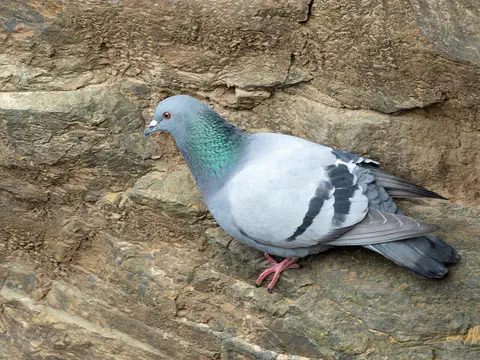
Rock pigeon
The rock pigeon, also called the rock dove, is the pigeon you see in city squares. Its wild ancestors nest on sea cliffs and mountain ledges, and city pigeons use buildings as if they were cliffs. Pigeons are famous for finding their way home from far away.
-
 Watch
3D
Animal
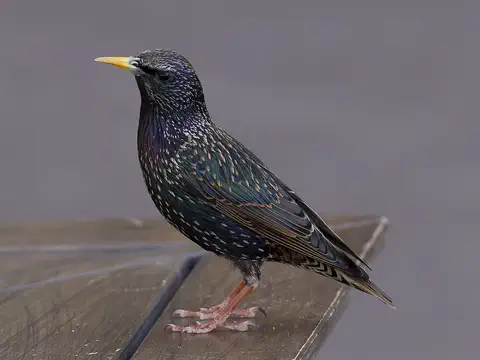
Common starling
The common starling, also called the European starling, is a glossy, spotted songbird from Europe, Asia and North Africa. It is a brilliant copycat that can imitate other birds and even car alarms, and in winter huge flocks swirl through the evening sky in shows called murmurations. People also carried starlings to North America, Australia and other places, where they now live in the wild.
-
 Watch
3D
Animal
Eastern bluebird
The eastern bluebird is a small thrush of open fields and parks in eastern North America, south to Central America. Males are bright blue with a rusty orange chest. Bluebirds watch from wires and fence posts, flutter down to catch insects, and nest in tree holes and in nest boxes that people put up for them.
-
 Watch
3D
Animal
Barn swallow
The barn swallow is a small, speedy bird with a glossy blue back, a reddish throat and a long, deeply forked tail. It catches insects in the air, builds cup-shaped mud nests on barns and bridges, and makes long migrations between the Northern Hemisphere, where it nests, and the Southern Hemisphere, where it spends the winter.
-
 Watch
 Country
United Kingdom
The United Kingdom, or UK, lies on islands off the northwest coast of Europe. It is made up of four parts, England, Scotland, Wales and Northern Ireland, and about 69.5 million people live there. Its capital is London.
-
 Watch
3D
Animal
Eurasian blue tit
The Eurasian blue tit is a small, colorful songbird of woods, parks and gardens across Europe and western Asia. It hangs upside down to find caterpillars, nests in holes and nest boxes, and can lay a very large clutch of eggs once a year, timed for when caterpillars are plentiful.
-
 Watch
Animal
Adélie penguin
The Adélie penguin is a medium-sized penguin, about 70 centimeters tall, with a black back, a white front and a bright white ring around each eye. It breeds in summer on rocky, ice-free ground all around Antarctica, building nests of pebbles, and spends the winter far out at sea among the pack ice.
-
 Watch
Animal
African fish eagle
The African fish eagle is a big eagle of Africa's lakes, rivers and coasts, with a white head, chest and tail and a chestnut-brown body. It snatches fish from the surface of the water, and its loud, ringing call is one of the best-known sounds of Africa.
For parents & teachers
What children will learn
- Tell male and female house sparrows apart.
- Explain how house sparrows depend on people for food and nest sites.
- Describe how house sparrows were introduced around the world and how that affects native birds.
- Understand that a common animal can still be declining.
Recommended ages: 3 to 17 · About 15 minutes
Talk about it
- Why do you think house sparrows live so close to people?
- Is it fair to blame sparrows for taking nest boxes meant for bluebirds?
- Why might a bird that eats spilled grain decline when farms change?
Try at home or in class
- Count the house sparrows you see on a walk and note whether each is a male or a female.
- Look for a patch of dry, bare soil in a park and check it for small hollows where sparrows have dust-bathed.
Key vocabulary: introduced, bib, dust bath, pecking order, cavity, decline
Where these facts come from
- The IUCN Red List of Threatened Species , International Union for Conservation of Nature (IUCN terms of use (no redistribution of Red List data or range maps))
- GBIF Backbone Taxonomy and GBIF Occurrence Search , Global Biodiversity Information Facility (CC0 1.0 (backbone); occurrence counts are facts derived from records under CC0, CC BY and CC BY-NC)
- Wikidata , Wikimedia Foundation (CC0 1.0)
- Passer domesticus (House Sparrow), global Red List assessment , IUCN Red List of Threatened Species
- House Sparrow overview , Cornell Lab of Ornithology, All About Birds
- House Sparrow life history , Cornell Lab of Ornithology, All About Birds
- House Sparrow identification , Cornell Lab of Ornithology, All About Birds
- House Sparrow , National Audubon Society, Guide to North American Birds
- House Sparrow , RSPB
- Wikimedia Commons , Wikimedia Foundation (Per file: Public domain, CC0, CC BY or CC BY-SA only (credited on each page))
Checked, not yet human-reviewed. Last updated October 28, 2026. Spotted a mistake? Tell us.