
Animal
Mandarin duck
The mandarin duck is a very colorful duck. The dad has orange 'sails' on his back. The ducklings jump out of a nest high in a tree!
The mandarin duck is a small, very colorful duck from East Asia. The male has orange 'sail' feathers on his back and orange whiskers on his face, while the female is soft gray and brown. Mandarins nest in holes in trees, and the ducklings jump down to the ground soon after hatching.
Aix galericulata is a duck of the family Anatidae, native to eastern Russia, China, Korea and Japan, with naturalized populations in Britain and parts of continental Europe. It lives on wooded ponds and streams, nests in tree cavities and is listed as Least Concern, though its global population is thought to be decreasing.
Photo: DAVID ILIFF, CC BY 3.0, via Wikimedia Commons
Meet the mandarin duck
The mandarin duck is small and very colorful.
The dad duck has orange feathers on his face and two orange 'sails' on his back. The mom duck is gray and brown, with a white stripe behind her eye.
The BTO calls the male mandarin duck, or drake, one of Britain's most splendid-looking ducks. He has orange feathers on the sides of his face, a broad white stripe over the eye, a purple chest, pale orange sides and two large orange feathers that stand up on his back like sails.
The female is much plainer. She is gray and brown, with a white stripe curving back from her eye and mottled sides. Both have a blue-green patch on the wings that shows in flight.
Aix galericulata is a small duck of the family Anatidae; Animal Diversity Web gives a mass of 428 to 693 grams, and the British Trust for Ornithology (BTO) a typical weight of 616 grams. In full plumage the drake has orange 'sail' feathers raised vertically above the back, an orange-and-cream crest, a broad white eye-stripe bordered by darker feathers, orange feathers on the sides of the face, a purple breast and pale orange flanks (RSPB).
The female is gray overall, with a curving white stripe behind the eye, a brown back and white-blotched, mottled underparts. In flight both sexes show an iridescent bluish-green speculum. The BTO describes the drake as one of Britain's most resplendent ducks and the female as 'contrastingly conservative'.
Quick facts
- Group
- Bird
- Length
- 0.41 to 0.49 m
- Wingspan
- 0.71 m
- Weight
- 0.43 to 0.69 kg
Native and introduced homes
Mandarin ducks come from China, Japan, Korea and eastern Russia.
They live on ponds and streams in the woods. People also brought them to Britain, and now wild ones live there.
Mandarin ducks are native to East Asia. They nest in eastern Russia, China, Korea and Japan, and many spend the winter in southern China and Japan. They like wooded ponds and fast, rocky streams with lots of trees and plants along the edges.
People took mandarin ducks from China to Britain, where some escaped from captivity. During the 1900s they settled in the wild, and today they live across England and in parts of Scotland and Wales. Introduced mandarins also live in several other European countries.
The IUCN's 2018 global assessment lists the mandarin duck as native in China, Japan and South Korea, breeding in North Korea and the Russian Far East, and wintering in Taiwan. It lists introduced populations in the United Kingdom (resident), Austria, Belgium and the Netherlands (breeding), and Denmark, France, Germany, Slovenia and Switzerland.
The RSPB says the British birds came from China and became established after escapes from captivity; the BTO notes the first British record in Berkshire in 1866 and naturalization in the 20th century. Mandarins favor river valleys and small water bodies with well-vegetated, wooded margins; Animal Diversity Web adds wooded ponds and fast-flowing rocky streams.
Continents
Its habitats


Where can you find this animal?
- Brought here by people · Countries and seas named by a scientific source
- Lives here naturally · Countries and seas named by a scientific source
- Sightings recorded · Records of wild sightings (GBIF)
- Visits for part of the year · Countries and seas named by a scientific source
Brought here by people · Countries and seas named by a scientific source
Mandarin ducks that escaped or were released now live in the wild in Britain, where they became established in the 1900s, and in parts of western and central Europe.
Places: UK, Austria, Belgium, Netherlands, Denmark, France, Germany, Slovenia and 1 more places.
Source: iucn-red-list · checked October 2026
Lives here naturally · Countries and seas named by a scientific source
Wooded ponds, lakes and streams of eastern Russia, China, Korea and Japan. Mandarins live in only part of each country shown.
Places: China, Japan, North Korea, South Korea and Russia.
Source: iucn-red-list · checked October 2026
Sightings recorded · Records of wild sightings (GBIF)
Counts of GBIF records of wild observations (human and machine) and preserved specimens. Records include introduced populations, vagrants, escaped or released animals and misidentifications, so a country with records is not necessarily part of the native range.
Wild sightings have been recorded in UK, Belgium, Netherlands, Germany, Sweden, Japan, South Korea, United States and 71 more places.
Source: gbif · checked October 2026
Visits for part of the year · Countries and seas named by a scientific source
Taiwan, which the IUCN lists for mandarin ducks outside the breeding season only.
Places: Taiwan.
Source: iucn-red-list · checked October 2026
Range maps show where scientists say an animal lives, often country by country. An animal may live in only part of a country shown, and sightings records can include animals that wandered far from home.
What mandarins eat
Mandarin ducks eat plants and seeds.
They eat water plants and grains like rice. They find their food in ponds and streams.
Mandarin ducks eat mostly plant food. Animal Diversity Web lists water plants, rice and other grains as their basic diet.
They are timid ducks of rivers and small ponds with plenty of plants along the banks. Outside the nesting season they gather in small flocks, usually not far from where they breed.
Animal Diversity Web gives the basic diet as water plants, rice and other grains. The BTO describes the species as a timid duck of river valleys and small water bodies with well-vegetated margins.
Outside the breeding season mandarins gather in flocks relatively close to their breeding sites, although bird ringing in Britain has revealed a few long-distance movements. In East Asia the species is migratory, while most British birds are sedentary.
Did you know?
Mandarin ducklings jump out of their tree-hole nest.
Soon after hatching, mandarin ducklings jump from their nest hole to the ground, land unhurt and follow their mother to water.
Ducklings leave the cavity, which may be several meters up, by dropping to the ground before they can fly.
A duck that perches
Mandarin ducks nest in trees!
They make their nests in holes high up in tree trunks.
Mandarins nest in holes in trees, sometimes up to about 9 meters off the ground. They also use nest boxes that people put up.
The drake courts the female with an impressive display that includes pretending to drink and shaking. When mandarins fly, both males and females show a shiny blue-green patch on each wing.
Mandarins nest in tree cavities, which Animal Diversity Web says can be up to 30 feet (about 9 meters) above the ground, and they readily use nest boxes (BTO). Animal Diversity Web describes the courtship as an impressive display including mock-drinking and shaking.
The sexes differ strongly: the female's gray and brown plumage and white eye-stripe contrast with the drake's breeding colors. Both sexes share a bluish-green speculum visible in flight.
The big jump
The mother duck lays her eggs in a tree hole.
When the ducklings hatch, she calls them from the ground. One by one, the fluffy ducklings jump out and land safely!
Mandarin pairs form at the start of winter, and some stay together for several seasons. The female chooses a hole in a tree, with the male tagging along, and lines it with her soft down. She lays 9 to 12 white eggs and keeps them warm by herself for 28 to 30 days.
All the eggs hatch within a few hours. Then the mother calls from the ground, and each duckling climbs out and jumps, landing unhurt. She leads them to water. The young can fly at 40 to 45 days old.
Pairs form at the beginning of winter and may persist for several seasons. The female selects the nest cavity while the male accompanies her, and she lines it with down. Clutches are 9 to 12 white eggs laid at daily intervals, incubated by the female alone for 28 to 30 days (Animal Diversity Web; the BTO also gives 9 to 12 eggs).
The eggs hatch within a few hours of each other. The mother calls from the ground, and the ducklings climb out of the hole and drop to the ground before they can fly; the BTO notes that up to 12 ducklings jump and follow the female to the nearest water. Young fly at 40 to 45 days and then leave to join a flock.
Shy and showy
Mandarin ducks are shy.
They like to stay near trees and plants where they can hide. The colorful dads show off to the moms.
Mandarin ducks are timid and like to stay near cover. Drakes court the females with an impressive display that includes pretending to drink and shaking.
In East Asia, many mandarins migrate between their nesting and wintering areas. Most of the mandarins in Britain stay in the same area all year, but a few have been found to travel long distances.
The BTO describes mandarins as timid, and Animal Diversity Web describes an elaborate courtship that includes mock-drinking and shaking. Pairs form at the beginning of winter and may stay together for several seasons.
Movements differ by population: East Asian birds are migratory, while most of the British population is sedentary, with ringing revealing a few long-distance movements. Outside the breeding season birds flock near their breeding sites.

Disappearing forests, new homes
Mandarin ducks are not in danger.
But in Asia, some of the forests they need have been cut down. Nest boxes and healthy woods help them.
The mandarin duck is listed as Least Concern, but the IUCN thinks its numbers in the wild are going down. In East Asia, cutting down forests has destroyed many of its nesting places.
In the UK, where mandarins were introduced, their numbers have grown quickly. The BTO counted about 4,400 breeding pairs in 2007 to 2011, and the breeding population grew by 663 percent between 1995 and 2024.
The IUCN lists the mandarin duck as Least Concern (global assessment, 2018) with a decreasing trend; it gives no global count. Animal Diversity Web reports severe impacts from habitat destruction in East Asia, where forests were cleared after a stronghold was opened to settlement in 1911.
In the UK the BTO reports about 4,400 breeding pairs and 14,000 wintering birds (2007–11), with the breeding population up 663 percent from 1995 to 2024. It notes the causes are uncertain but that the increase may have been helped by little competition from other mandarins and the ability to use a previously unoccupied habitat.
IUCN Red List
How is the mandarin duck doing in the wild?
- Least Concern (this animal)
- Near Threatened
- Vulnerable
- Endangered
- Critically Endangered
- Extinct in the Wild
- Extinct
Least Concern
Not at risk of disappearing from the wild right now.
See the IUCN Red List assessment · The IUCN Red List of Threatened Species 2021.3
Amazing facts
-
Mandarin ducklings jump out of their tree-hole nest.
Soon after hatching, mandarin ducklings jump from their nest hole to the ground, land unhurt and follow their mother to water.
Ducklings leave the cavity, which may be several meters up, by dropping to the ground before they can fly.
-
Mandarin ducks can use nest boxes.
Mandarin ducks nest in tree holes, and they will also use nest boxes that people put up.
The BTO notes that this cavity nester readily uses nest boxes.
-
The drake has two orange feathers that look like sails.
The drake's two big orange back feathers stand up like the sails of a boat.
The drake's 'sails' are enlarged orange feathers held vertically over the back in full plumage.
-
Some mandarin ducks live wild in Britain.
Mandarin ducks that escaped from captivity now live wild across England and in parts of Scotland and Wales.
First recorded in Britain in 1866, the species became naturalized in the 20th century and has spread across England.
Words to know
- drake
- a male duck
- cavity
- a hole, such as one in a tree trunk
- introduced species
- an animal that people brought to a place where it did not live before
- speculum
- a shiny colored patch on a duck's wing
- naturalized
- living and breeding in the wild in a new place
- incubate
- to keep eggs warm so they can hatch
Discovery challenge
-
Where do mandarin ducks build their nests?
Where do mandarin ducks usually nest?
What kind of nest site do mandarin ducks use?
- In holes in trees
- On floating rafts
- In sand burrows
Show the answer
In holes in trees
They nest in holes high in trees.
In tree holes, sometimes up to about 9 meters high, or in nest boxes.
Tree cavities up to about 9 meters high; nest boxes are also used.
-
Which mandarin duck has orange sails?
Which mandarin ducks have orange 'sail' feathers?
Which sex shows the erect orange 'sails'?
- The males
- The females
- The ducklings
Show the answer
The males
The dad ducks have orange sails.
Only the drakes; females are gray and brown.
Drakes in full plumage; females are gray with a white eye-stripe.
-
Where do mandarin ducks come from?
Where are mandarin ducks native?
What is the native range of Aix galericulata?
- East Asia
- South America
- Australia
Show the answer
East Asia
They come from East Asia.
East Asia: eastern Russia, China, Korea and Japan.
The Russian Far East, China, Korea and Japan; British and European birds are introduced.
-
How do mandarin ducklings leave the nest?
How do mandarin ducklings get out of their tree-hole nest?
How do mandarin ducklings leave the nest cavity?
- They jump down
- Their mother carries them
- They wait until they can fly
Show the answer
They jump down
They jump down and land safely!
They climb out and jump to the ground, then follow their mother.
They drop to the ground before they can fly and follow the female to water.
Places where you might see it
-
 Watch
 Country
China
China is the largest country in Asia, almost as big as all of Europe. The land steps down from the high, cold Plateau of Tibet in the west to plains and coasts in the east, and about 1.4 billion people live there, along with giant pandas in the mountains of south-central China.
-
 Watch
 Country
Japan
Japan is an island country in East Asia. Most of its land is steep mountains and forest, Mount Fuji is its tallest peak, and about 124 million people live there, many of them in big cities such as Tokyo.
Explore next
-
 Watch
3D
Animal
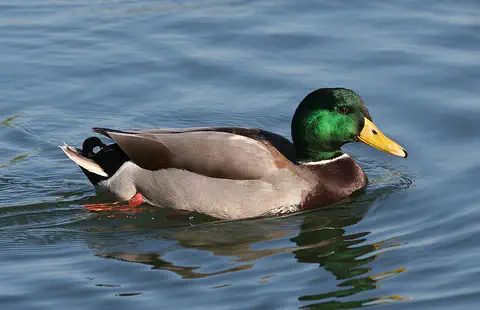
Mallard
The mallard is perhaps the most familiar duck in the world, found on ponds, lakes, rivers and city parks across North America, Europe and Asia. Males have glossy green heads; females are mottled brown. Almost all farm ducks are descended from mallards.
-
 Watch
Animal
Red-crowned crane
The red-crowned crane is one of the world's largest cranes, white with a black neck and a bright red crown. Pairs bow, bob and leap in a courtship dance. It nests in wetlands of eastern Russia, China and Japan, and it is Vulnerable because those wetlands are disappearing.
-
 Watch
3D
Animal
Canada goose
The Canada goose is a big, black-necked goose with a white chinstrap, found near lakes, rivers, fields and parks across North America. Many migrate in noisy V-shaped flocks, but more and more stay all year on city lawns. People also brought Canada geese to Britain and other parts of Europe.
-
Watch
Country
China
China is the largest country in Asia, almost as big as all of Europe. The land steps down from the high, cold Plateau of Tibet in the west to plains and coasts in the east, and about 1.4 billion people live there, along with giant pandas in the mountains of south-central China.
-
Watch
Country
Japan
Japan is an island country in East Asia. Most of its land is steep mountains and forest, Mount Fuji is its tallest peak, and about 124 million people live there, many of them in big cities such as Tokyo.
-
 Watch
Animal
Adélie penguin
The Adélie penguin is a medium-sized penguin, about 70 centimeters tall, with a black back, a white front and a bright white ring around each eye. It breeds in summer on rocky, ice-free ground all around Antarctica, building nests of pebbles, and spends the winter far out at sea among the pack ice.
-
 Watch
Animal
African fish eagle
The African fish eagle is a big eagle of Africa's lakes, rivers and coasts, with a white head, chest and tail and a chestnut-brown body. It snatches fish from the surface of the water, and its loud, ringing call is one of the best-known sounds of Africa.
-
 Watch
Animal
African penguin
The African penguin is a penguin of warm, sunny coasts. It lives only in South Africa and Namibia, nests in burrows and under bushes, and hunts sardines and anchovies in the cold sea. Its numbers have fallen so far that it is now Critically Endangered, and people are working hard to protect it.
For parents & teachers
What children will learn
- Describe how male and female mandarin ducks look different.
- Explain why mandarin ducks need trees as well as water.
- Describe how mandarin ducklings leave their tree-hole nest.
- Compare the native range in East Asia with the introduced population in Britain.
Recommended ages: 3 to 17 · About 15 minutes
Talk about it
- Why might it help a mother duck to be plain gray and brown?
- Why could cutting down forests harm a duck?
- How might an introduced duck affect the animals already living in a place?
Try at home or in class
- Draw a drake and a female mandarin side by side and color them in to compare their plumage.
- With an adult, look at plans for a duck nest box and talk about where it should go to suit a tree-nesting duck.
Key vocabulary: drake, cavity, introduced species, speculum, naturalized, incubate
Where these facts come from
- The IUCN Red List of Threatened Species , International Union for Conservation of Nature (IUCN terms of use (no redistribution of Red List data or range maps))
- GBIF Backbone Taxonomy and GBIF Occurrence Search , Global Biodiversity Information Facility (CC0 1.0 (backbone); occurrence counts are facts derived from records under CC0, CC BY and CC BY-NC)
- Wikidata , Wikimedia Foundation (CC0 1.0)
- Aix galericulata (Mandarin Duck), Red List global assessment 2018 , IUCN Red List of Threatened Species
- Mandarin Duck, BirdFacts , British Trust for Ornithology
- Mandarin duck , RSPB
- Aix galericulata (mandarin duck) , Animal Diversity Web, University of Michigan Museum of Zoology
- Wikimedia Commons , Wikimedia Foundation (Per file: Public domain, CC0, CC BY or CC BY-SA only (credited on each page))
Checked, not yet human-reviewed. Last updated October 28, 2026. Spotted a mistake? Tell us.