North America
Countries, cities, landmarks and natural wonders of North America. Pick one to explore it, or open the globe.
43 to explore
-
 Watch
Life around the world
Northern lights over Fairbanks, Alaska
Fairbanks, in the middle of Alaska, sits under a ring-shaped zone where the aurora often appears. The University of Alaska Fairbanks says its viewing season runs from about 21 August to 21 April, when nights are dark enough. Around the winter solstice there are fewer than four hours of daylight, and winter cold shapes daily life.
-
 Watch
Natural wonder
Grand Canyon
The Grand Canyon is a huge, steep-sided canyon in Arizona carved by the Colorado River. It is about 447 kilometers long and, on average, 1.6 kilometers deep, and its walls show layers of rock almost two billion years old.
-
 Watch
Life around the world
Maple syrup season in Quebec, Canada
Each spring in Quebec, nights below freezing and days above it make sap flow in maple trees. Producers collect the watery, slightly sweet sap and boil it in evaporators until it becomes syrup; early in the season about 20 liters of sap make 1 liter. In 2025, Quebec made 90 percent of Canada's maple syrup.
-
 Watch
Life around the world
Floating gardens of Xochimilco, Mexico City
Xochimilco, in the south of Mexico City, still has chinampas: long garden islands built up from lake mud, branches and plants, edged with willow trees and surrounded by canals. Farmers have worked them since Aztec times. UNESCO lists Xochimilco as World Heritage, and FAO named the chinampa system an agricultural heritage site in 2017.
-
 Watch
Journey
Building the Panama Canal
Before the Panama Canal, ships going between the Atlantic and Pacific had to sail around the tip of South America. A French company tried to dig a canal across Panama in the 1880s but failed. The United States took over in 1904, defeated dangerous diseases spread by mosquitoes, cut through mountains and built huge locks. The 80-kilometer canal opened in 1914.
-
 Watch
Life around the world
Corn and chocolate in Oaxaca, Mexico
In Oaxaca, in southern Mexico, corn has a very long history: maize cobs from a cave in the Valley of Oaxaca were the oldest known in the Americas when they were dated in 2001. Corn is cooked with lime, ground into masa dough and made into tortillas. Oaxaca also has many cacao drinks, including chocolate whisked until foamy with a wooden molinillo.
-
 Watch
 Country
United States
The United States is a large country in North America made of 50 states, from icy Alaska to the warm islands of Hawaii. It has the Grand Canyon, the Mississippi River and Yellowstone, and about 342 million people live there.
-
 Watch
Natural wonder
Niagara Falls
Niagara Falls is a set of three waterfalls on the Niagara River, which flows from Lake Erie to Lake Ontario across the border between Canada and the United States. About 500 waterfalls in the world are taller, but Niagara is famous for its height together with the enormous amount of water that pours over it.
-
 Watch
 Country
Mexico
Mexico is a large country in southern North America, between the Pacific Ocean and the Gulf of Mexico. It has smoking volcanoes, ancient cities built by the Maya and other peoples, and about 132 million people, many of them in and around Mexico City.
-
 Watch
 Country
Canada
Canada is the second-largest country in the world, stretching across the north of North America from the Atlantic to the Pacific and up into the Arctic. It has the Rocky Mountains, thousands of islands and about 42 million people, who speak English, French and many other languages.
-
 Watch
Natural wonder
Yellowstone National Park
Yellowstone National Park sits on top of a giant volcano in the western United States. Heat from melted rock deep underground powers more than 10,000 hot springs, geysers, mudpots and steam vents, and the park is home to bison, wolves and two kinds of bears.
-
 Watch
Natural wonder
Yosemite National Park
Yosemite National Park lies in California's Sierra Nevada mountains. Its granite cliffs, rounded domes and tall waterfalls were shaped by rivers and then by glaciers, which turned narrow canyons into wide U-shaped valleys. It is also home to giant sequoia trees and hundreds of black bears.
-
Watch
Natural wonder
Mississippi River
The Mississippi River flows about 3,770 kilometers from Lake Itasca in Minnesota to the Gulf of Mexico, through the middle of the United States. Its basin drains about 40 percent of the continental United States. Long ago Native Americans paddled canoes on it; later came steamboats, and today huge barges carry grain and fuel. Millions of birds follow it when they migrate.
-
Watch
Natural wonder
Rocky Mountains
The Rocky Mountains, or Rockies, stretch about 4,800 kilometers from northern Canada to New Mexico in the United States. They include more than 100 separate ranges, and their highest peak, Mount Elbert in Colorado, is 4,399 meters tall. Glaciers carved their peaks and valleys, and famous parks such as Banff, Jasper and Yellowstone protect their lakes, hot springs and wildlife.
-
 Watch
Natural wonder
Lake Superior
Lake Superior is the largest of North America's five Great Lakes, shared by the United States and Canada. It covers about 82,100 square kilometers, reaches 406 meters deep, and holds more water than the other four Great Lakes put together. It sits in an ancient crack in the continent that glaciers scooped out.
- Watch Natural wonder Mariana Trench The Mariana Trench is a long, curving valley in the floor of the western Pacific Ocean, near the island of Guam. Its deepest spot, the Challenger Deep, is the deepest place known in the whole ocean, close to 11,000 meters down. If Mount Everest stood on the bottom, its peak would still be about 2 kilometers under water.
-
 Watch
Natural wonder
Denali
Denali is North America's highest mountain, 6,190 meters (20,310 feet) tall, in the Alaska Range. It rises about 5.6 kilometers from its base, more than Mount Everest does from its own high base. Huge glaciers spread from it in every direction, and the national park around it is home to grizzly bears, moose, caribou, Dall sheep and wolves.
-
Watch
Natural wonder
Banff National Park
Banff National Park lies in the Rocky Mountains of Alberta, in western Canada. It began in 1885 around a group of hot springs, which makes it Canada's first national park. Today it covers 6,641 square kilometers of jagged peaks, glaciers, forests and turquoise lakes such as Lake Louise and Moraine Lake, and it is home to grizzly bears, wolves, elk and many more animals.
-
 Watch
Natural wonder
Everglades National Park
Everglades National Park covers 1.5 million acres at the southern tip of Florida. It protects marshes of sawgrass, forests of mangroves and pines, and shallow bays, all fed by fresh water flowing slowly south. It is home to alligators and crocodiles, the rare Florida panther and hundreds of kinds of birds, but invasive Burmese pythons have caused serious harm to its wildlife.
-
 Watch
Natural wonder
Bryce Canyon National Park
Bryce Canyon National Park, in southern Utah, is not really a canyon. It is a row of giant bowls, called amphitheaters, carved into the edge of a high plateau and filled with colorful rock spires called hoodoos. The park says it has the largest collection of hoodoos in the world. Ice and rain shaped them from rocks first laid down in an ancient lake.
-
 Watch
Landmark
Brooklyn Bridge
The Brooklyn Bridge crosses the East River between Brooklyn and Manhattan in New York City. Built from 1869 to 1883, it was the first bridge to use steel wire for its cables, and its main span was the longest in the world until 1890. Every day, cars, walkers and cyclists still cross it.
-
 Watch
City
Chicago
Chicago, in the state of Illinois, is the third-biggest city in the United States, with about 2.7 million people (2025). It grew fast beside Lake Michigan, rebuilt itself after the Great Fire of 1871 and became famous for its skyscrapers, railways, museums and music.
-
 Watch
Landmark
Chichén Itzá
Chichén Itzá is the ruin of a great Maya city on the Yucatán Peninsula in Mexico. Its people built pyramids, a huge ball court and a round building for watching the sky. Its most famous pyramid, El Castillo, has 365 steps, as many as the days in a year.
-
 Watch
Landmark
CN Tower
The CN Tower in Toronto is 553 meters tall. It was built between 1973 and 1975 so that radio and TV signals could reach over the city's new tall buildings. For more than 30 years it was the tallest freestanding structure in the world, and today more than two million people visit it every year.
-
 Watch
 Country
Costa Rica
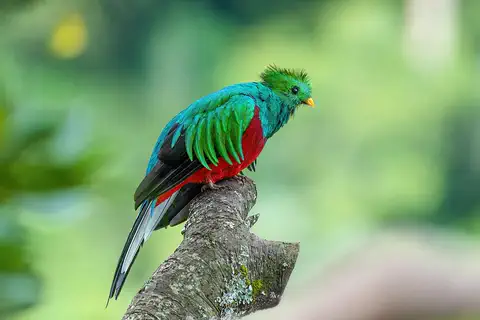
Costa Rica is a small country in Central America between the Caribbean Sea and the Pacific Ocean. Volcanoes and mountains run down its middle, its forests are full of wildlife, and many national parks protect them. Since 1949 it has had no army. About 5.2 million people lived there in 2025.
-
 Watch
 Country
Cuba
Cuba is the largest island in the Caribbean, a long, narrow country with about 1,600 smaller islands and cays around it. It has mountains, green valleys, coral reefs and the old city of Havana, its capital. About 9.4 million people lived there at the end of 2025, and Spanish is the main language.
-
 Watch
Landmark
Empire State Building
The Empire State Building rises 1,454 feet (443 meters) over Fifth Avenue in New York City. Its steel frame went up at about four and a half floors a week, and the whole building was finished in one year and 45 days, opening on May 1, 1931.
-
 Watch
Landmark
Golden Gate Bridge
The Golden Gate Bridge crosses the Golden Gate, the strait where San Francisco Bay meets the Pacific Ocean. Built from 1933 to 1937, it hangs from two huge steel cables slung over towers 746 feet (227 meters) above the water, and it is painted a color called International Orange.
-
 Watch
 Country
Haiti
Haiti covers the western third of the island of Hispaniola in the Caribbean. Its name comes from an old word meaning mountainous land. In 1804, after enslaved people freed themselves, Haiti became independent, and its people created their own language, art and music. About 11.9 million people lived there in 2024.
-
 Watch
 Country
Honduras
Honduras is a mountainous country in Central America, with the Caribbean Sea to the north and a short Pacific coast to the south. Its forests are home to jaguars and macaws, the Maya city of Copán stands in the west, and about 10.2 million people live there (official 2026 estimate).
-
 Watch
City
Los Angeles
Los Angeles is the second-biggest city in the United States, spread across a wide plain between the mountains and the Pacific Ocean. Founded in 1781 as a small farming village, it grew into a world center of movies and music. About 3.9 million people lived there in 2020.
-
 Watch
Landmark
Metropolitan Museum of Art
The Metropolitan Museum of Art, or the Met, stands on Fifth Avenue at the edge of Central Park in New York City. Founded in 1870, it is the largest art museum in the city, with art from ancient Egypt to today. Its grand front, with three arches and pairs of columns, was finished in 1902.
-
Watch
City
Mexico City
Mexico City, the capital of Mexico, sits 2,240 meters high in the Valley of Mexico. It was founded in 1521 on the ruins of Tenochtitlan, the Aztec capital that stood on an island in a lake. About 9.2 million people lived there in 2020, and more than 23 million in the wider metropolitan area.
-
 Watch
Landmark
Mount Rushmore
Mount Rushmore is a granite mountain in the Black Hills of South Dakota. From 1927 to 1941, nearly 400 workers carved the faces of Presidents Washington, Jefferson, Theodore Roosevelt and Lincoln into it, each about 60 feet (18 meters) tall. Most of the rock was removed with dynamite.
-
 Watch
City
New York City
New York City sits where the Hudson River meets a great harbor on the Atlantic coast. It has been the largest city in the United States since 1790. About 8.8 million people lived in its five boroughs in 2020, among skyscrapers, bridges and parks.
-
 Watch
City
Ottawa
Ottawa is the capital of Canada. It stands where three rivers meet, beside the Ottawa River, which divides the provinces of Ontario and Quebec. It began as a lumber town called Bytown, became the capital in 1857, and had 1,017,449 people at the 2021 census.
-
Watch
 Country
Panama
Panama is a narrow country in Central America that joins North and South America. Since 1914 the Panama Canal has let ships cross from the Atlantic Ocean to the Pacific without sailing around South America. Panama has rainforests, more than 1,600 islands and about 4.6 million people (2025).
-
 Watch
City
San Francisco
San Francisco sits on the tip of a peninsula between the Pacific Ocean and San Francisco Bay in California. Spanish settlers arrived in 1776, the Gold Rush that began in 1848 turned it into a booming port, and today it is famous for the Golden Gate Bridge, its cable cars, its steep hills and its summer fog.
-
 Watch
Landmark
Statue of Liberty
The Statue of Liberty stands on Liberty Island in New York Harbor. France gave her to the United States as a sign of friendship. The sculptor Auguste Bartholdi shaped her copper skin, Gustave Eiffel designed the iron frame inside, and she was dedicated in 1886.
-
 Watch
Landmark
Teotihuacan
Teotihuacan, about 50 kilometers northeast of Mexico City, was a huge city almost 2,000 years ago. A long, straight avenue runs through it, lined by giant pyramids, including the Pyramid of the Sun and the Pyramid of the Moon. Around 500 CE, it was one of the largest cities in the world.
-
 Watch
City
Washington, D.C.
Washington, D.C., is the capital of the United States, on the Potomac River. It was planned from scratch in the 1790s, with wide avenues, the U.S. Capitol, the White House and a long green park called the National Mall. About 690,000 people lived there in 2020.
-
 Watch
Landmark
White House
The White House in Washington, D.C. is the home and office of the President of the United States. Building began in 1792, and President John Adams moved in on November 1, 1800. Its sandstone walls are painted white, and today it has 132 rooms.
-
 Watch
Landmark
Willis Tower
Willis Tower, first called the Sears Tower, is a skyscraper in Chicago finished in 1973. It is 442 meters tall and was the tallest building in the world for about 25 years. Its clever 'bundled tube' design was made by engineer Fazlur Khan and the firm SOM.