
Landmark Asia
Selimiye Mosque
The Selimiye Mosque is a big building in Edirne, Türkiye. It has one giant dome and four tall, thin towers. The builder Sinan called it his best work.
The Selimiye Mosque in Edirne, Türkiye, was built from 1569 to 1575 for the Ottoman sultan Selim II. Its architect, Sinan, called it his masterpiece. A single great dome rests on eight supports, and four minarets about 71 meters tall stand around it. It became a UNESCO World Heritage Site in 2011.
The Selimiye Mosque and its Social Complex in Edirne, built for Selim II in 1569–1575, is the work Sinan himself considered his masterpiece. ICOMOS gives its dome a diameter of 31.3 m and an inner height of 42.3 m, with four fluted minarets of 70.89 m; UNESCO, which inscribed it in 2011, calls it the most harmonious expression of the Ottoman külliye.
Photo: Jorge Franganillo, CC BY 2.0, via Wikimedia Commons
Discover the Selimiye Mosque
The Selimiye Mosque is in Edirne, a city in Türkiye.
A mosque is a building where Muslims gather to pray. This one has a big round dome and four tall, thin towers called minarets.
The Selimiye Mosque stands in the city of Edirne, in Türkiye. UNESCO says its single great dome and four slender minarets rise above the city's skyline.
It is the center of a külliye, a group of buildings put up around a mosque and run as one institution. Around the mosque are two schools, a covered market, a clock house, a library and a large outer courtyard. The architect Sinan said this complex was his best work.
The complex stands in Edirne, a former Ottoman capital, on a site that ICOMOS says once held the first Ottoman palace in the city. UNESCO describes it as the most harmonious expression ever achieved of the Ottoman külliye, a group of buildings constructed around a mosque and managed as a single institution.
The mosque, with its fountain court and two madrasas (schools), sits at the heart of a walled outer court measuring 190 by 130 m. The property also includes the Arasta, a covered market built to earn income for the foundation, a primary school, a clock house and a library. UNESCO inscribed it in 2011 under criteria (i) and (iv).
- Where
- Edirne, Türkiye
- Built
- 1569–1575
- Architect
- Sinan
- World Heritage
- inscribed 2011
Built for Sultan Selim II
A ruler called Selim II asked for this mosque.
The great builder Sinan planned it. Workers finished it in 1575.
Edirne was the Ottoman capital from 1364 until Constantinople, today's Istanbul, became the capital in 1453. More than a century later, Sultan Selim II, son of Süleyman the Magnificent, ordered a great mosque complex here.
It was built from 1569 to 1575. Sinan, the chief architect of the Ottoman sultans, designed it. Selim II died before he could see it finished.
ICOMOS records that the complex was built for Sultan Selim II, son of Süleyman the Magnificent, from 1569 to 1575, on the square where Yildirim Beyazid's palace, the first Ottoman palace in Edirne, had stood; Edirne had been the capital from 1364 until the court moved to Istanbul after 1453.
The design is well documented: booklets by Sinan's friend Said Celebi quote Sinan calling it his 'masterpiece work', and surviving orders name the quarries for its stone and marble, the calligrapher Karahisari Molla Hasan, the water source for its fountains and the Iznik workshops for its tiles. Selim II died before the mosque was finished; under his successor Murat III, Sinan repaired it after a lightning strike in 1584.
One great dome on eight supports
The giant dome sits on eight strong supports.
That leaves room for lots of windows, so the inside is full of light.
Sinan rested the great dome on eight large supports inside a square hall. Because the supports carry the weight, the walls could have many windows, and the hall inside is filled with light.
The mosque is built of stone with brick arches and domes, and the domes are covered with lead. Outside, it is faced with honey-colored sandstone, with red sandstone around the windows. Its shapes step up from the courtyard to the dome, like a staircase of roofs.
ICOMOS describes a dome 31.3 m across, reaching an inner height of 42.3 m, raised on eight large but independent supports within a square plan, which frees the walls for large windows; UNESCO's statement gives the diameter as 31.5 m over a hall of 45 by 36 m. Sinan wrote that with this dome he had exceeded the span of Hagia Sophia's.
The structure is masonry with brick arches and domes covered in lead, faced in honey-colored sandstone with red sandstone outlining windows and string courses; the arches alternate red sandstone and white marble. Because the walls are plain, the effect comes from forms stepping up from the courtyard colonnade to the gallery, the octagonal arcade, the drum and finally the dome.
Minarets, tiles and a covered market
Each minaret has three little balconies, one above another.
Inside, the walls shine with blue and white tiles decorated with flowers and trees.
The four minarets are fluted, with grooves running up them, and reach 70.89 meters to their pointed tops. Each has three balconies, and two of them have three separate staircases that wind around each other.
Inside, tiles from the town of Iznik, made when Iznik tile-making was at its best, show flowers, tulips and blossoming fruit trees. Along one side of the outer courtyard, a covered market called the Arasta has 124 shops on a lane about 225 meters long. Its earnings helped pay for the complex.
The four fluted stone minarets are 3.8 m in diameter at the base and rise 70.89 m to their lead-covered cones; each has three corbelled balconies, and the two on the north side contain three independent, intertwining stairways, one to each balcony.
ICOMOS calls the Iznik tiles the high point of Iznik production in the second half of the 16th century, with designs attributed to Sinan featuring tulips, apple trees and fruit trees in blossom; carved doors and ivory-inlaid shutters show similar craftsmanship. The Arasta has 124 shops in two rows along a covered lane of about 225 m, and the library held 8,117 books, 3,384 of them manuscripts, when ICOMOS evaluated the site; the two madrasas now serve as museums.
- Minarets
- 4, each 70.89 m tall
- Dome
- 31.3 m across, 42.3 m high inside (ICOMOS)
- Arasta covered market
- 124 shops along about 225 m
The mosque and the architect's statue
In the photo, the mosque rises behind a garden.
In front stands a statue of a seated man. It shows Sinan, the builder!
The photo was taken on 1 May 2025. A statue of the architect Sinan, seated, stands on a stone base with his name carved on it. Behind the flower beds and lawns, the mosque's gray dome and four tall minarets rise against a cloudy blue sky, with smaller domes below.
In 2011 UNESCO said the complex was well maintained and that the views of it across the city must stay protected. It also said the mosque and the Arasta market kept their original use.
The photograph (1 May 2025) shows, in the foreground, a seated statue of the architect on a stone plinth inscribed 'Mimar Koca Sinan', with flower beds, lawns and paths behind it, and the mosque beyond: the great lead-gray dome, its four slender minarets with their balconies, and rows of smaller domes.
UNESCO judged in 2011 that the complex was well maintained and unaffected by development, but stressed that view corridors to this landmark must remain protected. It noted that the mosque and the Arasta keep their original use and function, while the madrasas have been slightly adapted as museums. A management plan overseen by the Edirne municipality was being prepared at inscription.
Amazing facts
-
Two of the minarets have three staircases inside, winding around each other!
Two of the minarets each have three separate staircases that wind around each other, one to each balcony.
The two north minarets contain three independent, intertwining stairways, each leading to one of the three balconies.
-
The architect Sinan called this mosque his best work.
Sinan, who built over 400 structures, called the Selimiye his masterpiece.
Sinan, chief architect to the Ottoman sultans for fifty years from 1538 and builder of over 400 structures, called the Selimiye his masterpiece.
-
Shops next to the mosque helped pay for it.
The Arasta, a covered market of 124 shops, was built to earn money for the mosque complex.
The Arasta bazaar was built to provide earnings for the foundation that ran the complex.
-
Selim II gave his own books to start the library.
The library began with 277 books given by Sultan Selim II.
The library's collection began with Selim II's donation of 277 of his own books, kept in the imperial treasury until the library was complete.
Words to know
- mosque
- a building where Muslims gather to pray
- dome
- a rounded roof shaped like half a ball
- minaret
- a tall, thin tower that is part of a mosque
- külliye
- a group of buildings around a mosque, such as schools and a market, run as one institution
- madrasa
- a school, often linked to a mosque
- architect
- a person who designs buildings
Discovery challenge
-
Who planned the Selimiye Mosque?
Which architect designed the Selimiye Mosque?
Which architect called the Selimiye his masterpiece?
- Sinan
- Gustave Eiffel
- Christopher Wren
Show the answer
Sinan
Sinan, the great builder!
Sinan, chief architect of the Ottoman sultans.
Sinan, quoted by his friend Said Celebi as calling it his 'masterpiece work'.
-
How many tall minarets does the mosque have?
How many minarets stand around the Selimiye Mosque?
How many fluted minarets anchor the dome?
- Four
- One
- Ten
Show the answer
Four
Four!
Four minarets, each 70.89 meters tall.
Four, each 70.89 m high with three balconies.
-
What holds up the giant dome?
What carries the weight of the great dome?
On how many independent supports does the dome rest?
- Eight big supports
- One thin pole
- Ropes from the minarets
Show the answer
Eight big supports
Eight big, strong supports!
Eight large supports, which leave room for many windows.
Eight large but independent supports within a square plan.
-
What is the covered market next to the mosque called?
What is the name of the covered market built to earn money for the complex?
Which part of the complex was built to provide income for its foundation?
- The Arasta
- The Colosseum
- The Louvre
Show the answer
The Arasta
The Arasta!
The Arasta, with 124 shops.
The Arasta covered bazaar, 124 shops along about 225 m.
-
When was the mosque finished?
In which year was the Selimiye complex finished?
Over which years was the complex built, according to ICOMOS?
- 1575
- 1364
- 2011
Show the answer
1575
In 1575!
In 1575, after building began in 1569.
1569 to 1575.
Nearby places
-
 Watch
City
Plovdiv
Plovdiv is the second-largest city in Bulgaria, on the rich plains of the Maritsa River, Universalis says. Its old town on rocky hills has Roman, Byzantine and Ottoman layers, and in 2019 it was a European Capital of Culture. Bulgaria's 2021 census counted 319,612 people.
-
 Watch
Natural wonder
Sea of Marmara
The Sea of Marmara is a small inland sea between the Black Sea and the Aegean Sea, joined to them by two narrow straits. A big fault runs across its floor, and its water comes in two layers: less salty water from the Black Sea on top, and saltier Mediterranean water below.
-
 Watch
Landmark
Aqueduct of Valens
The Aqueduct of Valens is a bridge of arches in Istanbul, Türkiye, 971 meters long with 86 arches. It carried a water channel across a valley between two hills. It is named after the emperor Valens, and a research project at Radboud University dates its construction to 368 to 373.
-
 Watch
Landmark
Süleymaniye Mosque
The Süleymaniye Mosque in Istanbul, Türkiye, was designed by the architect Sinan and built between 1550 and 1557 for the Ottoman sultan Süleyman. With the mosque, Sinan built a whole complex of schools, a hospital, an inn for travelers, a kitchen and a bath. It is part of the Historic Areas of Istanbul, a UNESCO World Heritage Site since 1985.
-
 Watch
City
Istanbul
Istanbul is the biggest city in Türkiye, built on both sides of the Bosporus, the narrow strait between Europe and Asia. Once called Byzantium and then Constantinople, it was the capital of two great empires. About 15.7 million people lived in Istanbul province in 2023.
-
 Watch
Landmark
Sultan Ahmed Mosque
The Sultan Ahmed Mosque in Istanbul was built between 1609 and about 1616 for the Ottoman ruler Sultan Ahmed I. Its central dome is ringed by half-domes and smaller domes, and six slender minarets rise around it. Many people call it the Blue Mosque because of the blue and green tiles and painted decoration inside. It is still a working mosque, where Muslims come to pray.
-
 Watch
Landmark
Hagia Sophia
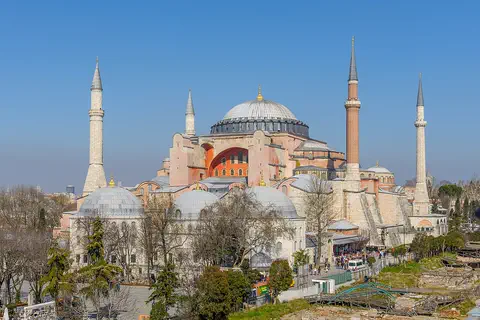
Hagia Sophia in Istanbul was built in under six years, from 532 to 537, for the emperor Justinian. Its enormous dome seems to float on a ring of 40 windows. Over almost 1,500 years it has been a church, a mosque and a museum, and since 2020 it has been a mosque.
-
 Watch
Landmark
Topkapı Palace
Topkapı Palace sits on a point of land where the Bosphorus Strait meets the sea in Istanbul. Sultan Mehmed II built it between 1460 and 1478, and for nearly 400 years it was the home of the Ottoman sultans and the center of their government. In 1924 it became a museum.
Explore next
-
 Watch
 Country
Türkiye (Turkey)
Türkiye, also called Turkey, lies partly in Asia and partly in Europe. A narrow waterway called the Bosporus runs through its biggest city, Istanbul, and its land is mostly mountains and high plains. About 86 million people live there.
-
Watch
Landmark
Süleymaniye Mosque
The Süleymaniye Mosque in Istanbul, Türkiye, was designed by the architect Sinan and built between 1550 and 1557 for the Ottoman sultan Süleyman. With the mosque, Sinan built a whole complex of schools, a hospital, an inn for travelers, a kitchen and a bath. It is part of the Historic Areas of Istanbul, a UNESCO World Heritage Site since 1985.
-
Watch
Landmark
Hagia Sophia
Hagia Sophia in Istanbul was built in under six years, from 532 to 537, for the emperor Justinian. Its enormous dome seems to float on a ring of 40 windows. Over almost 1,500 years it has been a church, a mosque and a museum, and since 2020 it has been a mosque.
-
Watch
Landmark
Sultan Ahmed Mosque
The Sultan Ahmed Mosque in Istanbul was built between 1609 and about 1616 for the Ottoman ruler Sultan Ahmed I. Its central dome is ringed by half-domes and smaller domes, and six slender minarets rise around it. Many people call it the Blue Mosque because of the blue and green tiles and painted decoration inside. It is still a working mosque, where Muslims come to pray.
-
Watch
City
Istanbul
Istanbul is the biggest city in Türkiye, built on both sides of the Bosporus, the narrow strait between Europe and Asia. Once called Byzantium and then Constantinople, it was the capital of two great empires. About 15.7 million people lived in Istanbul province in 2023.
-
 Watch
Landmark
Mehmed Paša Sokolović Bridge
The Mehmed Paša Sokolović Bridge crosses the Drina River at Višegrad, in eastern Bosnia and Herzegovina. The architect Sinan built it between 1571 and 1577. It is about 180 meters long, with eleven stone arches, and it has been a UNESCO World Heritage Site since 2007.
-
 Watch
Landmark
Aachen Cathedral
Aachen Cathedral in western Germany grew around the Palatine Chapel, the chapel of Emperor Charlemagne's palace, built around the year 800 with eight sides and a dome. A tall Gothic choir with very tall windows, called the Glass House, was added from 1355 to 1414. German kings were crowned here until 1531, and in 1978 it became a World Heritage Site.
-
 Watch
Landmark
Acropolis of Athens
The Acropolis is a steep, flat-topped rock in the middle of Athens. Walls have ringed its top for more than 3,300 years. In the 400s BCE, the Athenians built a grand gateway and three temples there, including the Parthenon. Restorers are still repairing them today.
For parents & teachers
What children will learn
- Locate Edirne in Türkiye and describe the Selimiye Mosque and the buildings of its complex.
- Explain how resting a dome on eight supports lets the walls hold many windows.
- Describe how a covered market could pay for schools and a library in the same complex.
Recommended ages: 4 to 17 · About 15 minutes
Talk about it
- Sinan called this building his best work. If you made something you were proud of, what would make it your best?
- Why might UNESCO want to protect the views of a building across a city, not just the building itself?
- The complex included schools, a library and a market. Why might people build them all together?
Try at home or in class
- Make a dome from half a paper ball or a bowl and try holding it up with eight pencils or straws standing around it.
- Draw a tile design with repeating tulips and blossoming branches, using blue, red and white.
Key vocabulary: mosque, dome, minaret, külliye, madrasa, architect
Where these facts come from
- Wikidata , Wikimedia Foundation (CC0 1.0)
- Selimiye Mosque and its Social Complex (World Heritage List) , UNESCO World Heritage Centre
- Advisory Body Evaluation: Selimiye Mosque and its Social Complex (No 1366, 2011) , ICOMOS, via UNESCO World Heritage Centre
- UNESCO World Heritage List , UNESCO World Heritage Centre (Linked as a reference; site facts come from Wikidata)
- Wikimedia Commons , Wikimedia Foundation (Per file (public domain, CC0, CC BY or CC BY-SA); see each media record)
Checked, not yet human-reviewed. Last updated November 1, 2026. Spotted a mistake? Tell us.