
Landmark Asia
Süleymaniye Mosque
The Süleymaniye Mosque is a huge building in Istanbul, Türkiye. It has a giant dome, many small domes and tall, thin towers. A great builder named Sinan designed it.
The Süleymaniye Mosque in Istanbul, Türkiye, was designed by the architect Sinan and built between 1550 and 1557 for the Ottoman sultan Süleyman. With the mosque, Sinan built a whole complex of schools, a hospital, an inn for travelers, a kitchen and a bath. It is part of the Historic Areas of Istanbul, a UNESCO World Heritage Site since 1985.
The Süleymaniye complex, designed by the chief architect Sinan in 1550–1557 for Süleyman (reigned 1520–1566), crowns a hill above the Golden Horn. UNESCO counts it, with its caravanserai, madrasa, medical school, library, bath, hospice and imperial tombs, among the supreme examples of Ottoman religious complexes; it lies in the Süleymaniye quarter of the Historic Areas of Istanbul, inscribed in 1985.
Photo: Hunanuk, CC0 1.0, via Wikimedia Commons
Discover the Süleymaniye Mosque
The Süleymaniye Mosque is in Istanbul, a big city in Türkiye.
A mosque is a building where Muslims gather to pray. This one sits on a hill and has many domes.
The Süleymaniye Mosque stands on a hill above the Golden Horn, in Istanbul. A mosque is a building where Muslims gather to pray. This one is the main building of a large group of buildings, called a complex, that Sinan designed for Sultan Süleyman.
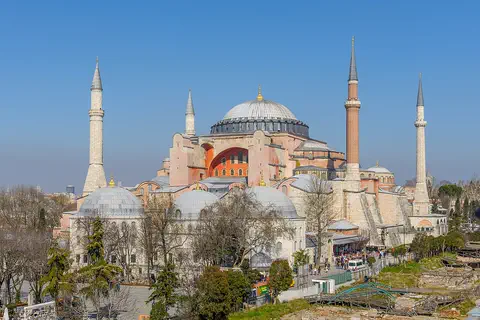
UNESCO names the Süleymaniye, together with the 6th-century Hagia Sophia, among the masterpieces of Istanbul, and says it is part of the city's skyline.
UNESCO lists the Süleymaniye Mosque complex among the masterpieces of the Historic Areas of Istanbul and, with the Şehzade Mosque complex, as works of the chief architect Sinan that reflect the climax of Ottoman architecture in the 16th century. A University of Notre Dame library record describes the mosque as built on a hilltop site above the Golden Horn, on the grounds of the old palace.
The Süleymaniye quarter is one of the four areas of the World Heritage property, together with the Archaeological Park, the Zeyrek area and the land walls. UNESCO notes that the skyline of the Historic Peninsula, with Topkapı Palace, Hagia Sophia and the Süleymaniye, is preserved by planning measures.
- Where
- Süleymaniye quarter, Istanbul, Türkiye
- Built
- 1550–1557
- Architect
- Sinan
- World Heritage
- part of the Historic Areas of Istanbul, inscribed 1985
Built for a sultan by a master architect
Long ago, a ruler named Süleyman asked for a new mosque.
The builder Sinan designed it. It took about seven years to build.
Süleyman ruled the Ottoman Empire from 1520 to 1566. His chief architect, Sinan, designed the mosque and the buildings of its complex, which UNESCO dates to 1550 to 1557.
The complex was built on the grounds of an old palace, according to the University of Notre Dame library. UNESCO says Sinan's works here and at the nearby Şehzade Mosque show Ottoman architecture at its high point.
ICOMOS's 1985 evaluation names the Şehzade and Süleymaniye mosques as two major works of the architect Koca Sinan, built under Süleyman the Magnificent (1520–1566), and calls the Süleymaniye a masterpiece of Sinan's architecture. UNESCO dates the complex to 1550–1557.
According to the University of Notre Dame library record, Sinan completed the külliye (the mosque and its linked buildings) in 1557 on part of the grounds of the old palace. UNESCO adds that the complex has kept its structural and architectural integrity, apart from some minor changes in its commercial part.
Domes, courtyard and minarets
The mosque has one giant dome on top.
Smaller domes sit all around it. Four tall, thin towers called minarets stand around it.
The mosque is topped by a big central dome, with a half dome and smaller domes stepping down around it. In front of the prayer hall is a courtyard surrounded by arches, each section with its own little dome.
Four tall, thin towers called minarets rise at the corners of the courtyard. The complex had many domes too: the Notre Dame record says it had more than 525 small domes, called cupolas.
The prayer hall rises in stages: a large central dome, a half dome on the courtyard side, and lower domes and small domed turrets around it. The forecourt is enclosed by an arcade whose bays each carry a small dome, and four minarets stand at the corners of the courtyard, as the photo shows.
The Notre Dame record notes that the complex as a whole had more than 525 cupolas and that rows of small shops and coffee-houses were set into its undercrofts and vaults.
A whole neighborhood of buildings
Sinan also built schools and a hospital for the mosque's complex.
There was a kitchen that gave out food, a bath and an inn where travelers could stay.
The mosque was the main building of a whole group of buildings. The Notre Dame record lists four madrasas, which are colleges, a preparatory school, a medical college, a hospital, a caravanserai, which is an inn for travelers, a public kitchen and a bath. There were also two tombs, rows of shops and stables.
Around the complex is the Süleymaniye quarter, with old wooden houses. In 1985, ICOMOS reported that 525 of them were listed and protected.
UNESCO lists the complex's caravanserai, madrasa, medical school, library, bath building, hospice and imperial tombs, and judges the ensemble a supreme example of the religious complexes of the Ottoman period. The Notre Dame record gives a fuller list: the mosque and two mausoleums, four madrasas, a preparatory school, a medical college, a hospital, a caravanserai, a public kitchen and a bath, with shops, coffee-houses, stables and a park for caravans.
The surrounding quarter is valued for its vernacular timber housing, which UNESCO says gives exceptional evidence of the late Ottoman urban pattern; ICOMOS reported 525 listed and protected wooden houses there in 1985, and UNESCO notes that the houses were already recognized as vulnerable at the time of inscription.
- Built for
- Sultan Süleyman (reigned 1520–1566)
- Cupolas in the complex
- more than 525
- Madrasas (colleges)
- four
- Wooden houses listed in the quarter (1985)
- 525
The mosque in the photo, and caring for the quarter
In the photo, you can see the giant dome and four tall minarets.
There are lots of small domes, green trees and water with boats far away.
The photo, taken from high above in July 2022, shows the big central dome with a gold-colored tip, the half dome and smaller domes below it, and the courtyard ringed by little domes. Four minarets stand at the corners. Green trees surround the mosque, and beyond it you can see rooftops, water with boats and a bridge, and tall towers far away.
The first conservation plans for the Süleymaniye quarter, the Zeyrek area and the land walls were approved in 1979 and 1981, UNESCO says, and the city's municipality has been working to revive the quarter's rundown parts.
The aerial photo (16 July 2022) shows the prayer hall's central dome and finial, its half dome and stepped smaller domes, the arcaded courtyard with its row of small domes, all four minarets with their balconies, and trees around the precinct, with the city, a waterway with boats and a bridge, and high-rise towers on the far side.
UNESCO reports that the first conservation plans for Zeyrek, Süleymaniye and the land walls were approved in 1979 and 1981 (ICOMOS records protection of the Süleymaniye quarter in 1980 and 1981), that the Metropolitan Municipality is attempting to rehabilitate the area's degraded parts, and that reviving the Süleymaniye and Zeyrek quarters is a long process of cleaning, conservation and restoration.
Amazing facts
-
The mosque's group of buildings had hundreds and hundreds of little domes.
The Süleymaniye complex had more than 525 small domes, called cupolas.
A University of Notre Dame library record notes that the complex had more than 525 cupolas.
-
There were little shops tucked under the buildings.
Rows of small shops and coffee-houses were built into the spaces underneath the complex.
Rows of small shops and coffee-houses were set into the complex's undercrofts and vaults, according to the Notre Dame record.
-
The complex had a hospital and a school for doctors.
Besides the mosque, the complex had a hospital and a medical college where doctors studied.
The külliye included both a hospital and a medical college, alongside four madrasas and a preparatory school.
-
Old wooden houses still stand in the neighborhood around the mosque.
In 1985, 525 old wooden houses in the Süleymaniye quarter were listed and protected.
ICOMOS's 1985 evaluation records 525 listed and protected wooden houses in the Süleymaniye quarter, a survival of its vernacular settlement.
Words to know
- mosque
- a building where Muslims gather to pray
- minaret
- a tall, thin tower beside a mosque
- dome
- a rounded roof shaped like half a ball
- complex
- a group of buildings planned and built together
- madrasa
- a school or college, especially one linked with a mosque
- caravanserai
- an inn where travelers and their animals could rest
Discovery challenge
-
Who designed the Süleymaniye Mosque?
Which architect designed the Süleymaniye Mosque and its complex?
Which chief architect designed the Süleymaniye complex in 1550–1557?
- Sinan
- Süleyman
- Anthemios of Tralles
Show the answer
Sinan
Sinan, a great builder!
Sinan, the sultan's chief architect.
Sinan; Anthemios of Tralles co-designed Hagia Sophia in 532–537.
-
Which city is the mosque in?
In which city does the Süleymaniye Mosque stand?
The Süleymaniye quarter is part of the World Heritage property of which city?
- Istanbul
- Cairo
- Delhi
Show the answer
Istanbul
Istanbul, in Türkiye!
Istanbul, in Türkiye.
Istanbul (Historic Areas of Istanbul, inscribed 1985).
-
What are the tall, thin towers called?
What are the tall, thin towers at the corners of the mosque called?
What name is given to the four tall towers at the corners of the courtyard?
- Minarets
- Pyramids
- Lighthouses
Show the answer
Minarets
Minarets!
Minarets.
Minarets; the photo shows all four, with their balconies.
-
Where could travelers stay in the complex?
What was the complex's inn for travelers called?
Which building of the külliye served travelers and their caravans?
- A caravanserai
- A madrasa
- A minaret
Show the answer
A caravanserai
In an inn called a caravanserai!
A caravanserai.
The caravanserai; a madrasa is a college and a minaret a tower.
-
When was the complex finished?
In which year was the Süleymaniye complex completed?
In which year did Sinan complete the Süleymaniye külliye?
- 1557
- 1457
- 1757
Show the answer
1557
In 1557!
In 1557, after work began in 1550.
1557 (UNESCO dates the complex 1550–1557).
Nearby places
-
 Watch
Landmark
Aqueduct of Valens
The Aqueduct of Valens is a bridge of arches in Istanbul, Türkiye, 971 meters long with 86 arches. It carried a water channel across a valley between two hills. It is named after the emperor Valens, and a research project at Radboud University dates its construction to 368 to 373.
-
 Watch
Landmark
Hagia Sophia
Hagia Sophia in Istanbul was built in under six years, from 532 to 537, for the emperor Justinian. Its enormous dome seems to float on a ring of 40 windows. Over almost 1,500 years it has been a church, a mosque and a museum, and since 2020 it has been a mosque.
-
 Watch
Landmark
Sultan Ahmed Mosque
The Sultan Ahmed Mosque in Istanbul was built between 1609 and about 1616 for the Ottoman ruler Sultan Ahmed I. Its central dome is ringed by half-domes and smaller domes, and six slender minarets rise around it. Many people call it the Blue Mosque because of the blue and green tiles and painted decoration inside. It is still a working mosque, where Muslims come to pray.
-
 Watch
Landmark
Topkapı Palace
Topkapı Palace sits on a point of land where the Bosphorus Strait meets the sea in Istanbul. Sultan Mehmed II built it between 1460 and 1478, and for nearly 400 years it was the home of the Ottoman sultans and the center of their government. In 1924 it became a museum.
-
 Watch
City
Istanbul
Istanbul is the biggest city in Türkiye, built on both sides of the Bosporus, the narrow strait between Europe and Asia. Once called Byzantium and then Constantinople, it was the capital of two great empires. About 15.7 million people lived in Istanbul province in 2023.
-
 Watch
Natural wonder
Sea of Marmara
The Sea of Marmara is a small inland sea between the Black Sea and the Aegean Sea, joined to them by two narrow straits. A big fault runs across its floor, and its water comes in two layers: less salty water from the Black Sea on top, and saltier Mediterranean water below.
-
 Watch
Landmark
Selimiye Mosque
The Selimiye Mosque in Edirne, Türkiye, was built from 1569 to 1575 for the Ottoman sultan Selim II. Its architect, Sinan, called it his masterpiece. A single great dome rests on eight supports, and four minarets about 71 meters tall stand around it. It became a UNESCO World Heritage Site in 2011.
-
 Watch
Landmark
Pergamon
Pergamon is an ancient city in western Türkiye, built on a steep hill above the Bakırçay Plain. It was the capital of the Attalid kings from the 3rd century BC and later of a Roman province. UNESCO says its kings founded one of the largest libraries, and it is a UNESCO World Heritage Site.
Explore next
-
Watch
City
Istanbul
Istanbul is the biggest city in Türkiye, built on both sides of the Bosporus, the narrow strait between Europe and Asia. Once called Byzantium and then Constantinople, it was the capital of two great empires. About 15.7 million people lived in Istanbul province in 2023.
-
 Watch
 Country
Türkiye (Turkey)
Türkiye, also called Turkey, lies partly in Asia and partly in Europe. A narrow waterway called the Bosporus runs through its biggest city, Istanbul, and its land is mostly mountains and high plains. About 86 million people live there.
-
Watch
Landmark
Hagia Sophia
Hagia Sophia in Istanbul was built in under six years, from 532 to 537, for the emperor Justinian. Its enormous dome seems to float on a ring of 40 windows. Over almost 1,500 years it has been a church, a mosque and a museum, and since 2020 it has been a mosque.
-
Watch
Landmark
Sultan Ahmed Mosque
The Sultan Ahmed Mosque in Istanbul was built between 1609 and about 1616 for the Ottoman ruler Sultan Ahmed I. Its central dome is ringed by half-domes and smaller domes, and six slender minarets rise around it. Many people call it the Blue Mosque because of the blue and green tiles and painted decoration inside. It is still a working mosque, where Muslims come to pray.
-
Watch
Landmark
Topkapı Palace
Topkapı Palace sits on a point of land where the Bosphorus Strait meets the sea in Istanbul. Sultan Mehmed II built it between 1460 and 1478, and for nearly 400 years it was the home of the Ottoman sultans and the center of their government. In 1924 it became a museum.
-
Watch
Landmark
Selimiye Mosque
The Selimiye Mosque in Edirne, Türkiye, was built from 1569 to 1575 for the Ottoman sultan Selim II. Its architect, Sinan, called it his masterpiece. A single great dome rests on eight supports, and four minarets about 71 meters tall stand around it. It became a UNESCO World Heritage Site in 2011.
-
 Watch
Landmark
Naqsh-e Jahan Square
Naqsh-e Jahan Square in Isfahan, Iran, was built by Shah Abbas I of the Safavid dynasty in the early 1600s. It is 560 meters long and 160 meters wide, with shops in two-story arcades and a grand building on each side. UNESCO listed it as a World Heritage Site in 1979.
-
 Watch
Landmark
Abraj Al Bait
Abraj Al Bait is a group of seven hotel towers in Mecca, Saudi Arabia, beside the city's Great Mosque. In the middle rises the Makkah Royal Clock Tower, 601 meters tall to the tip of its spire, with a huge clock near the top. It was finished in 2012.
For parents & teachers
What children will learn
- Locate the Süleymaniye Mosque in Istanbul and name its architect, Sinan, and the sultan it was built for.
- Identify the parts of the mosque (central dome, half dome, courtyard, minarets) from a photo.
- Describe how a külliye combined a mosque with schools, a hospital, an inn, a kitchen and a bath.
Recommended ages: 4 to 17 · About 15 minutes
Talk about it
- Why might a ruler build schools, a hospital and a kitchen together with a mosque?
- How do domes of different sizes work together to cover a large space?
- Why might a city protect old wooden houses around an important building?
Try at home or in class
- Build a model with a large bowl for the central dome, smaller bowls or cups around it, and four pencils or straws as minarets.
- Draw a plan of an imaginary complex with a mosque, a school, a hospital, an inn, a kitchen and a bath.
Key vocabulary: mosque, minaret, dome, complex, madrasa, caravanserai
Where these facts come from
- Wikidata , Wikimedia Foundation (CC0 1.0)
- Historic Areas of Istanbul , UNESCO World Heritage Centre
- Advisory Body Evaluation: Historic Areas of Istanbul (No 356) , ICOMOS, via UNESCO World Heritage Centre
- Süleymaniye Mosque: Raking view of central entrance facade , University of Notre Dame, Hesburgh Libraries (Marble)
- Wikimedia Commons , Wikimedia Foundation (Per file (public domain, CC0, CC BY or CC BY-SA); see each media record)
Checked, not yet human-reviewed. Last updated November 1, 2026. Spotted a mistake? Tell us.