
Landmark Asia
Baikonur Cosmodrome
Baikonur is a place in Kazakhstan where rockets blast off into space. The first satellite and the first person to go into space both left from here.
Baikonur Cosmodrome is a huge rocket launch site on the flat grasslands of Kazakhstan. The Soviet Union began building it in secret in 1955. Sputnik 1, the first satellite, launched from here in 1957, and Yuri Gagarin, the first person in space, in 1961. Today Russia rents it from Kazakhstan, and crews have launched from it to the International Space Station as recently as 2025.
Begun in 1955 as a secret Soviet missile test range near Tyuratam on the Kazakh steppe, Baikonur launched Sputnik 1 (1957) and Vostok 1 (1961) from its Pad 1, later Gagarin's Start. Since Kazakhstan's independence Russia has leased it, under an agreement running to 2050, and Soyuz crews launched from it to the International Space Station as recently as November 2025.
Photo: Ninara from Helsinki, Finland, CC BY 2.0, via Wikimedia Commons
Discover Baikonur
Baikonur is in Kazakhstan, a big country in Asia.
It is a place full of launch pads, where rockets blast off into space. All around is flat, grassy land. Winters are very cold, and summers are very hot.
Baikonur Cosmodrome is a spaceport, a place where rockets are launched into space. It lies on the steppe, wide, flat grassland, in Kazakhstan, about 2,100 kilometers from Moscow. The area has long, cold winters and hot, dry summers.
The cosmodrome is huge. Russia rents about 5,500 square kilometers of land there from Kazakhstan, with launch pads, assembly buildings, railways and a town where workers live. The first satellite and the first person to fly into space were both launched from here.
ESA places the cosmodrome at about 45.6°N, 63.4°E in the flat grasslands of Kazakhstan, with a continental climate of long, cold winters and hot, dry summers; Space.com, citing NASA, gives temperatures from about minus 40 °C in winter to 45 °C in summer, on a desert steppe east of the Aral Sea some 2,100 km from Moscow.
The name is famously misleading. The Soviet Union used the name and coordinates of Baikonur, a small mining town hundreds of kilometers away, to hide the true site near the railway station of Tyuratam; ESA gives the distance as about 370 km, NASA as about 322 km. The workers' town nearby, Leninsk, was renamed Baikonur in 1998. Russia leases about 5,500 km² from Kazakhstan.
- Country
- Kazakhstan (leased by Russia)
- Construction began
- 1955
- Area leased
- about 5,500 square km
- Distance from Moscow
- about 2,100 km
Where the space age began
Long ago, the first satellite was sent into space from here.
It was a small metal ball called Sputnik. A few years later, a man named Yuri Gagarin blasted off from the same launch pad. He was the first person ever to go into space!
The Soviet Union, a large country that broke up in 1991, began building Baikonur in secret in 1955 to test long-range missiles. A railway line nearby let workers bring in building materials and, later, the rockets.
On October 4, 1957, a rocket launched Sputnik 1, the world's first artificial satellite, from Baikonur's Launch Pad 1. On April 12, 1961, Yuri Gagarin lifted off from the same pad and became the first person to orbit Earth. The chief designer of these rockets, Sergei Korolev, worked at Baikonur from the start. Later firsts included the first woman in space, Valentina Tereshkova, in 1963.
The site was chosen in high secrecy for long-range intercontinental missile testing, the existing Soviet ranges being unsuitable; Space.com, drawing on the historian Anatoly Zak, cites a rail spur on the Kazakhstanskaya railroad as a key factor. Construction began in 1955, and by 1957 American U-2 aircraft were overflying a suspected missile site.
On October 4, 1957, an R-7 rocket launched Sputnik 1 from Launch Pad 1, under Sergei Korolev, then known publicly only as the 'Chief Designer'. On April 12, 1961, Yuri Gagarin lifted off from the same pad; the cosmodrome's name was announced only then, when the Soviet Union reported the launch site to the International Aviation Federation as the town of Baikonur. Luna 1 (1959), Valentina Tereshkova's flight (1963) and Voskhod 1 (1964) also flew from Baikonur.
Rockets by rail
At Baikonur, rockets are put together inside huge buildings.
A train carries the rocket out to the launch pad. Then the rocket is raised up to stand tall. Then, countdown, and lift off!
Baikonur works like a giant factory for launches. Rockets are put together in big assembly buildings, then carried along railway tracks to the launch pads. ESA describes Korolev and his team walking in front of the very first rocket as it rolled by rail to Pad 1.
Baikonur has had pads for many different rockets: Soyuz, which carries astronauts, Proton, Russia's largest working rocket in 2002, and Zenit. In 1988 a giant Energia rocket launched Buran, a Soviet space shuttle, from here. Buran flew only once, without a crew.
The R-7 that carried Sputnik was moved by rail from its assembly building to Pad 1, and railroad tracks also led to the Buran launch complex. In 2002 ESA listed the Proton, Zenit and Soyuz pads as in regular use, with the Proton then Russia's largest operational launcher.
Not every project succeeded. The giant N-1 Moon rocket, which ESA gives as weighing 2,750 tons, failed in all four test launches between 1969 and 1972. The Energia rocket launched the Buran shuttle on its single, uncrewed flight in 1988; after the Soviet Union's collapse the program ended, and Space.com reports that the flown Buran was destroyed when its hangar roof collapsed in 2002.
Gagarin's Start and the launch sites
Baikonur's most famous launch pad is called Gagarin's Start.
Signs in the Russian language mark the different launch sites. Visitors have been able to see the little house where Yuri Gagarin slept the night before his flight.
Launch Pad 1, where both Sputnik and Gagarin's rocket lifted off, became known as Gagarin's Start. ESA calls it probably the world's most historic launch site. In 2002, ESA wrote that visitors could still see the simple wooden house where Korolev worked, and the small building where Gagarin spent the night before his flight.
The cosmodrome is divided into numbered sites. The sign in the photo stands at Site 31 and is written in Russian. It names Russia's space agency, Roscosmos, and the launch complex. In November 2025, a Soyuz rocket carried astronauts from Site 31 to the International Space Station.
Pad 1 at Site 1, renamed Gagarin's Start, launched both Sputnik 1 and Vostok 1; ESA calls it probably the world's most historic launch site, and in 2002 it described Korolev's wooden house and the cottage where Gagarin spent his last night before launch as still standing.
The photographed sign at Site 31, in Russian, names the State Corporation Roscosmos, the company TsENKI and its Yuzhny space center branch and Test Center No. 1, and the 'Vostok' launch complex, launcher 6 at Site 31. NASASpaceflight.com reports that Soyuz MS-28 lifted off from Site 31, pad 6, on November 27, 2025. Inspections after that launch found that the pad's service cabin, a large platform that gives workers access to the rocket's engines, had fallen into the flame trench below; Roscosmos announced in March 2026 that Site 31/6 had been fully repaired.
- Sputnik 1
- October 4, 1957, Pad 1
- Yuri Gagarin
- April 12, 1961, Pad 1
- Buran's only flight
- 1988, uncrewed
Still launching people to space
Rockets were still blasting off from Baikonur in 2025.
In 2025, one carried astronauts to the International Space Station. People from many countries have flown from here.
After the Soviet Union broke up in 1991, Baikonur ended up in the new country of Kazakhstan. Russia now rents the cosmodrome and the town from Kazakhstan, and the lease runs until 2050.
Soyuz rockets have carried crews to the International Space Station from Baikonur for many years. On November 27, 2025, NASA astronaut Chris Williams and Roscosmos cosmonauts Sergey Kud-Sverchkov and Sergei Mikaev launched from Baikonur for about eight months on the station. Russia has also built a new launch site on its own land, Vostochny.
With the breakup of the Soviet Union in 1991, Baikonur fell within independent Kazakhstan. Tengrinews reported in 2012 that both the cosmodrome and its town are leased by Russia until 2050, at $115 million a year, and that the two countries were discussing a gradual shift from lease to shared use.
Soyuz crews have long launched from Baikonur to the International Space Station. NASA reports that Soyuz MS-28 lifted off at 2:27 p.m. Baikonur time on November 27, 2025, with Chris Williams, Sergey Kud-Sverchkov and Sergei Mikaev, for a stay of about eight months. Russia's newer Vostochny site, in eastern Russia, launched its first rocket in April 2016.
Amazing facts
-
The name Baikonur was used to keep the real place secret!
Baikonur is named after a small mining town hundreds of kilometers away. The Soviet Union used that town's name to hide where the launch site really was.
The Soviet Union deliberately used the name and coordinates of the mining town of Baikonur, about 322 km (NASA) or 370 km (ESA) from the real site, to conceal its location.
-
Yuri Gagarin's launch pad is named after him.
Launch Pad 1, where Sputnik and Yuri Gagarin both lifted off, is known as Gagarin's Start.
Pad 1 launched both Sputnik 1 (1957) and Vostok 1 (1961); ESA calls it probably the world's most historic launch site.
-
A Soviet space shuttle flew from Baikonur just once.
In 1988 the Soviet space shuttle Buran flew into space from Baikonur with no one aboard. It never flew again.
Buran, launched by the Energia rocket in 1988, made a single uncrewed flight before the program ended.
-
The first rocket rolled to its launch pad on a train.
The rocket that carried Sputnik was moved to its launch pad by rail, with its designers walking slowly in front of it.
ESA recounts that Korolev and his team walked bareheaded before the R-7 as it moved by rail from the assembly building to Pad 1.
Words to know
- cosmodrome
- a place where rockets are launched into space; a spaceport
- satellite
- an object that travels around a planet; people build and launch satellites into space
- launch pad
- the place where a rocket stands when it takes off
- steppe
- a huge, flat, dry grassland with few trees
- lease
- an agreement to rent land or a building for a set time
- orbit
- the curved path an object follows around a planet or star
Discovery challenge
-
Who was the first person to go into space?
Which cosmonaut launched from Baikonur in 1961 to become the first person in space?
Who lifted off from Baikonur's Pad 1 on April 12, 1961?
- Yuri Gagarin
- Neil Armstrong
- Sergei Korolev
Show the answer
Yuri Gagarin
Yuri Gagarin! He blasted off from Baikonur.
Yuri Gagarin, who orbited Earth on April 12, 1961.
Yuri Gagarin, aboard Vostok 1; the pad became known as Gagarin's Start.
-
What was Sputnik 1?
What was Sputnik 1, launched from Baikonur in 1957?
What did the R-7 launched from Pad 1 on October 4, 1957 place in orbit?
- The first satellite
- A space station
- A Moon rover
Show the answer
The first satellite
The very first satellite!
The world's first artificial satellite.
Sputnik 1, the first artificial satellite, opening the space age.
-
Which country is Baikonur in?
In which country is the Baikonur Cosmodrome?
Which country leases the cosmodrome to Russia until 2050?
- Kazakhstan
- Japan
- Brazil
Show the answer
Kazakhstan
Kazakhstan! It is a big country in Asia.
Kazakhstan. Russia rents the cosmodrome until 2050.
Kazakhstan, independent since the Soviet breakup of 1991.
-
How are rockets carried to the launch pad at Baikonur?
How do rockets travel from their assembly buildings to the pad at Baikonur?
By what means was the R-7 carrying Sputnik moved to Pad 1?
- By train
- By boat
- By airplane
Show the answer
By train
By train, on railway tracks!
By rail, along tracks from the assembly buildings to the pads.
By rail from the assembly building, with Korolev's team walking ahead.
Nearby places
-
 Watch
Natural wonder
Volga
The Volga is Europe's longest river. It rises in the Valdai Hills northwest of Moscow and flows about 3,530 kilometers to the Caspian Sea, all within Russia. Almost half of Russia's people live in its basin. Big dams now turn much of it into a chain of long lakes, and its huge delta shelters up to 750,000 waterbirds in mild winters.
-
 Watch
City
Baku
Baku, the capital of Azerbaijan, curves around a bay on the Caspian Sea, the world's largest inland body of water. Its old walled town, with the Maiden Tower and a palace of the Shirvan shahs, is a World Heritage Site, and oil has made the city important for more than 150 years.
-
 Watch
Landmark
Shaki
Shaki, also spelled Sheki, is a historic town in the forested Caucasus Mountains of Azerbaijan. After a flood of mud destroyed the old town in 1772, people rebuilt it higher up the valley, with houses, gardens, water channels and a khan's palace. Its wealth came from silk, and UNESCO made its historic center a World Heritage Site in 2019.
-
 Watch
City
Tehran
Tehran, the capital of Iran, spreads up the slopes of the Alborz Mountains, with snowy peaks to the north and desert to the south. Once a small village, and later a market town known for its pomegranates, it became the capital in 1786. Today it is a huge, modern city with an old roofed bazaar, a palace that is a World Heritage Site and the 435-meter Milad Tower.
-
 Watch
City
Tbilisi
Tbilisi, the capital of Georgia, lies along the Mtkvari River between mountain ridges. Its name comes from the Georgian word for "warm", after the hot springs that feed its old bathhouses. At the 2024 census, 1,331,485 people lived in the self-governing city.
-
 Watch
Natural wonder
K2
K2 is the world's second highest mountain, 8,611 meters tall, in the Karakoram Range of Asia. It got its short name in 1856, when a surveyor marked it as the second peak he measured in the Karakoram. It is one of the hardest mountains to climb, and its summit was first reached in 1954.
-
 Watch
Natural wonder
Ural Mountains
The Ural Mountains run about 2,500 kilometers from north to south through Russia, and they form most of the traditional boundary between Europe and Asia. They are very old mountains that have been worn down over a very long time; their highest peak, Mount Narodnaya, is 1,895 meters tall. The Urals stretch from icy Arctic tundra to dry steppe and are rich in metals and gems.
-
 Watch
Natural wonder
Mount Elbrus
Mount Elbrus is the highest peak of the Caucasus Mountains, in southwestern Russia. It is an old volcano with two snow-covered tops, the higher one 5,642 meters tall. Twenty-two glaciers cover its slopes and feed rivers below. Whether it counts as Europe's highest mountain depends on where you draw the line between Europe and Asia.
Experiments to try
- Watch Try it What If? Lab What if a rocket carried less fuel? Most of a rocket is fuel. In our model, a rocket that is 85 percent fuel gains about 5.7 kilometers per second. Cut the fuel to half the rocket and it gains only about 2.1, less than half as much speed. Find out why rockets need so much fuel, and why they drop parts on the way up.
- Watch What If? Lab What if you lived on a space station? On the International Space Station, astronauts and everything around them float. That sounds fun, but without the steady pull of gravity to work against, bones and muscles get weaker. That's why astronauts exercise for about two hours every day. Imagine moving in, and find out how they stay strong.
Explore next
-
 Watch
 Country
Kazakhstan
Kazakhstan is the largest country in Central Asia and the ninth largest in the world. It has no ocean coast, but the Caspian Sea lies along its southwest edge. About 20.6 million people lived there in 2026, and its capital is Astana.
- Watch Try it What If? Lab What if a rocket carried less fuel? Most of a rocket is fuel. In our model, a rocket that is 85 percent fuel gains about 5.7 kilometers per second. Cut the fuel to half the rocket and it gains only about 2.1, less than half as much speed. Find out why rockets need so much fuel, and why they drop parts on the way up.
- Watch What If? Lab What if you lived on a space station? On the International Space Station, astronauts and everything around them float. That sounds fun, but without the steady pull of gravity to work against, bones and muscles get weaker. That's why astronauts exercise for about two hours every day. Imagine moving in, and find out how they stay strong.
-
 Watch
Landmark
Agra Fort
Agra Fort is a huge red sandstone fortress beside the Yamuna River in Agra, India. The Mughal emperor Akbar began it in 1565. Its walls, about 2.5 kilometers around, protect palaces, halls and mosques added by later emperors. It was both an army base and a royal home.
-
 Watch
Landmark
Al-Aqsa Mosque
Al-Aqsa Mosque stands at the southern end of a huge raised plaza in the Old City of Jerusalem. Built in the early 700s, it has a silver-gray dome, and the golden Dome of the Rock stands nearby. The plaza is important to Muslims and to Jews.
-
 Watch
Landmark
Al-Masjid al-Haram
Al-Masjid al-Haram, the Great Mosque of Mecca in Saudi Arabia, was built around the Kaaba, a cube-shaped building that Muslims face when they pray. It is the most important place of pilgrimage in Islam. In 2026, 1,707,301 pilgrims came to Mecca for the hajj, and the mosque can hold up to about one million worshippers.
-
 Watch
Landmark
Angkor
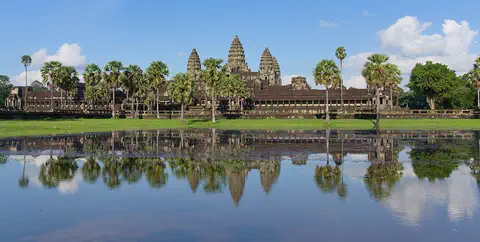
Angkor, in northwestern Cambodia, was the capital of the Khmer Empire from the 9th to the 15th century. Its kings built city after city here, with scores of temples, such as Angkor Wat and the Bayon, and giant reservoirs and canals to water the rice fields. Today it covers about 400 square kilometers, and more than 100,000 people live in villages inside it.
-
Watch
Landmark
Angkor Wat
Angkor Wat, near the town of Siem Reap in Cambodia, was built in the 12th century by the Khmer king Suryavarman II. Britannica (2026) calls it the world's largest religious structure. It was built as a Hindu temple and later became a Buddhist place of worship.
For parents & teachers
What children will learn
- Locate Baikonur in Kazakhstan and explain what a cosmodrome is.
- Describe the first satellite and the first human spaceflight, both launched from Baikonur.
- Explain how rockets are assembled and moved by rail to the launch pad.
- Understand that Russia leases the cosmodrome from Kazakhstan.
Recommended ages: 3 to 17 · About 15 minutes
Talk about it
- Why might a country build a launch site in a remote, flat place far from big cities?
- The Soviet Union used a false name to hide the site. Why might countries keep some places secret?
- Astronauts from many countries now fly together. Why is working together useful in space?
Try at home or in class
- Make a balloon rocket: tape a straw to a balloon, thread a string through the straw and let the balloon go to see how pushing air backward moves it forward.
- On a world map, find Baikonur, Moscow and the Aral Sea, and measure which is closest.
Key vocabulary: cosmodrome, satellite, launch pad, steppe, lease, orbit
Where these facts come from
- Wikidata , Wikimedia Foundation (CC0 1.0)
- Baikonur Cosmodrome , European Space Agency
- Baikonur: Steppe into Space (May 1, 2002) , European Space Agency
- Baikonur Cosmodrome: Russian Launch Complex , Space.com
- Trio Aboard Soyuz Launches to Station for Docking Today (November 27, 2025) , NASA
- Soyuz MS-28 launches three new crew members to ISS (November 2025) , NASASpaceflight.com
- Baikonur launch pad restored, clearing path for Progress MS-33 ISS mission (March 7, 2026) , NASASpaceflight.com
- Russia hopes changes to the Baikonur lease agreement will be introduced only after 2050 (December 11, 2012) , Tengrinews
- Wikimedia Commons , Wikimedia Foundation (Per file (public domain, CC0, CC BY or CC BY-SA); see each media record)
Checked, not yet human-reviewed. Last updated October 27, 2026. Spotted a mistake? Tell us.