
Landmark Asia
Shwedagon Pagoda
The Shwedagon Pagoda is a giant golden tower shaped like a bell, on a hill in Yangon, Myanmar. Its tip is covered with diamonds and other jewels!
The Shwedagon Pagoda is a huge Buddhist stupa covered in gold, on Singuttara Hill in the center of Yangon, Myanmar. Rebuilt and raised by kings and a queen over many centuries, it now stands 112 meters tall. Covered stairways climb the hill to it from the four directions.
The Shwedagon Pagoda, on Singuttara Hill in central Yangon, is a gold-covered Buddhist stupa that historians and archaeologists date to between the 6th and 10th centuries CE. Rebuilt to 18 m in the 14th century, raised to 40 m by Queen Binnya Thau and to 99 m by King Hsinbyushin, it reached its present 112 m with a new crowning umbrella in 1871. Myanmar placed it on its World Heritage Tentative List in 2018.
Photo: Stefan Fussan, CC BY-SA 3.0, via Wikimedia Commons
Discover the Shwedagon Pagoda
The Shwedagon Pagoda is in Yangon, a city in Myanmar. It stands on top of a hill.
It is a stupa: a tower shaped a bit like a bell, and it is covered in gold.
The Shwedagon Pagoda stands on Singuttara Hill, in the center of Yangon, in Myanmar. It is a stupa, a monument of the Buddhist tradition, and its full name means 'the Great Golden Mountain Stupa'.
The main stupa sits on the top terrace of the hill, surrounded by many smaller buildings, pavilions and large bronze bells.
Myanmar's Tentative List entry (2018, the State Party's own text) describes the Shwedagon on Singuttara Hill in the center of Yangon, with a proposed area of 46.3 hectares covering the hill, the main stupa and the buildings, bells and other features on and around it. Its formal name, Shwedagon Zedi Daw, translates as 'the Great Golden Mountain Stupa'.
The text describes the hill as terraced: three intermediate platforms with walkways and monasteries, and an uppermost platform where the main stupa stands among pavilions and large bronze bells.
- Where
- Singuttara Hill, central Yangon, Myanmar
- Height
- 112 m (since 1871)
- First built
- between the 6th and 10th centuries CE (historians and archaeologists)
- World Heritage
- on Myanmar's Tentative List since 2018
Raised higher and higher
Long ago, the stupa was much smaller. Kings and a queen made it taller and taller.
One queen gave her own weight in gold to the stupa!
Historians and archaeologists think the stupa was first built between the 6th and 10th centuries. In the 1300s, King Binnya U rebuilt it to 18 meters tall. In the 1400s, Queen Binnya Thau raised it to 40 meters and shaped the hill into terraces.
An earthquake in 1768 brought down its top. King Hsinbyushin rebuilt it to 99 meters, and in 1871 a new crowning umbrella made it 112 meters tall.
The Tentative List text notes that the stupa fell into disrepair until the 14th century, when King Binnya U (1323–1384) rebuilt it to 18 m. Queen Binnya Thau (1453–1472) raised it to 40 m, terraced the hill, paved the top terrace with flagstones and assigned land and workers to its upkeep; an inscription at the site lists repairs from 1436 onward.
Earthquakes over the following centuries caused damage, the worst in 1768, when the top of the stupa fell. King Hsinbyushin (1763–1776) raised it to 99 m, and a new crown umbrella given by King Mindon Min in 1871 brought it to its present 112 m.
A golden stupa on a terraced hill
The stupa's base is made of bricks covered with gold plates. The whole stupa is golden.
At the very top is an umbrella shape covered with diamonds and other jewels.
The stupa's base is made of bricks covered with plates of real gold, and the whole stupa above it is covered in gold. On its tip sits a crowning umbrella set with diamonds and other jewels.
Four covered stairways climb the hill from the north, south, east and west, passing three terraces on the way up to the main stupa.
According to the State Party's description, the plinth is of brick covered with genuine gold plates, the stupa itself is entirely covered in gold, and it is crowned by an umbrella encrusted with diamonds and other jewels. People have given gold to maintain the monument since Queen Binnya Thau began the tradition in the 15th century by giving her weight in gold.
Four covered monumental stairways rise from the four cardinal directions to three intermediate terraces and the uppermost platform, where the main stupa is reached through four halls facing the cardinal directions.
Gold, bells and stairways
Big bronze bells sit on the top terrace around the stupa.
The stairways up the hill are covered with roofs.
The stairways up the hill are covered with roofs. In the photo, the entrance of the southern stairway has tall, layered roofs with pointed spires, decorated in gold. Large bronze bells and many pavilions stand on the top terrace around the main stupa.
Over time, many shrines were added to the site, and today hundreds of monasteries stand on its terraces.
The Tentative List text describes how many shrines were added over time and how hundreds of monasteries now surround the stupa on its three terraced platforms. The property it proposes includes the hill, its encircling levels and monasteries, the covered staircases, and the uppermost platform with pavilions and bells.
The gold covering has been kept up by gifts from people of all walks of life and from rulers throughout the country's history, following the tradition begun in the 15th century.
- Covered stairways
- 4, from the four directions
- Terraces below the top
- 3
- Proposed area
- 46.3 ha
The southern stairway
In this photo, golden roofs rise toward the blue sky. Can you find the tall golden stupa on the right?
This photo, a scanned slide, was taken near the southern stairway. On the left is the long entrance building with layer upon layer of roofs and tall pointed spires, all trimmed in gold.
On the right, above the trees, rises the main golden stupa with its bell shape and its pointed tip.
The photograph (a scanned slide by Stefan Fussan) shows the southern stairway's entrance building, with tiered roofs and spired towers decorated in gold, and the main stupa rising behind the trees on the right.
The State Party notes that a 1768 earthquake brought down the top of the stupa and that it was raised to 99 m afterward; the crown umbrella of 1871 brought it to the 112 m seen today.
Amazing facts
-
A queen gave her own weight in gold to this stupa!
In the 1400s, Queen Binnya Thau gave her weight in gold, starting a tradition of giving gold to keep the stupa covered.
Queen Binnya Thau (1453–1472) donated her weight in gold, beginning a tradition of gifts of gold to maintain the monument.
-
The very top of the stupa is covered with diamonds and other jewels!
The crowning umbrella on the stupa's tip is set with diamonds and other jewels.
The stupa is crowned by an umbrella encrusted with diamonds and other jewels; a new crown umbrella was given in 1871.
-
The stupa grew more than six times taller over hundreds of years!
Rebuilt to 18 meters in the 1300s, the stupa reached 112 meters in 1871, more than six times taller.
From 18 m in the 14th century to 112 m after 1871: an increase of more than sixfold.
Words to know
- stupa
- a dome- or bell-shaped monument built in the Buddhist tradition
- pagoda
- a name for a tower-like Buddhist monument or temple in parts of Asia
- terrace
- a flat, level step cut into the side of a hill
- plinth
- the heavy base that a building or monument stands on
- spire
- a tall, pointed top on a tower or roof
- earthquake
- a sudden shaking of the ground
Discovery challenge
-
What covers the Shwedagon stupa?
What metal covers the whole Shwedagon stupa?
What covers the stupa's brick plinth, according to the State Party's description?
- Gold
- Iron
- Silver paint
Show the answer
Gold
Gold!
Gold.
Genuine gold plates.
-
How tall is the stupa now?
How tall has the stupa been since its new top of 1871?
What height did King Mindon Min's crown umbrella of 1871 bring the stupa to?
- 112 meters
- 12 meters
- 1,120 meters
Show the answer
112 meters
112 meters!
112 meters.
112 m.
-
In which country is the Shwedagon Pagoda?
In which country is the Shwedagon Pagoda?
In which country's city of Yangon is Singuttara Hill?
- Myanmar
- Japan
- Brazil
Show the answer
Myanmar
Myanmar!
Myanmar.
Myanmar.
-
What did a queen give for the stupa?
What did Queen Binnya Thau give for the stupa?
What gift by Queen Binnya Thau began a lasting tradition at the Shwedagon?
- Her weight in gold
- A boat
- A garden
Show the answer
Her weight in gold
Her weight in gold!
Her own weight in gold.
Her weight in gold.
-
What brought down the top of the stupa in 1768?
What happened to the stupa in 1768?
What event of 1768 led King Hsinbyushin to raise the stupa to 99 m?
- An earthquake
- A flood
- A strong wind
Show the answer
An earthquake
An earthquake shook it!
An earthquake brought down its top.
An earthquake that brought down the top.
Nearby places
-
 Watch
City
Yangon
Yangon, once spelled Rangoon, is the largest city in Myanmar and its main port. It lies in the eastern part of the Irrawaddy delta, where two rivers meet. At the 2024 census, 4,584,622 people lived in the city.
-
 Watch
City
Naypyidaw
Naypyidaw is the capital of Myanmar, in a wide basin in the center of the country. It is a new city: building work began in 2004 near the town of Pyinmana, and it was proclaimed the capital in March 2006. At the 2024 census, Naypyidaw, together with Pyinmana and Lewe, had 358,679 people.
-
 Watch
City
Chiang Mai
Chiang Mai is the main city of northern Thailand, on the Ping River. The encyclopedia Larousse says it was founded in 1296 as the capital of the Thai kingdom of Lan Na. Thailand's registration counted 127,240 people in the city at the end of 2019.
-
 Watch
Landmark
Ayutthaya Historical Park
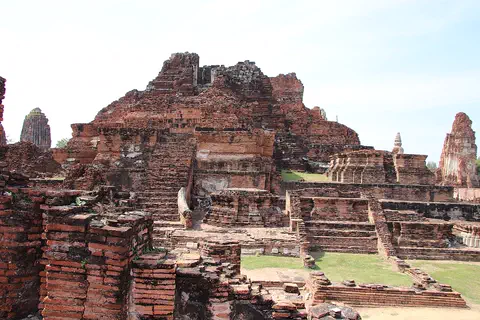
Ayutthaya, in Thailand, was founded in 1350 and became the second capital of the Siamese kingdom. From the 14th to the 18th centuries it grew into a center of trade and diplomacy. Today its brick ruins, tall towers and the remains of large monasteries are kept in a historical park, a UNESCO World Heritage Site since 1991.
-
 Watch
City
Bangkok
Bangkok, the capital of Thailand, lies on the delta of the Chao Phraya River, about 40 kilometers from the sea. It became the capital in 1782, when the new royal palace and temples were built. Once called the 'Venice of the East' for its canals, it is now a huge, busy city with skyscrapers and an elevated railway.
-
 Watch
City
Vientiane
Vientiane is the capital of Laos, on the left bank of the Mekong River. Lao Statistics Bureau figures give Vientiane Capital, the prefecture around the city, an estimated 844,020 people in mid-2015.
-
 Watch
City
Luang Prabang
Luang Prabang is a town in northern Laos, built on a peninsula where the Nam Khan River meets the Mekong. From the 14th to the 16th century it was the capital of the kingdom of Lane Xang, the 'Kingdom of a Million Elephants'. UNESCO lists the town as a World Heritage Site for the way it mixes traditional Lao buildings with buildings from colonial times.
-
 Watch
Natural wonder
Andaman Sea
The Andaman Sea is part of the eastern Indian Ocean, near Thailand and Myanmar, with the Andaman and Nicobar Islands nearby. Its rugged sea floor helps make large waves deep inside the water, and its islands have coral reefs and seagrass where dolphins and dugongs feed.
Explore next
-
Watch
 Country
Myanmar
Myanmar, also called Burma, is the northernmost country of Southeast Asia. Snowy mountains rise in the far north, and the long Irrawaddy River flows south through its heartland to a huge delta of rice fields. About 55 million people live there.
-
 Watch
Landmark
Sanchi
Sanchi, in central India, is a hilltop group of Buddhist monuments: stupas, temples, monasteries and a stone pillar, built from the 3rd century BCE to the 12th century CE. Its Great Stupa is a dome 36.6 meters across, entered through four richly carved stone gateways. It has been a World Heritage Site since 1989.
-
 Watch
Landmark
Borobudur
Borobudur is a huge Buddhist monument in central Java, Indonesia, built about 1,200 years ago. It is shaped like a stepped pyramid around a small hill, with carved walls and 72 bell-shaped stupas on its round top terraces. For centuries it lay hidden under volcanic ash and plants, and today it is a UNESCO World Heritage Site.
-
 Watch
Landmark
Angkor Wat
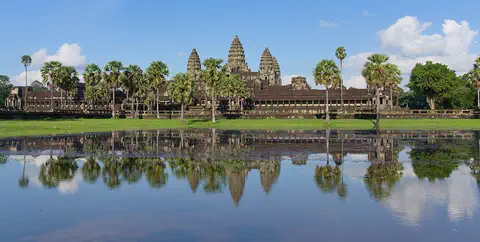
Angkor Wat, near the town of Siem Reap in Cambodia, was built in the 12th century by the Khmer king Suryavarman II. Britannica (2026) calls it the world's largest religious structure. It was built as a Hindu temple and later became a Buddhist place of worship.
-
Watch
City
Yangon
Yangon, once spelled Rangoon, is the largest city in Myanmar and its main port. It lies in the eastern part of the Irrawaddy delta, where two rivers meet. At the 2024 census, 4,584,622 people lived in the city.
-
 Watch
Landmark
Abraj Al Bait
Abraj Al Bait is a group of seven hotel towers in Mecca, Saudi Arabia, beside the city's Great Mosque. In the middle rises the Makkah Royal Clock Tower, 601 meters tall to the tip of its spire, with a huge clock near the top. It was finished in 2012.
-
 Watch
Landmark
Agra Fort
Agra Fort is a huge red sandstone fortress beside the Yamuna River in Agra, India. The Mughal emperor Akbar began it in 1565. Its walls, about 2.5 kilometers around, protect palaces, halls and mosques added by later emperors. It was both an army base and a royal home.
-
 Watch
Landmark
Akashi Kaikyō Bridge
The Akashi Kaikyō Bridge is a suspension bridge almost 4 kilometers long that crosses the Akashi Strait between Kobe and Awaji Island in Japan. Its middle span is 1,991 meters. When it opened in 1998, it was the longest suspension bridge in the world.
For parents & teachers
What children will learn
- Describe how a monument can be rebuilt and made larger by different rulers over centuries.
- Explain how gold is used as a thin covering on a building.
- Read a bar chart of the stupa's height through history.
Recommended ages: 4 to 17 · About 15 minutes
Talk about it
- The stupa grew from 18 to 112 meters over hundreds of years. Why might each ruler want to make it taller?
- People have given gold to keep the stupa covered for centuries. What do people in your town take care of together?
- How would you protect a tall building from earthquakes?
Try at home or in class
- Draw the stupa at 18, 40, 99 and 112 meters on graph paper, using one square for every 5 meters.
- Cover a paper bell shape with gold foil or yellow paper and add a sparkly paper umbrella on top.
Key vocabulary: stupa, pagoda, terrace, plinth, spire, earthquake
Where these facts come from
- Wikidata , Wikimedia Foundation (CC0 1.0)
- Shwedagon Pagoda on Singuttara Hill (Tentative List) , UNESCO World Heritage Centre (text by the State Party, Myanmar)
- File:Yangon - Shwedagon Pagoda 03.jpg , Wikimedia Commons
- Wikimedia Commons , Wikimedia Foundation (Per file (public domain, CC0, CC BY or CC BY-SA); see each media record)
Checked, not yet human-reviewed. Last updated November 1, 2026. Spotted a mistake? Tell us.