
Natural wonder Asia
Son Doong Cave
Son Doong is a giant cave in Vietnam. A river runs through it. Where the roof fell in, sunlight shines down and a little jungle grows inside!
Son Doong is a cave in the mountains of central Vietnam, inside Phong Nha–Ke Bang National Park. A river carved it, and its main passage is so wide and tall that a whole city block of skyscrapers could fit inside. Explorers first went in only in 2009. UNESCO says it holds the world's largest documented cave passage.
Hang Son Doong, in Phong Nha–Ke Bang National Park in Vietnam's Annamite Mountains, is a river cave in limestone that UNESCO credits with the world's largest documented cave passage by diameter and continuity. Surveyed by British and Vietnamese cavers in 2009-2010, its passage runs more than 4 km, up to about 90 m wide and over 180 m high, with collapsed dolines that let light reach forests on the cave floor.
Photo: Trantuanviet, CC BY-SA 4.0, via Wikimedia Commons
Discover Son Doong
Son Doong is a cave in Vietnam.
It is very, very big. A tall building could stand inside it. A river flows through the dark. In two places the roof has fallen in, and sunlight pours down.
Son Doong (Hang Son Doong in Vietnamese) means mountain river cave. It lies in the jungle-covered limestone mountains of Phong Nha–Ke Bang National Park, in central Vietnam near the border with Laos. National Geographic reported that it is part of a network of about 150 caves in the Annamite Mountains, many still not surveyed.
What makes Son Doong special is the size of its tunnel. Explorers measured a passage more than 4 kilometers long, as wide as about 90 meters and, in places, more than 180 meters high. UNESCO says Son Doong contains the largest documented cave passage in the world.
Hang Son Doong ('mountain river cave') lies in Phong Nha–Ke Bang National Park, part of a transboundary World Heritage property shared with Laos's Hin Nam No since 2025. National Geographic's January 2011 report places it in a network of about 150 caves in the Annamite Mountains, many still unsurveyed.
Laser surveys by the British-Vietnamese expedition showed a passage more than 2.5 miles (over 4 km) long, continuously as wide as 300 feet (about 90 m) and in places over 600 feet (about 180 m) high; from the bottom of one section to the ceiling, the cavers measured 654 feet (about 199 m). National Geographic compared it with Deer Cave in Malaysia's Gunung Mulu National Park, then thought to have the largest passage. UNESCO now records that Son Doong contains the world's largest documented cave passage in terms of diameter and continuity. Oxalis Adventure, the tour company that runs its expeditions, reports the team's figures of nearly 9 km for the whole cave and a volume of 38.5 million cubic meters.
- Country
- Vietnam (Phong Nha–Ke Bang National Park)
- Main passage
- more than 4 km long, up to about 90 m wide
- Height in places
- over 180 m
- First explored
- 2009
- Part of
- a World Heritage Site since 2003
A river carves a giant tunnel
The mountains here are made of limestone. Water can slowly wear this rock away.
A river ran into a crack in the rock. Over a very long time, it carved a huge tunnel. Then parts of the roof fell in.
Below the forest, this part of Vietnam is one enormous block of limestone, says geomorphologist Darryl Granger in National Geographic. The whole region was pushed upward when India crashed into the Eurasian continent, 40 to 50 million years ago.
Son Doong itself formed two to five million years ago. River water flowing across the limestone sank down along a crack in the rock called a fault, and slowly scoured out a giant tunnel under the mountains. Where the rock was weak, the ceiling collapsed, leaving enormous holes called dolines that open to the sky.
In National Geographic's 2011 account, Purdue University geomorphologist Darryl Granger describes the region as one immense limestone block, uplifted when the Indian subcontinent collided with Eurasia 40 to 50 million years ago. Son Doong formed 2 to 5 million years ago, as river water flowing across the limestone burrowed down along a fault and scoured a tunnel beneath the mountains; where the limestone was weak, the ceiling collapsed into sinkholes, producing the cave's skylights.
UNESCO places the cave in a karst that has been evolving since the Palaeozoic, about 400 million years ago, with a diversity of cave types preserving abandoned river passages, changes in river routes and giant speleothems that were deposited and later dissolved again. The river still flows: tour operator Oxalis describes an underground river fed by water from Hang En and Khe Ry caves that disappears near the first doline, and National Geographic photographed a white streak marking how high water rises in the wet season.
Jungles and clouds underground
Sunlight shines down through the holes in the roof.
Trees, ferns and vines grow inside the cave. Birds fly in the light. Clouds can float up near the ceiling!
Where the roof has fallen in, sunlight streams into the cave. National Geographic writer Mark Jenkins described the first skylight as at least 300 feet (about 90 meters) across, with vines dangling hundreds of feet from the surface and swifts darting through the light. There were even wispy clouds near the ceiling.
Beneath it, a tower of calcite more than 60 meters tall is covered with ferns and palms. The cavers named the spot Watch Out for Dinosaurs, because it looked like a world from millions of years ago. The second skylight, the Garden of Edam, holds a jungle of trees about 30 meters tall.
National Geographic's account describes the first collapsed doline as at least 300 ft (about 90 m) across, admitting a shaft of light that revealed a passage perhaps 300 ft wide under a ceiling nearly 800 ft high, with clouds near the roof. Beneath it, a calcite tower over 200 ft (about 61 m) tall is smothered by ferns, palms and other plants; stalactites fringe the skylight, vines hang hundreds of feet, and swifts hunt in the light. Cavers named it Watch Out for Dinosaurs, after Arthur Conan Doyle's novel The Lost World.
The second doline, the Garden of Edam, is described as almost as wide as the roof of New Orleans's Superdome, above a jungle of hundred-foot (about 30 m) trees, lianas and nettles. Beyond, the team found cave pearls the size of baseballs in a dried pool; most cave pearls are no bigger than marbles, and Jenkins suggests the long fall of the water drops may explain their size.
Life in the dark and the light
Some animals live deep in the dark cave.
Scientists found white fish, white woodlice and white millipedes there. Under the skylights, the plants are like the ones in the forest above.
Two kinds of life share Son Doong. In the dark, biologist Anette Becher found woodlice, fish and millipedes that are completely white, which is common for animals that live in darkness. Under the skylights, botanist Dai Inh Vu found mostly the same mix of plants that grows in the forest above the cave.
The forests around the cave are rich too. UNESCO counts more than 2,700 kinds of plants and 800 kinds of animals with backbones in Phong Nha–Ke Bang, and notes that some small invertebrates and fish live in just one cave system and nowhere else.
National Geographic reports that German caver and biologist Anette Becher found white wood lice, fish and millipedes, a coloring the article calls common for creatures that live in the dark, and that Dai Inh Vu of the Vietnam Academy of Science and Technology found the plants under the skylights to be essentially the same assemblage as in the forest above.
UNESCO's statement for the property describes high endemism produced by the complexity of the limestone landscape, which created many ecological niches: endemic orchids and begonias above ground, and invertebrate and fish species restricted to single cave systems below. Phong Nha–Ke Bang alone recorded over 2,700 vascular plant and 800 vertebrate species at inscription, including 237 globally threatened species, and UNESCO cautions that actual diversity is probably much higher.
Found by a local man, explored by cavers
A man named Ho Khanh found the cave's door in the jungle.
Later, he showed it to a team of explorers. They climbed a giant wall inside. In 2010 they reached the other end!
Ho Khanh grew up near the park and knew the jungle well. The tour company Oxalis says that in 1990 he sheltered from a storm near a small cave entrance, felt a strong cold wind and heard a roaring river inside, but later forgot exactly where it was. Years later, he found it again.
In 2009, he guided a team of British cavers, organized by Howard and Deb Limbert and working with Hanoi University of Science, to the entrance. They explored about 4 kilometers before a muddy wall about 60 meters high stopped them. They named it the Great Wall of Vietnam. In 2010 the team returned, climbed the wall and found the exit.
Howard and Deb Limbert, from the Yorkshire Dales, first caved in Vietnam in 1990 with the University of Science in Hanoi and, by National Geographic's account, helped Vietnam establish Phong Nha–Ke Bang National Park. Ho Khanh, a local man who knew the forest from years of working in it, had found Son Doong's entrance but lost it; Oxalis says he first saw it in 1990 and relocated it in 2008, while National Geographic says he found it as a boy.
The spring 2009 expedition explored about 2.5 miles (4 km) before a 200-foot (61 m) wall of muddy calcite, the 'Great Wall of Vietnam', blocked the way. In 2010 Gareth Sewell, belayed by Howard Clarke, spent about 20 hours over two days drilling and climbing the wall, and the team reached the far entrance. Guinness World Records listed Son Doong as the world's largest natural cave in 2013, Oxalis reports, and Oxalis began running tours that year.
Visiting safely
Only a few grown-ups can go inside Son Doong. It is a very long and hard trip.
Families can visit other caves in the park. Always go with a guide and wear a helmet.
Son Doong is not a cave you can simply walk into. Tours are run by the company Oxalis Adventure, and the expedition takes several days of hiking, river crossings and camping inside the cave. On the first day alone, guests trek about 14 kilometers and cross rivers around 30 times. A team of about 30 guides, safety experts, forest rangers, cooks and porters goes with every group.
Everyone must attend a safety briefing and wear a helmet. Families can enjoy easier caves in the park, such as Phong Nha Cave, which visitors reach by boat. Wherever you go, go with a guide and never enter a cave alone.
Access is tightly controlled. Oxalis Adventure, which opened Son Doong to visitors in 2013, runs a 6-day, 5-night package that includes a mandatory safety briefing and signed release, equipment checks, a 14 km first-day trek with about 30 knee-deep river crossings and steep slopes, and two nights camping inside the cave, with a team of about 30 guides, safety experts, forest rangers, chefs and porters per expedition. National Geographic described slick boulder slopes in the cave where a misstep could mean a fall of more than 100 feet.
In the monsoon, underground rivers in the area swell and flood passages, National Geographic reports. UNESCO warns that tourism pressure must remain within the ecological carrying capacity of the karst, so the strict limits also protect the cave's fragile formations and life. Visitors to any cave help by staying on the route, never touching formations, and carrying out all their litter.
Amazing facts
-
Clouds can form inside Son Doong.
The first skylight is so big that wispy clouds float up near the cave ceiling.
Mark Jenkins reported wispy clouds near the ceiling beneath the first doline, under a roof nearly 800 feet high.
-
Cave pearls as big as baseballs were found inside.
Explorers found round stones called cave pearls as big as baseballs. In most caves, cave pearls are no bigger than marbles.
Cave pearls form as dripping water jostles a grain in a small stone cup for thousands of years; Son Doong's are baseball-sized, larger than any the cavers had seen.
-
One part of the cave is called Watch Out for Dinosaurs.
A caver jokingly told his partner to watch out for dinosaurs under the first skylight, because it looked like a lost world, and the name stuck.
The name 'Watch Out for Dinosaurs' recalls Arthur Conan Doyle's The Lost World, as the caver who coined it told National Geographic.
-
Climbing the giant wall inside took two days.
To climb the 61-meter Great Wall of Vietnam, caver Gareth Sewell drilled and climbed for about 20 hours over two days.
Sewell drilled anchor holes for about 20 hours over two days, many too hollow to hold, before topping the wall in 2010.
Words to know
- limestone
- a rock that water can slowly dissolve, often full of caves
- doline
- a big hole where a cave roof has fallen in, also called a sinkhole
- fault
- a long crack in the rocks of the Earth's crust
- passage
- a long tunnel or corridor inside a cave
- cave pearl
- a round stone that slowly grows in a little pool of dripping water
- caver
- a person who explores caves
Discovery challenge
-
What carved Son Doong?
What carved Son Doong's giant tunnel?
According to Darryl Granger, what scoured out Son Doong?
- A river
- A glacier
- The wind
Show the answer
A river
A river! It flowed into a crack in the rock.
A river, sinking along a fault in the limestone 2 to 5 million years ago.
River water burrowing down along a fault in the limestone.
-
Why does a jungle grow inside the cave?
Why can trees grow inside Son Doong?
What lets a forest community grow on Son Doong's floor?
- Sunlight comes in where the roof fell
- People planted it
- The cave has lamps
Show the answer
Sunlight comes in where the roof fell
The roof fell in, so sunlight reaches the plants.
Collapsed parts of the roof, called dolines, let sunlight reach the cave floor.
Collapsed dolines admit light; plants under them match the forest above.
-
Who found the way into the cave?
Which local man found Son Doong's entrance and led the explorers there?
Who guided the 2009 expedition to the entrance he had found years earlier?
- Ho Khanh
- Howard Clarke
- Darryl Granger
Show the answer
Ho Khanh
Ho Khanh, a man who knew the jungle.
Ho Khanh, who had found the entrance years before and found it again in 2008.
Ho Khanh; Clarke was a caver on the 2010 climb and Granger a geomorphologist.
-
Why are some cave animals white?
Why are the woodlice, fish and millipedes in the dark parts of Son Doong white?
What explains the pale coloration of the cave animals Anette Becher found?
- They live in the dark
- They eat snow
- They were painted
Show the answer
They live in the dark
They live in the dark. Many dark-living animals are white.
Being white is common for animals that live in darkness.
Pale coloration is typical of animals adapted to permanent darkness.
-
How should you go into a cave?
What is the safe way to visit a cave like those in Phong Nha–Ke Bang?
How is access to Son Doong managed?
- With a guide, on an official tour
- Alone, at night
- Anywhere you like
Show the answer
With a guide, on an official tour
With a guide and a grown-up, wearing a helmet.
On official guided tours; never go into a cave alone.
Only on guided expeditions with a mandatory safety briefing, run by Oxalis since 2013.
Nearby places
-
 Watch
Natural wonder
Phong Nha–Ke Bang National Park
Phong Nha–Ke Bang National Park, in central Vietnam near the border with Laos, protects one of the world's great limestone landscapes. UNESCO says its rocks began forming about 400 million years ago, and more than 220 kilometers of caves and underground rivers have been mapped. One of them, Son Doong, holds the world's largest known cave passage.
-
 Watch
Natural wonder
Ha Long Bay
Ha Long Bay is a bay in northeast Vietnam where more than a thousand limestone islands rise straight out of the sea. Over millions of years, water dissolved the limestone into towers and caves, and then the sea flooded in around them. Together with the nearby Cat Ba Archipelago it is a World Heritage site.
-
 Watch
Landmark
Angkor
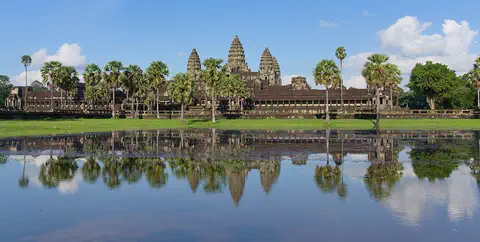
Angkor, in northwestern Cambodia, was the capital of the Khmer Empire from the 9th to the 15th century. Its kings built city after city here, with scores of temples, such as Angkor Wat and the Bayon, and giant reservoirs and canals to water the rice fields. Today it covers about 400 square kilometers, and more than 100,000 people live in villages inside it.
-
Watch
Landmark
Angkor Wat
Angkor Wat, near the town of Siem Reap in Cambodia, was built in the 12th century by the Khmer king Suryavarman II. Britannica (2026) calls it the world's largest religious structure. It was built as a Hindu temple and later became a Buddhist place of worship.
-
 Watch
City
Bangkok
Bangkok, the capital of Thailand, lies on the delta of the Chao Phraya River, about 40 kilometers from the sea. It became the capital in 1782, when the new royal palace and temples were built. Once called the 'Venice of the East' for its canals, it is now a huge, busy city with skyscrapers and an elevated railway.
-
 Watch
City
Ho Chi Minh City
Ho Chi Minh City, once called Saigon, is Vietnam's largest city and the economic heart of the country. It lies on the Saigon River, north of the Mekong Delta. Since merging with two neighboring provinces in 2025, it has more than 14 million people, and in 2024 it opened its first metro line.
-
 Watch
City
Hong Kong
Hong Kong, on the south coast of China, grew around one of the world's great natural harbors. It was a British colony for 156 years and has been a special administrative region of China since 1997. About 7.5 million people lived there in mid-2026.
-
 Watch
Landmark
Three Gorges Dam
The Three Gorges Dam crosses the Yangtze River in central China. It is 2,335 meters long and 185 meters high, and it can make more electricity than any other hydroelectric dam in the world. It also lets big ships travel far up the river, but building it meant that more than a million people had to move.
Experiments to try
Explore next
-
Watch
 Country
Vietnam
Vietnam stretches about 1,650 kilometers along the coast of Southeast Asia, with mountains in the west and two great river deltas, the Red River in the north and the Mekong in the south. About 102.3 million people lived there in 2025. Its capital is Hanoi, and its largest city is Ho Chi Minh City.
-
Watch
Natural wonder
Phong Nha–Ke Bang National Park
Phong Nha–Ke Bang National Park, in central Vietnam near the border with Laos, protects one of the world's great limestone landscapes. UNESCO says its rocks began forming about 400 million years ago, and more than 220 kilometers of caves and underground rivers have been mapped. One of them, Son Doong, holds the world's largest known cave passage.
- Watch Geography Caves and karst landscapes Most caves are made by slightly acidic water slowly dissolving rock such as limestone. Over hundreds of thousands of years, cracks grow into tunnels and rooms. The land above, with its sinkholes, disappearing streams and springs, is called karst. Inside, dripping water builds stalactites and stalagmites.
-
Watch
Natural wonder
Ha Long Bay
Ha Long Bay is a bay in northeast Vietnam where more than a thousand limestone islands rise straight out of the sea. Over millions of years, water dissolved the limestone into towers and caves, and then the sea flooded in around them. Together with the nearby Cat Ba Archipelago it is a World Heritage site.
- Watch Try it What If? Lab What if a plant lived in a dark cave? A green leaf makes sugar from light, water and air, but it also uses up a little sugar all the time just to stay alive. Carry our model leaf from bright sunshine into a dim cave and watch what happens when the sugar it makes drops below the sugar it uses.
-
 Watch
Natural wonder
Mount Everest
Mount Everest, in the Himalayas on the border of Nepal and China, is what Britannica calls the highest mountain in the world. In 2020 China and Nepal announced its height as 8,848.86 meters. It grew as two giant plates of Earth's crust pushed together, and it is still rising a tiny bit each year.
-
 Watch
Natural wonder
Mount Fuji
Mount Fuji, 3,776 meters high, is the highest mountain in Japan and an active volcano that last erupted in 1707. Its almost perfect cone was built by three volcanoes, one on top of another, and it has inspired artists for hundreds of years.
-
 Watch
Natural wonder
Dead Sea
The Dead Sea is a salt lake in the Middle East, with Jordan on its eastern shore and the Palestinian West Bank along part of its western shore. Its surface lies far below sea level, about 435 meters down in 2019, and its water is nearly ten times saltier than the ocean, so swimmers bob on top without trying.
For parents & teachers
What children will learn
- Locate Son Doong in central Vietnam and explain that it lies in Phong Nha–Ke Bang National Park.
- Explain how a river carved the cave and how collapsed roofs make skylights.
- Describe the forests and animals found inside the cave.
- Retell how the cave was found and explored, and why visits are limited.
Recommended ages: 3 to 17 · About 15 minutes
Talk about it
- How could a cave this big stay unknown until 2009?
- Why do you think animals that live in the dark are often white?
- Should very special places be visited by only a few people? Why or why not?
Try at home or in class
- Stack sugar cubes into a small 'mountain' and drip water slowly on one spot with a dropper. Watch a tunnel form, then a 'skylight' when the top gets thin.
- Measure 90 meters (about the width of the passage) on a playground or field by pacing it out with a grown-up.
Key vocabulary: limestone, doline, fault, passage, cave pearl, caver
Where these facts come from
- Wikidata , Wikimedia Foundation (CC0 1.0)
- UNESCO World Heritage List , UNESCO World Heritage Centre (Linked as a reference; site facts come from Wikidata)
- Vietnam Cave (Hang Son Doong), National Geographic Magazine, January 2011 , National Geographic
- Phong Nha-Ke Bang National Park and Hin Nam No National Park , UNESCO World Heritage Centre
- Son Doong Cave , Oxalis Adventure
- Son Doong Cave Expedition , Oxalis Adventure
- Wikimedia Commons , Wikimedia Foundation (Per file (public domain, CC0, CC BY or CC BY-SA); see each media record)
Checked, not yet human-reviewed. Last updated October 27, 2026. Spotted a mistake? Tell us.