Natural wonders
Mountains, deserts, waterfalls, reefs, rivers, caves and volcanoes, and how nature made them.
84 to explore · page 2 of 2
-
 Watch
Natural wonder
Mount Everest
Mount Everest, in the Himalayas on the border of Nepal and China, is what Britannica calls the highest mountain in the world. In 2020 China and Nepal announced its height as 8,848.86 meters. It grew as two giant plates of Earth's crust pushed together, and it is still rising a tiny bit each year.
-
 Watch
Natural wonder
Mount Fuji
Mount Fuji, 3,776 meters high, is the highest mountain in Japan and an active volcano that last erupted in 1707. Its almost perfect cone was built by three volcanoes, one on top of another, and it has inspired artists for hundreds of years.
-
 Watch
Natural wonder
Mount Kenya
Mount Kenya is the second highest mountain in Africa, 5,199 meters tall, standing just south of the Equator in central Kenya. It is an old volcano that stopped erupting millions of years ago and has been carved by glaciers into sharp rocky peaks. Its slopes climb through farms, forests, bamboo and strange giant plants up to small, shrinking glaciers.
-
 Watch
Natural wonder
Mount Kilimanjaro
Mount Kilimanjaro, in northeastern Tanzania, is what UNESCO calls the highest mountain in Africa: its top is 5,895 meters high. It is a huge volcanic mountain standing alone above the plains, and as you climb it you pass through farms, forest, moorland and high alpine desert to its icy top.
-
 Watch
Natural wonder
Mount Nyiragongo
Mount Nyiragongo is a steep volcano in the Virunga Mountains of the Democratic Republic of the Congo, near the border with Rwanda and just north of Lake Kivu. It is 3,470 meters high, and its deep summit crater often holds a lake of bubbling lava. Its lava is very runny, and eruptions in 1977, 2002 and 2021 sent lava flowing down its sides toward the city of Goma.
-
 Watch
Natural wonder
Mount Olympus
Mount Olympus is the highest mountain in Greece, about 2,918 meters tall, rising almost straight up from the shore of the Aegean Sea. It is made of limestone that formed in a warm, shallow sea long ago. Greece's first national park was created here in 1938, and nearly 2,000 kinds of plants grow on its slopes.
-
 Watch
Natural wonder
Mount Roraima
Mount Roraima is a huge flat-topped mountain called a tepui, in the Guiana Highlands of South America, where Brazil, Venezuela and Guyana meet. Its summit stands about 2,772 meters high, ringed by sheer sandstone cliffs. Tepuis like it are some of the world's oldest rock formations, and they are home to unusual plants such as marsh pitcher plants.
-
 Watch
Natural wonder
Mount Vesuvius
Mount Vesuvius is an active volcano that rises above the Bay of Naples in southern Italy. In AD 79 it erupted and buried the Roman towns of Pompeii and Herculaneum, which people can visit today. Its last eruption was in 1944. Because more than two million people live around it, scientists watch it closely, and Italy has a plan to keep everyone safe.
-
 Watch
Natural wonder
Namib
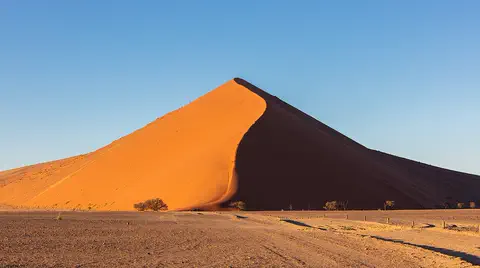
The Namib is a cool desert that runs for about 1,900 kilometers along Africa's Atlantic coast, from Angola through Namibia into South Africa. It gets almost no rain, but cold ocean water makes thick fog that drifts inland. UNESCO says its Namib Sand Sea is the only coastal desert in the world with huge dune fields influenced by fog.
-
 Watch
Natural wonder
Negev
The Negev is a dry region in the Middle East, shaped like a triangle with its point at the Red Sea. Its name comes from a Hebrew word meaning to dry. It has huge craters called makhteshim, carved by erosion, ancient towns on an old incense trade route, and farms watered by pipelines.
-
 Watch
Natural wonder
Ngorongoro Conservation Area
The Ngorongoro Conservation Area in northern Tanzania holds the Ngorongoro Crater, a giant bowl about 16 to 20 kilometers across, left when an ancient volcano collapsed about 2.5 million years ago. Around 25,000 large animals live in and around the crater. The area also protects Olduvai Gorge and Laetoli, where scientists have found important evidence of how humans evolved.
-
 Watch
Natural wonder
Niagara Falls
Niagara Falls is a set of three waterfalls on the Niagara River, which flows from Lake Erie to Lake Ontario across the border between Canada and the United States. About 500 waterfalls in the world are taller, but Niagara is famous for its height together with the enormous amount of water that pours over it.
-
 Watch
Natural wonder
Nile
The Nile flows north through northeastern Africa to the Mediterranean Sea, and its basin is shared by 11 countries. Its length is usually given as about 6,650 kilometers. Two great branches, the White Nile and the Blue Nile, meet at Khartoum in Sudan, and the green strip of farmland along its banks made it the lifeline of ancient Egypt.
-
 Watch
Natural wonder
Okavango Delta
The Okavango Delta, in northwestern Botswana, is a huge wetland in the middle of a dry land. The Okavango River flows in from Angola, spreads out into channels, lagoons and grassy plains, and then soaks away into the sands of the Kalahari instead of reaching the sea. Its flood arrives in the dry season, drawing elephants, buffalo, zebras and many other animals.
-
 Watch
Natural wonder
Pamukkale
Pamukkale, in southwestern Türkiye, is a hillside of bright white terraces and pools built by warm spring water. The water is full of a dissolved mineral called calcium carbonate, and as it flows over the slope it leaves the mineral behind as a rock called travertine. Its name means "cotton castle". On top stand the ruins of Hierapolis, an ancient spa town.
-
 Watch
Natural wonder
Pantanal
The Pantanal is one of the world's largest freshwater wetlands, mostly in Brazil and reaching into Bolivia and Paraguay. Each rainy season its rivers overflow and flood the lowlands, making shallow lakes and marshes; in the dry season the water slowly drains away. This rhythm feeds an amazing number of animals, from jaguars and giant otters to about 600 kinds of birds.
-
 Watch
Natural wonder
Phong Nha–Ke Bang National Park
Phong Nha–Ke Bang National Park, in central Vietnam near the border with Laos, protects one of the world's great limestone landscapes. UNESCO says its rocks began forming about 400 million years ago, and more than 220 kilometers of caves and underground rivers have been mapped. One of them, Son Doong, holds the world's largest known cave passage.
-
 Watch
Natural wonder
Rhine
The Rhine begins as two small streams high in the Swiss Alps and flows about 1,230 kilometers north and west to the North Sea, through Switzerland, Germany, France and the Netherlands. It tumbles over the Rhine Falls and winds through a gorge lined with castles. After a chemical spill in 1986, the countries along it worked together to clean it, and salmon came back.
-
 Watch
Natural wonder
River Congo
The Congo is Africa's second-longest river, about 4,700 kilometers long. It curves in a giant arc through the rainforests of central Africa and empties into the Atlantic Ocean. Rain falls in its basin all year, so it carries a huge amount of water, and its wild lower rapids are home to about 320 kinds of fish, about 90 of them found nowhere else.
-
 Watch
Natural wonder
Rocky Mountains
The Rocky Mountains, or Rockies, stretch about 4,800 kilometers from northern Canada to New Mexico in the United States. They include more than 100 separate ranges, and their highest peak, Mount Elbert in Colorado, is 4,399 meters tall. Glaciers carved their peaks and valleys, and famous parks such as Banff, Jasper and Yellowstone protect their lakes, hot springs and wildlife.
-
 Watch
Natural wonder
Sahara
The Sahara fills almost all of northern Africa. Britannica calls it the largest hot desert in the world: about 4,800 kilometers from east to west and about 8.6 million square kilometers in all. Only about a quarter of it is sand dunes; the rest is gravel plains, rocky plateaus and mountains.
-
 Watch
Natural wonder
Salar de Uyuni
Salar de Uyuni is a giant salt flat high in the Andes of Bolivia. It covers 10,582 square kilometers and was left behind when ancient lakes dried up. NASA calls it the largest salt flat in the world.
-
 Watch
Natural wonder
Serengeti National Park
Serengeti National Park in northern Tanzania protects 14,763 square kilometers of grassy plains and woodlands. Each year more than a million wildebeest, with zebras and gazelles, travel a great loop across the Serengeti and into Kenya in search of grass and water, followed by lions and other predators.
-
 Watch
Natural wonder
Son Doong Cave
Son Doong is a cave in the mountains of central Vietnam, inside Phong Nha–Ke Bang National Park. A river carved it, and its main passage is so wide and tall that a whole city block of skyscrapers could fit inside. Explorers first went in only in 2009. UNESCO says it holds the world's largest documented cave passage.
-
 Watch
Natural wonder
Sundarbans
The Sundarbans is a vast mangrove forest where the Ganges and Brahmaputra rivers meet the Bay of Bengal. It is shared by Bangladesh and India. Twice a day the tides flood its muddy islands, and its trees are made to live in salty water. It is one of the last homes of the Bengal tiger, and both countries protect it as a World Heritage Site.
-
 Watch
Natural wonder
Svalbard
Svalbard is a group of Arctic islands, part of Norway, far north of the Arctic Circle. Glaciers and snowfields cover nearly 60 percent of the land. Polar bears hunt seals on the sea ice, walruses rest on the beaches, and inside a mountain on Spitsbergen the world keeps a frozen store of seeds.
-
 Watch
Natural wonder
Uluru
Uluru is a huge sandstone rock in the desert of central Australia, rising 348 meters above the plain, with a base 9.4 kilometers around. The Anangu are its Traditional Owners, and the national park around it is run by Anangu and Parks Australia together.
-
 Watch
Natural wonder
Ural Mountains
The Ural Mountains run about 2,500 kilometers from north to south through Russia, and they form most of the traditional boundary between Europe and Asia. They are very old mountains that have been worn down over a very long time; their highest peak, Mount Narodnaya, is 1,895 meters tall. The Urals stretch from icy Arctic tundra to dry steppe and are rich in metals and gems.
-
 Watch
Natural wonder
Vatnajökull
Vatnajökull, in southeastern Iceland, is a huge ice cap covering about 7,500 square kilometers. It is Europe's largest ice cap by volume. Volcanoes lie hidden beneath the ice, and when they erupt, melting ice can burst out in sudden floods. The ice cap sits at the heart of Vatnajökull National Park, a World Heritage Site of "fire and ice".
-
 Watch
Natural wonder
Victoria Falls
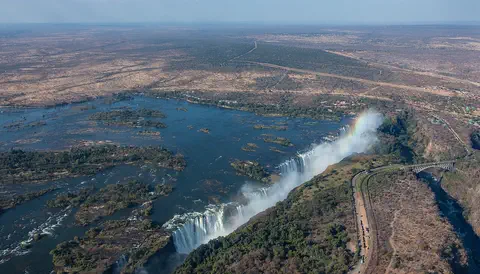
Victoria Falls, on the Zambezi River between Zambia and Zimbabwe, is about 1,708 meters wide and up to 108 meters deep. UNESCO calls it the largest curtain of falling water in the world, and its spray can be seen from tens of kilometers away.
-
 Watch
Natural wonder
Virunga National Park
Virunga National Park, in the east of the Democratic Republic of the Congo, was founded in 1925; the park describes itself as Africa's first national park. It stretches from active volcanoes in the south to the snowy Rwenzori Mountains in the north. About one third of the world's mountain gorillas live in its forests, along with elephants, hippos, chimpanzees and hundreds of kinds of birds.
-
 Watch
Natural wonder
Volga
The Volga is Europe's longest river. It rises in the Valdai Hills northwest of Moscow and flows about 3,530 kilometers to the Caspian Sea, all within Russia. Almost half of Russia's people live in its basin. Big dams now turn much of it into a chain of long lakes, and its huge delta shelters up to 750,000 waterbirds in mild winters.
-
 Watch
Natural wonder
Wadi Rum
Wadi Rum, in southern Jordan, is a desert of towering sandstone and granite mountains rising from valleys of red sand. Wind, water and salt have carved arches, gorges and honeycomb patterns into the rock. People have lived here for at least 12,000 years, leaving behind about 25,000 rock carvings and 20,000 inscriptions.
-
 Watch
Natural wonder
Yangtze River
The Yangtze, called Chang Jiang (Long River) in China, is the longest river in Asia, about 6,300 kilometers. It starts in glacier meltwater on the Plateau of Tibet, cuts through deep gorges, passes huge cities like Chongqing, Wuhan and Nanjing, and reaches the East China Sea at Shanghai. Nearly a third of China's people live in its basin.
-
 Watch
Natural wonder
Yellowstone National Park
Yellowstone National Park sits on top of a giant volcano in the western United States. Heat from melted rock deep underground powers more than 10,000 hot springs, geysers, mudpots and steam vents, and the park is home to bison, wolves and two kinds of bears.
-
 Watch
Natural wonder
Yosemite National Park
Yosemite National Park lies in California's Sierra Nevada mountains. Its granite cliffs, rounded domes and tall waterfalls were shaped by rivers and then by glaciers, which turned narrow canyons into wide U-shaped valleys. It is also home to giant sequoia trees and hundreds of black bears.