
Natural wonder Europe
Black Sea
The Black Sea is a big sea between Europe and Asia. Its top layer is less salty and has oxygen in it. Deep down, the water has almost no oxygen.
The Black Sea is a large, almost enclosed sea between Europe and Asia. Its water is in layers that hardly mix: the top 150 meters is less salty and has oxygen, while the deep water below has almost no oxygen, so plants and animals cannot live there.
The Black Sea is a semi-enclosed sea whose water has been stably layered for about 7,000 years (MPI Bremen, AWI). The upper 150 m is low-salinity, oxygen-rich water, mainly from rivers such as the Danube; below lies denser, saltier water that enters from the Mediterranean via the Bosporus, with dissolved oxygen near zero and hydrogen sulfide produced by bacteria. Its waters hold more than twice as much organic carbon as oxygen-rich marine areas.
Photo: Raymond Zoller from Bar, Montenegro, CC BY-SA 2.0, via Wikimedia Commons
Discover the Black Sea
The Black Sea is a big sea with land almost all around it.
Rivers pour fresh water into it. A channel joins it to another sea. This photo shows ships far out on the water.
The Black Sea is a large sea that is almost surrounded by land. Rivers such as the Danube flow into it, and the Bosporus connects it with the Mediterranean Sea.
Scientists call it an unusual body of water. Its water lies in layers that hardly mix, and the deep water has almost no oxygen. From the surface you would never guess it: the sea looks like any other.
Researchers at the Max Planck Institute for Marine Microbiology and the Alfred Wegener Institute describe the Black Sea as a semi-enclosed inland sea with conditions found in only a handful of other water bodies: stable stratification has largely prevented mixing between surface and deep water for about 7,000 years.
The upper 150 m holds low-salinity, oxygen-rich water that comes mainly from rivers such as the Danube, whose delta UNESCO lists as a World Heritage Site. Below lies heavier, high-salinity water that flows in from the Mediterranean over the Bosporus. Nothing at the surface reveals that the deep water is stagnant.
- Oxygen-rich upper layer
- about the top 150 m
- Layered for
- about 7,000 years
- Salty deep water comes from
- the Mediterranean, via the Bosporus
- Big river flowing in
- the Danube
A sea in two layers
The Black Sea is like a two-layer drink.
Light, less salty water floats on top. Heavy, salty water stays at the bottom. The two layers hardly mix.
Fresh river water is lighter than salty sea water. In the Black Sea, the river water stays on top, in a layer about 150 meters thick. Heavier, saltier water from the Mediterranean sinks below it.
Because the layers hardly mix, oxygen from the air cannot reach the deep water. Down there, the dissolved oxygen drops to around zero. Bacteria in the deep water make a gas called hydrogen sulfide, which smells like rotten eggs.
The Black Sea's density stratification is the key: low-salinity river water forms the upper 150 m, while denser saline water from the Mediterranean, entering over the Bosporus, fills the basin below. This stable layering has persisted for about 7,000 years and largely prevents vertical mixing.
Below 150 m the dissolved oxygen concentration falls to around zero, so higher life forms such as plants and animals cannot exist there. In the oxygen-free water, bacteria produce hydrogen sulfide; Jutta Niggemann of the University of Oldenburg says that the smell of rotten eggs from a deep-water sample almost knocks you over.
A store of carbon
Sea water holds tiny bits left over from living things.
Deep in the Black Sea, a smelly gas joins onto these bits and makes them last longer. So the Black Sea stores lots of carbon.
Seawater everywhere contains tiny amounts of dissolved organic matter, bits left over from living things. The Black Sea holds more than twice as much of this carbon as seas that are full of oxygen.
In 2021 scientists suggested a reason. Hydrogen sulfide in the deep water reacts with the organic matter and makes new compounds that last longer, so they build up. Nearly a fifth of the organic molecules in the oxygen-free water contain sulfur.
A team led by Gonzalo Gomez-Saez (AWI) and Jutta Niggemann (ICBM, University of Oldenburg) proposed in Science Advances that reactions with hydrogen sulfide stabilize dissolved organic matter (DOM) in anoxic waters. The reaction products are longer-lived than the reactants and accumulate, which helps explain why the Black Sea holds more than twice as much organic carbon as oxygen-rich marine areas.
Nearly a fifth of all organic molecules in the Black Sea's anoxic waters contained sulfur, far more than elsewhere, and many compounds were unique to the Black Sea. Niggemann describes this as a negative feedback that can counteract global warming over geological periods; the lead author, Gomez-Saez, adds that under current conditions the effect is too weak to noticeably affect climate change.
Life near the surface and in the delta
Plants and animals live only in the top layer, where there is oxygen.
Where the Danube River meets the sea, there are marshes and lakes. Hundreds of kinds of birds live there.
All the Black Sea's plants and animals live in its upper layer, because the deep water has no oxygen.
In Romania, the Danube River reaches the Black Sea through a delta of lakes and marshes. UNESCO calls it the largest and best preserved delta in Europe. More than 300 kinds of birds and 45 kinds of freshwater fish live there.
Because dissolved oxygen falls to near zero below 150 m, higher life forms are confined to the upper layer; the anoxic depths are the realm of bacteria.
The Danube Delta, where the Danube's waters flow into the Black Sea, was inscribed as a World Heritage Site in 1991 under criteria (vii) and (x) and covers 312,440 ha in Romania's Tulcea County. UNESCO describes it as the largest and best preserved of Europe's deltas, hosting over 300 bird species and 45 freshwater fish species in its many lakes and marshes; it is also a biosphere reserve and a Ramsar wetland.
Visiting safely
Black Sea beaches are fun in summer.
Swim only where lifeguards watch, with a grown-up. If the water pulls you, swim along the beach, not against it.
General beach advice from the US National Weather Service is to check the local forecast, ask the lifeguards and swim only where lifeguards are on duty.
Rip currents are narrow channels of fast water that can form even on sunny, calm days. Don't try to swim straight back against one. Swim parallel to the beach until you are out of it, then head back to shore at an angle.
Beach-safety guidance from the US National Weather Service is general enough for any coast: check the local forecast, talk to lifeguards, swim at guarded beaches and never turn your back on the water, since rip currents often form on calm, sunny days.
NOAA's National Ocean Service notes that rip currents can reach 8 feet (about 2.4 m) per second, faster than an Olympic swimmer, and that swimmers who fight them tire. The advice is to swim parallel to the shore and return at an angle.
Amazing facts
-
Water from deep in the Black Sea smells like rotten eggs!
A scientist says that when you open a sample of deep Black Sea water, the rotten-egg smell almost knocks you over.
Hydrogen sulfide made by bacteria in the anoxic deep water gives samples a strong rotten-egg smell (Jutta Niggemann, University of Oldenburg).
-
The top and bottom layers of the Black Sea have stayed apart for thousands of years.
For about 7,000 years, the Black Sea's surface water and deep water have hardly mixed.
Stable stratification has largely prevented mixing between surface and deep water in the Black Sea for about 7,000 years.
-
More than 300 kinds of birds live where the Danube meets the Black Sea.
The Danube Delta, where the river flows into the Black Sea, hosts more than 300 kinds of birds.
UNESCO's Danube Delta World Heritage Site hosts over 300 bird species and 45 freshwater fish species.
-
You can't tell by looking that the deep Black Sea has no air.
From the surface, nothing shows that the deep water of the Black Sea has almost no oxygen.
Nothing at the surface reveals that the Black Sea's deep water is stagnant and full of hydrogen sulfide (AWI).
Words to know
- layer
- one level lying on top of another, like water of different saltiness
- oxygen
- a gas that most living things need to breathe
- anoxic
- having no oxygen
- hydrogen sulfide
- a gas that smells like rotten eggs
- delta
- land and channels formed where a river splits up as it reaches the sea
- strait
- a narrow stretch of water that connects two seas
Discovery challenge
-
Where in the Black Sea is there air in the water?
How deep does the oxygen-rich layer of the Black Sea reach?
Below about what depth does dissolved oxygen fall to near zero in the Black Sea?
- In the top 150 meters
- Only at the very bottom
- All the way down
Show the answer
In the top 150 meters
Only in the top part.
About the top 150 meters.
Below about 150 m.
-
Where does the salty bottom water come from?
Where does the Black Sea's salty deep water flow in from?
What is the source of the dense saline water beneath the Black Sea's surface layer?
- The Mediterranean Sea, through the Bosporus
- Melting glaciers
- Rain
Show the answer
The Mediterranean Sea, through the Bosporus
From another sea, through a narrow channel.
From the Mediterranean, through the Bosporus.
Mediterranean water entering over the Bosporus.
-
What does deep Black Sea water smell like?
Which gas do bacteria make in the deep water?
Which reactive molecule do scientists link to the build-up of organic carbon?
- Rotten eggs: hydrogen sulfide
- Roses: perfume
- Nothing: pure oxygen
Show the answer
Rotten eggs: hydrogen sulfide
Rotten eggs!
Hydrogen sulfide, which smells like rotten eggs.
Hydrogen sulfide, which reacts with dissolved organic matter to make longer-lived compounds.
-
Why can't fish live deep in the Black Sea?
Why can't plants and animals live in the deep Black Sea?
What keeps the Black Sea's deep water oxygen-free?
- There is no oxygen down there
- The water is boiling
- It is frozen solid
Show the answer
There is no oxygen down there
There is no air in the deep water.
The layers hardly mix, so oxygen can't reach the deep water.
Stable stratification largely prevents mixing of surface and deep water.
-
Which river flows into the Black Sea through a big marshy delta?
Which river's delta, a World Heritage Site, lies on the Black Sea?
Which delta, inscribed in 1991, does UNESCO call the largest and best preserved in Europe?
- The Danube
- The Amazon
- The Nile
Show the answer
The Danube
The Danube.
The Danube Delta, home to more than 300 kinds of birds.
The Danube Delta, 312,440 ha, criteria (vii) and (x).
Nearby places
-
 Watch
City
Ankara
Ankara is the capital of Türkiye, in the interior of Anatolia, about 200 kilometers from the Black Sea. People have lived here since the Stone Age, and Romans, Byzantines, Seljuks and Ottomans all left buildings behind. It became the capital in 1923, and today it is a city of government, universities and museums.
-
 Watch
Natural wonder
Anatolia
Anatolia is a large peninsula in Western Asia, with a high, dry central plateau and mountains such as the Taurus. Erosion has carved the volcanic rock of Cappadocia into tall rock pillars called fairy chimneys, and its lakes range from fresh mountain lakes to the salty Lake Tuz.
-
 Watch
City
Istanbul
Istanbul is the biggest city in Türkiye, built on both sides of the Bosporus, the narrow strait between Europe and Asia. Once called Byzantium and then Constantinople, it was the capital of two great empires. About 15.7 million people lived in Istanbul province in 2023.
-
 Watch
Landmark
Topkapı Palace
Topkapı Palace sits on a point of land where the Bosphorus Strait meets the sea in Istanbul. Sultan Mehmed II built it between 1460 and 1478, and for nearly 400 years it was the home of the Ottoman sultans and the center of their government. In 1924 it became a museum.
-
 Watch
Landmark
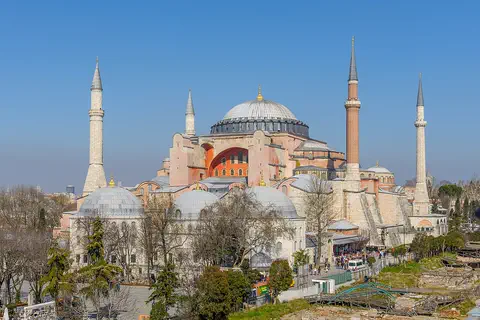
Hagia Sophia
Hagia Sophia in Istanbul was built in under six years, from 532 to 537, for the emperor Justinian. Its enormous dome seems to float on a ring of 40 windows. Over almost 1,500 years it has been a church, a mosque and a museum, and since 2020 it has been a mosque.
-
 Watch
Landmark
Sultan Ahmed Mosque
The Sultan Ahmed Mosque in Istanbul was built between 1609 and about 1616 for the Ottoman ruler Sultan Ahmed I. Its central dome is ringed by half-domes and smaller domes, and six slender minarets rise around it. Many people call it the Blue Mosque because of the blue and green tiles and painted decoration inside. It is still a working mosque, where Muslims come to pray.
-
 Watch
Landmark
Süleymaniye Mosque
The Süleymaniye Mosque in Istanbul, Türkiye, was designed by the architect Sinan and built between 1550 and 1557 for the Ottoman sultan Süleyman. With the mosque, Sinan built a whole complex of schools, a hospital, an inn for travelers, a kitchen and a bath. It is part of the Historic Areas of Istanbul, a UNESCO World Heritage Site since 1985.
-
 Watch
Landmark
Aqueduct of Valens
The Aqueduct of Valens is a bridge of arches in Istanbul, Türkiye, 971 meters long with 86 arches. It carried a water channel across a valley between two hills. It is named after the emperor Valens, and a research project at Radboud University dates its construction to 368 to 373.
Explore next
-
 Watch
Natural wonder
Caspian Sea
The Caspian Sea is the largest inland body of water on Earth, with five countries around its shores. About 130 rivers flow into it, but none flows out, so its level rises and falls with the balance of river water, rain and evaporation. Since the mid-1990s it has been dropping.
-
 Watch
Natural wonder
Danube
The Danube is Europe's second-longest river, after the Volga. It begins as two small streams in Germany's Black Forest and flows about 2,850 kilometers east to the Black Sea, passing through 10 countries and four capital cities. For more than 2,000 years it has been a border, a highway for boats and a home for wildlife, and it ends in a giant delta of reeds, lakes and birds.
-
 Watch
 Country
Romania
Romania is a country in southeastern Europe. The Carpathian Mountains curve around its middle, the Danube River runs along its southern edge to a huge delta on the Black Sea, and about 19 million people lived there at the start of 2026.
-
 Watch
Natural wonder
Sea of Marmara
The Sea of Marmara is a small inland sea between the Black Sea and the Aegean Sea, joined to them by two narrow straits. A big fault runs across its floor, and its water comes in two layers: less salty water from the Black Sea on top, and saltier Mediterranean water below.
-
Watch
City
Bucharest
Bucharest, the capital of Romania, lies on a wide plain beside the Dâmbovița River. First written about in 1459, it became the capital of Walachia in 1659 and of Romania in 1862. Today it is a city of broad boulevards, a huge parliament palace, the Romanian Athenaeum concert hall and an open-air Village Museum.
-
 Watch
Natural wonder
Baltic Sea
The Baltic Sea is a small, shallow sea in northern Europe, only 54 meters deep on average. Rivers pour in fresh water and only narrow, shallow straits connect it to the ocean, so its water is brackish: much less salty than the ocean. Part of it freezes every winter.
-
 Watch
 Country
Ukraine
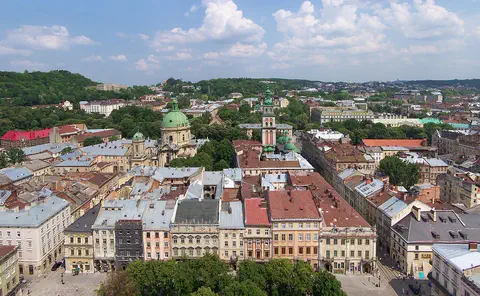
Ukraine is a large country in eastern Europe on the northern shore of the Black Sea. Most of it is level plain with some of the most fertile soil in the world, crossed by the Dnieper River. Its capital is Kyiv, and its official language is Ukrainian.
-
 Watch
 Country
Georgia
Georgia is a country at the eastern end of the Black Sea, below the high, icy Greater Caucasus mountains. It has warm, wet coasts, dry eastern plains and old monasteries, and about 3.9 million people lived there at the start of 2026.
For parents & teachers
What children will learn
- Locate the Black Sea, the Bosporus and the Danube Delta.
- Explain how fresh and salty water form layers.
- Explain why the deep Black Sea has no oxygen.
- Describe how the Black Sea stores carbon.
Recommended ages: 3 to 17 · About 15 minutes
Talk about it
- Why might a sea with layers that hardly ever mix be useful to scientists studying the past?
- Why do you think plants and animals can't live in water with no oxygen?
- How could storing carbon in the deep sea affect the climate over a very long time?
Try at home or in class
- With a grown-up, make a cup of very salty water and color it with food coloring. Slowly pour fresh water on top over the back of a spoon. Watch the two layers stay apart.
- Find the Danube on a map of Europe and follow it to where it reaches the Black Sea.
Key vocabulary: layer, oxygen, anoxic, hydrogen sulfide, delta, strait
Where these facts come from
- Wikidata , Wikimedia Foundation (CC0 1.0)
- Sulfur enhances carbon storage in the Black Sea , Max Planck Institute for Marine Microbiology
- Sulphur enhances carbon storage in the Black Sea (press release, 17 June 2021) , Alfred Wegener Institute, Helmholtz Centre for Polar and Marine Research
- Danube Delta , UNESCO World Heritage Centre
- Rip Current Safety , US National Weather Service
- What is a rip current? , NOAA National Ocean Service
- Natural Earth vector data , Natural Earth (NACIS) (Public domain)
- Wikimedia Commons , Wikimedia Foundation (Per file (public domain, CC0, CC BY or CC BY-SA); see each media record)
Checked, not yet human-reviewed. Last updated November 1, 2026. Spotted a mistake? Tell us.