Landmarks
Famous buildings, bridges, castles, monuments and heritage sites, with the stories of how they were made.
101 to explore · page 2 of 3
-
 Watch
Landmark
Memphis
Memphis was the capital of Egypt in the time of the first great pyramids, more than 4,000 years ago. It stood on the west side of the Nile, about 24 kilometers south of modern Cairo. Kings, priests, craftworkers and traders lived there, and its rulers were buried in pyramids and tombs along the desert edge, from Giza to Dahshur.
-
 Watch
Landmark
Metropolitan Museum of Art
The Metropolitan Museum of Art, or the Met, stands on Fifth Avenue at the edge of Central Park in New York City. Founded in 1870, it is the largest art museum in the city, with art from ancient Egypt to today. Its grand front, with three arches and pairs of columns, was finished in 1902.
-
 Watch
Landmark
Milan Cathedral
Milan Cathedral, called the Duomo, is a giant Gothic cathedral made of pink-and-white marble. Building began in 1386, and the last details of its front were finished only in 1965. It has more statues than any other building in the world, over 3,000 of them.
-
 Watch
Landmark
Mohenjo-daro
Mohenjo-daro was the largest city of the Indus civilization, which UNESCO calls one of the world's three great ancient civilizations. Built of baked brick and flourishing by about 2500 BCE beside the Indus River, it had streets in a neat grid, houses with bathrooms and covered drains. Its ruins were found in 1922.
-
 Watch
Landmark
Mont-Saint-Michel
Mont-Saint-Michel is a small rocky island off the coast of Normandy, in France. On top stands a Benedictine abbey built between the 1000s and 1500s, with a village and strong walls below. Around it, some of the biggest tides in Europe rush in and out across a huge sandy bay.
-
 Watch
Landmark
Moscow Kremlin
The Moscow Kremlin is the oldest part of Moscow. It began as a wooden fort on a hill by the Moskva River. Its present walls and towers were built from 1485 to 1516. Inside stand golden-domed cathedrals, palaces, a tall bell tower and museums.
-
 Watch
Landmark
Mount Rushmore
Mount Rushmore is a granite mountain in the Black Hills of South Dakota. From 1927 to 1941, nearly 400 workers carved the faces of Presidents Washington, Jefferson, Theodore Roosevelt and Lincoln into it, each about 60 feet (18 meters) tall. Most of the rock was removed with dynamite.
-
 Watch
Landmark
Musée d'Orsay
The Musée d'Orsay in Paris was built as a grand train station for the World's Fair of 1900. After the trains stopped, it was turned into a museum, which opened in 1986. Today about 3.7 million people a year come to see its art from 1848 to 1914, including famous Impressionist paintings.
-
 Watch
Landmark
Museo del Prado
The Museo del Prado in Madrid opened in 1819 to show the paintings collected by Spain's kings and queens. Its stone building was first planned as a science museum. Today it holds about 8,600 paintings, including the world's most complete collections of the Spanish painters El Greco, Velázquez and Goya.
-
 Watch
Landmark
Mycenae
Mycenae, in southern Greece, was the richest and most important palace city of Bronze Age Greece, more than 3,000 years ago. Its people built huge stone walls, a palace, a gate topped with two carved lions and great round tombs. Archaeologists have found gold masks, cups and jewelry there, and clay tablets with an early form of Greek writing.
-
 Watch
Landmark
Neuschwanstein Castle
Neuschwanstein Castle stands on a rocky ridge in Bavaria, Germany. King Ludwig II had it built from 1869 as a private retreat in the style of a medieval knights' castle, but with the newest technology inside. It opened to visitors in 1886, and in 2025 about 1.1 million people came.
-
 Watch
Landmark
Nineveh
Nineveh was the biggest city of the Assyrian Empire, on the east bank of the Tigris River in what is now Mosul, Iraq. About 2,700 years ago, King Sennacherib filled it with streets, canals and a palace of at least 80 rooms, and King Ashurbanipal collected a library of clay tablets. In 612 BCE the city was conquered and burned, and it never recovered.
-
 Watch
Landmark
Notre-Dame de Paris
Notre-Dame de Paris is the cathedral of Paris, a Catholic church begun in 1163 on an island in the Seine River. Its towers are 68 meters tall. In 2019 a fire destroyed most of its roof and its spire, and after five years of work it reopened in December 2024.
-
 Watch
Landmark
Olympia
Olympia, in a green valley in southern Greece, was a great religious sanctuary of the ancient Greeks and the home of the ancient Olympic Games. The Games were held there every four years from 776 BCE to 393 CE. Today you can walk among the ruins of its temples, its stadium and its training grounds.
-
 Watch
Landmark
Palace of Versailles
The Palace of Versailles began as a small royal hunting lodge. King Louis XIV turned it into a vast palace, and from 1682 it was the center of the French government. Today it has 2,300 rooms, the famous Hall of Mirrors and enormous gardens.
-
 Watch
Landmark
Palmyra
Palmyra is an ancient city built on an oasis in the Syrian desert. About 2,000 years ago it grew rich from caravans carrying goods between the Roman Empire and lands to the east. Its ruins, with a colonnaded street 1,100 meters long, are a UNESCO World Heritage Site.
-
 Watch
Landmark
Pantheon
The Pantheon in Rome was rebuilt by the emperor Hadrian almost 1,900 years ago, as a temple of ancient Roman religion. Its concrete dome, about 43 meters across, was the largest ever built until modern times. Since 609 it has been a church, and it still stands almost exactly as it was built.
-
 Watch
Landmark
Parthenon
The Parthenon is an ancient Greek temple on the Acropolis, a rocky hill in Athens. Built of marble between 447 and 438 BCE, it has 46 outer columns and was decorated with carvings. It has been a temple, a church and a mosque, and today experts are restoring it.
-
 Watch
Landmark
Persepolis
Persepolis was a royal city of the Persian kings. King Darius I began it around 518 BCE on a huge terrace at the foot of a mountain in southwestern Iran. Its palaces had very tall, slender columns and walls carved with long parades of people bringing gifts. It is a UNESCO World Heritage Site.
-
 Watch
Landmark
Petra
Petra, in southern Jordan, was the capital of the Nabataeans, who grew rich from trade in incense and spices. Many of its tombs and monuments are carved straight into red sandstone cliffs, and a narrow gorge called the Siq leads to its most famous facade, the Treasury.
-
 Watch
Landmark
Petronas Towers
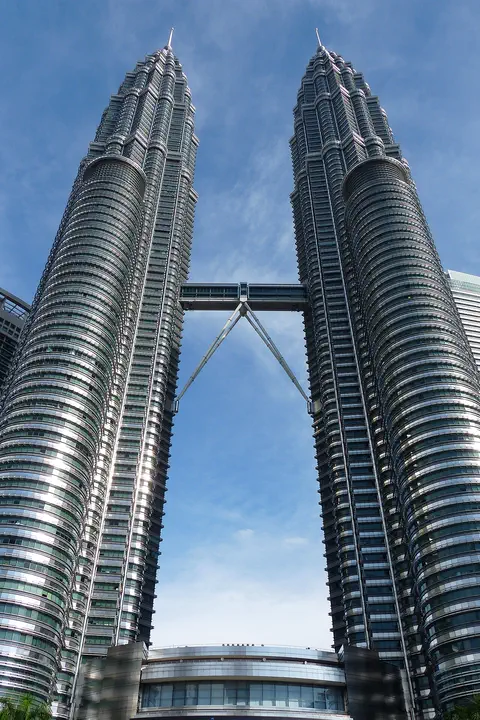
The Petronas Twin Towers in Kuala Lumpur, Malaysia, are two matching skyscrapers 452 meters tall, finished in 1998. Seen from above, each floor is shaped like an eight-pointed star, a pattern from Islamic art. A two-story skybridge joins them 170 meters above the ground, and from 1996 to 2003 they were counted as the tallest buildings in the world.
-
 Watch
Landmark
Pompeii
Pompeii was a Roman town near Naples, in Italy. In 79 CE the volcano Vesuvius erupted and buried it under ash and small stones. Digging began in 1748, and today you can walk its streets, shops, baths and houses. In 2025, 4,000,090 people visited.
-
 Watch
Landmark
Potala Palace
The Potala Palace rises from Red Mountain in Lhasa, high on the Tibetan Plateau, 3,700 meters above sea level. Its White Palace was finished in 1648 and its Red Palace in 1694. With more than 1,000 rooms, it was home to the Dalai Lamas and the seat of Tibet's government.
-
 Watch
Landmark
Prophet's Mosque
The Prophet's Mosque in Medina, Saudi Arabia, began as the simple home and courtyard of the Prophet Muhammad, who helped build it after he came to Medina in 622. Rebuilt and enlarged many times, it now has a famous green dome over Muhammad's tomb, ten minarets and room for up to a million worshippers at the busiest times.
-
 Watch
Landmark
Royal Monastery of San Lorenzo de El Escorial
The Royal Monastery of San Lorenzo de El Escorial stands at the foot of the Guadarrama mountains, northwest of Madrid, Spain. King Philip II began it in 1563, and it was finished in 1584. Inside its granite walls are a monastery, a church, a royal palace, a school and a famous library.
-
 Watch
Landmark
Sagrada Família
The Sagrada Família is a huge church in Barcelona, Spain, designed by the architect Antoni Gaudí. Building began in 1882 and is still going on. In February 2026 its tallest tower was finished at 172.5 meters, making it the tallest church in the world.
-
 Watch
Landmark
Samarra
Samarra, on the Tigris River in Iraq, was the capital of the Abbasid caliphs, rulers of a huge Islamic empire, from 836 to 892. In that short time they built enormous mosques, palaces, canals and even racecourses. Because the city was left so early, its plan survives, and its Great Mosque still has a famous spiral minaret.
-
 Watch
Landmark
Shaki
Shaki, also spelled Sheki, is a historic town in the forested Caucasus Mountains of Azerbaijan. After a flood of mud destroyed the old town in 1772, people rebuilt it higher up the valley, with houses, gardens, water channels and a khan's palace. Its wealth came from silk, and UNESCO made its historic center a World Heritage Site in 2019.
-
 Watch
Landmark
St. Basil's Cathedral
St. Basil's Cathedral stands at the end of Red Square in Moscow. Tsar Ivan IV ordered it in 1555, and it was finished by 1561. It is really ten small churches in one building, each with its own colorful dome, and today it is a museum.
-
 Watch
Landmark
St. Peter's Basilica
St. Peter's Basilica, in Vatican City, is the church of the popes and a place of worship for Catholics. Building began in 1506 and took more than a century. Bramante, Michelangelo, Maderno and Bernini all helped design it, and 800 workers raised its great dome in just 22 months.
-
 Watch
Landmark
Statue of Liberty
The Statue of Liberty stands on Liberty Island in New York Harbor. France gave her to the United States as a sign of friendship. The sculptor Auguste Bartholdi shaped her copper skin, Gustave Eiffel designed the iron frame inside, and she was dedicated in 1886.
-
 Watch
Landmark
Stonehenge
Stonehenge is a prehistoric monument on Salisbury Plain in England. It began as a round earthwork about 5,000 years ago, and its stone circle went up about 2500 BC. Hundreds of people moved huge stones, some from Wales, and lined them up with the sun.
-
 Watch
Landmark
Sultan Ahmed Mosque
The Sultan Ahmed Mosque in Istanbul was built between 1609 and about 1616 for the Ottoman ruler Sultan Ahmed I. Its central dome is ringed by half-domes and smaller domes, and six slender minarets rise around it. Many people call it the Blue Mosque because of the blue and green tiles and painted decoration inside. It is still a working mosque, where Muslims come to pray.
-
 Watch
Landmark
Susa
Susa, in southwest Iran, is one of the most ancient places where towns first grew. People built there from more than 6,000 years ago until about 800 years ago, one town on top of another. It was the capital of the Elamites and later of the Persian king Darius I, whose great palace still lies in ruins there.
-
 Watch
Landmark
Sydney Opera House
The Sydney Opera House stands on a point of land in Sydney Harbour, Australia. Danish architect Jørn Utzon won a competition to design it in 1957, building began in 1959, and it opened on October 20, 1973. Its shell-shaped roofs are covered in more than a million tiles.
-
 Watch
Landmark
Taipei 101
Taipei 101 is a skyscraper in Taipei, Taiwan, 508 meters tall with its spire and 101 stories high. When it opened, it was the tallest building in the world. Inside hangs a 660-ton steel ball, a tuned mass damper, that helps steady the tower in typhoon winds and earthquakes.
-
 Watch
Landmark
Taj Mahal
The Taj Mahal is a white marble tomb in Agra, India, beside the Yamuna River. The Mughal emperor Shah Jahan had it built in memory of his wife, Mumtaz Mahal. More than 20,000 workers spent about 22 years on the tomb, its gardens, a mosque and a great gateway.
-
 Watch
Landmark
Temple of Artemis at Ephesus
The Temple of Artemis at Ephesus was one of the Seven Wonders of the ancient world. It was rebuilt several times, and its 6th-century BCE version was more than 300 feet long. After a fire in 356 BCE it was built again just as big. Today only scattered stones and one column remain.
-
 Watch
Landmark
Teotihuacan
Teotihuacan, about 50 kilometers northeast of Mexico City, was a huge city almost 2,000 years ago. A long, straight avenue runs through it, lined by giant pyramids, including the Pyramid of the Sun and the Pyramid of the Moon. Around 500 CE, it was one of the largest cities in the world.
-
 Watch
Landmark
Terracotta Army
In 1974, farmers digging a well near Xi'an, China, found pieces of clay soldiers. Archaeologists uncovered an army of about 8,000 life-size soldiers and horses, made for the tomb of Qin Shi Huang, the first emperor of a united China, who died in 210 BCE. The figures were once brightly painted, and each has its own face.
-
 Watch
Landmark
The Great Sphinx
The Great Sphinx at Giza, Egypt, is a lion with a human head, carved out of the solid rock about 4,500 years ago. It is about 73 meters long and 20 meters high, one of the largest sculptures in the world. Most experts think it shows the face of King Khafre.
-
 Watch
Landmark
Thebes
Thebes was one of the greatest cities of ancient Egypt and, for long periods, its capital. It lay on both banks of the Nile, where the town of Luxor is today. On the east bank stand the giant temples of Karnak and Luxor; on the west bank are royal tombs, including the Valley of the Kings.
-
 Watch
Landmark
Three Gorges Dam
The Three Gorges Dam crosses the Yangtze River in central China. It is 2,335 meters long and 185 meters high, and it can make more electricity than any other hydroelectric dam in the world. It also lets big ships travel far up the river, but building it meant that more than a million people had to move.
-
 Watch
Landmark
Topkapı Palace
Topkapı Palace sits on a point of land where the Bosphorus Strait meets the sea in Istanbul. Sultan Mehmed II built it between 1460 and 1478, and for nearly 400 years it was the home of the Ottoman sultans and the center of their government. In 1924 it became a museum.
-
 Watch
Landmark
Tower Bridge
Tower Bridge crosses the River Thames in London, beside the Tower of London. Built from 1886 to 1894, it has two stone-covered towers joined by high walkways, and a road that splits in the middle and swings up like two giant seesaws to let tall ships pass. It still opens about 850 times a year.
-
 Watch
Landmark
Tower of London
The Tower of London is a castle on the River Thames, begun by William the Conqueror after 1066. Its great stone keep, the White Tower, is more than 900 years old. Over the centuries the Tower has been a royal palace, a fortress, a prison, a zoo, a mint for coins and a store for records, and today it guards the Crown Jewels.
-
 Watch
Landmark
Umayyad Mosque
The Umayyad Mosque, also called the Great Mosque of Damascus, was built between 705 and 715 by the ruler al-Walid I. Britannica calls it the earliest stone mosque still standing. It is one of the largest mosques in the world, with a vast courtyard, a long prayer hall and walls that once shone with mosaics.
-
 Watch
Landmark
Ur
Ur was a great city of Sumer, in the south of what is now Iraq, founded more than 5,000 years ago. Twice it was the capital of an empire. Archaeologists found royal tombs full of gold treasures, streets of brick houses and a huge stepped temple tower called a ziggurat. When the Euphrates River moved away, the fields dried up and the city was abandoned.