Asia
Countries, cities, landmarks and natural wonders of Asia. Pick one to explore it, or open the globe.
138 to explore · page 3 of 3
-
 Watch
Landmark
Mohenjo-daro
Mohenjo-daro was the largest city of the Indus civilization, which UNESCO calls one of the world's three great ancient civilizations. Built of baked brick and flourishing by about 2500 BCE beside the Indus River, it had streets in a neat grid, houses with bathrooms and covered drains. Its ruins were found in 1922.
-
 Watch
 Country
Mongolia
Mongolia is a large, landlocked country in Asia, between Russia and China. Most of it is a high plateau of grassy steppe, with mountains in the west and the Gobi in the south, and about 3.6 million people lived there in 2025.
-
 Watch
City
Mumbai
Mumbai, once called Bombay, is a giant port city on India's west coast, by the Arabian Sea. It grew on seven small islands that were joined into one, and it is India's main center of business and banking. At the 2011 census, more than 12 million people lived in the city and more than 18 million in its urban area.
-
 Watch
 Country
Myanmar
Myanmar, also called Burma, is the northernmost country of Southeast Asia. Snowy mountains rise in the far north, and the long Irrawaddy River flows south through its heartland to a huge delta of rice fields. About 55 million people live there.
-
 Watch
 Country
Nepal
Nepal is a landlocked country in South Asia, between India and China. It climbs from flat, warm farmland in the south to the snowy Himalaya in the north, where Mount Everest stands, and about 29.6 million people lived there in 2025.
-
 Watch
Landmark
Nineveh
Nineveh was the biggest city of the Assyrian Empire, on the east bank of the Tigris River in what is now Mosul, Iraq. About 2,700 years ago, King Sennacherib filled it with streets, canals and a palace of at least 80 rooms, and King Ashurbanipal collected a library of clay tablets. In 612 BCE the city was conquered and burned, and it never recovered.
-
 Watch
 Country
North Korea
North Korea, officially the Democratic People's Republic of Korea, covers the northern part of the Korean peninsula in East Asia. It is a land of mountains and river valleys with long, cold winters. About 26.6 million people lived there in 2025, and almost all of them speak Korean.
-
 Watch
 Country
Oman
Oman is a country on the southeastern corner of the Arabian Peninsula, with long coasts on the sea and the huge Empty Quarter desert inland. People have watered their farms with ancient channels called aflaj for more than 2,000 years, and Oman was famous for frankincense. About 5.4 million people lived there in 2026.
-
 Watch
Landmark
Palmyra
Palmyra is an ancient city built on an oasis in the Syrian desert. About 2,000 years ago it grew rich from caravans carrying goods between the Roman Empire and lands to the east. Its ruins, with a colonnaded street 1,100 meters long, are a UNESCO World Heritage Site.
-
 Watch
Landmark
Persepolis
Persepolis was a royal city of the Persian kings. King Darius I began it around 518 BCE on a huge terrace at the foot of a mountain in southwestern Iran. Its palaces had very tall, slender columns and walls carved with long parades of people bringing gifts. It is a UNESCO World Heritage Site.
-
 Watch
Landmark
Petra
Petra, in southern Jordan, was the capital of the Nabataeans, who grew rich from trade in incense and spices. Many of its tombs and monuments are carved straight into red sandstone cliffs, and a narrow gorge called the Siq leads to its most famous facade, the Treasury.
-
 Watch
Landmark
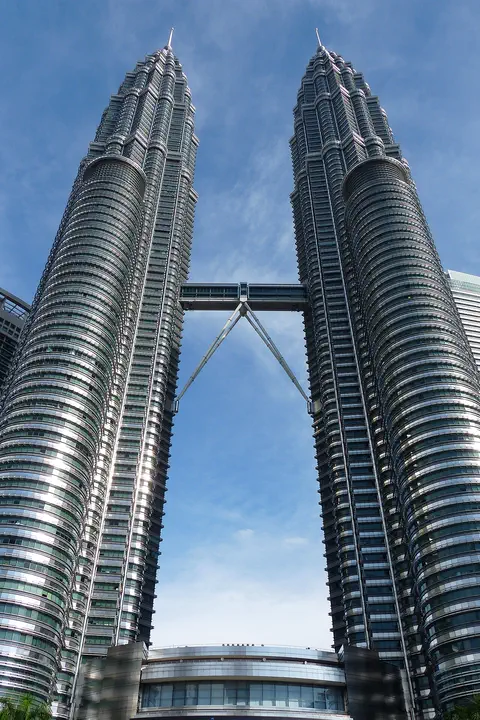
Petronas Towers
The Petronas Twin Towers in Kuala Lumpur, Malaysia, are two matching skyscrapers 452 meters tall, finished in 1998. Seen from above, each floor is shaped like an eight-pointed star, a pattern from Islamic art. A two-story skybridge joins them 170 meters above the ground, and from 1996 to 2003 they were counted as the tallest buildings in the world.
-
 Watch
 Country
Philippines
The Philippines is an island country in Southeast Asia, in the western Pacific Ocean. It has more than 7,000 islands, about 50 volcanoes and rich coral reefs, and about 112.7 million people were counted there in 2024.
-
 Watch
Landmark
Potala Palace
The Potala Palace rises from Red Mountain in Lhasa, high on the Tibetan Plateau, 3,700 meters above sea level. Its White Palace was finished in 1648 and its Red Palace in 1694. With more than 1,000 rooms, it was home to the Dalai Lamas and the seat of Tibet's government.
-
 Watch
Landmark
Prophet's Mosque
The Prophet's Mosque in Medina, Saudi Arabia, began as the simple home and courtyard of the Prophet Muhammad, who helped build it after he came to Medina in 622. Rebuilt and enlarged many times, it now has a famous green dome over Muhammad's tomb, ten minarets and room for up to a million worshippers at the busiest times.
-
 Watch
 Country
Qatar
Qatar is a small desert country on a peninsula that pokes north into the Persian Gulf. Its people once lived by pearl diving and fishing; today it is one of the world's biggest exporters of natural gas. Its capital, Doha, has a skyline of towers, and about 3.2 million people lived in Qatar at the end of 2025.
-
 Watch
Landmark
Samarra
Samarra, on the Tigris River in Iraq, was the capital of the Abbasid caliphs, rulers of a huge Islamic empire, from 836 to 892. In that short time they built enormous mosques, palaces, canals and even racecourses. Because the city was left so early, its plan survives, and its Great Mosque still has a famous spiral minaret.
-
 Watch
 Country
Saudi Arabia
Saudi Arabia covers about four-fifths of the Arabian Peninsula. Most of it is dry desert, including the Empty Quarter, the largest sand area in the world. About 35.3 million people lived there in 2024, most of them in cities such as Riyadh, the capital.
-
 Watch
City
Seoul
Seoul is the capital of South Korea, on the Han River. It became a capital in 1394, and its old palaces and city gates still stand among skyscrapers. About 9.7 million people lived there in 2020, and its subway is one of the main ways to get around.
-
 Watch
Landmark
Shaki
Shaki, also spelled Sheki, is a historic town in the forested Caucasus Mountains of Azerbaijan. After a flood of mud destroyed the old town in 1772, people rebuilt it higher up the valley, with houses, gardens, water channels and a khan's palace. Its wealth came from silk, and UNESCO made its historic center a World Heritage Site in 2019.
-
 Watch
City
Shanghai
Shanghai is China's most populous city, on the coast where the great Yangtze River meets the East China Sea. Once a small fishing village, it grew into one of the world's busiest seaports. About 24.9 million people lived in Shanghai in 2020, and the towers of Pudong rise across the Huangpu River.
-
 Watch
 Country
Singapore
Singapore is a city-state, a country that is also one city, on an island at the southern tip of the Malay Peninsula in Southeast Asia. It is small but crowded: about 6.21 million people lived there in 2026, and its port is one of the busiest in the world.
-
 Watch
 Country
Sri Lanka
Sri Lanka is an island country in the Indian Ocean, just south of India. Green highlands rise in the middle, surrounded by plains and sandy beaches. About 22 million people live there, and the island is famous for its tea, its ancient cities and its wild elephants.
-
 Watch
Landmark
Sultan Ahmed Mosque
The Sultan Ahmed Mosque in Istanbul was built between 1609 and about 1616 for the Ottoman ruler Sultan Ahmed I. Its central dome is ringed by half-domes and smaller domes, and six slender minarets rise around it. Many people call it the Blue Mosque because of the blue and green tiles and painted decoration inside. It is still a working mosque, where Muslims come to pray.
-
 Watch
Landmark
Susa
Susa, in southwest Iran, is one of the most ancient places where towns first grew. People built there from more than 6,000 years ago until about 800 years ago, one town on top of another. It was the capital of the Elamites and later of the Persian king Darius I, whose great palace still lies in ruins there.
-
 Watch
Landmark
Taipei 101
Taipei 101 is a skyscraper in Taipei, Taiwan, 508 meters tall with its spire and 101 stories high. When it opened, it was the tallest building in the world. Inside hangs a 660-ton steel ball, a tuned mass damper, that helps steady the tower in typhoon winds and earthquakes.
-
 Watch
 Country
Taiwan
Taiwan is an island in the western Pacific Ocean, about 160 kilometers off the coast of southeastern China. Mountains cover about two-thirds of it, and most of its 23 million people live on the flatter west side. It has its own government, based in Taipei. The People's Republic of China, governed from Beijing, says Taiwan is part of China, and Taiwan's status is disputed.
-
 Watch
Landmark
Taj Mahal
The Taj Mahal is a white marble tomb in Agra, India, beside the Yamuna River. The Mughal emperor Shah Jahan had it built in memory of his wife, Mumtaz Mahal. More than 20,000 workers spent about 22 years on the tomb, its gardens, a mosque and a great gateway.
-
 Watch
 Country
Tajikistan
Tajikistan is a small, landlocked country in Central Asia, and more than nine-tenths of it is mountains. The Pamir Mountains in the east have peaks over 7,000 meters and one of the longest glaciers in the world. About 10.7 million people live there, mostly in the valleys.
-
 Watch
City
Tbilisi
Tbilisi, the capital of Georgia, lies along the Mtkvari River between mountain ridges. Its name comes from the Georgian word for "warm", after the hot springs that feed its old bathhouses. At the 2024 census, 1,331,485 people lived in the self-governing city.
-
 Watch
City
Tehran
Tehran, the capital of Iran, spreads up the slopes of the Alborz Mountains, with snowy peaks to the north and desert to the south. Once a small village, and later a market town known for its pomegranates, it became the capital in 1786. Today it is a huge, modern city with an old roofed bazaar, a palace that is a World Heritage Site and the 435-meter Milad Tower.
-
 Watch
Landmark
Temple of Artemis at Ephesus
The Temple of Artemis at Ephesus was one of the Seven Wonders of the ancient world. It was rebuilt several times, and its 6th-century BCE version was more than 300 feet long. After a fire in 356 BCE it was built again just as big. Today only scattered stones and one column remain.
-
 Watch
Landmark
Terracotta Army
In 1974, farmers digging a well near Xi'an, China, found pieces of clay soldiers. Archaeologists uncovered an army of about 8,000 life-size soldiers and horses, made for the tomb of Qin Shi Huang, the first emperor of a united China, who died in 210 BCE. The figures were once brightly painted, and each has its own face.
-
 Watch
Landmark
Three Gorges Dam
The Three Gorges Dam crosses the Yangtze River in central China. It is 2,335 meters long and 185 meters high, and it can make more electricity than any other hydroelectric dam in the world. It also lets big ships travel far up the river, but building it meant that more than a million people had to move.
-
 Watch
City
Tokyo
Tokyo is the capital of Japan, at the head of Tokyo Bay. It began as the small town of Edo and was renamed Tokyo, the Eastern Capital, in 1868. About 14.3 million people lived in the Tokyo Metropolis in 2022, and Greater Tokyo is Japan's largest city region.
-
 Watch
Landmark
Topkapı Palace
Topkapı Palace sits on a point of land where the Bosphorus Strait meets the sea in Istanbul. Sultan Mehmed II built it between 1460 and 1478, and for nearly 400 years it was the home of the Ottoman sultans and the center of their government. In 1924 it became a museum.
-
 Watch
 Country
Turkmenistan
Turkmenistan is a country in Central Asia, and nine-tenths of it is desert. The huge Karakum sand desert fills its middle, while people live mostly in green oases along rivers and mountains. Ancient Silk Road cities such as Merv stand here, and the 2022 national census counted about 7.1 million people.
-
 Watch
Landmark
Umayyad Mosque
The Umayyad Mosque, also called the Great Mosque of Damascus, was built between 705 and 715 by the ruler al-Walid I. Britannica calls it the earliest stone mosque still standing. It is one of the largest mosques in the world, with a vast courtyard, a long prayer hall and walls that once shone with mosaics.
-
 Watch
Landmark
Ur
Ur was a great city of Sumer, in the south of what is now Iraq, founded more than 5,000 years ago. Twice it was the capital of an empire. Archaeologists found royal tombs full of gold treasures, streets of brick houses and a huge stepped temple tower called a ziggurat. When the Euphrates River moved away, the fields dried up and the city was abandoned.
-
 Watch
 Country
Uzbekistan
Uzbekistan is a landlocked country in Central Asia, between two great rivers, the Amu Darya and the Syr Darya. Most of it is dry desert, but its oases and valleys hold famous Silk Road cities such as Samarkand and Bukhara. It became independent in 1991, and about 37.1 million people lived there in 2025.
-
 Watch
Landmark
Western Wall
The Western Wall, in the Old City of Jerusalem, is the only remaining part of the huge wall that once held up the platform of the ancient Jewish Temple. More than 2,000 years old, it is a place of prayer and pilgrimage for Jewish people, and visitors come from all over the world.
-
 Watch
 Country
Yemen
Yemen sits at the southwestern corner of the Arabian Peninsula, between the Red Sea and the Arabian Sea. Its green, terraced highlands are unlike anywhere else in Arabia, its old towns have tall houses of stone and mud brick, and it was the first place where coffee was grown as a crop to sell.