Skip to content
Search the Discovery Encyclopedia
-
What If? Lab
What if Earth were the only planet?
Imagine a solar system with just the Sun, Earth and our Moon. The bright 'wandering stars' would vanish from our night sky, the paths of asteroids and comets would change, and scientists would lose the other worlds that teach us how planets work. Explore what Earth would miss.
-
 How Things Work
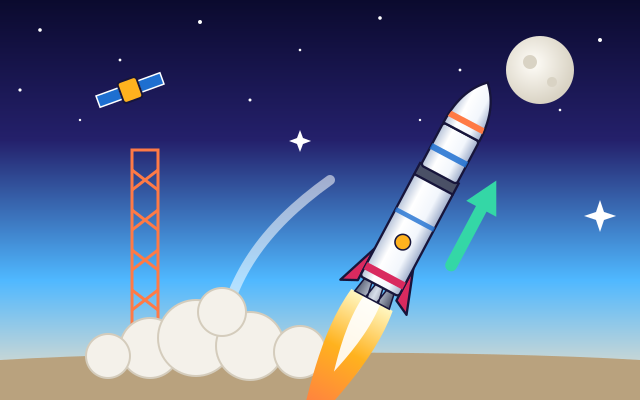
How do rockets reach space?
Look inside a rocket and follow its launch stages. Watch exhaust leave as the rocket accelerates, then experiment with thrust and cargo weight.
-
What If? Lab
What if we built a space elevator?
Rockets burn huge amounts of fuel to reach space. A space elevator would be a cable stretching from the equator about 35,786 kilometers up to a special orbit, with robot climbers riding up and down. NASA studies say it might cut the cost of reaching orbit hugely, but it needs a material far stronger than anything we can make in long lengths today. Explore the cable, the materials and the ride.
-
What If? Lab
What if you tried to swing in space?
A swing is a pendulum: gravity pulls the seat back down to the middle every time it rises. In our model, a swing with 2-meter ropes takes about 2.9 seconds to go there and back on Earth. Switch gravity off and the seat simply stays where you let it go.
-
What If? Lab
What if you lived on a space station?
On the International Space Station, astronauts and everything around them float. That sounds fun, but without the steady pull of gravity to work against, bones and muscles get weaker. That's why astronauts exercise for about two hours every day. Imagine moving in, and find out how they stay strong.
-
 How Things Work
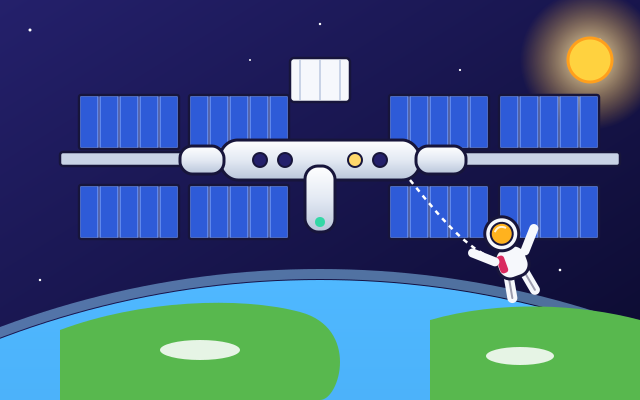
How does a space station support astronauts?
Explore air, water, food, power, exercise, and waste systems. Manage a small station and discover how astronauts live and work in orbit.
-
 How Things Work
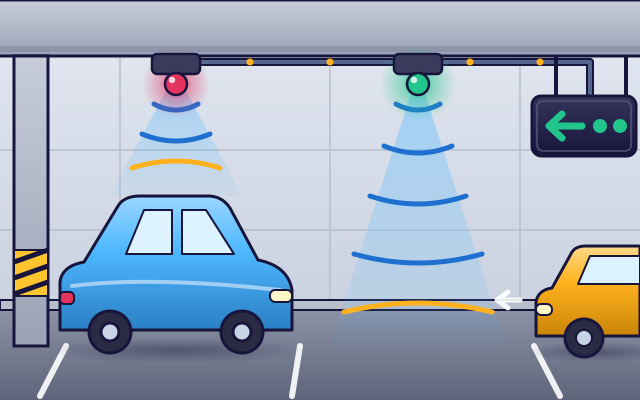
How do parking garages identify empty spaces?
Move cars between bays and watch sensors update guidance signs.
-
What If? Lab
What if planets were not round?
Big worlds are round because gravity pulls everything toward the center from all sides. Small asteroids don't have enough gravity to do that, so most stay lumpy. Imagine a cube-shaped planet, meet the lumpy asteroids, and compare worlds to see how big something must be before gravity rounds it off.
-
What If? Lab
What if telescopes found planets around every star?
Astronomers have confirmed thousands of planets around other stars, called exoplanets: 6,451 in NASA's Exoplanet Archive in October 2026. Most were found by watching a star dim slightly as a planet passed in front. Imagine planets around every star, meet some worlds a bit like Earth, and see how a tiny dip in starlight reveals a planet.
-
 How Things Work
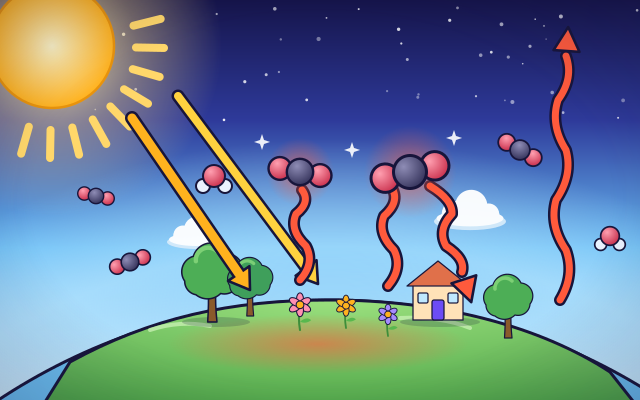
How do greenhouse gases warm the planet?
Compare incoming sunlight and outgoing heat in a simplified atmospheric model.
-
What If? Lab
What if Pluto were still called a planet?
Pluto was called our ninth planet for 76 years. Then astronomers found many similar icy worlds beyond Neptune, and in 2006 the International Astronomical Union wrote a definition of 'planet' that made Pluto a dwarf planet. What if Pluto had kept its old title? Explore how a planet is defined, the other dwarf planets, and why science sometimes changes its words.
-
What If? Lab
What if there were a planet between Mars and Jupiter?
Between Mars and Jupiter lies the asteroid belt: millions of rocky leftovers that never built a planet. NASA explains that young Jupiter's gravity stopped them. Explore the belt, Jupiter's tug, the dwarf planet Ceres, and what kind of planet could have formed there.
-
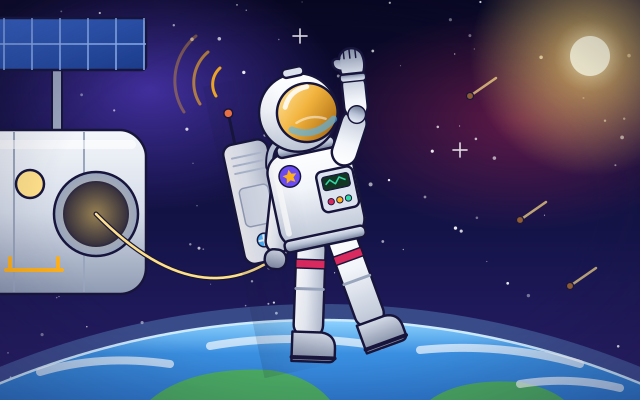 How Things Work
How do spacesuits support astronauts?
Explore pressure, oxygen, cooling, communication, and protective layers inside a suit.
-
What If? Lab
What if a spacecraft traveled faster?
A rocket's top speed depends on how fast its hot exhaust gas shoots out and on how much of the rocket is fuel. In our model, switching from a kerosene engine to a faster hydrogen engine lets the same rocket gain nearly half as much speed again.
-
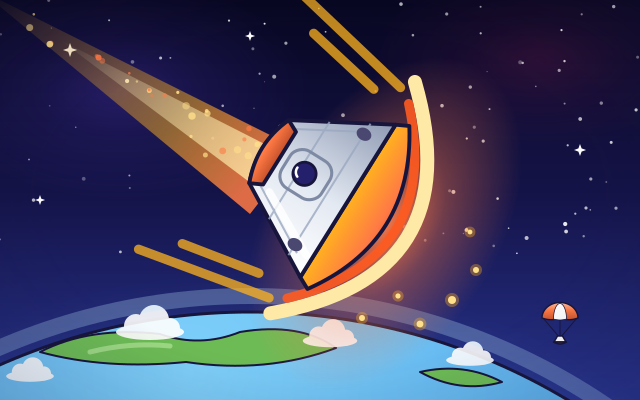 How Things Work
How do spacecraft return through the atmosphere?
Follow heating, shielding, slowing, and landing during a simulated return.
-
 Country
Kazakhstan
Kazakhstan is the largest country in Central Asia and the ninth largest in the world. It has no ocean coast, but the Caspian Sea lies along its southwest edge. About 20.6 million people lived there in 2026, and its capital is Astana.
-
 Animal
Tardigrade
Tardigrades, or water bears, are tiny eight-legged animals about a millimeter long or less. They live in damp moss, soil, fresh water and the sea all over the world, and they can survive drying out completely by curling into a little barrel called a tun.
-
 Landmark
Baikonur Cosmodrome
Baikonur Cosmodrome is a huge rocket launch site on the flat grasslands of Kazakhstan. The Soviet Union began building it in secret in 1955. Sputnik 1, the first satellite, launched from here in 1957, and Yuri Gagarin, the first person in space, in 1961. Today Russia rents it from Kazakhstan, and crews have launched from it to the International Space Station as recently as 2025.
-
What If? Lab
What if gravity disappeared?
Gravity is the pull that makes a dropped ball fall and keeps your feet on the ground. Switch it off in our model and watch what a ball does instead, then find out why astronauts float.
-
What If? Lab
What if you found a meteorite?
Meteorites are pieces of space rock that survived a fiery trip through Earth's air. Most come from asteroids, a few from the Moon or Mars, and many are older than any rock ever found on Earth. Imagine finding one: learn the clues scientists look for, what is inside, and why the right first step is to tell a grown-up and ask a museum or university.
-
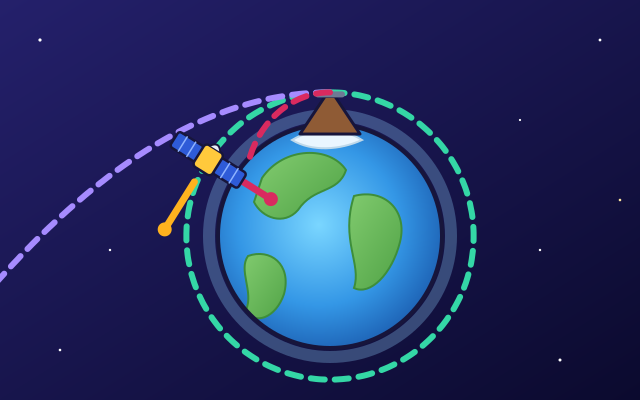 How Things Work
How do satellites stay in orbit?
Explore gravity and sideways motion in a simplified orbital simulation. Adjust a satellite's starting speed and height to compare its path.
-
What If? Lab
What if the Sun had no sunspots?
Sunspots are darker, cooler patches on the Sun made by strong magnetic fields, and their numbers rise and fall about every 11 years. Imagine a Sun with none: what would happen to its light, to solar storms and to the auroras they bring? Once, for about 70 years, the real Sun came close.
-
What If? Lab
What if people built homes on Mars?
Mars has air you cannot breathe, temperatures far below freezing and no magnetic shield like Earth's. A home there would need sealed rooms, a way to make oxygen and water, and gardens for fresh food. NASA is already testing pieces of the puzzle, from an oxygen maker on Mars to a 3D-printed practice habitat in Texas.
-
What If? Lab
What if auroras could be seen everywhere?
Auroras glow when tiny particles from the Sun crash into the air high above Earth. Earth's magnetic field steers them toward the poles, so that is where auroras shine most. Imagine lights over the whole planet, find out what makes the colors, and see how people keep satellites safe in big solar storms.
-
What If? Lab
What if sound couldn’t travel through air?
Sound is a push passed from particle to particle. In air it travels about 343 meters every second. Take the air away, as in empty space, and there is nothing to pass the push along, so a clap makes no sound at all. Water and steel still carry it, and much faster.
-
 Landmark
Chichén Itzá
Chichén Itzá is the ruin of a great Maya city on the Yucatán Peninsula in Mexico. Its people built pyramids, a huge ball court and a round building for watching the sky. Its most famous pyramid, El Castillo, has 365 steps, as many as the days in a year.
-
 Natural wonder
Atacama Desert
The Atacama is a cool desert in northern Chile, squeezed between the Pacific coast and the Andes mountains, about 1,000 to 1,100 kilometers long. It is one of the driest places on Earth: the city of Arica, on its coast, averages less than 1 millimeter of rain a year. Its dry, clear air makes it a top place for giant telescopes.
-
What If? Lab
What if Earth were much bigger?
Astronomers have found many planets bigger than Earth, called super-Earths. A simple calculation shows that an Earth twice as wide, made of the same rock, would pull twice as hard. Such a world might hold on to more air and might not grow such tall mountains.
-
What If? Lab
What if you could stand on Saturn?
You could not really stand on Saturn: it is a ball of gas and liquid with no solid surface. But imagine floating at its cloud tops. Saturn has 95 times Earth's mass, yet in our model you would weigh only about 14 percent more than at home, because Saturn is so wide that its cloud tops are very far from its center.
-
What If? Lab
What if our Sun were a different color?
A star's color tells you how hot it is: red stars are the coolest and blue stars the hottest. Our Sun is actually white, though it looks yellow through our air. NASA scientists have even worked out that plants on planets around other stars might not be green.
-
Geography
A warming world
Scientists measure Earth's temperature all over the world, and it is getting warmer: the WMO says 2025 was about 1.43 °C warmer than in the late 1800s. The main cause is extra greenhouse gases, mostly from burning coal, oil and gas, which trap heat. Ice is melting and the sea is rising. People are measuring the changes and building cleaner energy.
-
What If? Lab
What if Earth had two suns?
More than half of the stars in the sky have a partner star. Astronomers have even found planets that go around two stars at once. Imagine Earth with two suns: you might see two shadows and two sunsets. Explore what scientists have really found.
-
What If? Lab
What if Earth were covered in ice?
White ice bounces sunlight back to space, so an icy planet soaks up less of the Sun's warmth. In our energy-balance model, making Earth reflect 60 percent of its sunlight instead of 30 percent drops its average temperature from about 15 °C to about −23 °C.
-
What If? Lab
What if the whole Earth were covered by ocean?
Water soaks up a lot of heat before it gets hot, and gives it back slowly. Turn a patch of damp ground into ocean in our model and watch the gap between day and night temperatures shrink, then see how the sea already keeps coastal towns mild.
-
What If? Lab
What if you could ride a comet?
A comet's center is a dusty ball of ice a few kilometers across, racing around the Sun. In 2014, the European Space Agency's Philae lander touched down on comet 67P, and because the comet's gravity is so weak, it bounced! Imagine riding a comet, then see what a real spacecraft found.
-
What If? Lab
What if a comet passed close to Earth?
Comets are icy leftovers from when our solar system formed. Near the Sun, they warm up and grow a glowing cloud and long tails. Dust they leave behind gives us meteor showers. Astronomers have predicted comets' returns for centuries: Halley's Comet is due back in 2061.
-
 Country
Ecuador
Ecuador is a country in northwestern South America, named after the equator, which crosses it. In a small space it holds Pacific beaches, high snowy volcanoes of the Andes, part of the Amazon rainforest and the Galápagos Islands, whose wildlife helped Charles Darwin develop his ideas.
-
What If? Lab
What if the Moon had air?
The Moon has almost no air, so its sky is always black and it has no weather. Scientists have found that the Moon once had an atmosphere, billions of years ago, but it was lost to space or became part of the ground. Explore what air would change, and why small worlds lose theirs.
-
 Life around the world
Life along the Nile in Cairo
Cairo, Egypt's capital, has stood beside the Nile for more than 1,000 years. Around it lies desert, so people live close to the river: from space at night, their lights trace the Nile like a glowing flower. The river waters farms, and a new riverside walkway gives people a place to stroll.
-
What If? Lab
What if the Moon had no craters?
The Moon is covered with craters made by space rocks crashing into it. With no wind, rain or flowing water, the Moon keeps its craters for billions of years, while Earth wipes most of its craters away. Imagine a smooth Moon, and discover how scientists count craters to tell how old a surface is.
-
What If? Lab
What if an asteroid struck the Moon?
The Moon's craters are a record of space rocks landing over billions of years, and small ones still land there every day. Scientists watch for tiny flashes of light on the Moon and later find the brand-new craters. Explore what happens when a rock hits the Moon, and why the Moon keeps going around Earth as always.
-
What If? Lab
What if the universe stopped expanding?
Since the 1920s, astronomers have known that distant galaxies are moving apart as space stretches. In 1998 they found the stretching is speeding up, driven by something nobody understands, called dark energy. What if the expansion stopped? Our galaxy wouldn't notice, but the universe's long future would change, and scientists are still working out where it is heading.
-
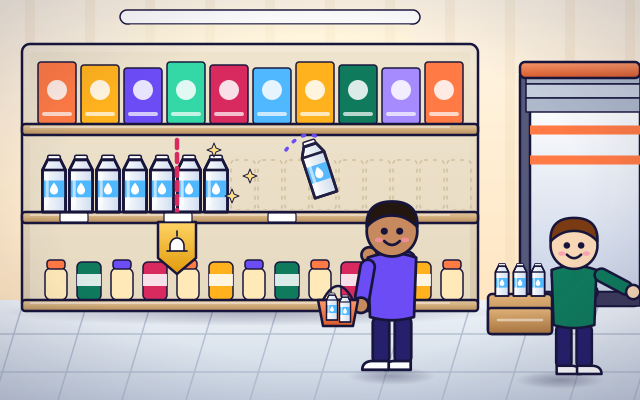 How Things Work
How do supermarkets keep shelves stocked?
Balance sales, inventory, reorder points, deliveries, and shelf space in a model store.
-
What If? Lab
What if paper were waterproof?
Paper is a mat of tiny plant fibers that water loves to cling to. Water creeps into the spaces between them and loosens the bonds that hold them together, so wet paper goes soft. Coatings can keep water out. Imagine paper that was always waterproof and follow what might change.
-
 How Things Work
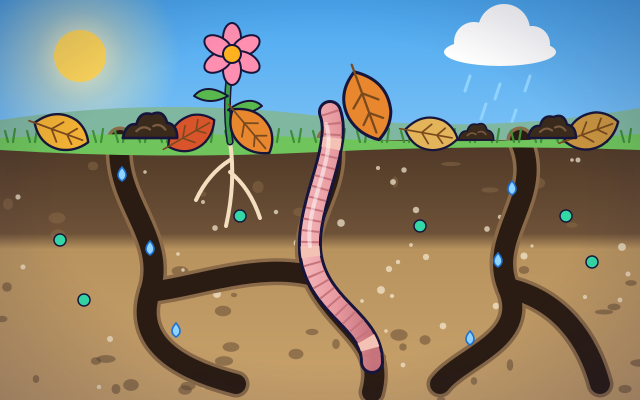
How do earthworms change the ground?
Follow tunnels and compare their effects on air spaces and organic material.
-
What If? Lab
What if you visited an icy moon?
Jupiter's moon Europa and Saturn's moon Enceladus are covered in ice, but scientists think salty oceans lie underneath. The squeezing pull of their giant planets keeps the insides warm. Imagine walking on the ice, peeking at the ocean below and joining the search for places where life could exist.
-
What If? Lab
What if the stars were much closer?
Every star is a sun, but even the nearest one is more than four light-years away, so stars look like faint points. Bring them closer and they would shine much more brightly. In real crowded star clusters, the sky would be full of bright stars, but stars that close may make it hard for planets to form.
-
Geography
Ocean currents
Ocean currents are flows of seawater from one place to another. Winds push the surface water, and because Earth spins, the currents curve into giant loops called gyres. Deep down, cold, salty water sinks and creeps slowly around the planet. Together, currents carry heat from the warm tropics toward the cold poles.
-
What If? Lab
What if Earth had rings?
Saturn's rings are made of billions of chunks of ice and rock, all circling the planet. Earth has no rings today, but scientists have found clues that it may once have had one. Explore what rings are, where they come from, and what a ring might do to our sky.
-
Geography
The water cycle around the world
Earth's water is always on the move. The Sun's heat lifts water from oceans, lakes and plants into the air as invisible vapor. It cools into clouds, winds carry it around the world, and it falls as rain or snow. Then rivers and groundwater carry it back to the sea. Some places get far more rain than others because of how air rises and sinks around the planet.
-
What If? Lab
What if Saturn’s rings vanished?
Saturn's rings are billions of icy chunks, and some of that ice is slowly raining down onto the planet. NASA scientists estimate the rings could be gone in less than 300 million years. Explore what the rings are, how they fade, how they already seem to vanish from Earth's view, and what Saturn would be like without them.
-
What If? Lab
What if the water cycle changed?
Warm air can hold more water vapor, about 7 percent more for each degree. In our model of the whole planet's water cycle, a world 2 °C warmer evaporates about 14 percent more water each year if rain kept up with that rule, or about 4 percent more at 2 percent per degree, a rate within the range climate models find.
-
What If? Lab
What if Earth had no magnetic field?
Deep inside Earth, swirling melted iron makes a magnetic field all around our planet. It turns compass needles, helps sea turtles find their way and shields our air from the solar wind. Imagine it gone, compare Earth with Mars, and find out why scientists are calm about Earth's changing field.
-
What If? Lab
What if Earth were farther from the Sun?
Sunlight spreads out as it travels, so a planet farther from the Sun gets less of it. Move Earth out to where Mars orbits in our model, keep everything else the same, and its average temperature drops from about 15 °C to about −40 °C.
-
What If? Lab
What if there were more greenhouse gases?
Adding greenhouse gases makes it harder for Earth's heat to escape, so the planet warms until it balances again. In our model a small change in how freely heat escapes warms Earth by about 2.6 °C, and the oceans make the warming take years.
-
What If? Lab
What if you could see Earth from the Moon?
From the Moon, Earth hangs in a pitch-black sky, glowing with blue oceans and white clouds. Like the Moon, it goes through phases: when we see a crescent Moon, Earth looks nearly full from the Moon. Discover Apollo 8's famous Earthrise, Earth's phases and the photos astronauts took of our blue planet.
-
What If? Lab
What if Earth had no Moon?
The Moon's pull stretches Earth's oceans and gives us most of our tides. Take the Moon away in our tide model and see what is left: the Sun still makes tides, but they are less than half as big as the Moon's.
-
What If? Lab
What if you lived on Mars?
You would be made of exactly the same amount of stuff on Mars, but Mars pulls on you less than Earth does. In our model, a bathroom scale there would show only a little over a third of your Earth reading, and your jumps would go more than twice as high.
-
 How Things Work
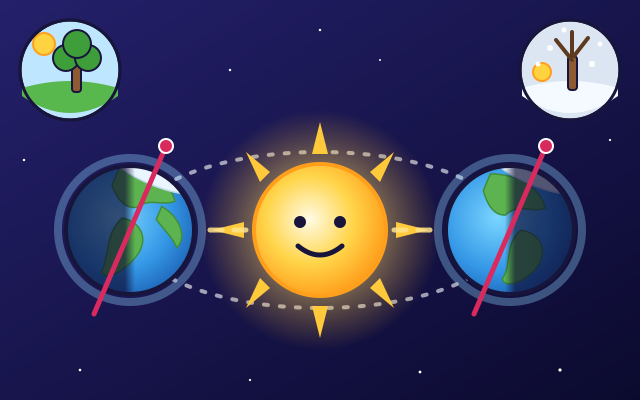
Why do the seasons change?
Move a tilted Earth around the Sun. Compare sunlight angle and day length in both hemispheres and follow a location through the year.
-
What If? Lab
What if Earth had two moons?
Our Moon goes round Earth in a neat, repeating loop. Add a second moon in our orbit model and watch what changes: the two moons tug on each other as well as on Earth, so their paths start to wobble.