Africa
Countries, cities, landmarks and natural wonders of Africa. Pick one to explore it, or open the globe.
76 to explore · page 1 of 2
-
 Watch
Life around the world
A school day in Nairobi, Kenya
Nairobi is the capital of Kenya. Children start school with two years of pre-primary, learn English and Kiswahili, study subjects such as mathematics and science, and in many public primary schools eat a lunch cooked fresh in the county's central kitchens.
-
 Watch
 Country
Democratic Republic of the Congo
The Democratic Republic of the Congo, or DR Congo, is the second-largest country in Africa. The mighty Congo River curves through its rainforests, volcanoes rise in the east, and its capital, Kinshasa, is a center of music, fashion and popular culture.
-
 Watch
 Country
Ethiopia
Ethiopia is a country on the Horn of Africa with no coast. Much of it is high, rugged land cut by the Great Rift Valley, it is one of the world's oldest countries, and more than 110 million people live there.
-
 Watch
 Country
Kenya
Kenya is a country in East Africa, crossed by the equator. It has the snow-capped Mount Kenya, the deep Great Rift Valley, Lake Victoria and a long Indian Ocean coast, and about 54 million people live there, many of them speaking Swahili.
-
 Watch
 Country
Tanzania
Tanzania is a country in East Africa, just south of the Equator, on the Indian Ocean. It has Mount Kilimanjaro, Africa's highest mountain, deep lakes in the East African Rift, and the Serengeti, where huge herds of wildebeest travel each year.
-
 Watch
 Country
Zimbabwe
Zimbabwe is a landlocked country in southern Africa, high on a wide plateau between the Zambezi and Limpopo rivers. It shares Victoria Falls with Zambia, and its name is a Shona word meaning "stone houses", the name of the great stone city of Great Zimbabwe.
-
 Watch
Life around the world
A market day in Lagos, Nigeria
Lagos is Nigeria's largest city. Trucks bring tomatoes, peppers, onions and grains from farms in the north to big markets such as Mile 12. Traders sell in bulk early in the day, then smaller sellers carry the food across the city. Other markets, like Balogun, are famous for fabric.
-
 Watch
Life around the world
Life along the Nile in Cairo
Cairo, Egypt's capital, has stood beside the Nile for more than 1,000 years. Around it lies desert, so people live close to the river: from space at night, their lights trace the Nile like a glowing flower. The river waters farms, and a new riverside walkway gives people a place to stroll.
-
 Watch
Natural wonder
Victoria Falls
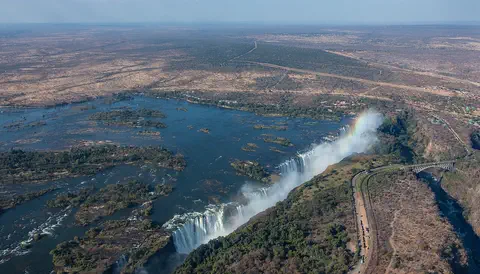
Victoria Falls, on the Zambezi River between Zambia and Zimbabwe, is about 1,708 meters wide and up to 108 meters deep. UNESCO calls it the largest curtain of falling water in the world, and its spray can be seen from tens of kilometers away.
-
 Watch
Natural wonder
Sahara
The Sahara fills almost all of northern Africa. Britannica calls it the largest hot desert in the world: about 4,800 kilometers from east to west and about 8.6 million square kilometers in all. Only about a quarter of it is sand dunes; the rest is gravel plains, rocky plateaus and mountains.
-
 Watch
Natural wonder
Mount Kilimanjaro
Mount Kilimanjaro, in northeastern Tanzania, is what UNESCO calls the highest mountain in Africa: its top is 5,895 meters high. It is a huge volcanic mountain standing alone above the plains, and as you climb it you pass through farms, forest, moorland and high alpine desert to its icy top.
-
 Watch
 Country
Egypt
Egypt is in the northeastern corner of Africa, and its Sinai Peninsula reaches into Asia. Almost all of it is desert, so most of its more than 100 million people live along the green banks of the Nile River, where one of the world's earliest civilizations grew.
-
Watch
Natural wonder
Serengeti National Park
Serengeti National Park in northern Tanzania protects 14,763 square kilometers of grassy plains and woodlands. Each year more than a million wildebeest, with zebras and gazelles, travel a great loop across the Serengeti and into Kenya in search of grass and water, followed by lions and other predators.
-
Watch
Natural wonder
Nile
The Nile flows north through northeastern Africa to the Mediterranean Sea, and its basin is shared by 11 countries. Its length is usually given as about 6,650 kilometers. Two great branches, the White Nile and the Blue Nile, meet at Khartoum in Sudan, and the green strip of farmland along its banks made it the lifeline of ancient Egypt.
-
 Watch
 Country
Algeria
Algeria is a country in North Africa and the largest country on the whole continent. More than four-fifths of it is the Sahara Desert, so most of its 47 million people (2025) live in the greener north, along the Mediterranean Sea. Its capital is Algiers.
-
 Watch
Natural wonder
River Congo
The Congo is Africa's second-longest river, about 4,700 kilometers long. It curves in a giant arc through the rainforests of central Africa and empties into the Atlantic Ocean. Rain falls in its basin all year, so it carries a huge amount of water, and its wild lower rapids are home to about 320 kinds of fish, about 90 of them found nowhere else.
-
 Watch
 Country
South Africa
South Africa is the southernmost country in Africa, with the Atlantic Ocean on one side and the Indian Ocean on the other. A high plateau covers most of it, about 63.5 million people (2026) live there, and it has 12 official languages and three capital cities.
-
 Watch
Natural wonder
Lake Victoria
Lake Victoria is the largest lake in Africa, and Britannica says only Lake Superior, in North America, is a bigger freshwater lake. It is shared by Kenya, Tanzania and Uganda. The lake is wide but shallow, its only outlet is the Nile, and it is home to hundreds of kinds of colorful fish called cichlids.
-
 Watch
Natural wonder
Lake Tanganyika
Lake Tanganyika lies in a deep crack in Africa called a rift valley. Britannica calls it the longest freshwater lake in the world, and only Lake Baikal, in Russia, is deeper. Four countries share it: Tanzania, the Democratic Republic of the Congo, Burundi and Zambia. Its water is home to about 250 kinds of cichlid fish found nowhere else.
-
 Watch
Natural wonder
Kalahari Desert
The Kalahari is a giant sandy plain in southern Africa, covering almost all of Botswana and parts of Namibia and South Africa. It stretches about 1,600 kilometers from north to south. Its southwest is a true desert, with long red dunes, while its north is green with woodlands and even has a huge swamp, the Okavango Delta.
-
 Watch
Natural wonder
Namib
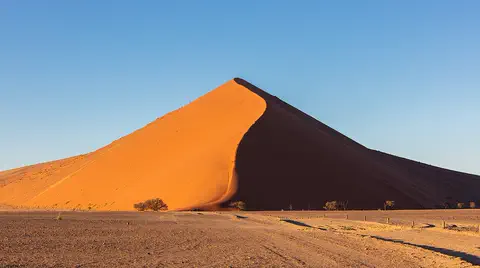
The Namib is a cool desert that runs for about 1,900 kilometers along Africa's Atlantic coast, from Angola through Namibia into South Africa. It gets almost no rain, but cold ocean water makes thick fog that drifts inland. UNESCO says its Namib Sand Sea is the only coastal desert in the world with huge dune fields influenced by fog.
-
Watch
Natural wonder
Mount Kenya
Mount Kenya is the second highest mountain in Africa, 5,199 meters tall, standing just south of the Equator in central Kenya. It is an old volcano that stopped erupting millions of years ago and has been carved by glaciers into sharp rocky peaks. Its slopes climb through farms, forests, bamboo and strange giant plants up to small, shrinking glaciers.
-
 Watch
Natural wonder
Great Rift Valley
The Great Rift Valley is a huge valley that runs through East Africa, where the continent is slowly being stretched and pulled apart. Long, steep cliffs line its sides, its floor holds lakes full of flamingos, and giant volcanoes such as Kilimanjaro and Mount Kenya rose beside it. Scientists think a new ocean may one day open here.
-
Watch
Natural wonder
Virunga National Park
Virunga National Park, in the east of the Democratic Republic of the Congo, was founded in 1925; the park describes itself as Africa's first national park. It stretches from active volcanoes in the south to the snowy Rwenzori Mountains in the north. About one third of the world's mountain gorillas live in its forests, along with elephants, hippos, chimpanzees and hundreds of kinds of birds.
-
 Watch
Natural wonder
Ngorongoro Conservation Area
The Ngorongoro Conservation Area in northern Tanzania holds the Ngorongoro Crater, a giant bowl about 16 to 20 kilometers across, left when an ancient volcano collapsed about 2.5 million years ago. Around 25,000 large animals live in and around the crater. The area also protects Olduvai Gorge and Laetoli, where scientists have found important evidence of how humans evolved.
-
 Watch
Natural wonder
Okavango Delta
The Okavango Delta, in northwestern Botswana, is a huge wetland in the middle of a dry land. The Okavango River flows in from Angola, spreads out into channels, lagoons and grassy plains, and then soaks away into the sands of the Kalahari instead of reaching the sea. Its flood arrives in the dry season, drawing elephants, buffalo, zebras and many other animals.
-
 Watch
Natural wonder
Mount Nyiragongo
Mount Nyiragongo is a steep volcano in the Virunga Mountains of the Democratic Republic of the Congo, near the border with Rwanda and just north of Lake Kivu. It is 3,470 meters high, and its deep summit crater often holds a lake of bubbling lava. Its lava is very runny, and eruptions in 1977, 2002 and 2021 sent lava flowing down its sides toward the city of Goma.
-
 Watch
Landmark
Abu Simbel
Abu Simbel is two temples cut into the rock by King Ramesses II of Egypt, around 1264 BCE. Four seated statues of the king, each 21 meters tall, guard the Great Temple. In the 1960s, a new dam was about to flood them, so workers cut them into more than a thousand blocks and rebuilt them higher up.
-
 Watch
 Country
Angola
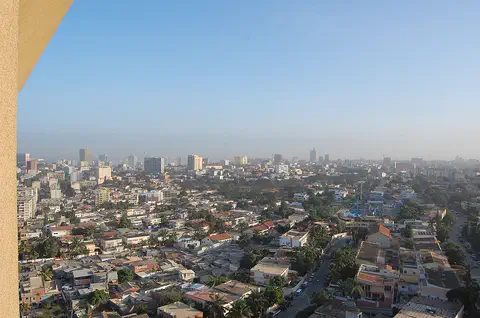
Angola is a large country in southwestern Africa, on the Atlantic Ocean. A narrow coast rises steeply to high plateaus, rivers such as the Cuanza run to the sea, and the Namib Desert reaches its far southwest. Its national statistics institute projects about 38.8 million people for 2026.
-
 Watch
Landmark
Aswan High Dam
The Aswan High Dam crosses the Nile River in southern Egypt. Finished in 1970, it is 111 meters high and 3,830 meters long. It controls the Nile's yearly flood, stores water for farms, makes electricity and created a huge reservoir, Lake Nasser. Ancient temples had to be moved to save them from the rising water.
-
 Watch
 Country
Benin
Benin is a narrow country in West Africa that stretches from the Atlantic coast up to the Niger River. Lagoons line its short coast, savanna covers the north, and the palaces of the old kingdom of Dahomey still stand at Abomey. About 15 million people live there.
-
Watch
 Country
Botswana
Botswana is a landlocked country in the middle of southern Africa. Deep Kalahari sand covers most of it, but in the north the Okavango River spreads into a huge green delta full of wildlife. Botswana became independent in 1966 and has grown more prosperous, helped by diamonds.
-
 Watch
 Country
Burkina Faso
Burkina Faso is a landlocked country in West Africa, on a wide plateau of savanna that is grassy in the north and dotted with forest in the south. About 24 million people live there. Its name, chosen in 1984, means Land of Incorruptible People, and its capital is Ouagadougou.
-
Watch
 Country
Burundi
Burundi is a small, landlocked country of green hills in east-central Africa, just south of the Equator. Its western edge runs along Lake Tanganyika, the longest freshwater lake in the world. About 14.4 million people live there, and its royal drum dance is famous around the world.
-
 Watch
 Country
Cabo Verde
Cabo Verde is a country made of ten islands in the Atlantic Ocean, about 620 kilometers off the coast of West Africa. Some islands are flat and sandy, others are steep and volcanic, and rain is rare. Its people are famous for their music, and the 2021 census counted about 491,000 people living there.
-
Watch
City
Cairo
Cairo, the capital of Egypt, has stood on the banks of the Nile for more than 1,000 years, where the river spreads out into its delta. Founded in 969, it has a medieval old city full of historic mosques and markets, the Egyptian Museum and, at its edge, the Pyramids of Giza. It is one of the largest cities in Africa.
-
 Watch
 Country
Cameroon
Cameroon sits where western and central Africa meet. In the south are thick rainforests full of monkeys and apes, by the coast rises Mount Cameroon, an active volcano, and in the north are dry savanna plains. About 29.9 million people lived there in 2025, and French and English are both official languages.
-
 Watch
 Country
Central African Republic
The Central African Republic is a landlocked country in the very center of Africa, about the size of France. Grassy savannas cover the north, rainforests grow in the south, and the capital, Bangui, stands on the Ubangi River. About 5.5 million people lived there in 2025.
-
 Watch
 Country
Chad
Chad is a large country in north-central Africa with no coast at all. The Sahara covers much of the north, savanna with elephants and giraffes covers the south, and Lake Chad lies on its western edge.
-
 Watch
 Country
Côte d'Ivoire
Côte d'Ivoire, also called Ivory Coast, is a country on the coast of West Africa. It has lagoons along the sea, rainforest in the south and savanna in the north. It became the world's leading grower of cocoa beans in the late 1980s, and about 32.7 million people lived there in 2025.
-
 Watch
 Country
Djibouti
Djibouti is a small country in the Horn of Africa, where the Red Sea meets the Gulf of Aden. It is hot and dry, with volcanic rock everywhere, and Lake Assal, 155 meters below sea level, is the lowest point in Africa. About 1.2 million people lived there in 2025, most of them in the capital, also called Djibouti.
-
Watch
Landmark
Egyptian pyramids
Egypt's pyramids were giant stone tombs for kings. They did not start out pointed: the first, King Djoser's Step Pyramid, was a stack of six giant steps. King Snefru's builders tried again and again, making the Bent Pyramid and then the Red Pyramid, the first planned true pyramid. Soon after came the great pyramids of Giza.
-
 Watch
 Country
Eritrea
Eritrea is a country in the Horn of Africa with a long coast on the Red Sea. Its capital, Asmara, sits high in cool mountains, while the coast below has one of the highest average temperatures in the world. About 3.6 million people live there, and its name comes from the Latin words for the Red Sea.
-
 Watch
 Country
Gabon
Gabon is a country on the Atlantic coast of Africa, right on the equator. About three-fourths of it is covered by dense rainforest, home to forest elephants, gorillas and mandrills. Most people live in towns and cities, and the 2026 census counted about 3.5 million people.
-
 Watch
 Country
Ghana
Ghana is a country in West Africa on the Gulf of Guinea. It has a coast of sandy bays, a belt of rainforest and wide northern savannas, and one of the world's largest artificial lakes, Lake Volta. In 1957 it became independent, and its capital is Accra.
-
 Watch
Landmark
Giza pyramid complex
The Giza pyramid complex is a group of ancient tombs on a rocky plateau beside the Nile River in Egypt. Three kings from one family, Khufu, his son Khafre and his grandson Menkaure, built huge pyramids there about 4,500 years ago. Around them are temples, small pyramids for queens, rows of tombs for nobles, the Great Sphinx and even the town where the builders lived.
-
Watch
Landmark
Great Pyramid of Giza
The Great Pyramid of Giza was built more than 4,500 years ago as the tomb of King Khufu of Egypt. About 2.3 million stone blocks were cut, moved and stacked to make it. Egypt's antiquities ministry calls it the last of the Seven Wonders of the Ancient World still standing.
-
 Watch
 Country
Guinea
Guinea is a country on the Atlantic coast of West Africa. Three of West Africa's great rivers, the Niger, the Sénégal and the Gambia, begin in its Fouta Djallon highlands. It has rainy coasts, high plateaus, savanna and rainforest, and about 17.5 million people were counted there in 2025.