Search the Discovery Encyclopedia
-
 Animal
Greater bird-of-paradise
The greater bird-of-paradise is a rainforest bird of southern New Guinea and the Aru Islands. Males have a yellow head, a green throat, long tail wires and huge golden flank plumes, which they show off in group dances high in tall trees to win a female.
-
 Animal
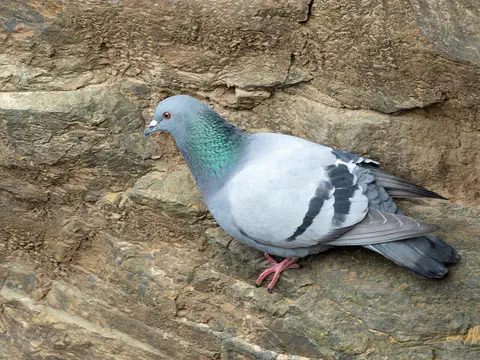
Rock pigeon
The rock pigeon, also called the rock dove, is the pigeon you see in city squares. Its wild ancestors nest on sea cliffs and mountain ledges, and city pigeons use buildings as if they were cliffs. Pigeons are famous for finding their way home from far away.
-
 Animal
House sparrow
The house sparrow is one of the most widespread songbirds in the world. It is native to Europe, Asia and North Africa, but people released it in many other places, and now it lives in towns and farms almost everywhere people do. Its numbers have fallen sharply in some places, including Britain and North America.
-
 Animal
European robin
The European robin is a small songbird of Europe's woods, parks and gardens, famous for its orange-red breast. It sings almost all year round, even at night under streetlights, and it defends its patch fiercely. Young robins have no red breast at all: they are speckled with golden brown.
-
 Animal
Roseate spoonbill
The roseate spoonbill is a bright pink wading bird with a long, flat bill shaped like a spoon. It sweeps its bill from side to side through shallow water and grabs the shrimp or small fish it feels. Its pink color comes from the food it eats.
-
 Animal
Southern crested caracara
The southern crested caracara is a large bird of prey from South America and a surprising member of the falcon family. It has a black crest, a bare orange-red face and long yellow legs, and it eats almost anything: dead animals, small creatures and insects.
-
 Animal
Shoebill
The shoebill is a tall gray bird of African swamps, named for its enormous bill shaped like a wooden shoe. It stands as still as a statue among the papyrus, then lunges forward to grab big, slippery fish such as lungfish.
-
 Animal
Tawny owl
The tawny owl is a medium-sized woodland owl, about the size of a pigeon, with a round head, big dark eyes and brown, streaky feathers that hide it against tree bark. It hunts mice and voles at night on silent wings, and its hoots are a familiar sound at night.
-
 Animal
Bald eagle
The bald eagle is one of North America's biggest birds, with a white head and tail, a dark brown body and a huge yellow bill. It lives near lakes, rivers and coasts and eats mostly fish. Once rare because of hunting and pesticides, it has made an amazing comeback.
-
 Animal
Wild turkey
The wild turkey is a big, bronze-feathered bird of North American forests and clearings. It walks most of the time but can run, fly and even roost high in trees at night. By the early 1900s wild turkeys had become rare in many places, but people helped them come back, and now they live in every U.S. state except Alaska.
-
 Animal
Barn swallow
The barn swallow is a small, speedy bird with a glossy blue back, a reddish throat and a long, deeply forked tail. It catches insects in the air, builds cup-shaped mud nests on barns and bridges, and makes long migrations between the Northern Hemisphere, where it nests, and the Southern Hemisphere, where it spends the winter.
-
 Animal
Golden eagle
The golden eagle is one of the largest and fastest birds of prey in North America, and it lives across much of the Northern Hemisphere. It soars over mountains and open country on wings more than two meters wide and dives at tremendous speed to catch rabbits, hares and ground squirrels.
-
 Animal
Scarlet ibis
The scarlet ibis is a bright red wading bird of South America, red all over except for black wingtips. It probes mud and shallow water with its long, curved bill for crabs, crayfish and insects, and its color comes from pigments in its food.
-
 Animal
American crow
The American crow is an all-black bird found across much of North America, from fields and beaches to city centers. It eats almost anything, lives in close family groups, gathers in huge winter roosts, and a University of Washington study found that wild crows can recognize and remember a human face.
-
 Animal
Andean condor
The Andean condor is one of the largest flying birds in the world. With wings up to 3.2 meters across, it soars over the Andes Mountains of South America, barely flapping, as it searches for dead animals to eat. It is a vulture, nature's clean-up crew.
-
 Animal
Burrowing owl
The burrowing owl is a small, sandy-brown owl with long legs and bright yellow eyes. Unlike most owls, it lives underground, in burrows dug by prairie dogs, ground squirrels or tortoises, or sometimes by the owls themselves. It lives in open grasslands and deserts from Canada to the tip of South America.
-
 Animal
Secretarybird
The secretarybird is a bird of prey that hunts on foot. It strides across the African savanna on the longest legs of any raptor, walking 20 to 30 kilometers a day, and stamps on grasshoppers, mice, lizards and even snakes with lightning-fast kicks.
-
 Animal
Common ostrich
The common ostrich is the tallest and heaviest bird alive. It cannot fly, but it is the fastest runner on two legs, sprinting at about 70 kilometers an hour across the savannas and deserts of Africa. It also lays the biggest egg of any living animal.
-
 Animal
Indian peafowl
The Indian peafowl is a large bird of the pheasant family from South Asia. Males, called peacocks, have a bright blue neck and a long train of shimmering feathers decorated with eyespots, which they spread into a giant fan to impress females, called peahens. It is the national bird of India.
-
 Animal
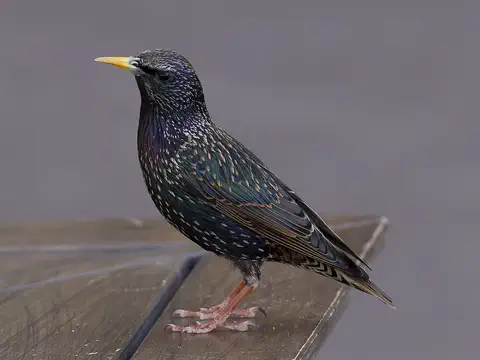
Common starling
The common starling, also called the European starling, is a glossy, spotted songbird from Europe, Asia and North Africa. It is a brilliant copycat that can imitate other birds and even car alarms, and in winter huge flocks swirl through the evening sky in shows called murmurations. People also carried starlings to North America, Australia and other places, where they now live in the wild.
-
 Animal
Red-tailed hawk
The red-tailed hawk is probably the most common hawk in North America. It soars in wide circles over fields or waits on a pole or fence post, watching for voles, mice and rabbits, then drops down to catch them with its sharp talons.
-
 Animal
Common blackbird
The common blackbird is a thrush found in gardens, parks and woods across Europe, North Africa and parts of Asia. Males are glossy black with a bright yellow-orange bill and eye-ring, females are brown, and on summer evenings males sing a mellow, fluting song from high perches.
-
 Animal
Eastern bluebird
The eastern bluebird is a small thrush of open fields and parks in eastern North America, south to Central America. Males are bright blue with a rusty orange chest. Bluebirds watch from wires and fence posts, flutter down to catch insects, and nest in tree holes and in nest boxes that people put up for them.
-
 Animal
Great blue heron
The great blue heron is the largest heron in North America. It wades slowly through marshes, rivers and ponds, or stands as still as a statue, then strikes like lightning with its dagger-shaped bill to catch fish, frogs and even small mammals.
-
 Animal
Peregrine falcon
The peregrine falcon is a crow-sized bird of prey famous for its hunting dive, called a stoop. Diving from high above, it can reach about 320 kilometers per hour, making it the fastest animal on Earth. It lives on every continent except Antarctica, even in big cities.
-
 Animal
Philippine eagle
The Philippine eagle is one of the largest and rarest eagles in the world. It lives only in the mountain rainforests of four Philippine islands, where it hunts monkeys, civets, flying squirrels and other forest animals. It is the national bird of the Philippines, and it is critically endangered.
-
 Animal
Superb fairywren
The superb fairywren is a tiny Australian songbird that lives in family groups. In the breeding season the male is bright sky blue and black; the female is brown with an orange-red face. Older family members help feed the chicks, and mothers even call to their eggs before the chicks hatch.
-
 Animal
American flamingo
The American flamingo is a tall, bright pink wading bird of the Caribbean. It gets its color from pigments in the tiny water animals and algae it eats, and it feeds by filtering water through its bent bill with its head upside down. Flamingos live and nest in huge, noisy groups.
-
 Animal
California condor
The California condor is the largest wild bird in North America, a giant vulture with wings about 2.8 meters wide. In the 1980s only 22 were left. Thanks to a huge rescue effort, the US Fish and Wildlife Service counted 607 condors at the end of 2025, 392 of them flying free.
-
 Animal
Eurasian blue tit
The Eurasian blue tit is a small, colorful songbird of woods, parks and gardens across Europe and western Asia. It hangs upside down to find caterpillars, nests in holes and nest boxes, and can lay a very large clutch of eggs once a year, timed for when caterpillars are plentiful.
-
 Animal
Goliath birdeater
The Goliath birdeater is a giant tarantula from the rainforests of northern South America. With legs spreading about 28 centimeters and a weight of up to about 170 grams, it is described as the heaviest spider in the world. Despite its name, it eats mostly worms and insects, not birds.
-
 Animal
Northern cardinal
The northern cardinal is a crested songbird of eastern North America and Mexico. Males are brilliant red with a black face; females are warm brown with red touches. Cardinals crack seeds with their thick bills, stay in the same area all year, and both males and females sing.
-
 Animal
African fish eagle
The African fish eagle is a big eagle of Africa's lakes, rivers and coasts, with a white head, chest and tail and a chestnut-brown body. It snatches fish from the surface of the water, and its loud, ringing call is one of the best-known sounds of Africa.
-
 Animal
American goldfinch
The American goldfinch is a small finch that eats almost nothing but seeds. In summer the male is bright lemon yellow with a black cap and black wings, and in winter both males and females turn a soft olive brown. Goldfinches wait until late summer to build their nests.
-
 Animal
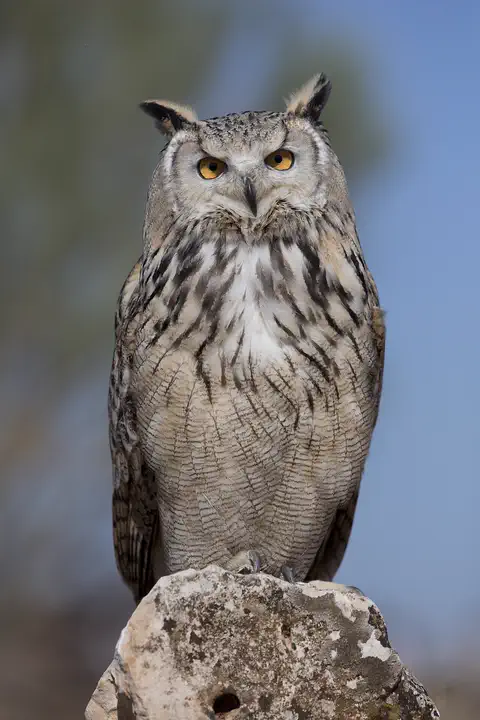
Eurasian eagle-owl
The Eurasian eagle-owl is one of the biggest owls in the world, with wings up to about 2 meters across, big orange eyes and two tall ear tufts. It lives across Europe and Asia, nests on rocky ledges and flies silently at night to catch rats, voles, hares and birds.
-
 Animal
Grey crowned crane
The grey crowned crane is a gray African crane with a spiky crown of golden feathers, white and red cheeks and a red throat pouch. It is one of only two cranes that can perch in trees. It is the national bird of Uganda, and it is Endangered because its wetlands are disappearing.
-
 Animal
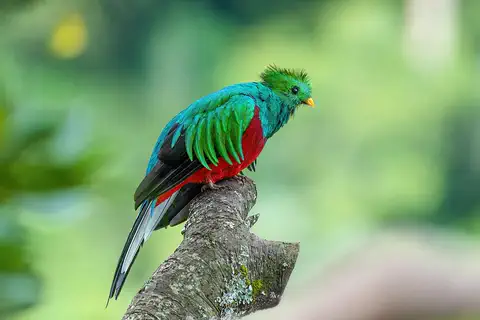
Resplendent quetzal
The resplendent quetzal is a glittering green and red bird of the cloud forests of southern Mexico and Central America. Males grow long, flowing plumes, up to about 90 centimeters. Quetzals eat mostly small fruits related to avocados, and the bird is the national emblem of Guatemala.
-
 Animal
Steller's sea eagle
Steller's sea eagle is one of the largest sea and fish eagles. Dark brown with bright white shoulders, tail and legs and an enormous orange-yellow beak, it nests in far eastern Russia and feeds mainly on salmon. In winter many fly south to Japan.
-
 Animal
Northern mockingbird
The northern mockingbird is a slim gray songbird famous for copying sounds. It sings long strings of phrases, many borrowed from other birds, and sometimes sings all night. It lives in towns, farms and brushy places across the United States, Mexico and the Caribbean.
-
 Animal
Kākāpō
The kākāpō is a large, moss-green parrot from New Zealand with an owl-like face. It cannot fly, it is active at night, and it eats only plants. It nearly died out, but careful work by New Zealand's Department of Conservation has grown the population to 325 birds (September 2026).
-
 Animal
Ocelot
The ocelot is a medium-sized wild cat of the Americas, from southern Texas to northern Argentina. Its golden coat has chains of dark-edged spots, and no two ocelots look alike. It hunts mostly at night, catching mice, rats, lizards and birds, and it needs thick plants to hide in.
-
 Animal
Caracal
The caracal is a sleek, reddish-gold wild cat of Africa, the Middle East and Central Asia to India. Its name comes from a Turkish word meaning "black ears", for its black-backed ears with long tufts. It hunts on the ground, but it can leap two meters or more into the air to catch birds.
-
 Animal
Arctic fox
The Arctic fox lives on the frozen tundra around the North Pole. Its coat changes color with the seasons, white or blue-gray in winter and brown or gray in summer, and it has short ears, a short nose and furry feet to keep the cold out. It eats lemmings, birds and leftovers from polar bears.
-
 Animal
Sociable weaver
The sociable weaver is a sparrow-sized bird of the dry savannas of southern Africa. Whole colonies, sometimes hundreds of birds, build and share one enormous thatched nest with many separate rooms. It is among the largest nests built by any bird.
-
 Animal
Superb lyrebird
The superb lyrebird is a large, ground-living songbird of Australia's moist forests. It is a famous copycat: most of its song is made of sounds borrowed from other birds and even machines. The male has a spectacular tail that he throws over his head as he dances and sings.
-
 Animal
Blue-footed booby
The blue-footed booby is a seabird of the tropical eastern Pacific, from Mexico to Peru and the Galápagos Islands. Its bright blue feet star in its courtship dance: birds with bluer feet are more likely to find a mate. It catches fish by diving into the sea from high in the air.
-
 Animal
Common nightingale
The common nightingale is a plain brown songbird with one of the most famous songs in the world. Males sing from thick bushes, often in the middle of the night, and every year the birds fly from Europe and Asia to Africa for the winter.
-
 Animal
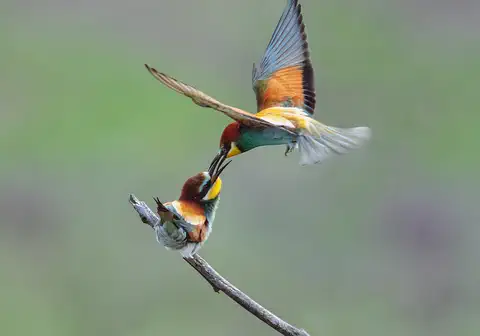
European bee-eater
The European bee-eater is one of the most colorful birds in Europe. It catches bees, dragonflies and other flying insects in midair, knocks out the stings on a branch, and digs a long tunnel in a sandy bank for its nest. Every autumn it flies to Africa for the winter.
-
 Animal
Laughing kookaburra
The laughing kookaburra is one of the larger members of the kingfisher family. It lives in the woodlands of eastern Australia, pounces on insects, worms and small animals, and lives in family groups. Its famous 'laugh' is really a territorial call that warns other birds to stay away.
-
 Animal
Black-capped chickadee
The black-capped chickadee is a small, curious songbird of North American woods and backyards. It hides thousands of seeds to eat later and remembers where they are, and its "chick-a-dee-dee-dee" call tells other birds how dangerous a nearby predator is.
-
 Animal
Emu
The emu is Australia's tallest native bird and the second-largest bird in the world, after the ostrich. It cannot fly, but it can sprint at about 48 kilometers an hour. Emus are famous fathers: the male sits on the eggs for about eight weeks without eating, then looks after the striped chicks.
-
 Animal
Serval
The serval is a slender wild cat of African grasslands and wetlands. Its huge ears can hear mice moving in tall grass, and its long legs let it leap high into the air to pounce on them or snatch a bird.
-
 Animal
Chicken
The chicken is a domesticated bird: people raise it on farms and in backyards all over the world for eggs and meat. Its wild ancestor is the red junglefowl of the forests of southern and Southeast Asia, and scientists think chickens were first domesticated about 3,500 years ago near rice fields in Southeast Asia.
-
 Animal
Hoatzin
The hoatzin is a strange and wonderful bird of the Amazon and Orinoco rivers. It eats mostly leaves and digests them slowly with the help of bacteria, a bit like a cow. Its chicks have claws on their wings that help them climb back up through the branches.
-
 Animal
Common loon
The common loon is a big diving bird of northern lakes. In summer it wears a black head, a striped white necklace and a checkered back. It chases fish underwater, calls with eerie wails and yodels, and spends the winter on the coast.
-
 Animal
Toco toucan
The toco toucan is the biggest toucan, and its huge orange bill is the largest of any bird compared with its body. The bill is light and hollow. It is a tool for picking fruit, and scientists have found it also works like a radiator that lets out body heat. Tocos live in open woodlands and savannas of South America.
-
 Animal
White stork
The white stork is a tall white bird with black flight feathers, a red bill and long orange legs. It nests on rooftops, chimneys and trees across Europe, North Africa and western Asia, and many storks soar south to spend the winter in Africa or South Asia.
-
 Animal
Brown pelican
The brown pelican is a large coastal bird of the Americas with an enormous bill and a stretchy throat pouch. It catches fish by diving head-first into the sea from high in the air. Brown pelicans almost disappeared from North America because of pesticides such as DDT, but after DDT was banned they made a full comeback.
-
 Animal
American robin
The American robin is a very familiar bird over most of North America, with a gray-brown back, a warm orange breast and a cheery song. It runs across lawns pulling up earthworms, eats lots of berries in winter, and builds a mud-lined nest for its sky-blue eggs.
-
 Animal
Gentoo penguin
The gentoo penguin is the penguin with the red-orange bill, orange feet and a white band across the top of its head. It lives on the Antarctic Peninsula and on islands around Antarctica, builds nests of stones, and usually lays two eggs. National Geographic says no other diving bird swims faster.