Europe
Countries, cities, landmarks and natural wonders of Europe. Pick one to explore it, or open the globe.
133 to explore · page 2 of 3
-
 Watch
Natural wonder
Eyjafjallajökull
Eyjafjallajökull is an ice cap in southern Iceland that covers a volcano. In 2010 the volcano erupted for the first time since 1821. Melting ice and hot lava made very fine ash, and winds carried it over Europe. To keep passengers safe, more than 100,000 flights were canceled in one week of April.
-
 Watch
Natural wonder
Vatnajökull
Vatnajökull, in southeastern Iceland, is a huge ice cap covering about 7,500 square kilometers. It is Europe's largest ice cap by volume. Volcanoes lie hidden beneath the ice, and when they erupt, melting ice can burst out in sudden floods. The ice cap sits at the heart of Vatnajökull National Park, a World Heritage Site of "fire and ice".
-
 Watch
Landmark
Acropolis of Athens
The Acropolis is a steep, flat-topped rock in the middle of Athens. Walls have ringed its top for more than 3,300 years. In the 400s BCE, the Athenians built a grand gateway and three temples there, including the Parthenon. Restorers are still repairing them today.
-
 Watch
Landmark
Alhambra
The Alhambra is a palace and fortress above the city of Granada, in Spain. The Nasrid rulers built most of it between 1238 and 1358. It is famous for its courtyards, fountains, carved plaster and tiles, and the gardens of the Generalife next door.
-
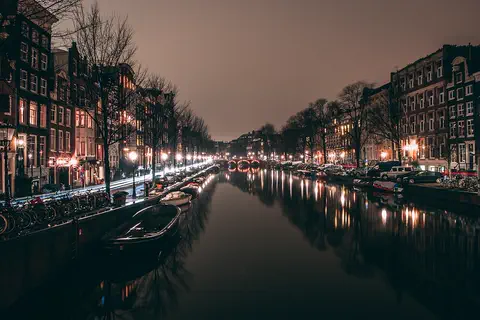 Watch
City
Amsterdam
Amsterdam is the capital of the Netherlands. It began as a fishing village beside a dam on the Amstel River, which gave the city its name. Today about 942,000 people live among its rings of canals, hundreds of bridges, houseboats and bicycles.
-
 Watch
 Country
Andorra
Andorra is a tiny country high in the Pyrenees mountains, between France and Spain. It is made of steep mountain valleys, its official language is Catalan, and about 89,750 people lived there in 2026.
-
 Watch
Landmark
Arc de Triomphe
The Arc de Triomphe is a huge stone arch at the top of the Champs-Élysées in Paris. Napoleon ordered it in 1806, but it took 30 years to finish. It is about 50 meters high and 45 meters wide, covered in giant carvings, and under it lies France's Tomb of the Unknown Soldier, with a flame that is rekindled every evening.
-
 Watch
City
Athens
Athens is the capital of Greece and one of the oldest cities in the world. Above it rises the Acropolis, a rocky hill crowned by the marble Parthenon, built about 2,500 years ago. Ancient Athens was home to early democracy, great thinkers and theater.
-
 Watch
City
Barcelona
Barcelona, the capital of Catalonia in northeastern Spain, lies on the Mediterranean between mountains and the sea. It is famous for the buildings of the architect Antoni Gaudí, including the Sagrada Família, a giant church begun in 1882. About 1.7 million people live in the city (2025).
-
 Watch
City
Belgrade
Belgrade, the capital of Serbia, stands where the Sava River flows into the Danube. Its name, Beograd, means "white city", probably because of the white limestone walls of its old fortress above the rivers. At the 2022 census, about 1.2 million people lived in the city itself and about 1.7 million in the wider City of Belgrade.
-
 Watch
City
Berlin
Berlin, the capital of Germany, grew from two small trading towns on the Spree River. From 1961 to 1989 the Berlin Wall divided it. Today about 3.7 million people live there (2025), among lakes, forests, museums and the Brandenburg Gate.
-
 Watch
Landmark
Big Ben
Big Ben is the nickname of the Great Bell inside the clock tower of the Houses of Parliament in London. The tower, 96 meters tall, was begun in 1843, and its clock started keeping time in 1859. Since 2012 the tower has been called the Elizabeth Tower.
-
Watch
Landmark
Brandenburg Gate
The Brandenburg Gate is a grand sandstone gateway in the center of Berlin, built from 1788 to 1791 with 12 columns and five passages. On top, a statue called the Quadriga shows a chariot pulled by four horses. From 1961 to 1989 the Berlin Wall shut it off, so the gate became a symbol first of a divided Germany and then of its reunification.
-
 Watch
Landmark
British Museum
The British Museum in London was founded in 1753 and opened in 1759. It holds treasures from all over the world, like the Rosetta Stone, which helped people learn to read Egyptian hieroglyphs. Its grand building with columns was built from 1823 to 1847, and in 2025 it had more than 6.4 million visits.
-
 Watch
City
Brussels
Brussels is the capital of Belgium. It began as a market where a road crossed the small Senne River, and its old name means "settlement in the marshes." Its Grand-Place, ringed by 17th-century guildhalls, is a UNESCO World Heritage Site, and the city is home to many offices of the European Union.
-
 Watch
City
Bucharest
Bucharest, the capital of Romania, lies on a wide plain beside the Dâmbovița River. First written about in 1459, it became the capital of Walachia in 1659 and of Romania in 1862. Today it is a city of broad boulevards, a huge parliament palace, the Romanian Athenaeum concert hall and an open-air Village Museum.
-
 Watch
Landmark
Buckingham Palace
Buckingham Palace began as a big house built for the Duke of Buckingham. King George III bought it in 1761, and King George IV had the architect John Nash turn it into a palace. Since 1837 it has been the London home of Britain's kings and queens. It has 775 rooms.
-
 Watch
City
Budapest
Budapest, the capital of Hungary, was made in 1873 by joining three towns on the Danube River: hilly Buda and old Óbuda on one bank and flat Pest on the other. About 1.7 million people live there (2026), with hot springs under the ground and the first underground railway built on the European mainland.
-
 Watch
Landmark
Colosseum
The Colosseum in Rome is an ancient Roman amphitheater, an oval arena with seats all around. Built between about 70 and 80 CE, it held about 50,000 people, who came to watch shows. Today it is one of Rome's major tourist attractions.
-
 Watch
City
Copenhagen
Copenhagen, the capital of Denmark, grew from a small harbor town into a royal city of palaces, canals and towers. Its name means "Merchants' Harbor." It has the Tivoli Gardens, opened in 1843, and the Little Mermaid statue, and about 673,000 people lived there in 2026.
-
 Watch
City
Dublin
Dublin, the capital of Ireland, sits where the River Liffey flows into Dublin Bay. Vikings built a town here in the 800s, and its name comes from a "black pool" in the river. Today it is famous for its writers, music, Georgian squares and Trinity College, home of the Book of Kells.
-
 Watch
Landmark
Eiffel Tower
The Eiffel Tower in Paris was built in just over two years for the 1889 World's Fair. Its 18,038 iron parts are held together by 2.5 million rivets. It was meant to stand for 20 years; today it is 330 meters tall and millions of people visit every year.
-
 Watch
 Country
Estonia
Estonia is the northernmost of the three Baltic states in northeastern Europe. Its low land of forests, bogs and lakes was shaped by ice, it has about 1,500 islands and islets, and about 1.36 million people lived there at the start of 2026.
-
 Watch
City
Hamburg
Hamburg, in northern Germany, is the country's second-biggest city and one of Europe's largest ports. It grew from a castle built about 825 into a rich trading city on the Elbe River, with canals, a big lake and brick warehouses. About 1.9 million people lived there in 2025.
-
 Watch
City
Helsinki
Helsinki is the capital of Finland, on a peninsula in the Gulf of Finland. Founded in 1550 and made the capital in 1812, it has white stone buildings, a sea fortress on islands, and the world's most northern metro. About 694,000 people lived there at the end of 2025.
-
 Watch
Landmark
Hermitage Museum
The Hermitage in Saint Petersburg is one of the world's great art museums. Empress Catherine the Great started it in 1764 as her private collection, and it opened to the public in 1852. Today it fills five connected buildings, including the green and white Winter Palace, and holds nearly three million objects, from the Stone Age to today.
-
 Watch
City
Kyiv
Kyiv is the capital of Ukraine, on the high west bank of the Dnieper River. More than 1,000 years ago it was the center of Kyivan Rus, the first East Slavic state, and its 11th-century St. Sophia's Cathedral and Pechersk Lavra monastery are a UNESCO World Heritage Site. About 2.95 million people lived there in 2022.
-
 Watch
Landmark
Leaning Tower of Pisa
The Leaning Tower is the bell tower of Pisa's cathedral, in Italy. Building began in 1173, and the tower started to lean while workers were still on its second floor, because soft ground lay under shallow foundations. It is 58.36 meters tall, has seven bells and 273 steps, and engineers made it safe between 1990 and 2001.
-
 Watch
 Country
Liechtenstein
Liechtenstein is one of the smallest countries in Europe, tucked between Switzerland and Austria. Its west is the flat valley of the Rhine River, and its east is steep Alpine mountains. About 41,000 people live there, and its head of state is a prince.
-
 Watch
City
Lisbon
Lisbon, the capital of Portugal, is the westernmost capital in mainland Europe, on the hills above the Tagus River near the Atlantic. By the 1400s it was the base for Portugal's voyages of exploration. Destroyed by an earthquake in 1755 and rebuilt, it is a city of steep streets, viewpoints and a famous tower at Belém. About 546,000 people lived there in 2021.
-
 Watch
 Country
Lithuania
Lithuania is the largest and southernmost of the three Baltic states. Its low land was shaped by glaciers and holds about 3,000 lakes, a long spit of sand dunes lines its coast, and about 2.89 million people lived there in 2025.
-
 Watch
City
London
London, the capital of the United Kingdom, began as a Roman town almost 2,000 years ago. About 8.8 million people lived in Greater London in 2021. It has the Tower of London, Big Ben, Tower Bridge and the Tube, an underground railway that opened in 1863.
-
 Watch
Landmark
London Bridge
London Bridge crosses the River Thames between the City of London and Southwark. Today's bridge, made of concrete, opened in 1973, but bridges have stood here for almost 2,000 years. The stone bridge before it was sold and rebuilt in Arizona, in the United States!
-
 Watch
Landmark
London Eye
The London Eye is a huge observation wheel, 135 meters tall, on the South Bank of the River Thames in London. It was built for the year 2000, the new millennium. Its 32 glass capsules carry up to 25 people each, and the wheel turns so slowly that people step on while it moves.
-
 Watch
Landmark
Louvre Museum
The Louvre in Paris began as a castle in 1190, grew into a royal palace and became a museum in 1793. About 30,000 works of art are on show, including the Mona Lisa. Since 1989, visitors have entered through a glass pyramid; 9 million came in 2025.
-
 Watch
 Country
Luxembourg
Luxembourg is one of the smallest countries in the world, tucked between Belgium, France and Germany. It has forested hills in the north, farms and vineyards in the south, a capital built on a steep rocky outcrop, and about 691,000 people (2026) who use Luxembourgish, French and German.
-
 Watch
City
Madrid
Madrid, the capital of Spain, sits almost exactly in the middle of the Iberian Peninsula, high on a flat plateau. Once a small fortress, it became the royal capital in the 1500s. About 3.5 million people lived there in 2025.
-
 Watch
 Country
Malta
Malta is a small island country in the middle of the Mediterranean Sea, south of Sicily. Its islands are made of limestone, its capital Valletta was built by the Knights of St John in the 1500s, and about 588,000 people lived there at the end of 2025.
-
 Watch
Landmark
Milan Cathedral
Milan Cathedral, called the Duomo, is a giant Gothic cathedral made of pink-and-white marble. Building began in 1386, and the last details of its front were finished only in 1965. It has more statues than any other building in the world, over 3,000 of them.
-
 Watch
City
Minsk
Minsk, the capital of Belarus, lies on the Svislach River near the middle of the country. First written about in 1067, it was almost completely destroyed in World War II and rebuilt with wide avenues, parks and apartment blocks. About 2 million people lived there in 2026.
-
Watch
 Country
Moldova
Moldova is a small landlocked country in eastern Europe, squeezed between Romania and Ukraine. Most of it lies between two rivers, the Prut and the Dniester, and its rich black soil grows grapes, sunflowers, grain and fruit. About 2.4 million people were counted there in 2024.
-
 Watch
 Country
Monaco
Monaco is a very small country on the Mediterranean coast, with France all around it on land. It covers just over 2 square kilometers, about 38,900 people lived there at the end of 2025, and it has been ruled by princes of the Grimaldi family since 1297.
-
 Watch
Landmark
Mont-Saint-Michel
Mont-Saint-Michel is a small rocky island off the coast of Normandy, in France. On top stands a Benedictine abbey built between the 1000s and 1500s, with a village and strong walls below. Around it, some of the biggest tides in Europe rush in and out across a huge sandy bay.
-
 Watch
 Country
Montenegro
Montenegro is a small country in the Balkans, on the Adriatic Sea. High, rocky mountains rise right behind its narrow coast, the Tara River has cut Europe's deepest gorge, and about 624,000 people lived there at the 2023 census.
-
 Watch
City
Moscow
Moscow, the capital of Russia, grew up on the Moscow River around a fortress called the Kremlin. About 13.3 million people lived there in 2025. Its rings of roads, snowy winters and palace-like subway stations make it like no other city.
-
Watch
Landmark
Moscow Kremlin
The Moscow Kremlin is the oldest part of Moscow. It began as a wooden fort on a hill by the Moskva River. Its present walls and towers were built from 1485 to 1516. Inside stand golden-domed cathedrals, palaces, a tall bell tower and museums.
-
 Watch
City
Munich
Munich is the capital of Bavaria, a state in southern Germany, and the country's third-biggest city. It began in 1158 as a market by a bridge over the Isar River, and its name means "Home of the Monks." Today it is famous for its palaces, art museums, the huge Deutsches Museum and its autumn Oktoberfest.
-
 Watch
Landmark
Musée d'Orsay
The Musée d'Orsay in Paris was built as a grand train station for the World's Fair of 1900. After the trains stopped, it was turned into a museum, which opened in 1986. Today about 3.7 million people a year come to see its art from 1848 to 1914, including famous Impressionist paintings.