Skip to content
Search the Discovery Encyclopedia
-
Geography
The five oceans
There is really only one global ocean, covering about 71 percent of Earth and holding about 97 percent of its water. People divide it into five named oceans: the Pacific, Atlantic, Indian, Southern and Arctic. They are all connected, so water and ocean animals can travel from one to the next.
-
What If? Lab
What if Mars had oceans again?
Mars is a cold, dusty desert today, but rovers have found dry riverbeds, deltas and an ancient lake. Its air is now so thin that liquid water can't last on the surface. Imagine a blue Mars, find out what it would need, and see a possible clue to past life that NASA's Perseverance rover has found.
-
What If? Lab
What if the oceans became warmer?
Water expands a little when it warms. The ocean is so deep and wide that this small stretch adds up: in our model, warming the top 700 meters by 2 °C raises the sea about 28 centimeters, with no ice melting at all.
-
 Animal
Ocean sunfish
The ocean sunfish, or mola, is one of the heaviest bony fish in the world. Its body is tall, round and flat, with a long fin on top, another underneath, and a strange frilly edge instead of a tail. It dives deep to eat jellyfish and is often seen resting at the surface, perhaps to warm up.
-
Geography
Ocean currents
Ocean currents are flows of seawater from one place to another. Winds push the surface water, and because Earth spins, the currents curve into giant loops called gyres. Deep down, cold, salty water sinks and creeps slowly around the planet. Together, currents carry heat from the warm tropics toward the cold poles.
-
Geography
The ocean floor
The bottom of the ocean is not flat. Starting from the shore, there is a shallow continental shelf, a steep slope, wide abyssal plains, a huge chain of underwater mountains called the mid-ocean ridge, and deep trenches. The deepest place, Challenger Deep in the Mariana Trench, is about 10,935 meters down.
-
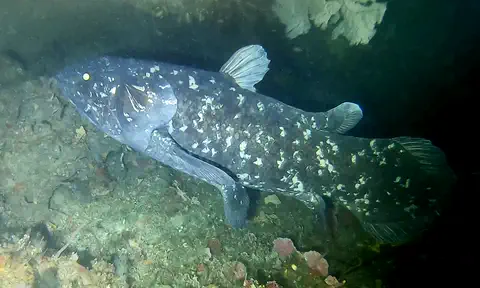 Animal
West Indian Ocean coelacanth
The West Indian Ocean coelacanth is a large, blue, spotted fish that lives in deep, rocky waters off eastern Africa. Its group was known only from fossils and thought to have died out about 66 million years ago, until a living one was found in South Africa in 1938.
-
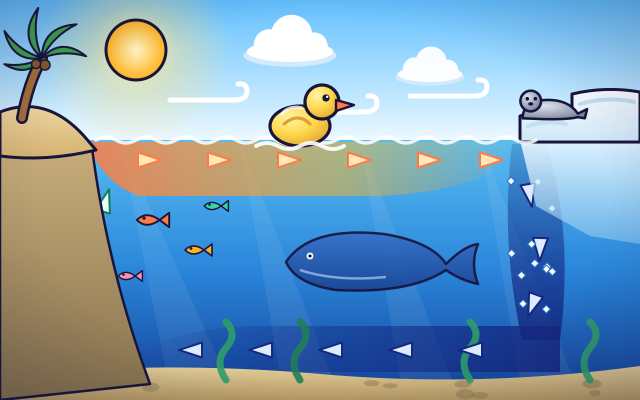 How Things Work
How do ocean currents move water?
Explore wind, temperature, salinity, and Earth's rotation in a simplified ocean model.
-
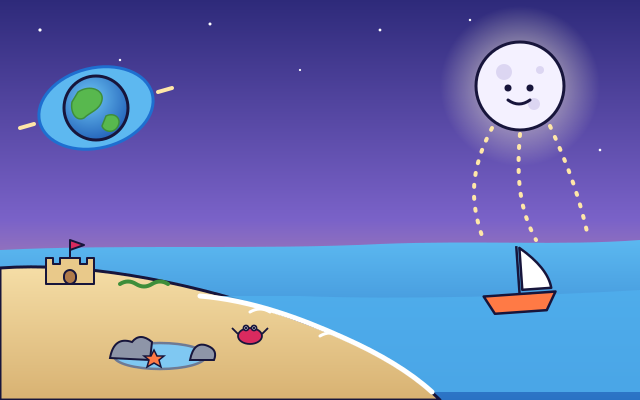 How Things Work
Why do ocean tides rise and fall?
Explore the Moon's and Sun's influence on a simplified ocean model. Move them into different positions and compare patterns of tidal change.
-
What If? Lab
What if an ocean food web changed?
Antarctic krill are small shrimp-like animals, but they feed a huge number of bigger ones. Take krill out of our model's Southern Ocean food web and all seven other species are affected: every animal in it loses all its food, from silverfish to orcas.
-
Geography
Ocean zones from sunlight to midnight
Scientists divide the ocean into layers called zones. Sunlight reaches only the top 200 meters. Below that is the dim twilight zone, then the pitch-dark midnight zone, the abyss and, deepest of all, the trenches of the hadal zone. The deeper you go, the darker, colder and more squeezed by water it gets.
-
What If? Lab
What if there were no ocean currents?
Ocean currents are like rivers in the sea. They carry warm water away from the equator and cold water away from the poles, and some lift food-rich water up from the deep. Imagine them stopping: follow the Gulf Stream, warm and cold coasts, and the rich fishing waters fed by upwelling.
-
What If? Lab
What if orcas left the Southern Ocean?
Orcas are apex predators: they eat at the top of the food web. Take them out of our model's Southern Ocean food web and the seals, penguins and fish they eat could become more common, which then changes the food of others. Explore the knock-on effects, and the real orcas that make long trips north.
-
What If? Lab
What if warmer seas changed ocean life?
When seawater gets too warm, corals can lose the tiny algae that feed them and turn white. Fish and shellfish move toward cooler water, and a long ocean heatwave can leave whole food webs short of food. Explore what scientists have seen, and what they still study about storms.
-
What If? Lab
What if whales returned to every ocean?
Hunting in the last century took away most of the world's great whales, and since a 1985 ban on commercial whaling many are growing in number again. Whale poop feeds the tiny drifting plants at the base of the ocean food web, and whale bodies carry carbon to the deep sea. Imagine whales back in every ocean and follow what they might do.
-
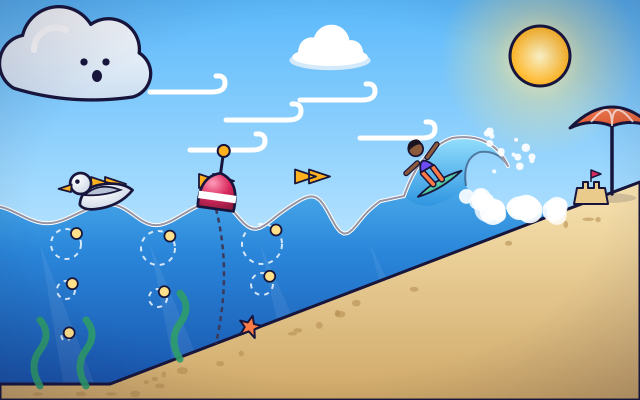 How Things Work
How do ocean waves form and reach the shore?
Add wind and follow wave energy toward shallower water.
-
What If? Lab
What if the whole Earth were covered by ocean?
Water soaks up a lot of heat before it gets hot, and gives it back slowly. Turn a patch of damp ground into ocean in our model and watch the gap between day and night temperatures shrink, then see how the sea already keeps coastal towns mild.
-
 Natural wonder
Dead Sea
The Dead Sea is a salt lake in the Middle East, with Jordan on its eastern shore and the Palestinian West Bank along part of its western shore. Its surface lies far below sea level, about 435 meters down in 2019, and its water is nearly ten times saltier than the ocean, so swimmers bob on top without trying.
-
Geography
Sea level
The sea's surface moves up and down with waves and tides, so sea level means its average height. It is the zero we use to measure land: Mount Everest is about 8,849 meters above sea level. Satellites show that the global average sea level has risen about 10 centimeters since 1993, mostly because ice on land is melting and warming seawater takes up more room.
-
 Animal
Sea otter
The sea otter is a marine mammal of the North Pacific coast that spends almost its whole life in the water. It has the thickest fur of any animal, floats on its back to eat, and even uses rocks as tools. By eating sea urchins, sea otters help kelp forests stay healthy.
-
 Animal
Blue sea star
The blue sea star is easy to spot on Indian and Pacific Ocean reefs: bright blue, with five smooth, tube-shaped arms. It cleans up the reef by eating dead animals, tiny creatures and the thin film that grows on rocks, and it can grow back an arm it loses.
-
 Animal
Marine iguana
The marine iguana is the only lizard in the world that finds its food in the sea. It lives only on the rocky shores of the Galápagos Islands, where it grazes on seaweed, warms up on black lava rocks and sneezes out extra salt.
-
 Animal
Ochre sea star
The ochre sea star lives on wave-washed rocky shores along the Pacific coast of North America. It can be purple, orange or brown, and it pries open mussels to eat them with a stomach it pushes out of its body. It is so important to its shore that scientists call it a keystone species.
-
 Animal
Green sea turtle
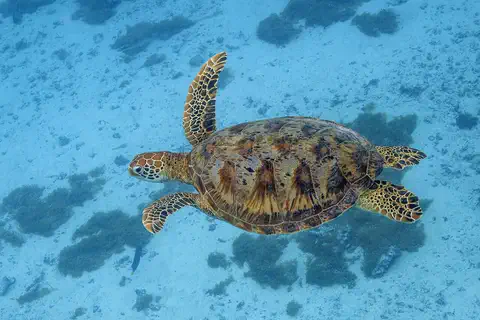
The green sea turtle is the largest sea turtle with a hard shell. It lives in warm seas around the world and, unlike other sea turtles, grown-ups eat mostly seagrass and algae. Females swim hundreds or even thousands of kilometers to lay their eggs on the beaches where they hatched long ago.
-
 Animal
Purple sea urchin
The purple sea urchin is a spiny, ball-shaped animal of North America's Pacific coast, up to about 10 centimeters across. It scrapes algae with a mouth of five teeth, walks on tiny tube feet, and can even carve a hollow in solid rock. Since 2014 its numbers have exploded in parts of California, and hungry urchins have eaten away large areas of kelp forest.
-
 Animal
California sea lion
The California sea lion is an 'eared seal' of the west coast of North America. It is clever, playful and very noisy, with a bark like a dog's. Unlike true seals, it has ear flaps and can turn its back flippers forward to walk on land. Its numbers have grown a lot since it was protected.
-
 Animal
Flatback sea turtle
The flatback sea turtle is named for its flat, smooth shell. It stays in shallow coastal seas around northern Australia, eats soft sea animals such as sea cucumbers and jellyfish, and nests only on Australian beaches, where its big hatchlings dash for the waves at night.
-
 Animal
Steller's sea eagle
Steller's sea eagle is one of the largest sea and fish eagles. Dark brown with bright white shoulders, tail and legs and an enormous orange-yellow beak, it nests in far eastern Russia and feeds mainly on salmon. In winter many fly south to Japan.
-
 Animal
Hawksbill sea turtle
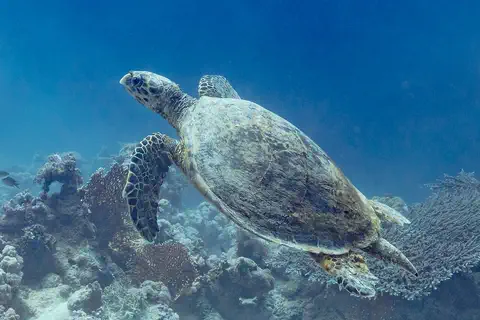
The hawksbill sea turtle lives in warm seas around the world, mostly near coral reefs. Its pointed, hawk-like beak reaches into cracks in the reef to find sponges, its favorite food. Its beautiful patterned shell once made it a target for hunters, and today it is critically endangered.
-
 Animal
Loggerhead sea turtle
The loggerhead sea turtle is named for its huge head and powerful jaws, which crush crabs, conchs and other hard-shelled animals. Babies hatch on sandy beaches, ride the open ocean for years and may cross an entire ocean before coming home to nest.
-
 Animal
Leatherback sea turtle
The leatherback sea turtle is the largest turtle on Earth. Instead of a hard shell it has tough, rubbery skin over a layer of tiny bones. It eats jellyfish, dives deeper than any other turtle and swims thousands of kilometers between feeding waters and the beaches where it lays its eggs.
-
 Animal
Magnificent sea anemone
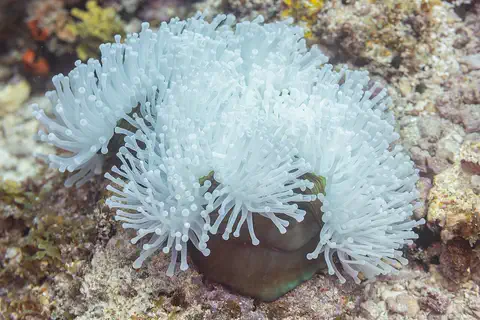
The magnificent sea anemone is a large sea anemone of warm Indian and Pacific Ocean reefs. Its body is a soft column topped with hundreds of finger-shaped tentacles, and it often perches on top of rocks in plain view. Many kinds of clownfish live safely among its stinging tentacles.
-
 Journey
The spice routes by sea
For centuries, ships crossed the Indian Ocean between East Africa, Arabia, India, Sri Lanka and the islands of Southeast Asia, carrying spices such as pepper, cinnamon, cloves and nutmeg. Sailors used the monsoon winds, which blow one way for half the year and the other way for the rest, to make their voyages.
-
What If? Lab
What if sea levels rose?
When the sea rises, the water's edge moves inland. How far depends on the land: on a steep cliff it barely moves, but on a flat, gentle coast a rise of 76 centimeters in our model moves the shore about 760 meters.
-
 How Things Work
How is sea salt produced?
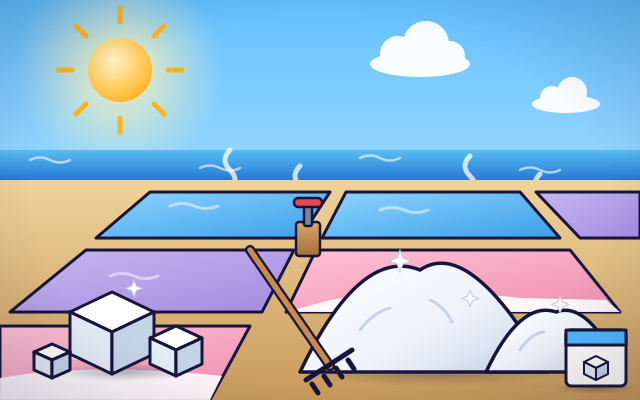
Guide seawater through evaporation, crystallization, harvesting, cleaning, and packaging.
-
What If? Lab
What if all the sea ice melted?
Sea ice floats, so it is already pushing aside about as much water as it will make when it melts, like an ice cube in a glass. In our model, melting all the Arctic's springtime sea ice raises the sea by only about 2 millimeters. The same ice melting on land would raise it about 7 centimeters.
-
What If? Lab
What if the sea were not salty?
Rain and rivers wash tiny bits of salt out of rocks and carry them to the sea, where they build up. Imagine a sea with no salt: most sea creatures are built for salty water, sea ice would form differently, and deep ocean currents would lose one of their pushes.
-
What If? Lab
What if cities floated on the sea?
Floating buildings already exist: in Rotterdam, in the Netherlands, a three-story office floats in a harbor on concrete pontoons. Designers have also planned a floating neighborhood off Busan, South Korea, for up to 12,000 people. But a floating city would need to stay afloat, cope with waves and storms, and find fresh water in the middle of salty sea. Explore each challenge.
-
What If? Lab
What if sea turtles lost their way?
Sea turtles cross oceans and return to the coast where they hatched, using Earth's magnetic field like a map. Baby turtles find the sea by heading for the brightest horizon. Imagine them losing their way: follow magnetic maps, bright beach lights, and how people help hatchlings.
-
What If? Lab
What if the sea were as clear as glass?
Sunlight fades as it goes deeper into the sea, and below about 200 meters there is hardly any. Tiny drifting plants and bits of mud also change how green, blue or murky the water looks. Imagine the sea perfectly clear, then follow how deep light would go, what it would mean for seaweed forests, and what gives the sea its colors.
-
 Animal
Harbor seal
The harbor seal lives along the northern coasts of North America, Europe and Asia, and it is one of the most common marine mammals on the east and west coasts of the United States. It has spotted fur, a dog-like face and no ear flaps, and it wriggles like a caterpillar on land. Its pups can swim within minutes of being born.
-
 Animal
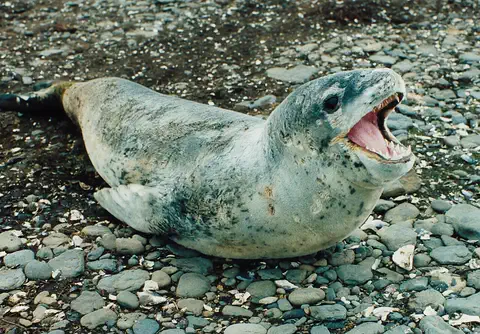
Leopard seal
The leopard seal is a large, slender seal of the icy seas around Antarctica, named for the dark spots on its gray coat. It is a fast, powerful hunter with a big head and long teeth, and it eats everything from tiny krill to fish, penguins and young seals.
-
 Animal
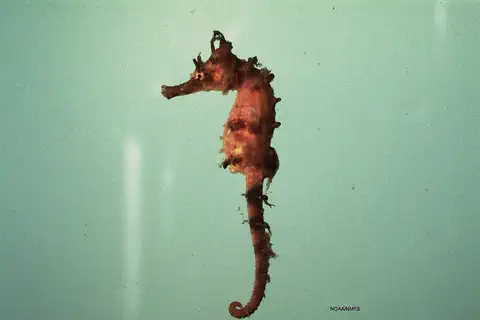
Lined seahorse
The lined seahorse is a small fish of the western Atlantic Ocean, from Canada and the United States down to Brazil. It has a horse-shaped head, a long snout with no teeth and a tail that grips seagrass. The male carries the eggs in a pouch until tiny seahorses are born.
-
 Animal
Leafy seadragon
The leafy seadragon is a relative of the seahorse covered in leaf-shaped flaps of skin. It drifts among seaweed so well that it almost disappears. It sucks up tiny shrimp through its long snout, and the father carries the eggs on his tail.
-
 Animal
Big-belly seahorse
The big-belly seahorse lives in the cool coastal waters of southeastern Australia and New Zealand. It is one of the largest seahorses, usually 18 to 28 centimeters long. It grips seaweed and jetties with its curly tail and sucks up tiny shrimp through its snout. As in all seahorses, the male carries the eggs in a pouch on his belly and gives birth to hundreds of babies.
-
Geography
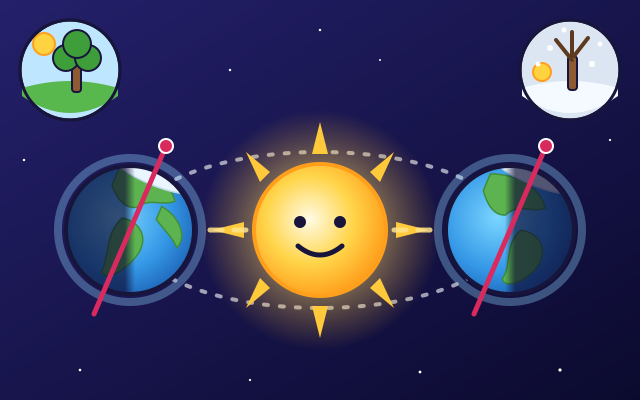
Why we have seasons
Earth's axis is tilted, so as Earth travels around the Sun each year, first one half and then the other leans toward the Sun. The half leaning toward the Sun gets stronger, more direct sunlight and longer days: that is summer. It is not because Earth is closer to the Sun.
-
 Animal
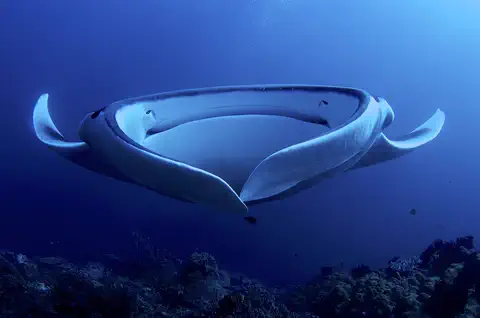
Giant oceanic manta ray
The giant oceanic manta ray is the largest ray in the world, with wing-like fins that can stretch more than 6 meters from tip to tip. This gentle filter feeder funnels plankton into its wide mouth, and it has a single pup only every two to three years.
-
 How Things Work
Why do the seasons change?
Move a tilted Earth around the Sun. Compare sunlight angle and day length in both hemispheres and follow a location through the year.
-
 Life around the world
Maple syrup season in Quebec, Canada
Each spring in Quebec, nights below freezing and days above it make sap flow in maple trees. Producers collect the watery, slightly sweet sap and boil it in evaporators until it becomes syrup; early in the season about 20 liters of sap make 1 liter. In 2025, Quebec made 90 percent of Canada's maple syrup.
-
 How Things Work
How do seat belts protect passengers?
Stop a model vehicle and observe how a belt restrains a passenger's continued motion.
-
 How Things Work
How does a search engine find websites?
Build a miniature index and compare which pages match different searches.
-
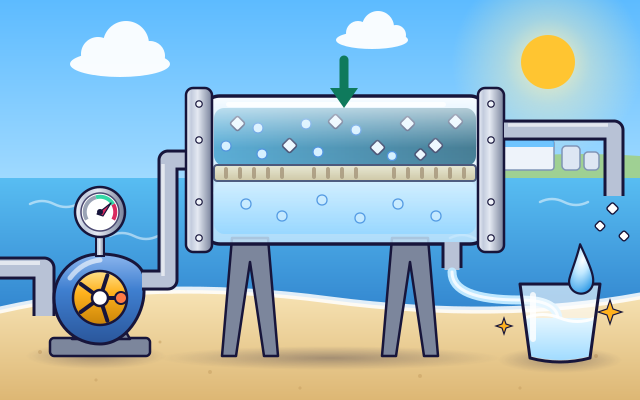 How Things Work
How do desalination plants remove salt from seawater?
Explore a simplified membrane system and compare its freshwater and concentrated saltwater outputs.
-
Geography
Tides
Tides are the slow rise and fall of the sea along coasts. The Moon's gravity, helped a little by the Sun, pulls Earth's oceans into two bulges. As Earth turns through them, most coasts get two high tides and two low tides every 24 hours and 50 minutes.
-
 Natural wonder
Galápagos Islands
The Galápagos Islands are a group of volcanic islands in the Pacific Ocean, about 1,000 kilometers off the coast of Ecuador. Many of their animals live nowhere else on Earth, and they helped inspire Charles Darwin's theory of evolution by natural selection.
-
 Natural wonder
Great Barrier Reef
The Great Barrier Reef stretches about 2,300 kilometers along the coast of Queensland, Australia. It is made of about 2,500 separate reefs and more than 900 islands, built by tiny coral animals, and it is home to more than 1,500 kinds of fish.
-
 Journey
Building the Panama Canal
Before the Panama Canal, ships going between the Atlantic and Pacific had to sail around the tip of South America. A French company tried to dig a canal across Panama in the 1880s but failed. The United States took over in 1904, defeated dangerous diseases spread by mosquitoes, cut through mountains and built huge locks. The 80-kilometer canal opened in 1914.
-
What If? Lab
What if Earth had no Moon?
The Moon's pull stretches Earth's oceans and gives us most of our tides. Take the Moon away in our tide model and see what is left: the Sun still makes tides, but they are less than half as big as the Moon's.
-
What If? Lab
What if waves had no wind?
Most ocean waves are made by wind blowing over the water. So what if the wind stopped everywhere? New waves would stop forming, but swells from earlier storms could keep rolling in for a while. And the tide would still come in and go out, because tides are made by the pull of the Moon and the Sun, not by wind.
-
What If? Lab
What if sharks disappeared?
Sharks catch and eat other sea animals, and just having them around changes where those animals go. Follow what scientists have found in Australia's Shark Bay seagrass meadows and on coral reefs, where the evidence is still debated, and how some shark populations are recovering.
-
What If? Lab
What if there were no plastic?
Plastic is light, cheap and lasts a long time, so it is everywhere: in toys, bottles, phones, cars and hospitals. Those same things make it hard to clean up when it ends up in the ocean. Imagine a world without plastic, then meet the older materials and the new plant-based plastics people are designing.